Review: Abaddon’s Gate

Abaddon's Gate (Expanse, #3)Abaddon’s Gate by James S.A. Corey

My rating: 3 of 5 stars

Another riveting book in the Expanse series! Only pick these books up when you’ve got some time to read, because otherwise you’ll stay up too late to read “just one more page.”
Abaddon’s Gate follows in the footsteps of Caliban’s War, dealing with the ongoing repercussions of the discovery of the protomolecule by Capt. James Holden and his crew.

And, as is now typical, things get bad fast—the mysterious molecule has constructed a large portal. To where?

For what purpose? Is something coming…or are humans being called?
We’re introduced to a new set of characters for this group, including a no-nonsense security chief, an annoying socialite along for the ride, and a minister who just can’t stop helping people, even when it means putting her life at risk. Through these characters–particularly Pastor Anna–Abaddon’s Gate reaches out to try to explore some of the greater mysteries of life: what is our purpose? How should we interact with each other? Is there a God in all the great expanse of the universe? If there are hyper-intelligent alien species, what does it mean for Earth and for religion?

Sidenote: I love that a character is gay with a family and that it is absolutely no big deal at all. Hurrah for a more inclusive future!

It’s an interesting book, if a little more philosophical and yet action-oriented than the prior two. While I still very much enjoyed it and would recommend it to sci-fi fans, this story just didn’t resonate with me quite as much as the first two. I even found a handful of glaring editing mistakes, adding to my feeling that this one was a smidge rushed. I miss some of the characters we’ve met before (though they do get notable mentions). Some parts were a little far-out, which is hard to believe when we’re dealing with hyper-advanced space-zombie-making molecules.

It’s still absolutely worth the read, but I’m hoping the next book in the series “gels” a little better.

View all my reviews

Leave a comment

Filed under Reviews

The Nine Elements of Worldbuilding

This awesome fictional map of "Clichea," created by Sarithus. Might want to avoid this sort of thing.

This awesome fictional map of “Clichea,” created by Sarithus. Might want to avoid this sort of thing.

I attended a really interesting lecture by prolific fantasy author Kevin J. Anderson on the fundamentals of worldbuilding. I don’t want to crib too much from his lecture—and the pending book on the same topic (keep an eye out for it; he can explain a lot better than he can!)—but I figure it’s still fair for y’all to benefit from my conference-attending.

The nine elements of creating a realistic, or at least believable, fictional world are: geography; climate; politics; economics; society; religion; intellectual/scientific; arts; and history.

When considering the setting and general plot for your totally rad fiction work, ask yourself some questions (and maybe more, as you put the pieces together):

  • Geography—could this landmass exist in the real world? Should it?
    • Make sure the actual structure of the land a) makes sense and b) fits with your plot. You’re unlikely to have a successful pirate story in a landlocked nation.
  • Climate—what’s the weather like?
    • Temperatures will inform clothing, and may affect culture. Would Jurassic Park or The Left Hand of Darkness be the same without their respective climates?
  • Politics—how does your society run?
    • A monarchy is going to look pretty different from a tribal theocracy.
  • Economics—what do people do for a living?
    • Anderson wrote a few Dune novels; of course, those books would not exist without the fictional “spice” upon which intergalactic travel relied.
  • Society—how are people treated? Are they generally happy?
    • There are a lot of components to consider here. Keep asking questions until it feels realistic.
  • Religion—what god/gods are worshiped? Are the benevolent…or scary? Incarnate…or imagined?
    • It seemed to me that religion could have a great deal of overlap with the “society” and “politics” questions.
  • Intellectual/Scientific—How do people feel about science?
    • Are they “burning the witches”?
  • Arts—What is the look and feel of your society? Do they have freedom of expression?
    • This is going to inform a lot of the descriptions! Everything from textiles up to architecture might be related to the arts.
  • History—what came before: constant upheaval? Centuries of peace?
    • A peaceful nation may react dramatically differently from a violent one.

I love those little maps in the front of books, but I’ve never endeavored to make on. Anderson’s class made me feel like I ought to try…or at least doodle some.

Bonus: Check out these cool “real” maps of fictional places!

Do you create elaborate fictional worlds? How do you put them together?

4 Comments

Filed under Conventional, Publishing, writing

Top 10 Things I Learned From DFWCon

DFW writers' convention

This weekend I had the pleasure of attending DFW Writers Convention, one of the bigger writers conventions, and after two days of shaking hands and smiling at other writers/editors/agents, early mornings and late nights, and many workshops, I feel obligated to try to sum up the experience. For those of you who have yet to attend a similar convention, I say get out there and find one: it’ll step up your game. In the meantime, read on:

10. Everyone is wary of Amazon. Agents practically felt they had to whisper it in case the shopping ma

gnate somehow overheard, but Amazon is currently the enemy you keep close. They all unanimously said it was essential, but are decidedly concerned about that growing monopoly. Remember: Amazon is useful, but Amazon isn’t your friend…it’s a business.

9. Those who excel at social media are people who already are very open and energetic. Though I did learn some about manipulating Facebook’s algorithm for your favor, my biggest takeaway from the social media conversation was that you have to be willing to tell the world just about everything about yourself…except nothing negative, at all. Remember, you’re selling yourself, and no one wants to hear the bad parts. It was very telling that the agents, who insist everyone must be represented on Twitter/social media, were also th

e first to say their Twitter persona is not the same as their real lives. Hmm…

8. No one has any idea what will sell. Not really. As is probably always true at these kinds of conferences, talk swirled around what was in demand. And depending on who you talked to, it was just about anything. This year sci-fi was the predominant winner, but none of the agents seemed particularly keen on it. (Two years ago it was all romance and some New Adult. This year, New Adult was practically dead.) One agent said something ridiculously specific was on her wishlist. It was all over the place.

7. Agents are not a hive mind. Along the same lines, just because one agent feels strongly about

something doesn’t mean they all will. At more than one panel the agents (politely) disagreed with each other, particularly at the all-important Query Gong Show (a game to suss out when an agent would stop reading a query). It really is about hitting the right mark.

6. It is less important to have an agent than it is to have the right agent. Following in the same train of thought, one lecture from an author who’d made the NYTimes Editor’s Choice list made this point really clear. He’d had a very well-known agent for years…who was completely unable to sell his material. But after he switched, it found a home. As painful as the agent-finding process is (and it is), sometimes having an agent may be worse than not.

5. Agents are really busy people. Keep this in mind while you’re fretting over your email inbox,

wringing your hands while you wait for a response: they have to respond to you and a helluva lot of other people. I’ve mentioned my negative agent experience—I waited nearly a year for a response on a requested manuscript!—so I know the waiting is terrible, but be realistic. One agent had had 10,000 queries the year prior, and had accepted … 6. Agents have a caseload of about 35 books they’re selling at any one time. Plus they’re going to conferences all over the country. That’s plenty for one person.

4. Keep your query letter short. Because agents are so busy, they may be reading your query at 11:30 at night, just before bed. They don’t have time for a long monologue. This was the number one reason letters were rejected at the gong show. Keep your query short—shorter than you think it should be!—and the

agent will open your manuscript if interested. Corollary: start with the genre and the word count to avoid surprises.

3. There is such a thing as “hybrid” publishing, and it may be the most successful option. I heard mixed reviews on this but I’m choosing to accept the positive: agents feel that there is definitely a place for a combination of self- and traditional publishing. Some even said that building an audience with a first, self-published book was a good way to eventually attract an agent. Authors also said that some things a

re not not suitable for the traditional route, making self-publishing some pieces a good idea. So there’s no n

eed to be “all in” one way or the other.

2. “Successful” authors seriously struggle. What seems like the end may just be the beginning of a new phase. I’m perhaps most grateful for the lecture by Dallas author Will Clarke, who had the markers of success—two traditionally published books, coverage in the New York Times and Rolling Stone, the book tour, the works. But his story was shocking: he’s never bought out his advance; the publisher dropped him; his book was optioned for Paramount studios but will never see the light of day; and the continual book tour burned him out creatively, emotionally, and physically. Success has its downsides.

1. Even the most experienced and successful authors are plagued by insecurity about their writing. Superstar author Charlaine Harris was this year’s keynote speaker, and despite being unequivocally a renowned and esteemed author, she admitted that she’s afraid to read Stephen King’s On Writing  or any other “how to write” book for fear of discovering she’s been doing it wrong for more than 30 years. If even someone as relentlessly successful has those fears, it’s ok for us newbies to admit to them, too.

Have you attended a conference? What wisdom can you share?

1 Comment

Filed under Conventional, Publishing, writing

Feel Like Writing

I recently got back from a dream vacation to Ireland. I’ve always wanted to go. For me, Ireland represented heritage, mystery, beauty, and fantasy.

And it pretty well lived up to my expectations. It was like heaven; everywhere I looked, there was great beauty.

It was at one such stunning vista that my friend traveling with my husband and I said, “Doesn’t it just make you want to write?”

And it did–it was the kind of place that made me seriously consider never returning home. 

But her words troubled me. Sure, Ireland’s gorgeous rolling green hills and crashing ocean waves inspired a poetic heart, but you shouldn’t need that in order to want to write. You ought to want to write just because it’s Tuesday, or because you had an idea in the checkout line at the grocery store, or just because that is what you do.
I’m not as wedded to the idea of a writing schedule as some people (or perhaps as much as I ought to be), but I do feel strongly that if you just sit around and wait to be inspired you won’t accomplish much at all.

“To write” is a verb–it’s something you have to do. It can’t be just something that happens. You have to seize that time and throw yourself into it.


Leave a comment

Filed under writing

At What Speed Do You Read?

Staples, of all places, came out with this cool little test to see how many words a minute you read. See how you do!

ereader test
Source: Staples eReader Department

I think it’s a smidge disengenuous because it tells you to read at your normal speed, then clocks you against speed readers (as well as the national average), but I LOVE the part at the end that estimates how quickly you’d finish various books. It estimated I’d read Harry Potter and the Sorcerer’s Stone in less than 3 hours (at 455 words per minute), and I’m pretty sure I did!

How fast do you read? I know I’m slower on some kinds of stories; other ones speed me up because they’re so much fun!

Leave a comment

Filed under Reading

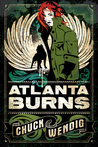
Review: Atlanta Burns

Atlanta Burns (Atlanta Burns #1-2)Atlanta Burns by Chuck Wendig

My rating: 3 of 5 stars

Atlanta Burns is what Veronica Mars would have been if, instead of growing up in sunny California with an understanding father, she’d been transplanted suddenly into “Pennsyltucky”—the rural/backwoods center of Pennsylvania—with an impoverished lost-soul mother and no one to fall back on. Atlanta Burns is Veronica Mars with red hair, a cut lip, dirt all over her face, and the vocabulary your momma wouldn’t approve of.

The story is good, but rough, hard to take. Atlanta is still recovering from the sexual assault she suffered at the hands of her mother’s boyfriend, and her unwanted legendary status she earned with a well-placed shotgun hit to his bait-and-tackle. It is in part because of this reputation, however, that she attracts the downtrodden, the friendless, and begins to help them fight back, too.

The only thing you can really say Atlanta has going for her is grit. She’s not always the smartest girl; she’s into way more drugs than I am even familiar with, often in tandem; she makes really shitty decisions and has a hard time remembering who her friends are. But she doesn’t give up, doesn’t back down, even as she stumbles into bigger and greater crimes against those who can’t fight back.

Chuck Wendig spins a good story, but I think he inserts a little bit too much of himself sometimes, making his agenda too clear and creating a gap in the fourth wall, like when his drug-dealing lowlife happens to be a frequent reader of Margaret Atwood. I don’t disagree with his message, and, true, it’s one of these clear agenda items that makes up the overall story arch, but there were times it drew me out of the story and had me rolling my eyes.

Overall, Wendig does good work here: it doesn’t always get better. Sometimes the bad guys are too big to fight. Sometimes you’re the dog in the ring, just having to fight to survive. It’s a good story, with a hard message to swallow, but it’s a bit too gritty and intense for me. Tread carefully, readers; this is a solid book but you’re going to need a steel stomach to get through it.

View all my reviews

Leave a comment

Filed under Reading, Reviews

Review: The Martian

The MartianThe Martian by Andy Weir

My rating: 5 of 5 stars

The Martian is a gem, an instant science-fiction classic that will blow your mind and make you long for (and fear) space travel. If this book (and its soon-to-be-produced movie) isn’t enough to reignite interest in NASA’s Mars mission, I don’t know what will.

The plot is simple: Mars astronaut Mark Watney is left behind on Mars after an accident; he is on his own to survive until NASA can figure out a way to pick him up…years later.

What’s particularly amazing is that with any other author, this book could have been an exhausting, emotionally-draining beat-down. It could have focused on how much it would suck to be totally alone on Mars; Watney could have spent the whole book being a pathetic, barely-surviving drag.

But “The Martian” is surprisingly funny, the kind of funny that means you’ll be laughing aloud and poking your spouse to share it with him. Watney is completely sarcastic, a naturally buoyant personality who, when faced with adversity, says, This is going to suck, but I am going to survive, damnit.
And then he’ll name rock formations on Mars after himself and declare himself King of Mars. And maybe institute worship of duct tape.

Another way this book distinguishes itself from pretty much all fiction is how clearly it was written by a science- and math-inclined mind. Author Andy Weir saves the reader from all the equations, but it is no less clear that there is intense math right under the surface; he even provides the variables used, in case another math-inclined person wants to try to figure it out, too. Most science-fiction, it need not be said, is more of the fiction, less of the science. But Weir is a world-class nerd of the best kind, and the hard science backbone to “The Martian” is what makes it so utterly believable.

“The Martian” is an outstanding book. What may make it truly great is its ability to transcend normal book-readers and reach those who care about hard numbers, math, and science, as well as those who could use a good laugh. It’s first-class writing that makes me believe we can send a man to Mars (but hopefully not leave him there).

View all my reviews

Leave a comment

Filed under Reading, Reviews, Science

My Wedding Craft Dissolved Friendships

wedding bouquetI wrote a contemplative piece a year ago as a form of therapy after the disaster regarding my bridesmaids before the wedding. I submitted it to the wedding planning site I’d been reading religiously, and then heard nothing for a while, so I assumed it was too bitter for a happy/planning website.

Turns out I was wrong; they just needed the right time. It published earlier this week on APracticalWedding.com (I cannot recommend the site enough for those planning a wedding!)

It’s written as a how-to guide to making paper flowers/a paper flower wreath, but it’s really a way to talk about friendship.

Take a look. Seems to have generated a lot of conversation over there.

http://apracticalwedding.com/2015/07/paper-flower-friendship-loss/

1 Comment

Filed under Uncategorized

Review: Bossypants

BossypantsBossypants by Tina Fey

My rating: 4 of 5 stars

I’m late to the Bossypants party, but luckily Tina Fey knows how to keep the party thumpin’. Bossypants is hilarious, smart, and deeply insightful. But mostly it’s hilarious.

Bossypants is less a biography and more a brilliant stream-of-consciousness into the life of Hollywood-stomping Fey. It’s loosely organized by periods in her life, with a brief bit on her childhood, including irreverent stories about who she met on the first day of school, all the way up into her ongoing surprise that “30 Rock” turned out to be a sleeper hit. She’s humble about her achievements, making Fey seem even more like the person you’d most like to have a beer with. This sounds stupid, but she really is “just like everyone else,” and it seems that maybe a little of that midwestern awareness of the ridiculousness of NYC culture/TV writing insanity is what makes her brand of humor so fresh and entertaining. She’s the girl next door who makes you laugh so hard you nearly pee.

But just because it’s funny—and it IS funny, the kind of funny that’ll have you tapping your husband on the shoulder at midnight to read “just one more line” aloud—doesn’t mean this is an idle book. Fey wraps her humor around sometimes biting criticism, particularly about gender roles. She’s a feminist icon for a reason, and she’s very aware of the limitations (and benefits) of being a woman who is also funny.

The only criticism I have is that I wish there were more, particularly about the writing process for “Mean Girls,” the smash-success movie about teenage girls’ social structure that has, for me at least, left lasting ripples. There’s a scant reference to it, with a lot more time devoted to “30 Rock,” which I have been negligent about seeing (I’ll be fixing that soon).
More, Ms. Fey, always more. I love you and can’t wait for more.

View all my reviews

2 Comments

Filed under Reading, Reviews

These Words Deserve a Comeback

As I said, I’m loving America In So Many Words. It’s great for getting acquainted with American history and some awesome random trivia. But it also has led me to discover a bunch of words that really ought to make a comeback.

  • kinnikinnick– a mixture of leaves for smoking (1729)
  • netop– a friend (1643)
  • punk– overcooked corn; slow-burning sticks; and, of course, a small-time hoodlum (originally 1618)
  • squaw winter– an early cold spell (contrasting with an indian summer) (1777)
    • Note: Though the settlers imbued the term “squaw” with a derogatory connotation, it originally meant a leader who was a woman. Maybe we should get squaw back to its roots!
  • pumpkin head– a New England colonist hairstyle, created by placing a pumpkin shell on someone’s head and cutting around it! (1654)
    • I imagine this is much like the ’90s fad of the “bowl cut”
  • backlog– the large log placed in the back of a fire, along with “top-stick,” “fore-stick,” and “and-irons”(1684)
    • nowadays, it’s an accumulation
  • prairie schooner- a covered wagon (1841)
  • loggerhead– a slow-witted person (ok, this one is Shakespeare)
  • johnny cake or jonakin– cornbread (1739)
  • breechclout– a clout of piece of cloth to cover one’s breech (buttocks) (1757)
  • bust my buttons– to strain or laugh (1921)
  • busticated- broken (1916)
  • bustified – pot-bellied (1939)
  • bee– a social, busy gathering (1768); also frolic
    • we’ve kept “spelling bee,” but they also had wood chopping bees, painting bees, and even kissing bees!
  • drugstore cowboy- someone who puts on airs of being tough or sophisticated (1779)
  • bug- an enthusiast, now a fan (1785); ex. baseball bug
  • keno-essentially, the modern lottery; a game where players mark of numbers printed on a ticket- the keno caller draws numbers on keno balls from a keno goose to determine the winner (1814)
  • bunkum- nonsense OR (a competing definition from the same time) excellent and outstanding (1819)
  • blizzard- a knock-down blow or punch (1825)
  • sockdolager- a decisive blow; something or someone big (1827)
    • interestingly, one of the last words President Abraham Lincoln ever heard!
  • callithumpian- a noisy parade (early 19th century)
  • slumgullion- something disgusting (early 19th century)
  • slangwhanger- a partisan speechmaker (early 19th century)
  • rawheel/tenderfoot- a beginner or newcomer (1849)
  • high muckamuck- plenty of food or someone who assumes an air of importance (1856); we’re left now with “muckety mucks”
  • hulloo- a predecessor to “hello” (1885)
  • jellybean– a derogatory term for someone weak or timid (1905)

I don’t know about you, but these are basically the cool kinds of words that I’ve always wanted out of a word-a-day calendar.

Whattya say? Can we give these all-American words a new life? Do you have any favorite obscure words?

Leave a comment

Filed under writing