Review: Dead Until Dark

Dead Until Dark (Sookie Stackhouse, #1)Dead Until Dark by Charlaine Harris
My rating: 3 of 5 stars

I read this book because I got to hear author Charlaine Harris speak at a conference—and everything about her was adorable. I felt I owed it to her to actually read her work. I’d seen (some of) the TV show TrueBlood based on the books, so I was a little worried I’d ruined the experience for myself. Luckily, it just left me well-prepared.

Let me give an aside on Ms. Harris. She has a gentle Southern accent, just a touch, and a modest demeanor. Judging by her appearance and her publicity photos, she’s partial to the long, elegant, drapey fabric looks. But underneath, just below the surface, is a sharp wit and a snappy bite. She’s the epitome of the Southern women I know: all cookies and Bless your hearts on the surface, but acute observation and rapier wit hiding just below the surface, where it’s modest and ok to whisper behind your hands.

So, in that way, Dead Until Dark is very true to life for me. My absolute favorite character was Sookie’s grandmother (which…may be unfortunate). She doesn’t hold truck with people being discriminatory for no good reason; she cooks a damn good spread and keeps a tidy house; and hopes against hope that her granddaughter will just get a date already–even if he IS dead.

The writing in this book was warm and cool like a glass of iced tea on a hot, sticky day. The story is certainly original: rather than Anne Rice’s cool and distant, extremely frightening vampires, Harris’ vamps come in a range–still spooky, maybe even deadly, but much more approachable. You’re invited to fangirl right next to Sookie as she swoons over the hunks in the vampire community. And hunks there are, of both the male and female variety. You can immediately see why HBO wanted this for their channel.
That said, the book is more tame than the TV series, by far. It almost feels that Harris wanted sex scenes, but felt they were rather too icky to actually write down (that Southern discretion again). Much of the scenes are…left to the readers’ imagination. Which is good. Because it seems vampires don’t particularly invest in foreplay; I imagine a more realistic rendition would involve bruising.

A lot happens in the story, and it pulls you right along. I find it a little hard to get into, for the same reason I eventually dropped out of the TV show—the townspeople in Bon Temps seem to roll with an awful lot of punches, without asking too many questions. Convenient for the author, perhaps, but it took me out of the story a bit. Plus, there’s so much action, so much I want to know…and then the story stopped as suddenly as if we’d crashed into a tree. I actually put my Kindle down and exclaimed,”That’s IT?!”

I guess it’s supposed to make you want to read more–and maybe I will–but it was also frustrating. Overall, these books will make excellent vacation reads, or perhaps an All Hallow’s Read book for those who can’t handle spooky stuff. They’re brain candy, as rich as Sookie’s grandmother’s hummingbird cake.

View all my reviews

Leave a comment

Filed under Reviews

Review: Eric

Eric (Discworld, #9)Eric by Terry Pratchett
My rating: 4 of 5 stars

Goodreads doesn’t aptly display the cover of this book, so let me describe it. It has “Faust” written in normal typography, crossed out with fat red marker and “Eric” written in its place. And that perfectly well sets you up for this misguided teenager’s wish-fulfillment disaster.
As always, Pratchett is insightful and hilarious. This time he takes on Homer, which not enough authors are brave enough to do. This is the line that made me love the book: “He tried to remember what little he knew of classical history, but it was just a confusion of battles, one-eyed giants and women launching thousands of ships with their faces.”
Glorious!
Anyway, this short little jaunt is about a jerky prepubescent teenager, Eric, who manages to call up the hapless/cowardly/useless wizard Rincewind, convinced Rincewind is a demon who can grant wishes. Eric makes wishes–bad ones, of course, or rather traditional ones that come to bad ends–and much to his surprise, Rincewind hurtles him toward it. Or at least, seems to.
Goethe, Homer, and Dante all get a thorough Pratchett treatment, and it’s a delight. Plus it’s only about 200 pages, so it’s a quick read. You’ll be giggling right through bedtime.
That old blind classical guy doesn’t get teased enough, I say. Pratchett to the rescue!

View all my reviews

Leave a comment

Filed under Reading, Reviews

To Boldly Go Toward Diversity in Science Fiction

With the sad little white men known as the “Sad Puppies” shitting all over the Hugo awards, diversity in science fiction has been a hot topic of late. And it likely will continue to be a conversation, in literature. But right now I want to talk about another medium, and a body of science fiction that has definitively transformed the cultural landscape for the better. Because it was diverse.

I want to talk about Star Trek, a TV show, several movies, and a long string of spin-off books. Because my friend died, and it’s what they loved.

I’ve written about my love of Star Trek before. But I don’t know that I’ve explained how important it has been in my life. Star Trek was the show that my brother, my dad, and I gathered around to watch most nights growing up (and sometimes mom joined in, too). We predominantly watched Star Trek: Next Generation, but we weren’t choosy and have dabbled in all of them. We didn’t always watch them in order, but that wasn’t important. I can’t even tell you which of the movies I’ve seen, except to say “yes.” I had a crush on Wesley as an awkward teenager, because he was a smart awkward teenager about the same time I was just awkward, so he seemed to have a lot to aspire to.

My parents were the type who didn’t allow us to watch anything they deemed “inappropriate,” and heavily favored those they viewed as “educational.” And Star Trek absolutely fit that bill (lucky for me). I probably didn’t learn that much about actual science, but I learned a great deal about philosophy, about friendship and familial relationships, about hope. And I most certainly learned about acceptance.

Of course we all know it was Star Trek that braved to blast through the color barrier on TV, with the first interracial kiss. But more than that, Star Trek taught that anyone could be accepted. You could have weird spoon indentations on your head, or a tendency to fight at a moment’s notice, or the ability to read emotions and strange marriage rituals, but it wouldn’t matter: Starfleet would find a place for you. You were respected for who and what you were. It may not have always been logical or the easiest choice, but it was Captain Picard’s (and later, Captain Janway’s) prevailing approach. To learn. To welcome those who are friendly and demilitarize or avoid those who aren’t.

I can’t have been the only one who learned tolerance from Star Trek. I know it has inspired others. It inspired my friend, who I first met the first week of college; they performed Hamlet‘s “To Be or Not To Be” speech… in Klingon. They made an impression–not necessarily flattering, but certainly brave and owning their geek pride. And I could respect that.

I’m using the pronoun “they” because, though in college my friend presented as male, some time a few years later they decided/realized they preferred the pronoun “they/their.” They identified not as male, but as “genderfluid.”

Yet again my friend stunned me a bit. I mean, that is a tough thing to wrap your head around, for sure. But I hadn’t been in close touch with this friend for years, and even so they felt the need to reach out, to share this very intimate part of their life, with me. I was touched, and felt guilty for having been so far out of touch. I admired them their brave eccentricity, their self-acceptance, their newfound sense of confidence, of self.

I think Star Trek had a lot to do with that. See, in Star Trek, no one would blink twice at this kind of switch, about the idea that gender is not fixed or biologically determined. Sure, what else is new? We’ve got these furry things that reproduce like mad, let’s go deal with them. The captain’s banging a green alien again, what else is new? We’ve got solar systems to explore, who cares about a stupid pronoun?!

My friend loved Star Trek. I mean, they were fluent in Klingon, of course they loved it! But I can’t help but think, now, that one of the big appeals for them must have been that acceptance of diversity. That dream of a future utopia wherein poverty has been eliminated, where disease can be cured by a flashy light, and where people can be who they are…whoever and whatever that may be.

My friend passed away very suddenly last week. I never got the opportunity to tell them how brave they were. But they reminded me of something important, even now: that diversity in science fiction is absolutely not a bad thing. It’s a beautiful thing. It is perhaps the best thing about science fiction, that we can create safe spaces in which we can explore the possibilities of a bright future.

I hope my friend has found their Nexus.

Leave a comment

Filed under Feminism, Uncategorized

Review: Neuromancer

 Neuromancer is undoubtedly an original, at what was once the cutting edge of science fiction, breeding a whole new genre known as cyberpunk, from which much of what we now take for granted was invented. I can see why it’s on many “must-read” sci-fi lists.

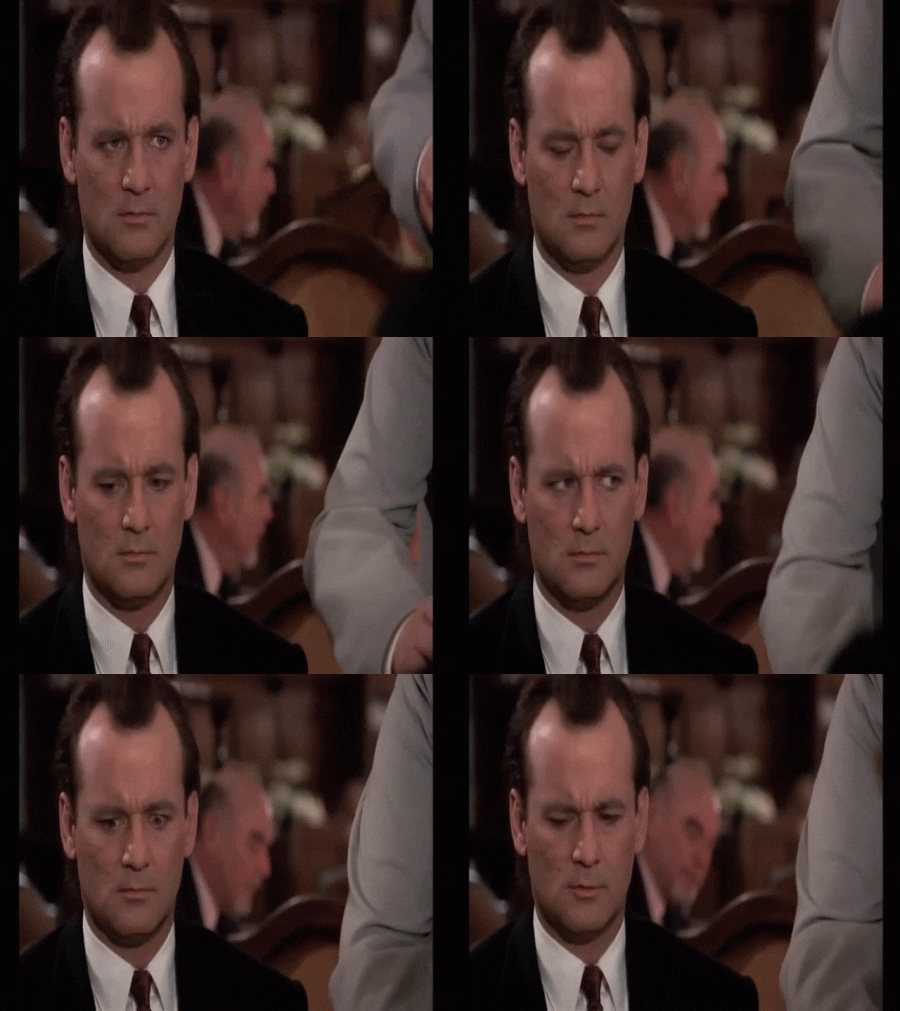
But I don’t much care for it.

Despite the reviews saying it’s about a hacker and a big conceptual challenge, the challenge I faced for the full first third of the book was just figuring out what the heck was going on. The main character, Case, is a washed-up drug addict and former “cowboy.” Apparently “cowboy” means “hacker,” but it took a lot of reading to really grok that. Case is pulled into a weird “team” of characters to kill an AI, which supposedly can’t be done, for reasons. I never really did figure out what motivated most of the characters to be willingly on this quest or interact with each other. A lot of imagined jargon is thrown at you from the outset, and I found it so foreign I had no context to help. And because Case is so drug-addled–particularly at the beginning–it’s immensely hard to figure out what is even real.

I really was confused when a brand-new character, a “razor girl”–woman with retractable razor blade claws–meets Case and then a scene later has sex with him. I’m all for characters being bonded and all, but they just met! And she tried to kill him! How is that attraction or flirtation? I almost gave up on the book then, but it’s a classic, so I persevered.

I got it, eventually, fell into the flow of the language and found the story, but I had already lost some of the mystique the book had held from being a first. I just didn’t love it.

However, I can absolutely see its value as literature. It is a definite pioneer of the new, of the future of technology. It tries to comprehend what eventually became the Web, and even though it is conceptually very different from today’s user experience, you can trace the gene pool.

The “matrix” looks an awful lot like Tron or Reboot and it’s an immersive alternate reality, perhaps like some movie in 1999 called, oh, I dunno, The Matrix. Dub step music almost certainly hardens at least partially to this book, as does almost any movie where a guy behind a screen can be a hero.

Neuromancer is an important book…but probably not one I’d read again.

Leave a comment

Filed under Reading, Reviews

Thanks to ‘Sad Puppies,’ Hugo Awards Were a Mess

This year’s prestigious Hugo Awards were far more dramatic than usual, and not for any good reason. In case you haven’t been following the hoopla, the long and the short of it is that a group of (white, male) writers who felt that white, male authors’ stories about space marines weren’t getting enough attention through a hissy fit and manipulated the awards to try to get awards for people and stories they deemed more acceptable.

And, it didn’t work: None of the people the self-named “Sad Puppies” put forward won.

Wired has an outstanding article about it: Who Won Science Fiction’s Hugo Awards, And Why It Matters. You should go read it right now.

Some particularly salient quotes:

“Would sci-fi focus, as it has for much of its history, largely on brave white male engineers with ray guns fighting either a) hideous aliens or b) hideous governments who don’t want them to mine asteroids in space? Or would it continue its embrace of a broader sci-fi: stories about non-traditionally gendered explorers and post-singularity, post-ethnic characters who are sometimes not men and often even have feelings?”

It’s crazy that it’s even an argument.

“Not a single Puppy-endorsed candidate took home a rocket. In the five categories that had only Puppy-provided nominees on the ballot—Best Novella, Best Short Story, Best Related Work, and Best Editor for Short and for Long Form—voters instead preferred ‘No Award.'”

Honestly, as glad as I am that the rigged votes didn’t result in wins, I feel terrible for those authors. In fact for all the authors on this years’ ballot. It’s hard to know the exact effect of the Sad Puppies’ campaign, and therefore hard to tell which authors had a groundswell of deserved support and how many were picked just because someone didn’t like the other guy (or gal). How terrible that such an incredible award should be tainted. And how sad that so many categories resulted in a “No Award” this year, when I’m sure there are many deserving authors who got either locked out by the manipulated ballot or tainted by the Puppies’ touch.

I sincerely hope the Hugo folks manage to figure out a way to improve the voting process to make this better next year and going forward, but I feel certain that this culture shift (and resulting puppy-pooping) is not going to go away overnight.

Leave a comment

Filed under Publishing

5 Secrets About Literary Agents

One of the best things about attending a writers’ conference is it is a great way to meet literary agents…and demystify them a bit. Here are the top 5 secrets I learned about them:

1. They tend to work odd hours. The number one takeaway I got from the conference was to write a query letter as if the reader is half-asleep…because they very well may be. The agents I met were workaholics, ad several admitted to reading queries late into the night, before bed. That makes it a little trickier to grab their attention, so keep it simple!

2. There are bad times to solicit them. Of course, this doesn’t just mean when they’re in the bathroom (but don’t do that!). Certain times of year tend to be trickier to get their attention: in the summer months, they’re taking vacations (along with everyone else!) and many are also out of the office in December. Don’t send your manuscript on January 1! Wait until mid-month, when the flow of queries from authors who didn’t get this advice will have tapered off.

3. Some really like self-publishing. We sometimes imagine that self-publishing and getting a literary agent are entirely opposing ideas, but the agents at the conference really didn’t think so! While not all of them would accept a self-published author, they all admitted that there are some genres, stories, and situations where self-publishing is a better route, and many said they would take on self-published clients.

4. They work really hard. These folks…wow. They are a devoted bunch. They all really seemed to genuinely want to see more books published (and not just because it means a revenue stream for them, too). They are people who like books, at heart. (One woman I met was a member of three different book clubs!) Which is good, because they have to read a lot of books, and queries, and manuscripts to do their jobs right. Sometimes (angry) authors can push the idea that agents are evil, book-hating gatekeepers who just want to keep an author down, but that definitely didn’t seem true.

5. They are all different. Shocking, I know, but there isn’t exactly a literary agent hive mind. There are similarities, because they are all doing the same job, but what appeals to Agent A just may not resonate with agents B, C, and D, and vice versa. That can make our job as writers seeking to court them tricky, but it also means that all those rejections may not at all be personal. So keep trying.

What “secrets” have you learned about literary agents? 

Leave a comment

Filed under Conventional, Publishing

Your Amazon Author Central Page

Amazon is an excellent tool for selling your book, but it isn’t necessarily intuitive. There are completely different sites for print books (createspace.com) and ebooks (kdp.amazon.com), and then there is a different site to craft your author tools. It took me six months to realize I wasn’t using their author tools! I figured I’d write it up to save y’all the same embarrassment.

Amazon Author page interface

Amazon Author page interface

First, find the site. I had to Google it. You can also click through one of your favorite books, and click on the author name, then scroll down to find the “are you an author?” link. You’re looking for https://authorcentral.amazon.com.

If you are already selling your books through an Amazon platform, it should be easy to connect your name to your book. It’s an easy-to-follow interface, and won’t take very long.

You’ll fill in a short biography, and it’s a good idea to add your author photo. Bonus points if you have other photos or videos that will help readers connect with you as a person, but you have to work within your comfort zone. Connect your blog and Twitter* feed, and it’ll give readers just one more chance to follow you. You may need to look up exactly how to find your blog’s RSS feed, but once again Google is your friend there.

This is what it will look like when you’re done (and it’s been approved by Amazon).

amazon author page

As we know, connection with readers is critical! The author page is a fantastic, free way to connect the dots. Don’t make the same mistake I did!

There are a lot of other tools back in there, including a sales chart, your sales rank against all other books in Amazon’s stock, your current author rank, and an easy snapshot of all the Amazon customer reviews of your books. I mean, seriously, how did I miss the memo on these? They’re great to have access to, finally!

Do you use Amazon’s author page tools? What’s your favorite feature?

*Note: Amazon’s having some kind of dispute with their tweet provider, so tweets aren’t currently uploading, but it’ll resolve sooner than later.

Leave a comment

Filed under Publishing, Undead Rising

The Weirdness of Weddings

wedding paper flowersLast year, just after I got married, I was lonely, depressed, and trying to come to terms with what had happened in the wedding planning: two of my three bridesmaids dropped out of the wedding and stopped talking to me. I wrote up a piece about it, framing it not as a explanation (because I’m honestly not completely sure), but as a “how to” craft piece. The step-by-step craft process gave me a little emotional distance, and I thought it was kinda poetic.

I submitted it to APracticalWedding.com, a site upon which I’d relied heavily during wedding planning. This summer, they decided to publish it, which was pretty cool. Then it was republished by Refinery29—bonus cool!
But I’ve noticed something. Women, online and in person, respond a few typical ways:
  • “Well, at least you know who your friends are now?” or “Well, they just weren’t very good friends, were they?”
    I’ve gotten this from several commenters, as well as my mom and the therapist I briefly visited. You know how helpful this response is? Not at all. Because they were my closest friends, and their absence meant the utter dissolution of my friend circle. So, sure, I knew who my friends were: older friends, from college, who I rarely get to see. I had no “Let’s go see a movie” friends left.
  • “You shouldn’t have wanted such a hard craft project! Some people aren’t crafty!”
    Mostly received online, from people I think who didn’t understand that the craft was just a way to talk about it. For the record, they didn’t leave just over the craft. They ignored me about the craft, then were dismissive about it, didn’t offer ideas on dresses or like any of the ones I picked, and didn’t bother to RSVP to any shower invitations, didn’t come to my birthday party, weren’t available to meet for dinner, and then were upset when I asked for more support. I even said that if I was asking too much of them, I’d understand if they didn’t want to do the bridesmaid thing and they could just come to the wedding if that was easier. They, apparently, didn’t think so.
  • “I think we’re only getting one side of the story here.”
    Another from the commenters, and—well yeah, of course you are. That’s how a narrative works. This comment has a little added zing of implying I’m lying or manipulating the story. But, if it helps, I don’t know any more, really. They never said why, exactly, they were dropping out. They never said anything at all, except one half-hearted “I’m sorry things turned out this way” a week later, before dropping off my Facebook friends list and not talking to me again. One changed her username so I can’t search for her.
And that would be it, except a few men I know read my article, too, because I forgot who can see things I post to my personal Facebook page. And this is what they said:
  • “Wow, did that really happen? I’m sorry. That’s really shitty.”
    And that was amazing. Because the majority of the women who responded hadn’t given me that kind of empathy. These men validated my experience and just let me say, yes, that was a thing that happened. It was shitty. They didn’t blame me or accuse me of being a “bridezilla” (more than one woman has made that suggestion—including the therapist). They didn’t tell me they weren’t crafty. They didn’t try to play it off as no big deal.
I think it says a lot about women and weddings. The women are afraid to admit that something like this could happen to them, that weddings aren’t always the Hollywood ideal of being so popular you have to be in 27 weddings. So they look for “if only’s”—”if only I don’t do that, it won’t happen to me.”
I didn’t have a Hollywood wedding experience. Parts of wedding planning were really, really shitty. I don’t think I “deserved” what happened, and it’s taken me a long while to stop feeling as hurt about it; it was hard to mourn those friendships. But I did have a lovely event, in the end, with lots of dancing and happy people. I married a really amazing man, and we’re building a solid life together.
Plus I have this kickass wreath, so that’s cool.
paper flower wreath

4 Comments

Filed under Crafts, Feminism

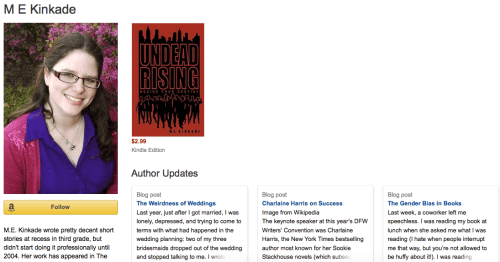
Charlaine Harris on Success

Image from Wikipedia

Image from Wikipedia

The keynote speaker at this year’s DFW Writers’ Convention was Charlaine Harris, the New York Times bestselling author most known for her Sookie Stackhouse novels (which subsequently became the True Blood TV phenomenon).

She just absolutely adorable.
Ms. Harris seems like everything I’d like in the sweet neighbor next door: a grandma who bakes cookies on the regular but also is more than willing to slip you a bottle of booze after a hard day. She was sharp and funny and seemed so lovely; I wish I’d gotten to speak to her personally. At the very least, I’ve bought the first novel in her series as a tribute!
Ms. Harris gave a short speech about her life’s work before opening the floor to questions. She talked about how difficult it was to write as a parent (“I wanted to have kids, but I just had to write. You make it work.”), about where her ideas come from (“I don’t know. They’re just there!”), and on the tenacity it takes to be a writer.
But the part that stuck with me most were her comments on her success. She said, “I still haven’t read On Writing or any other writing book, because I’m too afraid I’ll find out I’ve been doing it wrong all this time.”
Wow.
This woman has published a passel of books, literally just laughed when asked if an agent ever said she couldn’t do something, and yet still has that crippling fear of “doing it wrong.” It’s comforting to know that insecurity doesn’t have to be a barrier; it’s just something you work with and through.
She also said there’s an award she’d like to win…but fully expects never to be able to. She’s so accomplished in many ways—she’s the writer dream achieved!—but she still has goals she feels are unattainable.
And finally, she talked about failure, about how you just have to take it and barrel on anyway. She said she’s been dropped by publishers before…but you just can’t let that stop you. Having kids while writing was hard…but you can’t let that stop you. Your book may not sell…but you can’t let that stop you.
It was very powerful to me to “meet” this unassuming, very inspiring, dogged determined, funny lady who happens to be a literary powerhouse. I hope to have her tenacity and humor.
 
Which authors inspire you? How do you get through the insecurity and the bad days?

1 Comment

Filed under Conventional, Publishing, writing

The Gender Bias in Books

Last week, a coworker left me speechless. I was reading my book at lunch when she asked me what I was reading (I hate when people interrupt me that way, but you’re not allowed to be huffy about it!). I was reading Abaddon’s Gate and was about to start telling her how much I enjoyed it when she asked: “Is that science fiction?” This, honest to goodness, is how that conversation progressed from there:

“Yeah, it is.”

“Oh… Does your husband science fiction?”

“Oh yeah, my husband and I both love it, and–”

“Did you like it before you met him?”

“…uh, well, yeah, I mean, it was practically a requirement for me to–”

“Oh.” (pauses, biting her lip) “Well, it’s lucky you found a husband who liked it. I guess it’s probably easier for a woman to find a man like that than the other way around, though!”

I think I gave her this face:

Apparently being a woman and liking science fiction means I’m basically unmarriable and should be incredibly lucky that I found a forgiving man to marry me.

And if that were it, that would be one thing. I could shrug off one lady as just being kinda crazy.

And then author Catherine Nichols wrote about her query experiment—she sent her exact same book and exact same query letter to agents under a male name. And the male version of her got far, FAR more favorable responses than her real name.

Read about it here.

Here is one of the more salient points:

Total data: George sent out 50 queries, and had his manuscript requested 17 times. He is eight and a half times better than me at writing the same book. Fully a third of the agents who saw his query wanted to see more, where my numbers never did shift from one in 25.

And even the rejections she got were more favorable, with more long-form responses and positive reactions.

This article—particularly following those outdated, sexist comments from my coworker—just was a real punch in the gut. I may be getting tanked before a single word is written, all because of unconscious (or perhaps a little bit conscious) bias on the part of the agents, the very first gatekeepers in the traditional publishing journey.

Bias against female authors in sci-fi/horror is part of why I use my initials with my book, Undead Rising. But I thought that was just for the reader who may be wary of a “girly” book…I had no idea that this sort of bias had leeched all the way through the system. But I can’t say I’m truly that surprised. Publishing is one of the most opaque, challenging industries, with a convoluted process and a lot of gut feel on the part of agents and editors in determining who gets in the door. And with the recent events at the Hugo Awards, I think there is a good reason to be concerned.

I used to sign my query letters with my name, thinking it would be more personal and therefore welcoming for the agent on the other end. I thought I was improving my odds by being warm and friendly. But perhaps I need to switch to only using my initials there, too; perhaps that is what it will take for my fiction to get a fair shake (especially as the book I’m querying is either sci-fi or literary fiction…both genres which carry a reputation as a boys’ club).

I’m deeply frustrated by this revelation, and sure, it’s one woman’s experiment with a relatively small sample. But her results are huge. I hope it leads to some careful thought in literary circles.

Do you see a bias in publishing? What should we do about it?

Leave a comment

Filed under Feminism, Publishing, writing