Tag Archives: books

Review: Transmetropolitan (all)

Transmetropolitan V. 1-10Transmetropolitan V. 1-10 by Warren Ellis

My rating: 5 of 5 stars

Transmetropolitan is a comic book, and anyone remotely interested in dystopias needs to immediately stop what she is doing, go buy all these books, and read them before continuing with life. Yes, it’s that good.

This is a review for ALL 10 collected volumes. I’m going to write the review in the style of the comics, so if you’re ridiculously sensitive to explicit language, you’d better stop reading now. (But it’s really your loss.)

To say Spider Jerusalem is a muckraking journalist is to put it lightly. No–Spider does not just rake muck; he wallows in it while tripping on sixteen kinds of heroine pumped directly into his veins through the City’s sewers while he ejaculates into the ensuing muck. He is dirty, foul, horrible–and the only goddamn person left in the entire City who has the balls to take on the corrupt government and the injustices of a city of the future.

He is a despicable, low-down uncaring asshole because he cares too much to let the city (and the country) destroy itself through ignorance and petty distractions.

So: Transmetropolitan follows journalist Spider Jerusalem as he gets reacquainted with the City, a (not far enough) far-future metropolis swarming with all the problems of real cities, if the problems were turned to 11 and injected with a form of swarming AIDS. In the style of many brilliant authors before him, Ellis is working with hyper-exaggerated features of the real world to show us the many problems with our own–and it’s unnerving.

First, be impressed with the level of deranged thought Ellis has put into his City: of course there is porn for children! And people commonly eat the meat of endangered animals–or heck, try out some food from Long Pig (don’t worry, they’re only clones!). “Maker” technology allows you to create pretty much anything at home, and journalists sometimes employ “source gas” to record info from unwitting sources while still managing to make it past security. While you’re enjoying the future, make sure you get one of the many DNA splices–try the one that allows you to take massive doses of drugs and alcohol without dying. Or maybe you’re totally past the human experience–why not join the Transients and splice with alien DNA? Or really embrace the cloud and become nothing more than a bunch of floating molecules. Groovy.

It’s amazing, and immersive, and simultaneously plausible and disgustingly far-fetched.

Much like Spider Jerusalem. It’s like the Deadpool of journalists, seemingly throwing normal tactics out the window. But really, he’s just good. In fact, I know journalists like him. Spider is, if anything, alarmingly realistic. He’s devoted in a time when many reporters seem like shills. He’s dogged and willing to take risks. He has a gift for it, something that can’t really be taught and must come from some burning fuel within. He’s addicted to the thrill of the chase–and sometimes that puts people he talks to in the line of danger. But mostly, that makes people want to open up to him. Because he loves them, even while he hates them to the core.

In other words, Spider Jerusalem is my hero. I want to give Warren Ellis a hug for writing something so transgressive, so daring and truly sickening, and I want to make this series required reading for EVERYONE. The world would be better for it if more people paid as much attention to goings-on as Spider does.

Go buy these books. You may find it hard to read them sometimes, but don’t you dare fucking stop. You need to take your medicine, world.

View all my reviews

Leave a comment

Filed under Reviews, Uncategorized

Review: MaddAddam

MaddAddam (MaddAddam Trilogy, #3)MaddAddam by Margaret Atwood

My rating: 4 of 5 stars

Margaret Atwood clearly enjoyed writing the conclusion to her most recent post-apocalyptic trilogy. Her enthusiasm is sometimes palpable. There are mini-jokes and obscure references, and at times you can almost hear her snort with amusement at a turn of phrase. It’s a fascinating conclusion to a possible future, but the story is uneven and ends with a fizzle rather than a bang. (Perhaps that’s the way a story about “life finding a way” should end, however.)

MaddAddam completes the story begun with Oryx and Crake and continued with The Year of the Flood. The post-human creatures known as the Crakers are developing in ways their mad-scientist creator hadn’t anticipated, but they are still fundamentally helpless against hostility and don’t truly comprehend fear. The group of former cult members known as the God’s Gardeners and the big-brained MaddAddam scientists who helped create the Crakers are the only (known) humans left: except for the delirious Jimmy and two less-than-human Painballers, men who survived a man-eat-man prison game and now feel nothing but a need for violence.

The story mostly follows Toby–the ultra-practical former God’s Gardener to whom the Crakers gravitate–and Zeb, the man who bridged the gap between the God’s Gardeners and the MaddAddamites. Frustratingly, even though this feels like it truly ought to be Toby’s story outright, much of the interesting action is left to Zeb. The reader finally understands (most of) what happened with Jimmy and Crake and God’s Gardener leader Adam One.

It turns out that the day-to-day mechanics of survival are pretty mundane, and though that is the part o the story left for Toby to recount, there’s just not a lot that hasn’t already been covered. Besides, unlike Jimmy/Snowman in “Oryx and Crake,” Toby and Zeb are pretty good at basic survival. Though it isn’t glamorous, the basic needs are met. That leaves Toby with little to actually tell the reader.

Zeb, on the other hand, turns out to be a bountiful mine of information, as he (beyond believability) was present for just about every critical juncture in the Story of How The World Bit It. Zeb is not just Adam One’s right-hand man; he’s his brother. From their twisted abusive childhoods up through the discovery of super-genius Glenn/Crake and the founding of the God’s Gardeners cult, Zeb knows everything interesting, and he recounts his life story to Toby as they slowly allow themselves to fall in love.

For an otherwise intense and compelling story, the touches of romance between the two come off as cloying and unnecessary. Toby frets over “does he love me or not” more than I cared for. Frankly, it seemed a bit unlike her–though of course that could be the point. It felt like the romance was not there because it developed naturally, but because Toby needed something else to talk/think about beyond “are we going to survive today?” (Personally, survival alone would have been enough reason for me to read more.)

The best parts are undoubtedly when Toby recounts watered-down versions of Zeb’s stories to the incredulous and trusting but incredibly naive Crakers. Here we see one way myths could have been founded: trying to understand something that is beyond our scope. These parts are hilarious and frustrating and awe-inspiring all at the same time.

(Some spoilers below)
Personally, I’m frustrated with the way historically feminist writer Margaret Atwood handled the female characters. Sometimes it seems like Toby is the only useful female in the whole story, and that, apparently, is only because she is post-menopausal and otherwise, apparently, useless. Rebecca, who–while certainly a secondary character–at least had a distinct personality in “The Year of the Flood,” was reduced to scenery. Ren and Amanda are vehicles for other peoples’ trauma; they were not only assaulted by the Painballers, but raped by the Crakers, in a confusing scene that is later referred to only as a “cultural misunderstanding.” I didn’t even BELIEVE a rape had actually happened until Amanda turned up pregnant; some clearer, less vague, writing at that pivotal scene would have been helpful. And then, in a final affront, when it comes to the critical battle, ALL the women–except for Toby, who as we said “did not count”–are excluded because of concerns over their well-being. It is ridiculous, to me, that so many would have spent their time getting pregnant, and all at roughly the same time.

And after the final battle, the story just…sort of stops. Toby loses all her voice, and the story shifts over to one of the Crakers, a character who grows from a boy to a man during the novel. While this transition is perhaps inevitable, as the Crakers represent the “next phase” of humanity, it is unsatisfying. This is Toby’s story, and for it to be passed off without her even having a say in it feels incomplete and unfair. Rather than the “drop the mic” ending we got in “Oryx and Crake,” this ending feels like sneaking offstage while the audience isn’t looking. It feels like Atwood just didn’t know what to do so she just…stopped.

The book isn’t bad–certainly not–but I admit to being a touch disappointed in this final story in this rare post-apocalyptic survival story. I’d give it 3.5 stars.

This book could probably be read alone, but you’ll get a lot more out of the series as a whole if you read them in sequence. Or you could just read “Oryx and Crake” and be satisfied; that’s the best of the series, anyway.

View all my reviews

3 Comments

Filed under Reading, Reviews

Imaginary Books From Real Books

This is a pretty fun list: pretend books mentioned in real books. It’s designed as a “library,” so (rather inconveniently) organized by imaginary author, alphabetically (personally, I’d prefer to have them listed by the real book in which they are included).

It looks like the curator of this rather impressive and oddball list hasn’t read Neil Gaiman’s Sandman comic books, which is a pity. Sandman has a whole library of pretend books, the premise being it’s a collection of all the books the authors dreamed of writing but never actually got around to. It’s a fascinating list, and shows an interesting peek at sigh authors’ (imagined) psyches.

Still, take a moment and peruse the books that only exist as a figment of someone else’s imagination. It’s sort of fun.

Leave a comment

Filed under Reading, writing

Review: South Beach Diet Supercharged

The South Beach Diet Supercharged: Faster Weight Loss and Better Health for LifeThe South Beach Diet Supercharged: Faster Weight Loss and Better Health for Life by Arthur Agatston

My rating: 3 of 5 stars

I don’t read a lot of diet and fitness books, so I’m approaching this review not as an expert but as a ‘regular joe’ reader. I started the diet as a New Years’ resolution at the recommendation of a doctor. I’m glad I had the book because I referred to it many times, but you could probably get away without buying it if you were already pretty dedicated.

It’s divided into three sections: first, an explanation of why this diet is supposed to work. Second comes a breakdown of the three phases of the diet, with an explanation, food list, and sample menu. Third is a workout routine, with drawings of how to complete the workouts and generally why it’s a good idea.

I found the first section, the explanation, sufficiently detailed to convince me that Arther Agatston is a real doctor who believes in the science behind his diet. The nerd in me would have liked some annotations of studies to look up research on my own, but Agatston used medical terminology where appropriate and made the language relatable but not overly simplified. I like that. I found the argument mostly compelling and had confidence that South Beach was not some crazy fad diet but was a plausible way to eat for a short period of time for weight loss purposes.

The actual breakdown of the three phases of the diet was helpful. I liked the sample meal plan in particular, even though it was quickly apparent that there was no way I was going to have that much diversity in my diet: if I made a snack one day, odds were good that I was eating that snack for the next four days, so I had better like it. So I wouldn’t say the sample was necessarily realistic or practical, but it was a good model to work off of. The three phases are broken down well, easy to understand, and I really appreciated that Agatston goes out of his way to insist that the most restrictive phase, while the fastest at inducing weight loss, is no practical way to eat all the time. Indeed, this gave me a lot more faith in him as a doctor, too.

I mostly ignored the exercise portions. It quickly became obvious that the target audience for the book as a whole was middle-aged people who had never performed exercise and who were much more overweight and out of practice than I am. Because I had already completed a Couch to 5K running program in addition to weekly dance classes, I feel like I’m advanced pretty far past this baseline group and the exercises were not relevant or useful to me. So I skipped that whole section.

Also, the book is shiny. This was probably floated as a great marketing idea, because it certainly draws attention, but if you’re like me and a little embarrassed to admit that you’re on a diet, this basically means you don’t want to take the book anywhere or read it in public because it is SO eye-catching that everyone is sure to know. I have the paperback version, and that nicely fits in a purse or maybe even a pocket, so I took it to the grocery store once, but the distracting cover made me self-conscious and uncomfortable.

As for the diet itself: I found it was successful, but difficult. I did not “cheat” in the critical first phase, but that also meant I spent far more than my normal food budget in order to prepare the approved foods and was not able to eat at any restaurant. Even in the later phases, eating at a restaurant is ridiculously challenging and it’s hard to not inadvertently “cheat.” While that’s plausible in an ideal dieting world, in real life a lot of social interaction happens in restaurants. Not eating there meant skipping a lot of social time.

It also meant devoting a great deal of energy and focus on what the heck I was going to eat. I had to plan more intensely for every single meal; there are no shortcuts on this diet. Be prepared to spend a lot of time chopping vegetables. In fact, this diet is the one thing that has made me really want to get a food processor. I struggle to imagine what this would be like for someone who also had to cook for a family.

That’s my other criticism of the diet: though Agatston claims that it is workable on any budget, I have a hard time believing that is true. I blew my typical grocery AND restaurant budget out of the water on grocery items alone, and that was even when I looked for bargains. For some things, you practically are required to shop at a store like Sprouts or Whole Foods just to find something (please, no one makes wheat tortillas. That’s just crazy, man), and those types of stores are not cheap.

It may be plausible in theory to stick to this diet on a low-income budget, but you’ll be eating the same thing every single meal, which doesn’t sound like a recipe for success to me. This is very much a diet dreamed up by a middle-aged, wealthy man. Who maybe as a personal chef to spend all day laboring over difficult to prepare, multi-step recipes. Or at least has an hour to cook a lunch from scratch rather than trying to pack something.

I have found the diet successful and am mostly continuing on phase 2 until I meet my goal, but after completing the initial 8 weeks I broke and let myself eat a burger. And it was delicious, proving that Agatston’s premise that food from “before” wouldn’t be as appealing is absolutely crazy. Besides, I needed a mini “food vacation,” just to relax from some of the rigor of trying to maintain such a restrictive diet. I’ll continue, and it was successful, but I don’t know that I’ll worry about following it to the letter.

View all my reviews

Leave a comment

Filed under Reviews

How To Make Paper Roses

Because I am a foolish and cheap person, I am making paper flowers for my wedding. For what? I’m not sure exactly; I just know I want them. For centerpieces, for bouquets, for boutonniere, for whatever.

But they are $7 each to buy! (Though there are some really beautiful bouquets for sale on Etsy, if you’ve got more money than time).

I have a dictionary I rescued from a trashcan, and I like crafty things anyway, plus I figured making paper flowers would be a good way to get to do wedding things in the months before I could do anything practical.

As it turns out, it’s good that I started early. That $7 isn’t for supplies or difficulty: it’s for TIME. These suckers just take awhile. I can typically make two or maybe three during a movie; that’s about 30 to 45 minutes per flower.

So if you are brave, have some time on your hands, and want some cheap but pretty decorations, here is how to make them (cobbled together from several online tutorials and my own screw-ups).

1. Gather Supplies

Paper Flowers- Gather Supplies

I have my dictionary (circa 1970, a very good year), floral tape, scissors, Tacky Glue, and floral wire. I bought the Tacky Glue, floral wire, and floral tape at the craft store for less than $5. You could probably use Elmer’s glue or something similar instead, but this is NOT a craft for hot glue unless you have very burn-resistant fingers. Tacky Glue works great and dries pretty quickly.

With just these supplies, you’ll be able to make 30 flowers with stems. (You could make far more if you just need short stems).

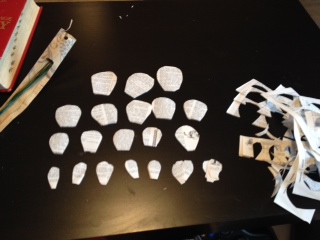
2. Cut Out Petals

Paper Flowers - Cut Petals

You’ll want petals in about 4 sizes: itty bitty; sort of roundish; large; and giant. They look sort of like Hobbit-hole doors or church windows. For the littlest ones, you’ll want the flat bottom bit to be at least 1/4 of an inch or you won’t have enough paper to work with. The big ones can be up to 3 or 4 inches, but you need them to be less wide at the base; anything more than an inch, inch and a half or so gets really unwieldy.

I don’t use a template, and I don’t really think you should either. Some oddity is useful for a project like this, and makes them look more like real flowers. Just get a range of sizes and you’ll be set.

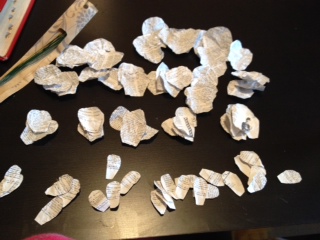
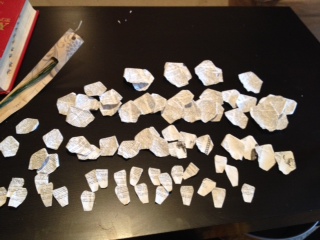
Paper Flowers - Petals with Curls

I find I work best conveyor-belt style, so I cut out all the petals first. You’re going to need more petals than you think you will, so just make a bunch. With thin dictionary paper, you can cut out 4 pages at a time; just stack them together and cut away. I prefer to cut from the bottom edge and work up, so all my words are left-to-right, but this really doesn’t matter in the end. It’s just easier for me.

3. Crumple

Paper Flowers- Crumple

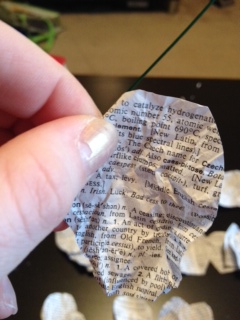
Now that you have painstakingly cut out all those petals, you need to crumple them up. Take a few in your hand at a time and wad them up into little balls. Then uncrumple them a bit. You want your paper to be wrinkly; it makes the flowers look a little more realistic (trust me, it really does). I find it useful to sort of push the petal into my palm with the thumb of my opposite hand because this gives them a bit of a natural curve, but as long as you crumple them up, it doesn’t matter much. Crumple, then smooth out again.

4. Roll Edges

Paper Flowers - Roll Edges

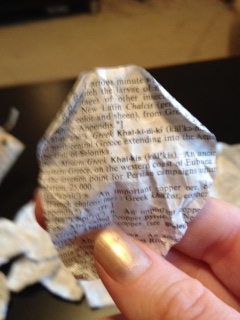
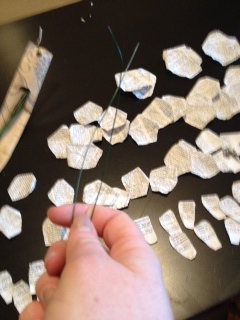
Now that you have crumpled them, you’re going to gently roll the edges back. Just the top, and for the smaller ones you may just make one roll; use your judgement. To roll the edges, I just fold the desired edge over a piece of floral wire and roll it between my fingers a bit until it takes the curl. This becomes the BACK side of the petal, the side that will face out.

Paper Flowers - Lots of Petals

Do this on all your petals. See how they lay differently now? They’re a tad more dynamic.

5. Prepare Your Floral Wire

Paper Flowers - Floral WireOk, so your petals are complete: now it’s time to get your floral wire ready. If you’ve got the long kind like you see here, bend it in half, then cut with your scissors (it make take a bit of work, but it’s doable). Bonus points if you have wire cutters.

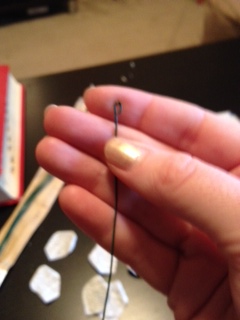
Paper Flowers - Bend WireThis is an important step, one that I didn’t find in other tutorials! If you may be moving your flowers around at all (or, um, if you have cats like mine who will immediately pull any flowers out of a vase), you need to now put a little loop in the top of your wire. Just bend the pointy bit down on your newly shortened piece and fold it into itself. It doesn’t have to be very big at all; you’re just making a place for the petals to “grip” so that when you drop your flowers (or your cat knocks them all off the counter), you don’t also lose your bud off its stem.

6. Glue On Petals

Paper Flowers - Wrap PetalsTime to glue on your petals! Start with a dot of glue on one of your small petals. You’re going to place your wire loop right in that glue dot and then fold the petal over it, left to right. Basically just pinch it. Count to three. Your Tacky Glue should then be dry enough for you to keep going.Paper Flowers - Add More PetalsIn order for your rose to look like a real flower, you need to alternate your petal “start points.” Basically, don’t stack them all up behind each other. At this point, the project is less science than art; just do what feels right (bonus points if “what feels right” is a Fibonacci sequence, like in nature. I…am not that good).

Work small to big, using just a bit of glue on each petal. When you get to the bigger petals, your dot of glue will be some a thin line–just run your glue along the bottom, then pinch it around. Keep going until you feel like your flower is flower-like. Like this:

Paper Flowers - A Rose By Any Other Name7. Tape It Up

Next, you’ll need your floral tape. Cut yourself a piece about an inch and a half long.

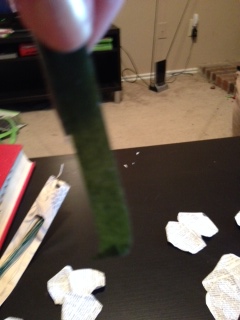
Paper Flowers - Floral TapeThe tape should be slightly tacky but not actually sticky at this point, and it should be pretty easy to roll off. Cut it with scissors; tearing it is hard (on purpose).

Paper Flowers - Tape the StemYou’re going to pinch your floral tape at the base of your rose. You’ll then slightly pull on your floral tape, causing it to stretch and become sticky. Wrap it around and slightly up onto the paper. This, for our horticulturalists in the crowd, will be how you make your sepal calyxes (everyone else: this is the thick green bit at the bottom of your flowers.)

Paper Flowers - Completed StemIt should look kinda like that. It will be thicker at the top, and naturally thin out toward the green floral wire.

8. Ta-Da! You’re Done!

Paper Flowers - Completed BunchStick ’em in a vase and enjoy them! You may find the stems don’t “sit” well in the vase; the paper can be a bit too heavy. I just twist several wires together and that holds them in pretty well. If you’re using them for display, you could now put in some pretty stones or otherwise camouflage the floral wire, but mine are only temporarily in a vase, so this is perfect for me!

Good luck on your paper flowers! Let me know what you use them for.

5 Comments

Filed under Crafts

Review: The Assassin’s Apprentice

Assassin's Apprentice (Farseer Trilogy, #1)Assassin’s Apprentice by Robin Hobb

My rating: 3 of 5 stars

I read most of Robin Hobb’s Liveship Traders/Rain Wilds series (and was eager to finish it, but it wasn’t completely written at that point!) years ago, and when I was leaving on a trip I thought I’d pick up another series of hers and take a little “fantasy vacation,” too.
I’m glad I was reading this one on a plane; otherwise, I might not have finished it.
In fact, I am not sure if I’ve read this one before or not, which maybe isn’t the best sign.
It’s not a bad story at all; it’s full of court intrigue and a light dusting of magic. Characters are relatable, I enjoy the castle keep setting, and I was pulled along to reach the end.
However, compared to the Liveship Traders series, (or at least my memories of it) this book was pretty dull.
I kept having the thought that, in the hands of another writer, this same story would have been more enlivened. As it was, it was like the narrator couldn’t decide if he was being unreliable or not. At first this is forgivable: it starts with our hero–a bastard son of the king without a formal name (awkward!)–as a young child. He has a child’s perspective and it makes sense that he wouldn’t necessarily recall some things.
But as the kid grows up and becomes the titular assassin’s apprentice, I just kept finding myself wanting more. More details about training to be an assassin, about how to kill, about his childhood training and his relationship with the others at the keep. Instead, things are mentioned frequently in passing, and more time is devoted toward side stories that frankly I never got particularly invested in. The end result is that I liked the book but feel like there was a lot of dithering and wasted time. It felt more like a book I was reading just because I was trapped on a plane than something I was really drawn to keep going with. The moments that seemed like potential for incredible action descriptions I found myself daydreaming about–how would I have written that? What could have happened on that misadventure? What greater depth could that scene show?
I read this on an ereader, so I don’t know page numbers, but I do know that the really exciting and interesting stuff–I’ll have to leave it out in case you decide to read it anyway–didn’t show up until I was 90% through with the book.
Then the action was over before I could blind and it turned out the last 5% of the book was filler, so that wasn’t a lot of room for a denouement, either.
Part of me is still curious about the rest of the trilogy, and though I mostly had figured out the twists in this one before they happened, it was still an interesting courtly intrigue type plot, so I’m curious as to what might happen next. But I wouldn’t rank it as engaging fantasy and I don’t feel pressed to immediately pick up the next book. Maybe it can wait until I need to wait in an airport again.

View all my reviews

Leave a comment

Filed under Reading, Reviews

If You “Don’t Read,” I’m Judging You

A recent study by the Pew Research Center found that 23% of Americans did not read a single book in the last year.
And I am judging every one of them.
(Okay, actually, not all of them. America has a surprisingly low literacy rate for a developed nation, and it’s absolutely tragic how people in an industrialized country like ours could have been deprived of this vital skill, which basically dooms them to minimum wage jobs. NPR had a brilliant report on it. I tried to volunteer for an adult-reading program, but apparently this kind of work wasn’t compatible with my 9-5 job.Those people? I do not judge those people. I am sorry we failed them as a community.)
If you are a competent, reasonably educated person–as most folks in America are–then I 100% judge you and think you are less competent if you aren’t opening a book, turning on a Kindle, or otherwise taking time to read something other than your work emails.
The Atlantic article shows that the 23% non-book-reading rate has actually held from the last time the poll was completed, so in 2012 AND in 2014, about a quarter of the population hadn’t read a single book in a year.
The reddit conversation about this report raised good questions: What counts as a book? Are we just talking adult fiction? Would the training manual for work qualify? How about “Hop on Pop” that I read to my kid?
I don’t know the answers to that, but my answers would be: maybe yes, if you actually read it and didn’t skim; and probably no, but chapter books should totally count.
Another set of comments suggested that it didn’t matter because people were reading more than ever, just not books–reading news online, reading personal correspondence, reading magazines. They contend that therefore, it doesn’t matter that people aren’t reading books. I disagree. We’ll get to that in a minute.
The study also reports that only a quarter of people said they had read more than 11 books in a year–not a high sum, and that means that most people (about 50%) have read between 1 and 10 books in a year, far less than one a month.
Last year, I used Goodreads to track my reading, and surprised myself to find that I read more than 30 books last year. I didn’t even find it to be that hard; after all, I’m a fairly busy person. I guess the only thing I do differently from others is that I don’t watch TV…but even then, I watch a show or movie on Netflix several times a week, so I still have an affinity for the boob tube.
(The Atlantic story dug in a little deeper to suggest that because more people are graduating college, more people will likely be readers later on. Maybe. I certainly hope so.)
But–all those non-readers: I’m judging you. I am judging you for your shallow appreciation for fine literature, for an experience that literally takes you out of yourself and teaches you to empathize for others; to allow you to be anyone you could imagine (or can’t imagine!); to teach you new words and concepts that are beyond your ken. Reading unlocks worlds, both within you and outside of you, and I think you are a pathetic person if you can’t be bothered to even read ONE BOOK in a year.
I don’t even care what it is–Young Adult books have seen a surge recently, and it ain’t just kids reading those. Some YA books are my favorites! It’s a great way to escape adult pressures.
Why don’t magazines and online reading count? Basically, they are too short and don’t provide that escapism or empathy portion that you get from complex storylines in a novel or nonfiction work. There isn’t sufficient complexity. I mean, the average newspaper (and magazine) is written at the 8th grade level. That’s not a very high bar. You can do better! Stretch your mind! It will make you more interesting. I am full of random tidbits and knowledge picked up in a book somewhere along the lines!
And the time thing isn’t really an excuse; you’re just not trying. I read before bed. I also bring a book to lunch with me, in case my coworkers are busy. Reading while eating is far better than just eating alone because you got ditched for a meeting!
One of my favorite college professors recently declared on Facebook that she read 177 books a in the last year! That’s incredible! I mean, I felt accomplished with 30! I told her that Stephen King claims to read 70 books a year, so clearly she needs to start writing.
Reading is good for the soul and the mind. Go pick up a book, you lazy louts.

4 Comments

Filed under Reading, Science

Review: The Shipping News

The Shipping NewsThe Shipping News by Annie Proulx
My rating: 1 of 5 stars

This book is proof that personal taste will vary–dramatically. I have not labored so long on a book I so utterly disliked in years. I have to be missing something, though, because it won a Pulitzer Prize and it’s one of my fiance’s favorites (the latter is the only reason I kept reading at all).

But I just don’t get it.

First, the book offended my editor’s sensibilities. Proulx clearly is well-versed in how to write, and yet she insists on crafting whole paragraphs of sentences without subjects, for example. Were I her editor, I would have thrown my hands up in frustration (as her reader, I still did!) Sentences could not be read on their own but had to be read as part of the whole. It took me several chapters to realize the sentences were more about rhythm than paragraphs–the sentences flow like waves. In. Out. In. Out. Constant little swells to remind you this is a story tied to the ocean. Then at least I understood, even if I didn’t like it.

While reading, it also struck me that, by all the standards agents claimed were essential, The Shipping News should never have been published. The story starts with the very beginning of the character’s life, completely without offering any enticing action, without even a likeable character. The story is vague at best and it’s hard to see the point. There is plenty of symbolism for your 9th grade English teacher to dissect though, so it’s got that, I guess?

And yet it was, so let that be hope to all you aspiring authors out there–you may not only prove them wrong, you may win a Pulitzer for it!

Like I said, I just did not get this book. It is the story of Quoyle, a guy who is a newspaperman because he’s terrible at all other jobs and is mediocre at this one. He is enormously fat and basically just a giant sad and possibly retarded sack. He has two kids who are ill-tempered and is married to Petal, the first woman who would look at him. Petal is a horrible person in every way and openly cheats on Quoyle. She even tries to sell off the kids as sex slaves! The first several chapters make sure you are fully aware of how pathetic a person Quoyle is in every way.

The inciting incident is the completely deus ex machina death of Petal, death of Quoyle’s parents, and firing from his job. Completely untethered, he and his overbearing closeted lesbian uptight aunt take the kids to their ancestral home in Newfoundland.

The biography for Ms. Proulx says she lives at least some of the time in Newfoundland. With that information, you’d think perhaps she likes it there. That’s impossible to tell from this book, which has both made me think about Newfoundland for the first time ever and then promptly made me think I never ever ever want to go there.

According to The Shipping News, Newfoundland:

-is bitterly cold
-is overrun with sexual deviants and child molesters
-is completely boring and devoid of anything to do
-offerings nothing but disgusting-sounding "cuisine"
-is dirt-poor
-is going to find a way to drown you
-hates the rest of British Columbia
-has absolutely nothing to offer

Sounds like a nice place, amiright?

Anyway, so Quoyle moves there, and the rest of the book is him very slowly discovering that the rest of his ancestors are horrible people, falling in love with another sad sack, and gaining some kind of professional capability not because he has a talent for it but because he is another warm body.

I never could answer the “Why should the reader care?” question that is supposed to be so significant in a successful book, so I don’t know why you should read this. Maybe to figure out what the heck I was missing that was supposed to make it enjoyable or at least worth contemplating? The message, as far as I can tell, is that sometimes you are dealt a raw hand and with time and a good bit of magical plot devices, you can work your way all the way to a moderately decent but actually not all that wonderful life. So just settle for the lives you’ve got, you sorry excuses for human beings.

Not my cup of tea, like I said. Can’t account for taste, I guess.

I’m just glad to be done with it.

View all my reviews

Leave a comment

Filed under Reviews

How Quickly Do You Read? Take the Test!

Fun little test here to see how quickly you read (and there’s a vital comprehension part to ensure you aren’t skimming and cheating).

Mine was pretty quick, in the 575 words per minute range, which was faster than I’d expected! Supposedly at that rate I could read all of War & Peace in just over 17 hours–hard to believe, really. (But could I read Harry Potter and the Sorcerer’s Stone in two and a half? Bet your bottom dollar. In fact, I might’ve…)

Plus it tells you how many books you could read on an ereader without recharging. Clever.

Fun and quick. How do you rank?

ereader test

8 Comments

Filed under Reading

A Stegosaurus Blasted My Gender Stereotypes

stegasaurus, stomping gender normsI consider myself to be pretty thoughtful regarding gender issues. I was the kid in kindergarten who, when asked to draw a doctor, scribbled a woman in a lab coat, not a man (earth-shattering at the time, let me tell you (I’m sure this had nothing to do with the fact that my doctor was a woman and we watched  Dr. Quinn: Medicine Woman as a family. Nothing.)) I care about feminist issues and try to be considerate of the issues faced by LBGTQ individuals. I made a female lead character for my science fiction dystopia and wrote a genderless novel for my gamebook.
I think about this stuff a lot.
And yet, I still have so much to learn sometimes. Unconscious biases can be a bitch.
Neil Gaiman was my teacher, as he has been so many times previously. And he did it with a children’s book.
You’ve read Fortunately, The Milk by now, right? I mean, I gave it a breathlessly positive review, so you definitely went out and bought it already, right?
Well, if not, you may not want to read the rest of this post, because of spoilers.
Anyway, I read Fortunately, The Milk. (And it’s marvelous. Practically perfect in the most Mary Poppins way.) One of the main characters is a time-traveling stegasaurus named Dr. Steg. (I mean, of course).
I’m as enchanted by the story and the misadventures as the children in the story, and then… everything came to a screeching halt.
90% of the way through the book, you are informed that Dr. Steg is a “madam.”
LADY DINOSAUR ALERT
To be fair, this comes as a surprise to the narrator/father as well, but this really hit me like a ton of bricks. Why did it throw me off so much? Why did I automatically assume Dr. Steg was a Mr. Dr. Steg?
I’ve given this some thought, and I think there are several reasons:
  • The drawings include no eyelashes or gaudy bows, cultural codes for “lady cartoon.”
  • The drawing depicts a rather heavyset dinosaur. Often, absent other markers, heavyset cartoons are male.
  • Dinosaurs are “boy things.”
  • Despite my kindergarten drawings, doctors, particularly “sciencey” doctors, are male.
  • Time-travelers are male.
— And they all still amount to “you still probably shouldn’t have made that assumption.”
And that’s what triggered me to write this post. Question your assumptions. It doesn’t have to be “that way,” even — especially! — if that is how it has always been done. (I mean, I’d like to see someone write some elves that are not musical, arrow-wielding, thin blond people. (Yes, I’ve just seen The Hobbit…)).
What assumptions did you have squashed by a fiction book?

2 Comments

Filed under Feminism, writing