
I just discovered this video, created in 2009. It features everybody’s esteemed captain* and knight, Sir Patrick Stewart, talking about his childhood, and the effect of his father’s violence against his mother on Patrick and his brother. It is mesmerizing. Please, take a moment to watch.
*We can argue best Trek captain later. But you’ve got to admit he’s not a bad one to follow into the great unknowns of space.
Patrick Stewart on Violence Against Women
March 5, 2013 · 10:00 am
A World Without Gender

Try writing your MC as if you don’t know the gender. Just like Tilda Swinton here demonstrates, it doesn’t always matter–your MC can be incredible either way.
Gender is a pretty fundamental part of a character description. Even the name you pick generally gives you a hint of who this person you’re reading about is going to be. Failing that, you can fall back on the physical description; dresses tend to indicate women (sorry Scotland!), while a manly man might wear weathered boots and heft an axe. And if even that is pretty vague, at least you’ve got pronouns to rely on when the author gets tired of calling the character by name.
But in interactive fiction and gamebooks, you, as the author can’t utilize those standbys. After all, your reader could be male, female, old, young, or, heck, even an alien. And since they are taking on your story from the driver’s seat, so to speak, the author can’t be telling them too much about who they are. After all, you can’t address the reader using “he” or “him” without thereby cutting out or annoying half of your prospective audience.
My novel, Undead Rising, is a gamebook for adults. The challenge of gender was one of the most interesting parts of writing it, because it stripped me of so many descriptive options. It was a helluva fun book to write, and I think all writers should give writing without gender a shot. It’s illuminating.
Of course, Undead Rising isn’t completely without gender; all the characters besides the reader’s perspective have gendered names, physical descriptions, and pronouns. But writing dialogue gets extra tricky when your No. 2 character can’t ever say “She did it!” in reference to your MC. And figuring out how to deal with pockets was surprisingly hard; luckily, it’s fairly common for women to also wear trousers, or my MC would never have carried anything around.
I resolved many of the direct references between characters and my MC with filler phrases like “dude”: “Dude, what have you been up to in here?” or “Wow, dude, you are such a great friend.” (I realize “dude” is technically gendered, but, at least among my friends, it’s used for either gender, not just men). The name problem wasn’t too hard, as the novel was written in second-person perspective. Anytime another character is introduced to the MC, I plugged in something like “You say your name.”
I even managed to write in a romantic interlude without any reference to the gender of the main character. That was a sticky wicket!
Gender is typically important to a character, but my experiment in writing a genderless character was very powerful. It really showed me how many things are universal. While writing, I imagined the character as male or female, sometimes one, sometimes the other. I hope that no matter who reads Undead Rising, they feel they are fairly represented.
How important are gender roles and gendered descriptions in your writing? Could you write a whole character without a gender?
(To see a real pro try it, read The Left Hand of Darkness, which is partially about an alien species whose gender shifts based on several factors, but most of the time is genderless.)
Filed under writing
A Calendar of Twittery Tales
Fantastic author Neil Gaiman launched A Calendar of Tales, a short fiction project, this month. It combined prompts from his massive Twitter following, and now he’s soliciting art to illustrate the final calendar, a story for each month.
It’s a pretty impressive challenge, so I thought I’d grab on to his long, black, mysterious (very well-fashioned) coattails and have a crack at some short fiction, too. It’s good practice.
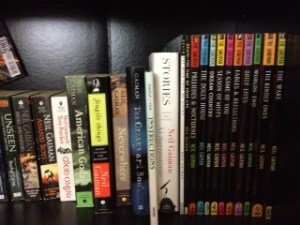
I’m only a *little bit* of a fan, as you can see.
To really emulate one of my absolute favorite authors, I’ll try to follow his rules:
- Write a story off the Twitter prompts.
- Don’t poach Neil’s ideas. I read his stories once, but I’m not going to peek again until after I’ve finished. They’ll use similar themes, I imagine, as I’m starting from the same prompts, but we’ll go different places.
- Between 500 and 1,100 words (I did a word count on each of his stories to find this range).
- Spend no more than 3 hours on each story. (This is gonna be tough! I got this figure by assuming he spent 12 hours per day writing for each of the three days it took him to complete this challenge. If I was able to write full-time, I might try the three-day sprint, but this is going to have to do.)
Thanks for the inspiration, Neil!
-ME
My first three stories are up!
January (Dangerous Veteran)
February (Grandma’s Pendant)
March (Anne Bonny Dreams)
Filed under writing
Infinite and Beyond
I’ve been looking forward to a video game for about two years now. It’s finally (nearly!) here, and all signs are pointing to “probably gonna be awesome.”
Bioshock Infinite is the newest title in the Bioshock line. Though it’s not part of the original Bioshock timeline, it similarly explores a dystopic society held in remove from the rest of the world, explored by the player, someone from the “regular” world. The experiences are as new to the character as the player.
For non-gamers, a quick summary: Bioshock (the original) was one of the best games I have ever played. It had an interesting concept, cool weapons and powers, and, most of all, a completely immersive storyline. It was everything I wanted in not just a video game, but also a story. It was revolutionary.
In the original Bioshock, the player wandered around the ruins of an underwater city called Rapture. It was a look at what might happen if pure capitalism were allowed to run its course—long story short, it ain’t pretty.
I played that first game so much that I still associate the title screen for the production company (2K) with clutching my controller in the dark, fearful and exhilarated.
Bioshock 2 was an okay game, analyzing some socialistic dystopic ideas in the same underwater city, but it couldn’t touch the sheer power of that first story.
Fans are hoping this newest game will be a return to that original breath-snatching incredulity.
And the cinematic trailer released this month is confirming a lot of those ideas.
Hopefully even non-gamers can feel the intrigue of that trailer. That trailer doesn’t even have any game footage in it (typically a requirement to get any traction with fans) and I’m really looking forward to it. I read a lot of dystopias and I’m interested in a lot of these ideas, but the Bioshock was something different. Video games have an advantage over other media in that the reader/user can literally interact with the environment, allowing a strong story to unfold at the reader’s pace. A good game can do that with optional voiceovers (in Bioshock, you can find audio journals of lost citizens, and choose to play them or discard them), but Bioshock also went above and beyond with their perfectly on-point background music, in-game advertising jingles, and stylized art.
Yes, it was a first-person shooter, so there was a lot of gory fighting, but that wasn’t what made the game outstanding—after all, Bioshock 2 had the exact same fighting, slightly improved, and it wasn’t nearly as fun to play.
No, it’s all about the story.
I love video games, but they’re a secondary medium for me. I hope to get that same overwhelmingly scared-in-the-dark-what-might-happen-next feeling with every book I read, too. And hopefully, along the way, with every book or story I write.
-ME
Filed under video games
Review: The Power of Myth
 The Power of Myth by Joseph Campbell
My rating: 3 of 5 stars
I came to this book via the serendipity of the bookstore and a nudge from a great TED talk. (Go watch it, I’ll wait… really marvelous, isn’t it?)
I mean, I love mythology, I love stories, I’m interested in learning more about the hero’s journey–what’s not to like?
Let me tell you, I really wavered on those stars up there. It was thisclose to earning a 2. In fact, I almost gave up on this book a third of the way in.
First, the problems:
In my opinion, Bill Moyer, esteemed journalist that he is, completely failed in his duty in this book. I understand that it’s a transcript of a conversation, and perhaps it would have worked better in a visual medium, but Moyer is so transfixed by his subject (Joseph Campbell) that he loses the ability to control the flow of thought and respond critically to anything Campbell says. He says as much in the introduction; he is enamored of this interview.
Maybe, on TV, it isn’t as clear how frequently conversation derails, but in print, in a straight transcription, it’s a trainwreck. Had Moyer taken the time to construct a real book–with transcriptions, and sources, and clear structure–this book would have been dramatically easier to follow. As it is, the reader is just expected to hang on and sort of passively observe the literature, to sort of be transformed by its aura.
And that’s my next criticism: if you didn’t know (because Moyer says so) that Campbell is a leading scholar, you’d think he was a crackpot. He relies heavily on a swill of mixed metaphors and images pulled from whatever story happens to be handy for his current theme.
Seriously, you get things like this:
“If you undergo a spiritual transformation and have not had preparation for it, you do not know how to evaluate what has happened to you, and you get the terrible experiences of a bad trip, as they used to call it with LSD.”
If you didn’t know a professor said that, wouldn’t you think you were talking to an inebriated hippy? And that was actually a milder example; others were too long to transcribe.
Other problems with the text are products of the time it was written and Campbell’s (and Moyer, since he can’t help but butt in all the time) experiences as a child. Campbell especially has a sort of obsession with the “noble savage,” idealizing Native Americans to such a degree you lose a sense that they were a real people. He seems to apply the same idealization to “Orientals” and non-Western religion.
Paradoxically, much of the book revolves around Christian theology and ideals–in fact, it would probably be hard to understand this book without being able to reference the Bible and Christian tradition.
In a sort of one-two combination of these and a 1950s upbringing, you also get a lot of negative depictions of women and their role in society. Campbell’s pretty clear that a woman’s place is in creating children, and that requires a necessary sacrifice of any other priority in her life. He doesn’t even seem aware how these references, again and again, deprioritize women’s personal drives–heck, any sense of women as people with any desires outside of getting hitched and producing heirs for her husband–because he’s so busy deifying the process. It’s hard to argue that you aren’t meant to raise children when you’re being compared to the Virgin Mary at every turn.
Mix all that in with a giant dollop of “Back in MY day,” and you’ve got The Power of Myth.
Positives
And yet, despite all those problems, I kept reading. Weirdly, this is a book that does well if you don’t think about it too much as you’re reading, but let it marinate in the back of your head. It’s good as a general philosophy (though thank goodness no one ever thought to make a religion out of Campbell’s beliefs!) and has some good overall messages.
For example, his message for everyone, no matter who they are is “Follow your bliss.” Now that’s a nice big ebullient idea, but it’s a lovely sentiment and can be a good motivation.
Because of the philosophizing nature of this book, it’s also rife with juicy inspirational quotes of all kinds. This is the one that stood out to me:
“”Do you think I can be a writer?”
“Oh,” I would say, “I don’t know. Can you endure ten years of disappointment with nobody responding to you, or are you thinking that you are going to write a best seller at the first crack? If you have the guts to stay with the thing you really want, no matter what happens, well, go ahead.””
I’m sure anyone, regardless of their personal bliss, could find a similarly provocative quote in this book.
I wouldn’t recommend this book to most people. It’s twisty, poorly constructed, and full of sort of New-Age-y mumbo-jumbo. But I wouldn’t talk you out of reading it, either; it might provide just the right magic words for you. And besides, the message that we are all heroes traveling our own mythic journeys is pretty nice.
Filed under Reviews


 M.E. Kinkade