Best Social Media Advice Ever

This post by the Bloggess is the best and truest advice about social media I have ever seen.

It was on the internet, so it must be true.

As a new-ish blogger, it’s easy to find tons of “advice” about how to be rich and famous and awesome. It’s freakin’ everywhere. I have to keep up with a high-level internet marketing blog that shall not be named for my 9-to-5, and it’s full of those shitty articles, except they aren’t kidding. And every time I look one over, I see gads of banal comments about how “OMG THIS is the best advice ever!”

Spare me.

At the day job, I can’t say anything for fear of pointing out the emperor is naked, but I have always held the belief that the incredible vast majority of internet stardom is generated by pure dumb luck. The internet is mostly about showing up and getting lucky. (Unrelated, but the internet is also the reason every time I hear that Daft Punk song I think it’s saying “Get Loki.” Which is fun).

Don’t trust anyone who says they know the answer; they’re lying.

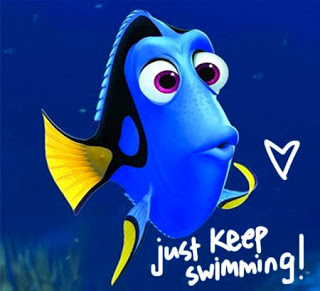
The best advice I have is better spoken by a Blue Tang…

Leave a comment

Filed under Publishing

It’s Dictionary-Official, Guys.

Thank goodness there is something to talk about besides “twerking.”

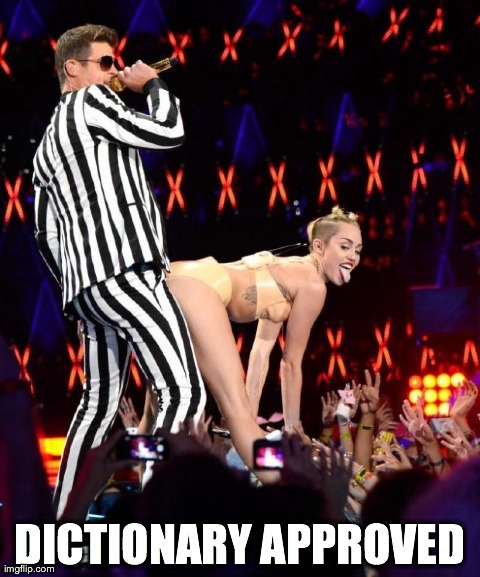
Oh wait, no, there’s not, because even the good ole’ dictionary is in on the butt-oscillation trend. It was announced yesterday that a bunch of internet-originated terms, including “twerk” of course, have been included in the Oxford Dictionary Online.

Twerk it.

Cue massive moaning and gnashing of teeth and cries about how the world is probably coming to an end, or worse, English is so over.

There’s a whole crop of “new” words that have been officially recognized by an official-sounding dictionary linked to an actually official dictionary; you can read the whole list here.

(But you probably won’t; it’s TL:DR. Oh well).

And, as always happens when dictionaries do this, people freaked out, because there’s a fundamental misunderstanding about the point of dictionaries and the validity of language.

Here’s the truth: Putting a word in a dictionary does not make it “official.” It does not make a word acceptable to use in all cases, and it doesn’t mean it’s more or less legitimate than other words people use. It just means it is a word that has reached an arbitrary threshold of use in pop culture and someone thought maybe you’d benefit from having a definition to help you in the event that you run into it in the wild and don’t know what someone is saying.

That’s it! That’s all it means!

As for appropriateness, you should use whatever words you need to in order to tell your story. If that means inventive, morphine-induced Jabberwockys–power forward, friend! If that means a carefully culled vocabulary from your Scrabble dictionary? Blessings be upon you. One of my favorite books of all time progressively eliminates letters, making it amazing and a challenge I can’t wrap my head around. And that’s great!

As an editor and a reader, I might flag something that I don’t think fits or makes sense, but I’ll never tell anyone they can’t use a word if they want to, dictionary-approved or not. Go ahead! Have a ball!

Actually, I think the Oxford Dictionary Online deserves props for lighting the internet (temporarily) on fire. I mean, how often do you get people to talk about a dictionary, anyway?

4 Comments

Filed under Editing, writing

Waiting Game

It feels like all I’m doing. Waiting. Waiting to hear back on the status of my works. On if it even “works.” Waiting for November, for the full-tilt NaNoWriMo madness I love and dread every year.

Last October, I entered my first book, Alt.World, a science-fiction dystopia, into the insane HarperVoyager open submissions cattle call. I figured, “why not?” I had it edited, had sent it around for queries and got lots of rejections, gotten disheartened and set it aside. But I still love it (do you ever not love your works, even if they don’t take off?) so I figured it was worth a shot at one of the 12 digital titles Harper Voyager crazily said they’d take from open calls.

Except they got way more of a response than they expected–more than 4,500 entries in two weeks. So that kind of blew their whole timeline, and they said it would take longer. So I put on my patience hat and worked more on Undead Rising, my second novel, a zombie-survival gamebook.

In May, they said they’d read through and rejected 3,595 of those submissions, leaving 948 in their “further review” pile. I hadn’t heard anything–I’m in the further review pile.  So that was exciting, and I was content to keep waiting. After all, they promised to check in more frequently.

It’s the end of August, and no further updates. I’m checking my junk email folders twice a day out of pure paranoia. The internet rumors say maybe they’re down to fewer than 400, but no one seems to know for sure and I won’t take it as gospel until they say so. Here’s hoping they haven’t forgotten/overlooked mine somehow.


Patience. Patience.

And then there’s the manuscript for Undead Rising, which two agents seemed excited about at DFW Writers’ Convention in May, resulting in two glorious requests for fulls. It’s hard not to pester them (okay, I pester a little. Just a “hey, how’s it going?” email once every month. Just one sentence, I swear. Teensy pester…).

It’s hard to wait.

My writing brain can’t live in the same space as my business brain, it seems; I have to switch one off to work on the other. And lately, with all this waiting, my business brain has been fussing at me a lot.

Any suggestions for winning at the Waiting Game, folks? I felt like I was doing well at patience, but it’s starting to wear on me by now. Let me know your advice in the comments.

4 Comments

Filed under Publishing, writing

You’re Equal to Me in Every Way…For A Lady

The full cast o’characters.

In fighting the late-summer heat, I recently picked up a new-t0-me video game: Dragon Age: Origins. It’s pretty cool; you are on a hero’s journey to become a Grey Warden and travel from town to town fighting monsters and trying to save the kingdom. There’s a lot of customization, and the choices you make throughout will affect the outcome of the game.

And you have to make a lot of choices. (It’s almost the Starbucks of video games: and would you like whip with that? (I’m easily overwhelmed by Starbucks….can you tell?))

The very very first choice, though, is building your character: Will you play as a male or a female?

In some ways, the fact that it’s even an option to play as female is a great thing; in some games, forget it. You’re just a white-ish athletic dude no matter what. So I always enjoy games that give you more versatility in that way.

The prompt as you choose your playable gender says Fereldon, the world, is a pretty equal place, with opportunities for both men and women in the three playable careers–warrior, mage, and rogue. That’s important, because I like to know when I’m cutting myself off from parts of the game with my choices.

So I built my female human mage with red hair and dark eyes and went happily on my way.

Except I was constantly reminded by other characters (non-playable characters, or NPCs, for you non-gamers out there) that woah, hey! You’re a lady!

In some cases, it made sense and fit with the story: when Morrigan the wild witch met me, she was more friendly because she carries a general dislike for men, having grown up in isolation.

But most of the time, it doesn’t. It’s more like “wow, you’re a fighter and a lady? Whodathunkit?!” In a world that is supposedly equal. And where I periodically see other female warrior/mage/rogues running around.

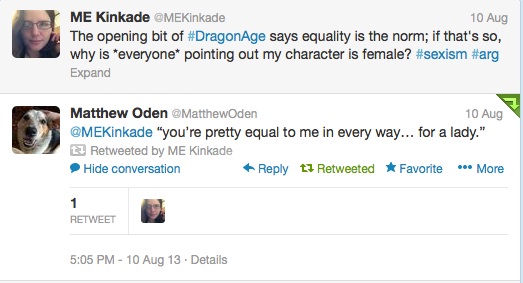
It just got tiresome. So this happened:

dragonage Twitter

Think about this in your writing. If your character is something different, that’s fantastic! We need more minority characters–not just female, but also non-white nationalities. And that should affect the story where appropriate–as in the case with Morrigan in Dragon Age.

But when all the “NPCs” in your book take time to comment on the difference, you aren’t showing that there’s equality. You may be telling the reader that there is, but what you’re showing is exceptionalism. And it’s pretty tiresome, both in our stories and just to read. (See: Repetition)

(There may be stories of exceptionalism where it is still relevant–“wow, she’s the only one who can do that!”–but I personally think the gender-based exceptions are played out. Do something different.)

Don’t tell me how equal I am: just let me get on with the monster-fighting and world-exploring. That’s how I KNOW I’m equal–because I can definitely kick some undead monster butt if you’ll just let me get on with it.


4 Comments

Filed under Feminism, video games, writing

Is There an Echo in Here? Editing Out Repetition

Inspiration can come from the damnedest places, and so today’s editing lesson comes from a rather old inspiration: the Bible. Specifically, the book of Daniel, chapter 3.

You’ve probably heard this one, the story of the three guys who refused to worship a golden idol and were thrown into a blazing furnace but didn’t die because God was down with their loyalty. (Veggie Tales has a pretty fun take on it if you want a refresher–Rack, Shack, and Benny).

But this is an editing lesson, not a Bible lesson. Bear with me here.

If you go read that first link, you’ll get a sense of what I’m talking about. Daniel Chapter 3 is really repetitive.

  • “the satraps, prefects, governors, advisers, treasurers, judges, magistrates and all the other provincial officials” –stated 3 times
  • “the sound of the horn, flute, zither, lyre, harp, pipe and all kinds of music” – stated 4 times
  • “Whoever does not fall down and worship will immediately be thrown into a blazing furnace.” -stated 4 times (one has a different tense, but close enough)
  • “Shadrach, Meshach and Abednego”–always listed together, just like that, is repeated 11 times.

To be clear, it’s not that long a chapter. Let’s just say the congregation got pretty restless during the reading. It was like “come ON already, get to the point!”

Shel Silverstein does repetition right. I love “Lazy Jane.”

Repetition has its place–it’s a fantastic way to provide emphasis, and you should certainly have repeating themes throughout your book. Stephen King in On Writing talks about how he specifically went back and added more mentions of blood and blood-related imagery to Carrie to help sneakily prepare the reader for the bloody mess at the end.

But often writers end up a bit more like the book of Daniel, just repeating things for the sake of it. I mean, I don’t think this chapter would have been changed at all had some of those “Shadrach, Meshach and Abednego”‘s been changed to “the three men” or, heaven forbid*, “they.”

A lot of the time, our repetitions are smaller: “crutch words.” Every writer has a certain proclivity to use the same word over and over and over and over. (Mine is “actually.” I shudder when I reread my manuscripts and find it everywhere. Bleah.) Another one I see a lot in my editing is “seemingly” or “seemed to.” (For the most part, if something “seems to be,” you can just cut it out entirely…if you’re locked into a character’s perspective, everything they perceive can just be reported.)

The problem with this kind of needless repetition is a) it bores your reader which b) makes them less likely to keep reading. It slows the pace down dramatically, which can kill your pivotal scene. Even if you don’t notice your crutch words, I guarantee the reader will.

Repetition, particularly of “crutch words” because they’re harder to notice when its fresh, is one of those things that justify an editor, or at least a second read after you’ve put it down for awhile. Your grammar and spelling can be perfect, but if you’ve got a bunch of repeated phrases, it’s going to throw the reader out of the flow. But take the time (and, often, money) to get it thoroughly edited, and you’ll cut down, if not outright cut out, a lot of the problematic repetition.


*This is a joke. Get it? Heaven forbid? Bible? I’m hilarious.

Leave a comment

Filed under Editing, writing

Review: The Curious Incident of the Dog in the Night-Time

The Curious Incident of the Dog in the Night-TimeThe Curious Incident of the Dog in the Night-Time by Mark Haddon

My rating: 4 of 5 stars

A lot of the time when we talk about writing, we say it’s because we “want to get into someone else’s head.”

But that’s not true, is it? A lot of the time, we want to be ourselves, but in someone else’s life. You want to stop being a truck driver who takes the same route to work every day, day after day, and be a prince fighting faeries instead; you want to not be a frazzled mother of three young kids and instead be a footloose woman who can pick up and find herself in countries totally different from your real world; you want to not be a lost teenager in a scary world with things out of your control, because you’d rather be a boy wizard who has amazing friends and literally saves the world.

The Curious Incident of the Dog in the Night-Time is a rare book that literally puts you inside someone else’s mind. And it’s incredibly disorienting at first, but all the more powerful for this transformation.

The Curious Incident of the Dog in the Night-Time is a story about a deeply autistic boy, Christopher, who discovers his neighbor’s dog is dead and decides to be a detective like the Sherlock Holmes stories he likes to read, and he writes down everything that happens in a book he began making as a class assignment.

Because he is autistic (and because author Mark Haddon is very good at what he does and has worked with special needs kids), Christopher’s writings are not like anything else. There’s very little emotion, not much introspection. There are math problems. Chapters are numbered with sequential prime numbers. There are very precise drawings of the patterns of the fabric of a new chair.

The presumably non-autistic reader is left to fill in a lot of the gaps in the story, because while Christopher is perhaps the most literal narrator in some senses (describing even the number of holes in someone’s shoe, and the exact color of the beans on the plate), his perceptual lapses means he truly can’t understand some things. But the reader can, making this book a lot more interactive between the character and the reader than most.

It’s hard to relate directly to Christopher, and that’s what makes this book so compelling. You see through his eyes and are frustrated that he misinterprets information that seems so obvious. The people all around him–even his pet rat sometimes!–are more like the reader than Christopher, and you feel their frustration with dealing with Christopher’s many needs, with his seeming dichotomy between a kid who is stunning at some things and completely empty in others.

It’s a lesson in empathy, if nothing else.

This book isn’t an easy read, and it’s not a happy read, either, and I’m mystified by the quotes on the cover exclaiming the “bleak humor” within, because I found nothing funny–just sad. Because as more children are diagnosed with autism and society finds ways to cope, much of what happens in the book is barely fiction for many parents and teachers and caregivers. I can’t imagine the pain it must cause those real parents who have to find strategies to manage real Christophers.

The Curious Incident of the Dog in the Night-Time is a fantastically written book, but be prepared for something a bit more weighty than your average fare.

View all my reviews

4 Comments

Filed under Reviews

A Journalism Major Who Doesn’t Subscribe

Newspapers have been in the news lately, not just writing it. The sale of The Washington Post to Jeff Bezos and the Boston Globe to John Henry made serious ripples–and well it should have. The reversion of newspapers to private hands is a big shift from the publicly traded past.

In the midst of all this hubbub, I have a confession: I majored in journalism in college and worked for three newspapers… but I’ve never had a newspaper subscription in my name. And I don’t plan to.

It feels a bit traitorous to admit that, but it’s true. Now don’t get me wrong: I loved, loved working for a newspaper. I don’t know if I’ll ever be so happy with my work as I was at a copydesk just before deadline. It’s exhilarating, intense, heady work. You know your tiniest mistake will be nitpicked by hundreds if not thousands of readers, but you also know you can maybe change minds. You can certainly inform, and entertain. It’s intoxicating, and there is nothing like it.

And if you ask me if its The End of Newspapers, I’ll tell you no, probably not, and I’ll really hope that’s true. I think the world, if not the United States, needs a thriving Fourth Estate. I think it’s very important, highly undervalued work. Those people work very very hard for very little pay–unless you’re a bigwig, you’re barely making ends meet. No, people get into journalism because they are hungry for it; it’s a passion. And it’s a passion that is increasingly derided and pooh-pooh’d, and that’s a damn shame.

I do think newspapers will stick around, but they’ll probably shed some if not all of the paper. And that’s as it should be, really, though the Guys On Top have been really loathe to admit that. And that’s part of the reason that most news organizations have been very slow to adapt to the electronic revolution.

My EIC was strikingly like J. Jonah Jameson, the EIC from Spiderman. My first week of work, he dumped me out of my chair for sitting cross-legged.

I saw it. That’s why I got out. I saw my bosses working 14-hour shifts, literally never getting to see their children because of their hours; I saw them storing up their sick leave for years so they could have a needed surgery without losing their salary during recovery, only to have management put in a new policy just before the schedule surgery, wiping out all unused sick leave–to “save money.”  The people on the ground are miles away (sometimes literally) from the people making the financial and organizational decisions.

I worked with THE website guy (yeah, there was only one), who had to maintain the website, learn all the coding, and try to contain the fires in the comments section (unsurprisingly, he often failed). There was no way he could get ahead of the curve for online; the bigwigs wouldn’t let him. They had only begrudgingly created a website, anyway, why would they actually bother to staff it? (Nevermind that the website was the only way our readers could find out what was going on in their homes after they had to evacuate for a hurricane; print still came first).

It was infuriating to me when–in our rather low-morale workplace–the editor-in-chief, a guy who reminded me of no one so much as J. Jonah Jamison from Spiderman, rounded up the staff and told us that although our paper was the highest-earning publication in the company, it wasn’t enough, so more corners were going to have to be cut. So they cut, cut, cut from the very heart of the publication, the parts that made people care, and learn, and desire, to keep the stakeholders–stock holders on Wall Street–happy, while our newsroom became ever more empty, ever more decrepit.

It would be poetic if I said I quit out of moral outrage for the industry, but that’s not true. I left because I was terribly alone, worked weird hours in a small town and couldn’t meet anybody friendly, and I couldn’t stand the idea of riding out another hurricane after I’d been without power for 2.5 weeks. It just didn’t seem worth working so incredibly hard for an industry that didn’t love me back.

So I said goodbye. I didn’t want to work at the newspaper in my hometown after it went through three waves of layoffs; I knew it wouldn’t matter how good I was the next time someone upstairs felt the margins weren’t profitable enough. What was the point of building a career when it could be taken from me at any moment? So I moved on.

And so far, that has also meant saying goodbye to subscribing; for one, I can’t afford it, a cruel irony for the newspaper publishers, who have lost advertising and so “must” raise subscription fees.

I wish Jeff Bezos and John Henry, and the staffs of the highly regarded Washington Post and Boston Globe, much luck, and good leads. I hope that private owners can maintain the respect for good journalism without giving into the merciless bottom line.

I’m sorry I can’t be with you on that journey.

3 Comments

Filed under Publishing, Uncategorized

Review: All There Is; Love Stories from StoryCorps

All There Is: Love Stories from StoryCorpsAll There Is: Love Stories from StoryCorps by Dave Isay

My rating: 5 of 5 stars

I am not a crier by nature. The Notebook didn’t make me cry; though I do always get a lip quiver when I watch Moulin Rouge, I don’t cry; and I don’t typically read a book or watch a movie with the intent that it’ll evoke some strong emotion.

So when I say that I have found the book I’ll keep handy in the event I’ll ever join a soap opera and need to sob on demand, know that means something.

All There Is: Love Stories from StoryCorps can make me cry in two pages. Not gentle tears, but complete face-twisting uninhibited emotion. And you should absolutely read it.

All There Is is a compilation of true stories collected by StoryCorps as part of their mission to collect stories of people’s lives. These will be given to the storyteller as a family keepsake and another copy goes to the Library of Congress, to pass on to future Americans. It’s a simple mission, but incredibly powerful. If you’ve never heard StoryCorps on the radio, go watch this animated version. It’s one of the stories in the book, but it’s a little different to see it. Go watch right now.

I don’t think this book is necessarily supposed to be sad. The first section is all about finding love, and the stories are all happy endings, and you can practically hear the giggles in the narrators’ voices as they describe their first dates with the people they spend their whole lives with. It’s charming and so authentic, though, it strikes a chord on your heartstrings like nothing else. It makes you believe in true love.

The second segment is about love lost, and that one packs a definite wallop. In fact, my fiance took the book away from me, because by the third story in, I was clutching him and crying uncontrollably. So, to be completely honest, I haven’t read the whole book–yet. I’m going to need to space it out, because this book is so moving it needs to be taken in small doses.

The final section is on love found again. If it’s anything like the first two, I’ll need the tissues handy.

This is no Chicken Soup for the Soul. No, All There Is is your favorite Chicken Soup story turned to 1000. It’s so raw and heartfelt and emotional, so matter-of-fact, so inherently inspirational and compelling, that I promise it will be like nothing else you’ve ever read.

Even if you’re not a crier and can’t bring yourself to read something that’s going to clear out your tear ducts, I recommend you buy this book, to support StoryCorps in their mission. Or donate to their cause.

It’s money well spent.

View all my reviews

Leave a comment

Filed under Reviews

Review: The Black Unicorn

The Black Unicorn (Magic Kingdom of Landover, #2)The Black Unicorn by Terry Brooks

My rating: 2 of 5 stars

Used book stores are amazing places, but they can lead to book-mania.
I blame the irrationality of book-mania for this book. It was in the clearance section (of Half Price Books! Even more cheap!), and I hadn’t read anything pure fantasy in awhile, and honestly it has a picture of a unicorn on the cover, so yeah, I bought it.
I realized about a third of the way through that I’d made a mistake, but I kept going–surely it will get better any time now.
It didn’t.
First, this is a sequel, but I’ve not read the first book in the series (oops), because I didn’t realize it was a No. 2 until after it was too late. So I didn’t know what was going on at first. Things eventually were kind of revealed, but…this plot needs work. Terry Brooks was clearly going for some kind of “know thyself” message, but it was really muddled. This was one of the rare books that I honestly thought would have been better if the main character had switched with the secondary character: that is, rather than mostly following lead character Ben Holiday, I kept wishing I could drag the perspective away and see what Willow, the tree-girl/sylph, was up to. Because while Ben spends the majority of the book totally lost and aimless, Willow has purpose. She may not know WHY she’s doing something, but she knows she should (oh the “my fairy magic told me so” excuse).
It was particularly upsetting when the BIG REVEAL made it up to Ben to suddenly know everything, when the reader knows Ben is completely clueless. It was like Spicoli from Fast Times at Ridgemont High suddenly became Sherlock Holmes. There was just NO WAY.
Also, it’s probably a bad idea to have one of your characters declare he’s not a deux ex machina. Odds are if he says he isn’t, the magical mysterious cat-like-fairy-creature doth protest too much.
Anyway, I’m relieved to be moving on from this one.

View all my reviews

2 Comments

Filed under Reviews

Where Are The Super-Moms?

Hollywood/Marvel/DC, I’ve got a beef with you guys.

See, I finally got around to seeing Man of Steel, a movie I’ve been looking forward to because Superman, duh. And it was a fun movie and a worthy inclusion in the Superman films.

And I noticed something.

Kal-El’s dad, Jor-El, is really important. He’s got big dreams for his son, and is willing to sacrifice himself to make those dreams happen. And Jor-El can’t be stopped from helping his son even in death, because he magically imported his unconscious into a memory stick (or something. I wasn’t really clear on the how of that part).

And Jonathan Kent, as ever, is hugely important. He’s full of practical, hard-knock advice for this son that fell from the heavens to be his boy. And he is willing to sacrifice himself to save the family dog and to protect Clark’s secret. It’s Jonathan’s death that could be said to motivate Clark/Superman/Kal-El to greatness and noble sense of duty.

Martha Kent is looking for any sign of a superhero movie mom who is really important, not just supportive. I think she’s going to be disappointed.

But CK’s two moms? Well, Lara-El (is that how you’d do her name?) quite nobly …pushed a button…to launch her son to Earth. And stood…nobly? …while politicians sentenced the bad guys to jail time. And then she…nobly?…died when her planet blew up.

Martha Kent is every bit as practical as her husband, but CK leaves her to go grow a beard and play on boats. And she’s very supportive, but doesn’t have a lot of advice. Her biggest moment is talking to Clark through a panic attack. And she does that from the other side of a door. She, um…knows the value of her family photo album? Has a natural mistrust for Lois Lane?

Lara’s subconscious couldn’t be imported into that memory stick? Did that not even occur to ol’ Jor-El, there? And what the hell, Martha, you didn’t even try to rescue your husband! You didn’t even seem all that upset when aliens blew up your barn! You didn’t even seem upset that your son wandered off without leaving an address for, apparently, years! I mean, running a farm alone must be hard work…couldn’t you use a strong back? Or company, at least?

In other words, Man of Steel has two moms that could potentially be really significant in Clark Kent’s life, and both, in the movie, are reduced to being complete background characters. I can’t think of a single action that either of them does that had any real effect on the movie.

And Supes has four parents, so he’s got double as many chances to have a meaningful and significant moment from his mother. Judging from the movie, though, all he gets from mom is clean laundry and cookies when he comes home after long trips.

Seriously? That’s sad. I mean, I got more from my mom than that. I learned all sorts of life lessons from my mom, and I’d guess most people have. So what is going on here?

The bad news? It’s not just Man of Steel. It’s not even just Superman.

Moms in Movies

Luckily, there have been a lot of really awesome superhero movies in the past decade. Surely we can find an awesome mom-character in one of them.

Okay, Spider-Man. Peter Parker doesn’t have a mom around, but he’s got Aunt May, arguably the nicest woman alive. But… it’s Uncle Ben who utters that incredible quote, “With great power comes great responsibility.” And it’s Uncle Ben’s death that spurs Peter to become Spider-Man. In the first movie, all Aunt May does is cook a mean Thanksgiving turkey and struggle to pay for her house. Oh, and get kidnapped.

She doesn’t even get a single genuinely important line.

She fares a little better in the next movie, Spider-Man 2, when she talks about why people need heroes, but …she doesn’t even know Peter is Spider-Man, so while this is a lovely moral statement, she doesn’t do much.

Batman: Everyone knows Batman’s parents die early on and it’s very sad and makes him want to fight crime his whole life. But do you even remember Batman’s mom in Batman Begins? I didn’t even remember her name, if that tells you anything. Martha Wayne has three lines in Batman Begins, and one of them is “Dear…”! Thomas Wayne is a doctor! He’s a philanthropist! He is a business man! He saves his son from a well and tells him not to be afraid of the bats, and that we fall to learn how to pick ourselves up!

Martha Wayne worries about nightmares and screams as she is shot by Joe Chill. *sigh*

Thor: I couldn’t even remember Freyja’s name. She doesn’t say anything, anyway.

Captain America: Sarah Rogers wasn’t in the movie. In comics, she died in Steve’s teens.

Fantastic Four: No parents.

Wolverine: No parents.

Iron Man: Maria Stark isn’t in the movie. Her husband, Howard, is very distant and yet still manages to be a major motivator for Tony.

X-Men: Okay, we’ve got a group film here, lots of potential. Magneto’s mom is ripped away from him during the Holocaust–I guess that makes her significant, but she’s not the instigator so I don’t think it counts. We don’t see Storm’s, Professor X’s, Wolverine’s, or Cyclops’ parents, so we can’t analyze them at all.

Rogue’s mom (Mystique) is in the movie, but considering she’s evil and abandoned Rogue at birth, I think we can leave her out.

Iceman’s got a mom, but neither of his parents do much other than send him away to school. No moms to speak of in X-Men.

Green Lantern: I had to look this one up, because, like the rest of America, I didn’t see this movie. But the internet tells me Janice Jordan has zero quotes in that movie, though there is at least an actress listed and she is named (unlike Rogue’s adopted parents, who don’t even get movie names).

That covers all the superhero films since 2000, and frankly, it’s getting depressing, so any further will have to wait. Besides, I think I’ve made my point.

What Do They Do?

The moms in these movies do share some characteristics, despite being overwhelmingly background characters. They don’t serve as the moral guidance that their husbands do, and they aren’t the ones who set the hero on his journey, but they do provide emotional “care packages” along the way–a reassuring word, a cookie, a hug after they’ve nearly been blown up by the bad guy.

These “care packages” have the potential to be important and significant, but for the most part, they are just the sort of throwaway comments that sound good but have very little impact.

These moms are universally patient and kind. And supportive, loving, and loyal to their (often dead) husbands. (Actually, that’s pretty sad, too–can no super-moms date after their husbands die?)

Those are indeed characteristics often assigned culturally–we expect “good moms” to kiss our boo-boos and ask us if we’ve found a nice boy/girl to date. But I find it odd that, in super-cinema at least, moms can’t be the moral tentpole–can’t even really have enough initiative to do something themselves at all, really.

Super Comics Moms

The thing is, Hollywood/Marvel/DC, you DO have great material to pull from if you want to make some legitimately super moms. You could start with Aunt May and Martha Kent, each who in TV shows and comics have managed to be incredibly significant to their sons.

I understand Diana Prince/Wonder Woman has a pretty awesome mom–probably expected in an Amazon society where she’s queen, but still–so you could go ahead and make that Wonder Woman movie already.

Hippolyta crafted Diana from clay. Despite being Queen, it’s good to know she has time for art.

And I consulted my SO, who has read a lot more comics than I have so far, and he says there are some other epic moms you could look into:

  • Steve Rogers/Captain America– In canon, he has an abusive dad. It’s his mom who teaches Steve Rogers to “get back up” after a fight. (In the movie, that moral moment was erased, and Steve gets back up just because.)
  • Genis-Vell/Captain Marvel-His mom’s a single parent, having impregnated herself with baby Marvel using her futuristic technology. (It’s comic canon, that stuff can be really weird, okay?)
  • Kyle Rayner/Green Lantern-His dad abandoned the family when his mom was pregnant, so he’s also the son of a single mom.

We Need Strong Moms

But maybe you’ll notice the problem with all the above moms in that “good mom” section: They’re all single parents. In that sense, it can be assumed that those moms have to pull double parent-duty–they didn’t get the strong mom stuff because they are inherently strong characters, they got it because there isn’t a dad around to do it. And that’s stupid.

While positive portrayals of single moms are really important and worthy of inclusion, there is a distinct dearth of strong-mom figures in a two-parent household. Either there’s no dad around to give our hero his “hero moment,” leaving it to mom, or mom is a supportive background character only. (Even Martha Kent and Aunt May fit into that analysis, as they both only really pick up the leadership slack after their husbands die).

That is a damn shame.

It’s bad enough that we can’t get a female superhero movie made: why can’t we have a super mom?

5 Comments

Filed under Feminism, Uncategorized, writing