True Stories of Being Buried Alive

Snopes is definitely one of the best things to ever happen to the internet–maybe the world. The smart-but-snarky duo behind the website has saved me from many a well-intended grandparent spam message (“No, Grandpa, I don’t need to look under my car for someone who might slash my ankles…Snopes says it isn’t true. Ok, ok…I’ll check anyway. Love you too.”).

I didn’t realize it may also be such an incredible font for story ideas and research…until I found this article: Just Dying to Get Out
True stories of people who were buried alive.
If that doesn’t send a flutter through your belly, I don’t know what will. Maybe this:
“In the 1850s, a young girl visiting Edisto Island, South Carolina, died of diphtheria. She was quickly interred in a local family’s mausoleum because it was feared the disease might otherwise spread. When one of the family’s sons died in the Civil War, the tomb was opened to admit him. A tiny skeleton was found on the floor just behind the door.”
Or maybe this punishment for vestal virgins who were found to be unchaste in Roman days:
“…a narrow room is constructed, to which a descent is made by stairs; here they prepare a bed, and light a lamp, and leave a small quantity of victuals, such as bread and water, a pail of milk, and some oil; so that body which had been consecrated and devoted to the most sacred service of religion might not be said to perish by such a death as famine. The culprit herself is put in a litter, which they cover over, and tie her down with cords on it, so that nothing she utters may be heard. Then they take her to the Forum…when they come to the place of execution, the officers loose the cords, and then the high priest, lifting his hands to heaven, pronounces certain prayers to himself before the act; then he brings out the prisoner, being still covered, and placing her upon the steps that lead down to the cell, turns away his face…the stairs are drawn up after she has gone down, and a quantity of earth is heaped up over the entrance to the cell…”
Eeeep.
So now we know: Snopes is good for a whole lot more than just crazy urban legend-busting. It’s also good for giving yourself nightmares.

Leave a comment

Filed under writing

Review: The Thousand-Dollar Tan Line

The Thousand-Dollar Tan Line (Veronica Mars, #1)The Thousand-Dollar Tan Line by Rob Thomas

My rating: 4 of 5 stars

TV and movie screenwriter Rob Thomas may bring the noir novel back–and that is a wonderful thing.

“The Thousand-Dollar Tan Line” is the first in what may be a series of Veronica Mars books that follow after the TV show AND the recent movie (Rob would be a fool if there weren’t more!). If you’ve never seen either the show or the movie, here’s the rough notes: Modern noir/murder mystery with all the basic elements but replace the solitary and case-worn older male PI with a 28-year-old petite blonde and a penchant for snarky comebacks. What isn’t there to love about this?!

[Full disclosure: I was one of the folks who Kickstarted the recent movie. I didn’t discover the TV show until about a year and a half ago, though, so I wouldn’t consider myself a super-fan or anything. It’s a darn adorable show and I enjoyed the movie. Plus I got a cool T-shirt. But I wasn’t planning on buying this book: it was loaned to me by a friend who not only had never seen or heard of VMars in other incarnations, but didn’t know about the Kickstarter stuff.]

NOTE: Don’t read this book OR this review any further if you want to see the movie but haven’t. The novel will spoil a bunch of the movie for you, in a very casual way. So see the movie first for optimum flow!

Things are a bit tense for Veronica on the open of the book. Her dad is still recovering from his serious injuries–he’s doing well, but isn’t back to himself and isn’t allowed to work–and though Veronica has been manning the PI desk while he’s gone, there haven’t been any cases. Money is starting to look tight, and Veronica’s decision to drop her whole career path and life to return to the private investigator life in Neptune is starting to look questionable at best. (For once, though, Logan isn’t at the heart of some scandal; he’s tucked away doing important military things and is barely in contact.)

But when first one, then two college girls go missing while spring-breaking at Neptune, the city council wants them found…and don’t trust corrupt and/or stupid Sheriff Lamb to keep ruining Neptune’s image. Veronica goes on the case–forcing her to face straight-on her father’s understandable fears for her safety.

It’s a great mystery, and unlike some others, I didn’t see the result coming at all. The story has all the same snap and zest as the show/movie, and it felt like returning to a beloved but slightly changed town. Perhaps it shouldn’t have surprised me so much, but Rob Thomas is excellent with dialogue. It’s like he’s somehow channels 20-something women today, which is pretty crazy. The non-dialogue bulk of the story is solid, even though there are some minor things a long-form writer (versus a screenwriter) would have done differently (that’s probably something only the really devoted reader will notice, however). It’s a lot of fun and would make the perfect summer read. I can’t wait for there to be more.

But… well, I couldn’t give it 5 stars because of a plot decision that is both minor and a major spoiler, depending on your perspective. It never felt plausible and threw off my feeling that this was a realistic concept.

SPOILERS BELOW
It seems like a complete betrayal of readers for Veronica’s estranged mother to also just “happen” to be the step-mother of one of the missing girls. I mean, really? First, that the daughter would have selected to go to Neptune for spring break instead of ANYWHERE else. Second, that she would then go missing. Third, that her missing persons case would have some seriously hinky twists to it?

It all felt too contrived. I am all for more drama and intrigue with Veronica’s mother, and we did get some interesting character development out of the situation, but for a first novel in what will hopefully be a series, it felt like Rob threw that in merely to play “rehash all the important characters from Veronica’s past.”

There was no reason for her mom to make an appearance in this. No plausible explanation, even, for the scenario to come up. Maybe if this had been a later novel I could have accepted the “amazing coincidence” of Lianne being involved in a case Veronica had to solve, but this was just a little too much for me and it felt trite.

Overall, this is a really fun book and I hope to see more. The noir genre is old and had been pretty musty. A feisty and smart gal like Veronica may be exactly what it needs to come back to life.

View all my reviews

3 Comments

Filed under Reviews

Defending “Fangirls” and Why Greg Rucka is Awesome

Comics writer/novelist/awesome guy Greg Rucka (who is really, really, really good at his job) went to a comic convention last week, and what he saw so frustrated him that he went home and wrote a really marvelous piece on inclusiveness in geek activities.
The basics, if you haven’t heard a whiff of the controversy, is there is a loud (male) subgroup of the “geek” category that feels invaded by the growing population of female fans. The internet labeled these fans “fake geek girls”–ie. girls who don’t REALLY like geeky things, but were somehow pretending to in order to lure themselves a tasty geek boyfriend.
The latest trigger for Rucka was a t-shirt that read “I like fangirls like I like my coffee. …I hate coffee.”
In response, Rucka posted this incredible piece speaking up for female fans of all kinds, but particularly his wife and daughter, whom he sees personally effected by this kind of sexist claptrap.
So, I saw that bullshit piece of shit “joke” t-shirt that managed to insult not only women, not only those of us who call coffee the Black Bean of Life, not only men (via the fact that it was created by an individual with a penis who thinks said piteous appendage allows him the right to tar the rest of us with the same brush), not only fandom, not only, dammit, people with an ounce of decency and who understand that a sense of humor is viable only when it enlightens, entertains, and instructs, rather than demeans and diminishes, and yes, I’ve been thinking about this pretty much all day, why do you ask?”

Read it all here.

[Aside: I met Rucka a few years ago and heard him talk about the writing process. I wanted to become a sponge on his brain and immediately began concocting scenarios in which he adopted me and I became the Robin to his Batman, only in writing. In other words, I really liked him even before this]

I don’t go to a lot of cons, but I have seen this “boo, go away” sort of reaction. On the internet (of course, how could I avoid it?). The worst, though, was when I went to a Star Wars shop with a friend. It was cool–where else can you browse nothing but fan stuff?!

We were the only potential-customers, and the shopkeeper came to chat us up. We were happy to talk, pointing out that we had noticed the shop because of the Rebel Alliance decal hanging outside. He asked if we were looking for gifts…for someone else. No, we were just there to browse. When he caught on that we were, in fact, fans of Star Wars –how could you not be?! It’s the modern myth of our day! Plus lightsabers!–he started to quiz us.

I finally turned red and walked out when he insisted we identify the sex of the tauntaun Han rides on Hoth. And then scoffed when we guessed wrong.

…seriously.

We left the store and the shopkeeper lost out on all potential sales from us, then and in the future. And it’s not always like that. But Rucka is right: let people like what they like. Liking something doesn’t have to be a negative– it’s actually a good thing that your special favorite thing is interesting to others now!

Anyway, go read Rucka’s piece. It has a lot of good things to say.


3 Comments

Filed under Conventional, Feminism

What Will You Miss After the Apocalypse?

I recently read Margaret Atwood’s MaddAddam, the final in her post-apocalyptic trilogy of the same name. It’s set about a year after 99.9% of humanity died off, and the remaining survivors are just trying to get by. They are mostly safe and have the basics down, but the narrator of this third book periodically pines for some of the comforts lost–probably forever (things do look pretty bleak).

One sort-of funny moment comes when the women of the camp get excited about the arrival of a bunch of scavenged “feminine products.” They’re practically giddy and collected far more than they can use in a years’ time.
Which made me think: What small pleasure would I miss the most?
For me, without question, it is going to be my hair loops. Those little rings of elastic are sanity-savers for me. It isn’t even end-times and I already fight with my cat for possession of each one! I keep a spare in my purse at all times, and another is probably either on my hair or around my wrist, just in case. Since I probably wouldn’t be able to get regular haircuts in the dystopian future, those hair loops are going to take on additional importance.
But considering their tendency to snap at the worst possible times, they won’t be around for long after the Age of Man is over. …I’d better start storing up, actually…
So what will you miss, beyond the obvious stuff, like food and running water?

5 Comments

Filed under Uncategorized

Never Gonna Grow Up: Permission to be Silly

In second or third grade, I resolved to never grow up.
Even then, I knew I couldn’t stop aging. There was no way to stop growing up–besides, I wanted some of the perks of being big, like being allowed to eat ice cream whenever I wanted and have my own money to buy things.
But I felt, deep in my heart, that I never wanted to be a sad grownup: I wanted to keep playing, forever (and, being me, this was meant in a slightly more responsible Peter Pan way). Grownups didn’t seem happy. They never did anything fun. And I didn’t want that.
I grew up, as is the way of things, of course. But it’s only fairly recently that I’ve thought about how difficult that “be fun” part is. It’s a constant battle to maintain creativity: adults have inertia tugging at them all the time–it’s ok, just sit down and watch that show and zone out for awhile; just sit at your deskjob and hope things get better; just wait patiently. And, in many ways, the “fun” and joie de vive is intentionally squashed: even a casual office has rules about what you can wear, and there’s a lot of subtext about what you can (or shouldn’t) do at work, and while you may want to go and play *someone* still has to do the dishes… And those things never really stop.
And there’s some peer pressure to conform, too: it’s considered perfectly acceptable to spend your paycheck on that sport TV package, but you’re unusual if you do tabletop gaming or read a lot of books.
My fiance is of a similar silliness quotient to me, so he doesn’t blink when I do things like text him to let him know that I have a newfound interest in starting an aquarium so I can put an Aquaman figure in it. But his response made me think.
See, he took my completely ridiculous concept at complete face-value, and replied that “we could, but we’d have to worry about the cat.” When I asked him about it later–and pointed out how silly my idea had been–he said “well, I thought I’d be the responsible one so you could be silly a little bit longer.”
Whammo.
See, being an adult is a lot of work. That ice cream for dinner had to come from somewhere, and it turns out people don’t give you money very often when you are big, so you have to earn it. That sometimes means being serious and not-fun. But we are not alone! We can team up and be silly together or take turns!
I think this is a revelation.
Truly, I think I’m not the only Gen-Y-er to have this sense that we don’t want to become like the grownups we knew when we were small. I see a lot more embracing of everyday silliness and niche interests, and more people are carving time out to participate in a hobby. Heck, even my own parents aren’t like the grownups I knew them as when I was younger.
I think this is a good start. Yes, you may be alive if you are getting through the day without thought or passion, but you aren’t truly living. Give yourself permission to be silly–even if it means sharing with someone else.

3 Comments

Filed under Uncategorized

Review: The Penelopiad

The PenelopiadThe Penelopiad by Margaret Atwood

My rating: 4 of 5 stars

After reading The Song of Achilles, I has a ken for more. I came to the right place with The Penelopiad by the outstanding Margaret Atwood.

Much like The Song of Achilles, the Penelopiad is a retelling of a classic tale from a new perspective. The Penelopiad, you might say, is the companion book to The Odyssey: the story told by Queen Penelope to match Odysseus’ epic.

In The Odyssey, just in case you’ve forgotten, the hero Odysseus is just trying to get home after 10 hard years in the Trojan War. But he’s pissed off Poseidon, making water travel difficult, and he gets into one scrape after another for 10 whole years. When he finally gets home, his wife and kingdom are beset by “suitors” after his money, so he tricks the suitors then defeats them with his skill with the bow that only he can string. Then, because he’s pissed, he kills all the suitors: all 110 of them or so.

A mere footnote in the story, however, is the death of 12 maids: they are accused of having been raped by the suitors (or having had sex with, depending on your view) and are forced to clean the hall of their spilled blood. Then, Odysseus and his son Telemauchus hang the maids. Odysseus retakes his throne and lives out his life.

The Penelopiad turns everything on its head. All of Odysseus’ grand achievements are thrown into question, and the 12 hanged maids form a Fury chorus to chant and sing out the story. Penelope is given shape beyond her “loyalty,” and is finally rewarded for her cleverness, her patience, her skill in running a kingdom all alone for 20 years and fending off the suitors.

This book was an eye-opener for me. I’d read the Odyssey, of course, but I don’t think I even noticed the maids, much less worried about the absolute unfairness of their plight. While I did think of Penelope a bit more, I didn’t reach beyond the story I was told: I took her loyalty at face-value as it was presented.

Until The Penelopiad threw off the covers. There was so much MORE to find in this story! The 12 maids, mere teenagers at best, were punished for something they had no control over: slaves can’t tell a prince “no.” Of all the people Odysseus killed, only the maids hadn’t really done anything to deserve it. They are literal pawns in this story.

Penelope is barely more, yet Atwood saw how much potential was in Penelope, and her relationship with Helen, the most beautiful–and most bitchy–woman in the ancient world. Penelope is there, plodding along in Helen’s shadow, trying to get by and having to work three times as hard, while Helen prances about and starts wars with the toss of her pretty little head. No wonder Atwood’s Penelope has some bite to her!

I got to meet Margaret Atwood, actually, and had her sign this book for me. Even though this was not the first of her books I discovered, this was the one that most rocked my world. During her presentation, she talked about this book, and how the injustice of the maids really stood out to her.  From snippets and bare mentions in the original text, she crafted this whole lush, emoting world for these women: it’s remarkable.

This book is a delight. Classics fans will get more out of it than someone new to the tale, but the story structure is enchanting regardless. It’s a lesson in deft storytelling and a joy to read. I only wish it were longer.

View all my reviews

2 Comments

Filed under Reviews

Review: The Song of Achilles

The Song of AchillesThe Song of Achilles by Madeline Miller

My rating: 5 of 5 stars

I nearly double-majored in Classics, and the most enjoyable class I took in college was a Classics/Archaeology crossover class where we read classical texts then watched movies based on them to pick them apart for historical accuracy.

But that kind of knowledge is fairly niche now, and I don’t get a lot of opportunities to think about Homer and the Greek gods anymore.

Going back, though, is extremely satisfying. Anyone with more than a passing interest in The Iliad needs to immediately pick up this book — even if your only exposure to the tale is what you gleaned from “Xena: Warrior Princess” and the movie “Troy,” you’ll enjoy this book.

Achilles, the hero of the Iliad, is “the best of the Greeks,” and yet the Trojan War lasted 10 years as men fought for land, power, and the rights to the most beautiful woman in the world. But the original text provides very little insight into the life and character of this man.

That’s where The Song of Achilles comes in, telling Achilles’ story through the eyes of his most beloved, the footnoted and glossed-over Patroclus (laughably called Achilles’ “cousin” in the modern interpretation; sure, we believe he went to his death on behalf of his “cousin,” Hollywood. Suuuure.)

Tackling Greek myths for a modern audience is pretty tricky work: how do you remain faithful to a story format conceived thousands of years ago?

But Madeline Miller more than manages: her writing is deft, loving, and honors both human skill and god-gifted powers. You’ll believe the gods–tricky, unreachable, unassailable in their pretty deceptions–really do intercede into a human war, and you’ll also see how a change in the wind could be interpreted as a blessing from the gods.

The relationship between Achilles and Patroclus is nuanced, taking them from their time as children together up through and beyond Patroclus’ death. Their love as a couple is potent and poignant, and I sometimes had to stop reading to clutch the book to myself, hoping that, maybe, this time, Patroclus wouldn’t have to die.

Despite the homosexual relationship between Achilles and Patroclus, I wouldn’t call this a necessarily LGBT work. This is a Classics piece, and will be best loved by those who love the Classics. The text itself is vague on whether or not they would, by modern terms, be considered gay: do they love men–any men?–, or do they merely love each other? I’ll not spoil it, but Patroclus and Achilles both have moments where the rigidity of a sexual category are questioned.

The perhaps most incredible part of this story is how a demi-god manages to live when he knows, with complete certainty, that his early death is assured. How can you live a full life knowing you will not be able to grow old? What kind of person would chose the allure of glory and fame over life? The portrait of Achilles here painted is a believable structure of such a man.

I can’t wait for Miller to tackle The Odyssey next! (I hope she does!)

View all my reviews

Leave a comment

Filed under Reviews

How to DIY a Flower Centerpiece

Happy Spring!

If you’ve got some time on your hands and a hankering for some faux flowers in the house, have I got a craft for you! Now you, too, can be the owner of a floral ring centerpiece.

How? you ask. Well sonny, I certainly don’t mind telling you.

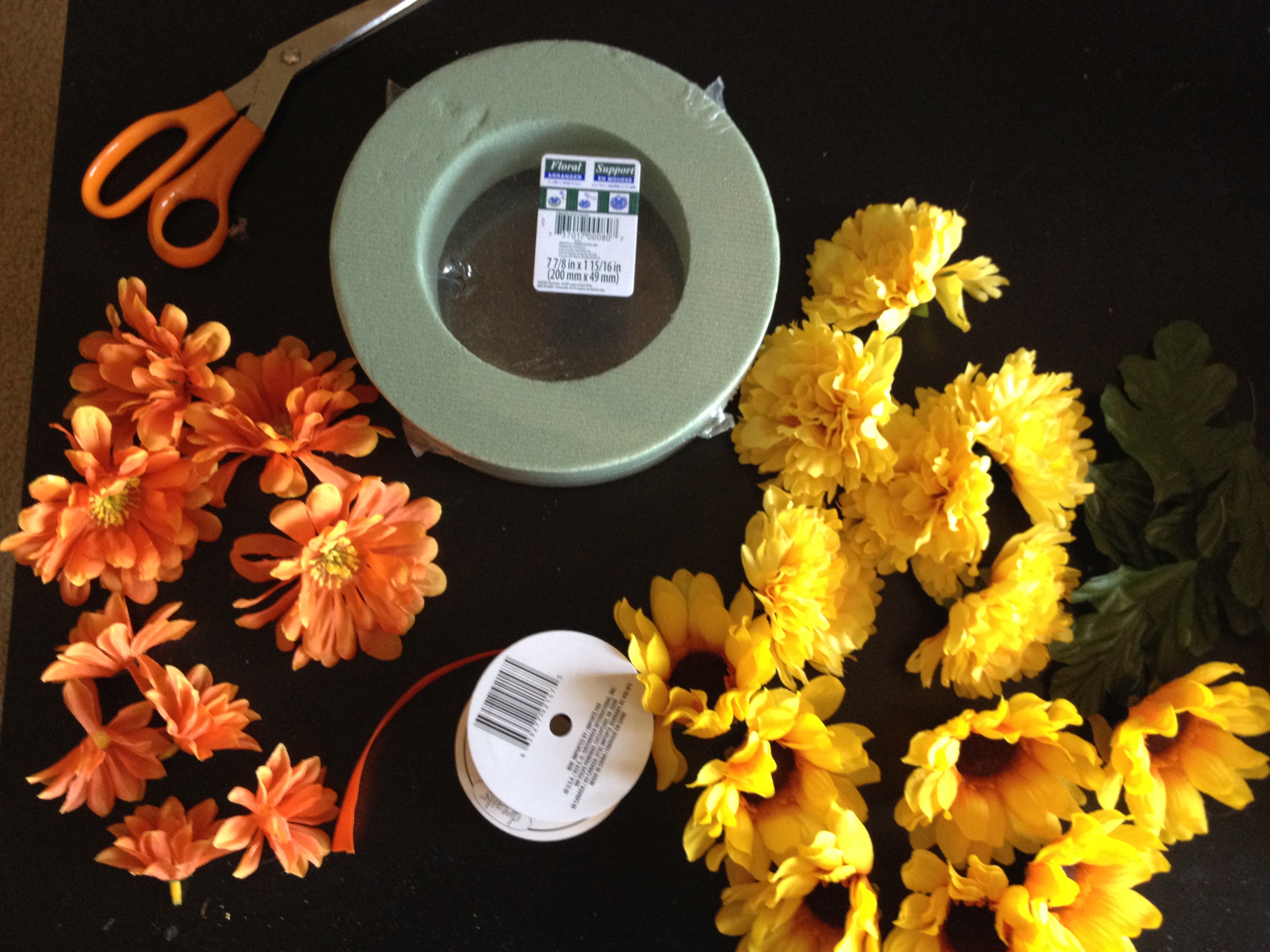
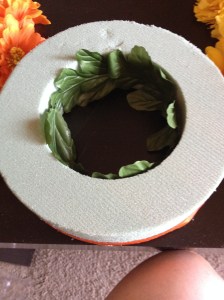
DIY floral circle- gather supplies1. Gather supplies: You’re going to need a hot glue gun (not pictured), a foam ring, scissors, ribbon*, and silk flowers in different sizes. The ribbon is optional, but I liked it. I bought the floral ring, orange flowers, and ribbon at Dollar General for….$1 each. (The yellow flowers were a gift.)

Get more flowers than you think you’ll need, in complimentary colors and different sizes. I can’t tell you how many to buy, because that will depend a lot on what kind of flowers you pick and how big a ring you make. Buy a stem or two extra.

Here I’ve plucked all the flowers from their stems, leaving just the little nubbins at the base. You may need to cut them off with scissors or wire cutters, but try just yanking them off; mine came off easily.

DIY floral circle- hot glue

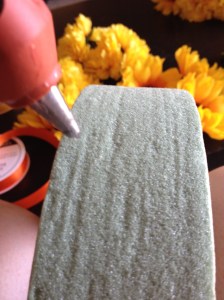
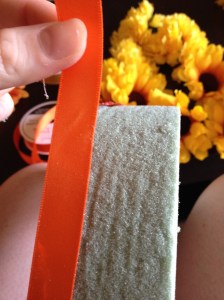
1A. Hot glue ribbon– If you decide to add ribbon to your floral ring, you’re going to need to apply hot glue in a line along the bottom edge of the ring. Then just gently spool out your ribbon all along the bottom.

DIY floral circle-add ribbon

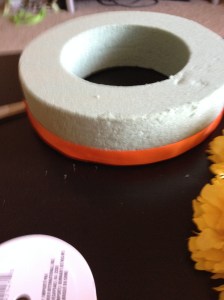
The ribbon may not show on the final product, but I like it as a “finishing” piece just in case someone does peek at the lower portion. DIY floral circle-Finished ribbon

This is what it looks like. ^^

1B. Glue Leaves on Inside– Another optional step that just adds to the finished look. I glued the leaves from my sunflowers to the interior of the ring, just so there is something covering the foam. Not a necessary step, and you could wait until the ring is otherwise complete to see if you want this.

DIY floral circle- Glue Leaves

Just add a short line of hot glue and stick on a leaf until the inner ring is more or less covered. It doesn’t need to be perfect. Remember, this will most likely not be seen.

DIY Floral ring

2. Start adding flowers.  Take your flowers and stick the nubbins into your foam. Press gently but firmly and they should slide right in without much resistance.

DIY Floral ring- place flowers

This lets you get a sense for how it will look in the overall ring. At this point, you can either place all the flowers until you’re happy with them, or you can do them one by one. I do them one by one for this tutorial.

You can place them at a slight angle, or straight down into the foam. I recommend having a little bit of diversity: nature isn’t precise, so having them perfectly uniform will actually look a bit more unusual than having them a bit oddball in placement.

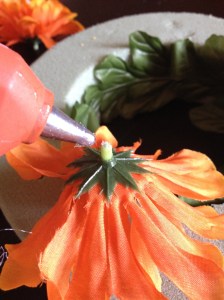
DIY Floral ring- glue flowers

3. Glue Flowers. Now that you’ve decided how you would like to arrange your flowers, gently pull them out of the ring (one or a few at a time) and apply a dot (or swirl) of hot glue to the nubbin. It doesn’t take much. Then, push the flower back into the hole you removed it from.

DIY floral ring- place flowers

The hot glue will hold the flower in place better than the foam alone. You can skip this step if you’re confident your flower ring won’t be moved around much and you only want it temporarily.

DIY Floral ring- top ring flowers

4. Fill in the Gaps. Fill in your flowers all along the foam, making sure to mix up the color and type of flower. This is more art than science; go with what feels good! You mostly just need to cover the floral foam, so if that means squishing the petals a little, that should work. Don’t feel obligated to make it too cramped. This is also why you are placing the flower before you glue it; you can switch them out if you don’t like the placement.

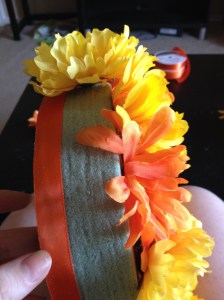
DIY floral ring - side flowers

I did the top first, then went around the side of the ring. My flowers were large enough that I only needed one flower to fill the side; your results may vary. Do whatever works best for your project.

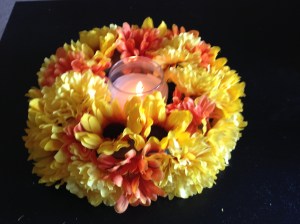
DIY Floral Ring- Complete centerpiece

5. Enjoy! Your floral ring is a good centerpiece all by itself, or you could add a candle or tall vase to complete the look. (Note: if using candles, be careful to keep the flowers well away from flame! I recommend using a glass vase rather than an exposed wick.)

DIY Floral Ring with Candle

1 Comment

Filed under Crafts

States of Change

I’m planning a wedding, and it’s got me thinking about how we live our lives. For the most part, we make small, inconsequential choices (ignoring the possibility of butterfly effect situations: stopping to buy a candy bar, which makes us late for the train, which means we are distracted when the taxi comes out of nowhere to hit us). Sure, these actions always have consequences of some kind (sunburn today = skin cancer in 20 years), but for the most part are unimportant.

But there are a few times in our lives when we make a choice that forces a change of state: we will no longer be the same thing we were before.

Putting aside all the situations that would be like this but that we could not control (tsunami, random mugging, diagnosis of a genetic illness, getting older), we are left with a few opportunities where we can make a choice and change who we are.

Getting married is one of them: once I am wed, I will never again be able to be “unwed.” Sure, I could be divorced, separated, or widowed, but I can never again go back to the “never married” state. It’s a one-time deal.

Outwardly, this doesn’t necessarily mean much: I check a different box on government forms, woo. And I don’t know if it will change my actual relationship with my significant other–some people say yes, but then there are a lot of people who are married in all but name, and they don’t seem that different–but this idea that I am consciously changing myself in a way that I can’t take back is pernicious.

There don’t seem to be many of these kinds of choices in life. Having kids, certainly: you can never really undo that, even if they are given up for adoption. Death, of course, is a major one, at least until we get some cryogenics going on.

Writing a novel is one, I think: even if you aren’t yet published, you have created something that will never actually go away, even if it is mostly just a folder on your desktop.

Some stories require this kind of grand-scale state-changing choice, but it’s sort of surprising that not all are required to. For example, in The Lord of the Rings, Frodo at first does not make a state-changing choice: he is just going on a walk because Gandalf told him to. It could be argued that taking on the ring in Rivendell “transforms” him into the Ringbearer, and he could never again not be the ringbearer, but I don’t think that’s true. Yes, he decides to stick with it, but there are multiple times when he nearly (or actually does!) lose the ring. And (while it wouldn’t have been a good story) there remains a choice that he could have made: to just turn around and go home.

But a state change does happen in American Gods, but not until very late in the story, when Shadow has already experienced much of the hero’s journey. It is similarly the pivotal moment in Good Omens, when our young antiChrist chooses to stop the apocalypse.  (What do you mean, you hadn’t read that one yet? Go read that book, right this instant!)

And the excellent Life of Pi does not offer much in the way of choice at all for our hero: he must make a series of small decisions. True, the stakes are high, but there is no one crucial decision.

For the broad swath of our lives, we make choices, but rarely do we make these kinds of life-altering decisions. Have you made one that I’ve overlooked? Are these choices similarly critical to our characters as they are to us? Tell me what you think.

5 Comments

Filed under Uncategorized, writing

World Destruction Reading List

Reddit’s r/books thread recently had a conversation about best dystopian novels. There were a lot on the list I hadn’t heard of, and I have a particular love for dystopias (I’ve written two and a half, so far!).

So, for my benefit and yours, here’s a compilation of the crowd-sourced dystopian titles (plus some that I didn’t find on reddit), in no particular order, you should read:

  • Earth Abides, George R Stewart
  • The Passage, Justin Cronin
  • Do Androids Dream of Electric Sheep?, Philip K. Dick
    • Doctor Bloodmoney, Philip K. Dick
  • Foundation, Isaac Asimov
  • Oryx & Crake; The Year of the Flood; MaddAddam – trilogy by Margaret Atwood
    • A Handmaid’s Tale, Margaret Atwood
    • Positron, Margaret Atwood
  • Never Let me Go, Kazuo Ishiguro
  • A Brave New World, Aldus Huxley
  • 1984, George Orwell
  • A Canticle for Leibowitz
  • Wool, Hugh Howey
  • Swan Song, Robert R. McCammon
  • Wastelands anthology, John Joseph Adams
  • Y The Last Man,  Brian K. Vaughan (comics)
  • The Walking Dead,  Robert Kirkman (comics)
  • Lucifer’s Hammer, Larry Niven and Jerry Pournelle
  • The Road, Cormac McCarthy
  • I Am Legend, Richard Matheson
  • Ashes, Ashes, Jo Treggiari
  • Alas, Babylon, Pat Frank
  • The Giver, Lois Lawry
  • Cloud Atlas, David Mitchell
  • The Postman, David Brin
  • This Perfect Day, Ira Levin
  • Day of the Triffids, John Wyndam
  • World War Z, Max Brooks
  • The Stand, Stephen King
  • Plague Year, Jeff Carlson
  • The Genesis of Shannara, Terry Brooks
  • The Deluge, Mark Morris
  • Robopocalpyse, Daniel Wilson
  • Windup Girl, Paolo Bacigalupi
  • We, Yevgeny Zamyatin
  • Emberverse series, R.M.Stirling
  • Shades of Grey, Jasper Fforde
  • Noughts and Crosses, Malorie Blackman
  • The Tripods, John Christopher
  • Mortal Engines, Phillip Reeve
  • The Children of Men, P.D. James
  • The Hunger Games trilogy,
  • Dog Stars, Peter Helle
  • The Last Policeman, Ben H Winters
  • Idlewild; Edenborn; and Everfree, Nick Sagan
  • The Maze Runner, James Dashner
  • The Time Machine, H.G. Wells

Undead Rising coverFor a new way to destroy the world, buy Undead Rising: Decide Your Destiny, available in print and on Kindle. Your choices shape the story! When you die in the book, sometimes you rise again as a zombie, unlocking new adventures.

4 Comments

Filed under Reading