Editing Quick Hit: ‘Backward’ Apostrophes

What I’m about to say may shock and confuse you–it’s okay, it’s not your fault; the machines are lying to you. But I’m here to help.

Your apostrophes are backwards.

Don’t worry, it’s not all the time. The most common writing software is just making things bonkers for you.

On fonts that utilize “curly” apostrophes (unlike online, like this typeface) should always have the “tail” of the apostrophe pointing toward the missing letters in a shortened word, such as in dialogue. In other words, the apostrophe should be “closed” or shaped like a number 9.

But Microsoft Word botches this every time, like this:

wrong way to use apostrophes

The apostrophes for ’em (them) and ’90s (1990s) should show the reader where the missing letters go. Thinkin’ (thinking) is correct, however; the tail says, “there should be a ‘g’ right here!” Instead, Microsoft Word thinks those apostrophes are single quotation marks, which leads it to put in the wrong one.

Here’s how it looks when it is correct:

correct apostrophe position

Now our helpful apostrophes say, “look, these two words are missing letters!” Perfect. (And “thinkin'” is still correct.)

Individually, this is easy to correct: just put in two apostrophes when you want to flip one around. The second apostrophe will be turned the correct direction. Then, just delete the first one.

If you’re going to be apostroph-izing frequently, you may want to look into the programming to see if you can turn off the flippy apostrophes, but most people don’t need to go that far. Of course, you can also hire a good editor/proofreader (like me!) to do all the apostrophe-scrounging for you.

I recently worked on a fun book that featured a lot of Western-y dialogue. There were a lot of backward apostrophes to fix. Here’s an example of how this kind of dialogue should look when it is done correctly:

example of dialogue with apostrophes

With all the shortened words spelled out, this would say, “That is because you run faster than I do, so as I gotta get them first.” But that just sounds crazy, so shortened dialogue it is! Just be sure to keep track of which direction your apostrophes are facing.

If you want to read up on apostrophe directions, consult section 6.114 of your Chicago Manual of Style, 16th Edition.

Are your apostrophes backwards? Have you run into this problem before?

3 Comments

Filed under Editing, Publishing, writing

Review: The Golden City

The Golden City (The Golden City, #1)The Golden City by J. Kathleen Cheney

My rating: 4 of 5 stars

In a genre awash with elves, dwarves, and wizards, The Golden City is a splash of interest. There may be those sorts in the wider world, but The Golden City features the little-seen sereia (mermaids) and selkies, seals that can shed their skins to become human.

While still traditional magical creatures, these are wonderful bright spots in an overcrowded genre. I just loved getting to know the inner workings of mermaids and selkies. Sereia have a complicated social structure but are at nature similar to aristocratic humans. Selkies are a whiff of human with a great deal more seal; they’re a little simple, and lusty.

The story doubles its benefits by setting the story not in the traditional vaguely-British countryside, but rather in historical Portugal. This opens up whole new realms: the clothes they wear, the languages used, the traditions they keep, their religion and culture. It’s fantastic.

In The Golden City, Cheney has crafted a light and delicate story, part mystery, part spy tale, and the lightest touch of romance.

Oriana Peredes is a sereia–mermaid–who is a spy among the humans in the Golden City. She works as a companion for the Paris Hilton of the aristocracy–perhaps sweet, but empty-headed, and wanted by several suitors. The pair are on their way to a secret rendezvous with her mistress’s suitor when they are abducted. When her mistress is murdered right in front of her with elements of mysterious magic at work, Oriana puts aside her mission as a spy in order to find vengeance for her friend.

As she works to discover who tried to kill her, Oriana meets Duilio Ferreira, a police consultant and member of the nouveau riche. Oh, and he’s half-selkie.

Together they work to solve the case and protect the innocents of the city, and feel out the first touches of romance as they try to solve the riddle of destiny and whether it is even possible for a sereia and selkie to find love.

(HOWEVER, if you’re interested in paranormal romance, look elsewhere. This is a Victorian romance… in short, there is barely any more than a sideways glance and a flutter of the heart. It’s a nice change of pace, but I admit it was a tad unsatisfying.)

I picked this book up on a whim, and I am so glad I did! I can’t wait to read the next and learn more about these fascinating sea fantasies.

View all my reviews

Leave a comment

Filed under Reviews

Deaths in The Iliad Infographic

For all your Classics class needs, someone made a great infographic on all the deaths in Homer’s The Iliad.

I just love this. I nearly minored in Classics in college (I had already double-minored, though, so that seemed a little excessive) but I just loved those classes. My favorite class of all time was a Classics/Archeology class where we watched famous movies and talked about how much they got wrong. For that class, I blazed through the entire Iliad in two weeks (on top of my other courseload) so…while I remember a lot of it, I forget a lot of this fine-detail stuff. And it must have taken so much data to get this one beautiful infographic! High-quality stuff, this.

(If you can’t read Greek, here’s a translation of the bottom portion:

  • Badass! Most kills in one book – Patroclus
  • Most Consistent – Achilles
  • Most Overlooked – Diomedes
  • Most Bloodthirsty – Agamemnon
  • Sneakiest – Teucer
  • Most Useless – Paris

Poor, poor useless Paris. He can’t help that all he can do is lob some arrows.)

Oh, and if you like this, I *highly* recommend you go read The Song of Achilles. It’s just so much fun; the best modern take on the genre I’ve read.
Brb, gonna go rewatch Troy for the thousandth time.

Leave a comment

Filed under Reading

Making a Book, Literally

How to Make Your Own Hardcover Book

This is just neat: this man on Reddit made his own book, in a very literal sense. He has good reason for not buying it: it is originally in a different language, without an official English translation. But he procured the English version and wanted to keep it on his shelf. Ta-da, build-your-own-book!

The process is both complicated and relatively simple. It looks time-consuming, but that shouldn’t be a barrier to anyone who is really passionate about the idea.

The steps essentially are:

  1. Acquire text for book. Print it out on good paper.
  2. Fold printed pages into “signatures” (folded-in-half sections).
  3. Measure where the stitches for the binding should go.
  4. Poke holes into each signature. Looks time-consuming.
  5. Sew the signatures to each other. (Careful about keeping those suckers in order.)
  6. Put glue on the outside edge of the stitched pages. Let dry.
  7. Trim and sand down rough edges on the pages.
  8. Acquire old hardcover book you don’t want; remove the cover (you could also make your own. See Pinterest).
  9. Add cover pages and any other details to your text.
  10. Recover your new book cover.
  11. Glue in the pages.
  12. Enjoy!

Leave a comment

Filed under Crafts, Publishing

Gardening Your Words

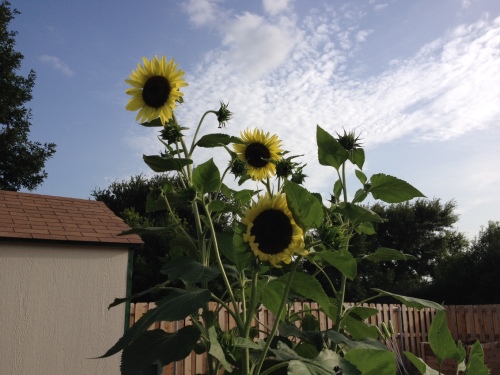
sunflowers

I have a plot at a community garden (though the garden journal-ing hasn’t been going too well lately), and it makes me contemplative. Gardening has been used as an allegory for so many things–not that it’s surprising, with growing our own food being so important through most of civilization. So here’s my allegory: Gardening as the publishing process.

  • Gardens start with relatively few raw materials: you’ve got good dirt, a spot with sun, some seeds and some water. Hopefully you’ve got a trowel.
    • Similarly, it takes relatively little in “things” to start writing. You need a computer or just a paper and pen. Maybe a good “writing chair,” if you’re lucky.
  • The beginning of a garden is full of mystery. You stick some seeds in the ground and water them, but nothing happens. You just hope that they’ll grow. And for days–if not weeks–nothing seems to be happening. You just have to keep showing up, watering and checking for weeds, and hope that the seeds you planted weren’t duds. I found this incredibly frustrating. What were they doing down there?! Other people started their plots with starter-plants bought from the garden center, but sunflowers have to come from seed. And it looked, for at least 2 and a half weeks, like nothing was going to come from it.
    • We don’t know the outcomes when we write. First, we face that terror of the blank page. Then, even if we manage to fill it, we don’t know if it’s any good, or if we’ll get anything out of it. It’s all a big gamble at first, then a lot of waiting. Being a writer of any kind takes simultaneous constant work and patience.
  • Without warning, though, things just start to grow. The little heads of my sunflowers were just the tiniest little hints of green one day, and by the end of the week they were over two feet tall. By the time they were fully grown, they were taller than me and had flowers the size of saucers (see photo above!). But not everything in my garden grew evenly, and other people had a lot more produce than I did. All season, I’ve produced a total of three tomatoes! Little ones!
    • Comparing yourself to others is natural, but it doesn’t always help. Sure, I only have three tomatoes, but I had killer sunflowers that no one else could boast. The same is with my writing; I’m strong in some areas where others may be weak. Even though we’re doing the same things, we have different strengths.
  • Things outside of your control can have a big effect on your outcomes. In the garden, that was a sudden and devastating infestation of squash bugs. No matter what we did to squash them or spray them or make our plots seem unappealing, they proliferated. Everyone in the garden was forced to pull out every squash plant. I even had to sacrifice my cucumber plant–the squash bugs didn’t know they weren’t supposed to like eating that, too.
    • You can do literally everything right and still not have success. I have a zombie book I think has great potential, but zombies are considered passe now; the trend-mobile has already moved on. Does that mean my book isn’t good or that I’m a bad writer? No, it just means there’s something else going on. (Besides, it doesn’t mean I have to tear it up forever. I’ve held on to it, and now maybe it’s time to publish after all.)
  • Gardening takes a lot of work that doesn’t look like work. I’ve been by every day this week: 100+ degree days are not good for growing vegetables, and it’s all I can do to keep my plot watered. But it doesn’t look like I’m doing much; all this watering doesn’t have a lot to show for it. Today I planted potatoes, and hauled two wheelbarrows full of fresh mulch into the bed. You can’t tell at all; it’s just more dirt.
    • Day-to-day, writing doesn’t look like much. It’s a lot of sitting behind a keyboard. It can be tough when someone says “so, what have you written?” and you know there is nothing you can point them to. But that doesn’t mean you haven’t been hard at work.

I’ve decided to think of my writing process as a garden: tend it well, and it will reap rewards…eventually. How do you think of your writing career? How do you keep yourself motivated?

1 Comment

Filed under Publishing, writing

Editing Quick Hit: How Many Spaces Go After A Period?

Spacebar: the Final Frontier

I’ve been saving this image so long; I can’t believe I can finally use this joke.

An unexpected furor popped up among some family friends last month, and because I work as an editor, I was the subject-matter expert (in other words, the controversy swirled around me). And it all started with a 3-year-old online article.

The very important question: How many spaces go after a period ending a sentence?

The question-asker had stumbled upon this article from Slate: Space Invaders: Why You Should Never, Ever Use Two Spaces After A Period.

And it’s full of fightin’ words.

Forget about tolerating differences of opinion: typographically speaking, typing two spaces before the start of a new sentence is absolutely, unequivocally wrong,” Ilene Strizver, who runs a typographic consulting firm The Type Studio, once wrote. “When I see two spaces I shake my head and I go, Aye yay yay,” she told me. “I talk about ‘type crimes’ often, and in terms of what you can do wrong, this one deserves life imprisonment. It’s a pure sign of amateur typography.”

Yowza.

But, yes, the accepted standard is now one space after a period, in all cases. (If you’d like to look it up yourself, it’s in section 6.7 of the Chicago Manual of Style, 16th Edition.)

It came to be with typewriters, which didn’t leave enough visual space between a period and the next letter with just one space. But you probably haven’t touched a typewriter in years, so it’s okay to drop the preference.

I know, it’s likely you learned the habit in school–or maybe just picked it up as a sly way to increase the page count on assigned homework–but you’ll make your editor’s life easier if you slim your manuscript down to just one space after the period. If it’s challenging to unlearn the long-engrained habit, you can also use your search bar in Word to search for two spaces, then use the replace function to replace it with one space (it’ll look like you’re searching for nothing, but this works).

Does it really matter? Not truly. It’s just one of those accepted rules. Consider it like brushing your hair before you leave the house. Sure, you don’t have to, but you’ll look more polished and professional if you do. I don’t care if you put two-three-four! spaces after a period in your personal emails, your journal, your thank-you notes–but when finalizing a manuscript, stick to just one.

5 Comments

Filed under Editing, Publishing, writing

Off the Fence and Into Self-Publishing

Icat on a fence‘ve written a lot about publishing versus self-publishing, and have made it pretty clear that I’ve been fence-sitting: researching both, querying agents, and monitoring the self-publishing world and the struggle between the two methods of publication.

Well, I just got pushed off the fence.

At DFW Writer’s Convention in 2013, I was able to sit down with two agents for pitch sessions. They both went really well, and I went home with two full manuscript requests for my zombie gamebook, Undead Rising. I sent them in, and began my patient waiting.

After a few months, I received a rejection from one of the agents. It was short and vague. I found out a week later that she had switched agencies, so I think she probably picked up only her favorite things and took them with her. So my feelings weren’t that hurt.

And then I waited some more. And, frankly, I had a really busy year… so I forgot about it.

I just this week got the other rejection. That’s 15 full months (a year and a quarter!) of waiting to hear back one way or another on a  requested manuscript; she’d already shown enough interest to get me to “phase 2” of querying.

Now, the agent was really kind in her rejection and apologized for the “unconscionable delay,” which she attributed to her “large backlog of requested material.” In fact, the rejection was largely positive; she mentions a quibble or two, but it (in my opinion) seems extremely minor and not a big deal. She said it was “well-executed” and that there was “a lot to like here.” Which is good to hear.

I’m not trying to call her out here–I’m not going to say who the agent was; she was very nice in person and I would have liked to have worked with her. But a 15-month delay on a requested manuscript seems ridiculous. Particularly because it is considered good manners to not consult other agents while a manuscript is with an agent (though I could have, had I notified her. Like I said, I forgot.)

This isn’t the only reason–the stars in general are feeling like they’ve aligned for me–but this is a big reason that I’ve decided to self-publish this book. The traditional publishing structure seems to be oriented toward very narrow types of books (whatever the gatekeepers think will sell well immediately) set on incredibly long-term time frames (making the process more about luck and timing than content). That combined with the lower rate of return… I just don’t feel like my oddball book will ever be a good fit in the industry. And that’s disappointing.

But it’s also exciting.

So, by Halloween of this year, I intend to have a complete zombie gamebook adventure available for sale as an ebook (and maybe a print book). I look forward to getting Undead Rising: Decide Your Destiny to an audience in time for All Hallows Read!

If you’ve self-published, can you offer any tips or tricks?


12 Comments

Filed under Publishing, writing

Review: Gone Girl

Gone GirlGone Girl by Gillian Flynn

My rating: 5 of 5 stars

“Gone Girl” is without a doubt the best, most original book I’ve read all year. Maybe in the past few years. It’s outstanding, and if you even remotely like crime novels or TV shows, you need to read this book.

I know, it’s super-hyped and sometimes you may not want to read a book because it can’t possibly be that good and books sometimes get popular because of some unquantifiable zeitgeist. Worry not: “Gone Girl” is just genuinely good and surprising.

It’s the kind of book that makes you say, “OMIGOD, you HAVE to read this book!” because you desperately want someone to talk to about it.

It’s a book that says, “Oh, you think you’ve seen this on “Law & Order” that one time? You think you know what’s coming? WHAM! YOU KNOW NOTHING!”

It’s the kind of book that made me wonder, initially, if my newly acquired husband could ever turn out to be a murderer. And then it made me wonder if maybe I had it in me to be a murderer.

“Gone Girl” really takes the crime novel standards and turns them on their ear. It’s revolutionary in a lot of ways. I mean, how often are you allowed to view the story from the perspective of suspect #1–and yet don’t know if he did it or not?

The set-up is that it is Nick and Amy’s fifth wedding anniversary, and their marriage has started to unravel. Nothing major, just bits here and there; it’s not what it was. And then Amy goes missing. As is so common in crime shows and books and in real life, suspicion automatically falls on Nick.

I won’t reveal more than that, because as much as I want to talk about this book, the surprises are worth keeping secret for other readers–they’ll hit you like a club to the head.

The story is incredible for the writing alone (excluding the truly brilliant plot for a moment). It’s told from both Nick’s perspective–he talks to you as if you’re perhaps his little mental Jiminy Cricket, or an audio diary–and from excerpts from Amy’s diary, which retells parts of their lives, leading up to the cataclysm, from their first meeting all the way up to the collapse of their marriage. The tone is spot-on: it sounds just like normal people. I’ve never seen real-life captured so thoroughly on the page, so intimately intertwining the reader and the author’s voice. Gillian Flynn is a helluva writer. Plus, I used to live in Missouri, where the book is set, and I am astounded by the little details only a Missourian would pick up on, little things like the blanket adoration for the Cardinals baseball team–things that make these people seem very much alive.

I guarantee, no matter how much a TruCrime connoisseur you think you are, you will be surprised, pleased, disturbed and amazed by this book. I absolutely cannot recommend it enough.

View all my reviews

3 Comments

Filed under Reading, Reviews

My Top 10 Most Influential Books

I was challenged to the silly “book duel” on Facebook by an acquaintance, and though I typically don’t like those sorts of “pass it on” challenge deals, this was good to think about.

So here are the top ten books that have the most influenced me thus far:

I’ve been challenged to a “book duel,” which sadly doesn’t mean throwing books at other people. But it does mean listing 10 of the books that most influenced me. (I will be opting out of the “challenging” of others. Answer if you wish.) My top 10 most influential books, in no particular order:

1. The Power of One, by Bryce Courtenay
2. The Handmaid’s Tale, by Margaret Atwood
3. Grimm’s Fairy Tales, by the Brothers Grimm –the older, far scarier and more demented versions
4. Sandman comics, all of them, by Neil Gaiman
5. The Bible, without the context of which I wouldn’t understand much of modern literature, in addition to any faith-related benefits
6. Ella Minnow Pea, by Mark Dunn, for showing me how flexible and creative writing can be.
7. Eats, Shoots & Leaves, by Lynne Truss, for my early editing education and one good panda joke
8. The Weather Wardens series by Rachel Caine, because she’s a local author who started young and made it big.
9. Black Beauty, by Anna Sewell. I just love that book.
10. Jane Eyre, by Charlotte Bronte.

Also, it wasn’t until I wrote this up that I realized I’ve MET three out of the 10 authors on this list; if we exclude the ones that are long dead, my percent leaps up to 50%! Wow!

What would make your list? What do you recommend?

2 Comments

Filed under Reading

Author Hugh Howey Has Good Questions for Amazon

I admit it–because of all the Amazon/publisher tiffs lately, I’ve started to view breakthrough author Hugh Howey as a bit of an Amazon brown-noser; he always seemed quick to defend the ebook giant, even when they made strange choices. But I think maybe that assumption was wrong.

He recently published a long list of questions directed at Amazon, titled simply “Stuff I Want to Know.” Some of his questions seem…trivial:

I would love to know why we don’t have any sort of gamification of writing implemented yet? Writers should receive little congratulatory badges for hitting reasonable sales milestones.

Why don’t you all create a newsletter system for authors?

But he also has some extremely good and pointed questions, and it’s good to see his perspective as a super-producing Amazon insider. For example:

I want to know why you all haven’t come out and explained that the 70% cut we make on ebooks priced in a certain range aren’t really royalties. (See #5 of this list for an example of improper usage of the term). When they’re called royalties, the 70% seems exceedingly generous. Because publishers pay a lot less. But publishers provide other services, like editing and cover art. We are handing you a finished product. As a distribution fee, you taking 30% (plus more for delivery fees) sounds less crazy-generous. It seems downright reasonable, in fact. Or even an area where you all could afford to give a little more.

Or:

I would love to know how many readers borrow a book and then go on to buy a copy of the same book. I’ve done this before, and I tend to doubt my uniqueness. For Prime members especially, who only get one borrow a month, do they ever love an ebook so much that they decide to own a copy for good?

It’s great stuff, providing both a peek behind the curtain and some food for thought. Read the whole post here.

I’m still only gently wading into the publishing world, but do any of you have questions for Amazon or any of the major publishers? What are the things you want to know? So much of the process is cloaked in mystery; there has to be something.

Leave a comment

Filed under Publishing