Category Archives: Publishing

Your Amazon Author Central Page

Amazon is an excellent tool for selling your book, but it isn’t necessarily intuitive. There are completely different sites for print books (createspace.com) and ebooks (kdp.amazon.com), and then there is a different site to craft your author tools. It took me six months to realize I wasn’t using their author tools! I figured I’d write it up to save y’all the same embarrassment.

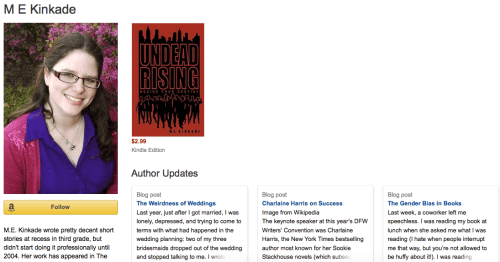
Amazon Author page interface

Amazon Author page interface

First, find the site. I had to Google it. You can also click through one of your favorite books, and click on the author name, then scroll down to find the “are you an author?” link. You’re looking for https://authorcentral.amazon.com.

If you are already selling your books through an Amazon platform, it should be easy to connect your name to your book. It’s an easy-to-follow interface, and won’t take very long.

You’ll fill in a short biography, and it’s a good idea to add your author photo. Bonus points if you have other photos or videos that will help readers connect with you as a person, but you have to work within your comfort zone. Connect your blog and Twitter* feed, and it’ll give readers just one more chance to follow you. You may need to look up exactly how to find your blog’s RSS feed, but once again Google is your friend there.

This is what it will look like when you’re done (and it’s been approved by Amazon).

amazon author page

As we know, connection with readers is critical! The author page is a fantastic, free way to connect the dots. Don’t make the same mistake I did!

There are a lot of other tools back in there, including a sales chart, your sales rank against all other books in Amazon’s stock, your current author rank, and an easy snapshot of all the Amazon customer reviews of your books. I mean, seriously, how did I miss the memo on these? They’re great to have access to, finally!

Do you use Amazon’s author page tools? What’s your favorite feature?

*Note: Amazon’s having some kind of dispute with their tweet provider, so tweets aren’t currently uploading, but it’ll resolve sooner than later.

Leave a comment

Filed under Publishing, Undead Rising

Charlaine Harris on Success

Image from Wikipedia

Image from Wikipedia

The keynote speaker at this year’s DFW Writers’ Convention was Charlaine Harris, the New York Times bestselling author most known for her Sookie Stackhouse novels (which subsequently became the True Blood TV phenomenon).

She just absolutely adorable.
Ms. Harris seems like everything I’d like in the sweet neighbor next door: a grandma who bakes cookies on the regular but also is more than willing to slip you a bottle of booze after a hard day. She was sharp and funny and seemed so lovely; I wish I’d gotten to speak to her personally. At the very least, I’ve bought the first novel in her series as a tribute!
Ms. Harris gave a short speech about her life’s work before opening the floor to questions. She talked about how difficult it was to write as a parent (“I wanted to have kids, but I just had to write. You make it work.”), about where her ideas come from (“I don’t know. They’re just there!”), and on the tenacity it takes to be a writer.
But the part that stuck with me most were her comments on her success. She said, “I still haven’t read On Writing or any other writing book, because I’m too afraid I’ll find out I’ve been doing it wrong all this time.”
Wow.
This woman has published a passel of books, literally just laughed when asked if an agent ever said she couldn’t do something, and yet still has that crippling fear of “doing it wrong.” It’s comforting to know that insecurity doesn’t have to be a barrier; it’s just something you work with and through.
She also said there’s an award she’d like to win…but fully expects never to be able to. She’s so accomplished in many ways—she’s the writer dream achieved!—but she still has goals she feels are unattainable.
And finally, she talked about failure, about how you just have to take it and barrel on anyway. She said she’s been dropped by publishers before…but you just can’t let that stop you. Having kids while writing was hard…but you can’t let that stop you. Your book may not sell…but you can’t let that stop you.
It was very powerful to me to “meet” this unassuming, very inspiring, dogged determined, funny lady who happens to be a literary powerhouse. I hope to have her tenacity and humor.
 
Which authors inspire you? How do you get through the insecurity and the bad days?

1 Comment

Filed under Conventional, Publishing, writing

The Gender Bias in Books

Last week, a coworker left me speechless. I was reading my book at lunch when she asked me what I was reading (I hate when people interrupt me that way, but you’re not allowed to be huffy about it!). I was reading Abaddon’s Gate and was about to start telling her how much I enjoyed it when she asked: “Is that science fiction?” This, honest to goodness, is how that conversation progressed from there:

“Yeah, it is.”

“Oh… Does your husband science fiction?”

“Oh yeah, my husband and I both love it, and–”

“Did you like it before you met him?”

“…uh, well, yeah, I mean, it was practically a requirement for me to–”

“Oh.” (pauses, biting her lip) “Well, it’s lucky you found a husband who liked it. I guess it’s probably easier for a woman to find a man like that than the other way around, though!”

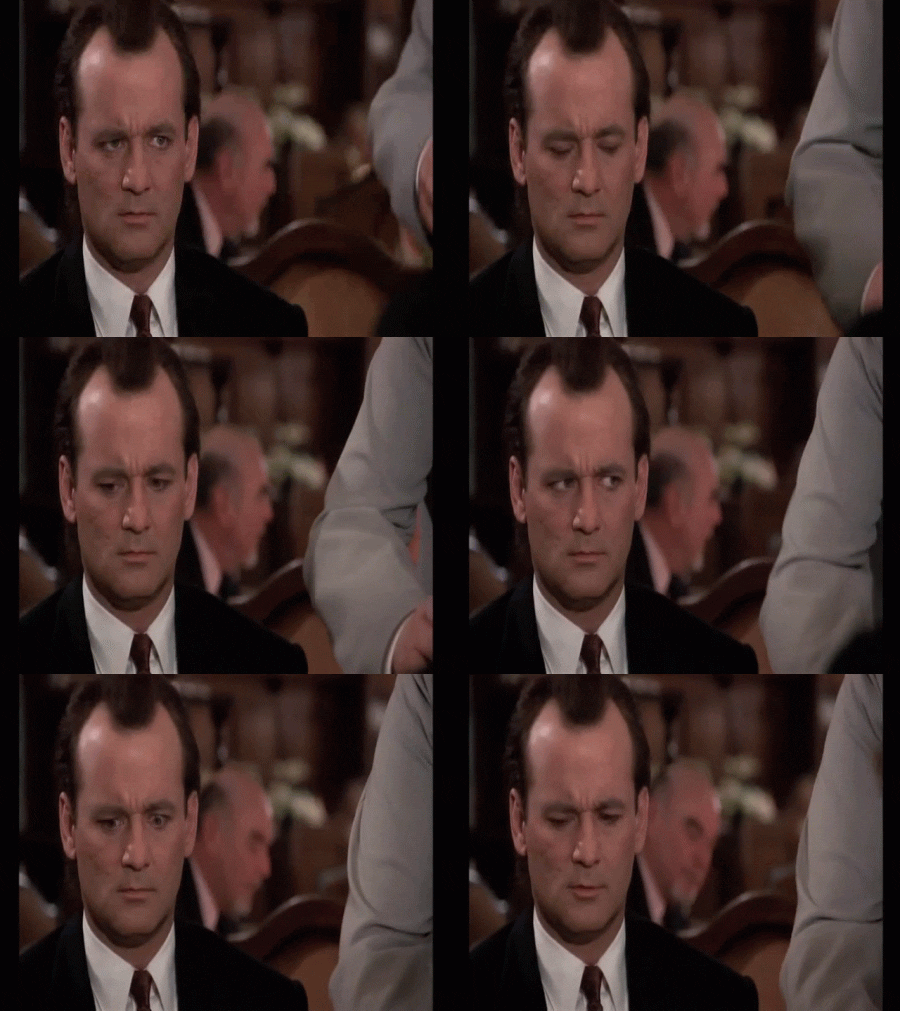
I think I gave her this face:

Apparently being a woman and liking science fiction means I’m basically unmarriable and should be incredibly lucky that I found a forgiving man to marry me.

And if that were it, that would be one thing. I could shrug off one lady as just being kinda crazy.

And then author Catherine Nichols wrote about her query experiment—she sent her exact same book and exact same query letter to agents under a male name. And the male version of her got far, FAR more favorable responses than her real name.

Read about it here.

Here is one of the more salient points:

Total data: George sent out 50 queries, and had his manuscript requested 17 times. He is eight and a half times better than me at writing the same book. Fully a third of the agents who saw his query wanted to see more, where my numbers never did shift from one in 25.

And even the rejections she got were more favorable, with more long-form responses and positive reactions.

This article—particularly following those outdated, sexist comments from my coworker—just was a real punch in the gut. I may be getting tanked before a single word is written, all because of unconscious (or perhaps a little bit conscious) bias on the part of the agents, the very first gatekeepers in the traditional publishing journey.

Bias against female authors in sci-fi/horror is part of why I use my initials with my book, Undead Rising. But I thought that was just for the reader who may be wary of a “girly” book…I had no idea that this sort of bias had leeched all the way through the system. But I can’t say I’m truly that surprised. Publishing is one of the most opaque, challenging industries, with a convoluted process and a lot of gut feel on the part of agents and editors in determining who gets in the door. And with the recent events at the Hugo Awards, I think there is a good reason to be concerned.

I used to sign my query letters with my name, thinking it would be more personal and therefore welcoming for the agent on the other end. I thought I was improving my odds by being warm and friendly. But perhaps I need to switch to only using my initials there, too; perhaps that is what it will take for my fiction to get a fair shake (especially as the book I’m querying is either sci-fi or literary fiction…both genres which carry a reputation as a boys’ club).

I’m deeply frustrated by this revelation, and sure, it’s one woman’s experiment with a relatively small sample. But her results are huge. I hope it leads to some careful thought in literary circles.

Do you see a bias in publishing? What should we do about it?

Leave a comment

Filed under Feminism, Publishing, writing

The Nine Elements of Worldbuilding

This awesome fictional map of "Clichea," created by Sarithus. Might want to avoid this sort of thing.

This awesome fictional map of “Clichea,” created by Sarithus. Might want to avoid this sort of thing.

I attended a really interesting lecture by prolific fantasy author Kevin J. Anderson on the fundamentals of worldbuilding. I don’t want to crib too much from his lecture—and the pending book on the same topic (keep an eye out for it; he can explain a lot better than he can!)—but I figure it’s still fair for y’all to benefit from my conference-attending.

The nine elements of creating a realistic, or at least believable, fictional world are: geography; climate; politics; economics; society; religion; intellectual/scientific; arts; and history.

When considering the setting and general plot for your totally rad fiction work, ask yourself some questions (and maybe more, as you put the pieces together):

  • Geography—could this landmass exist in the real world? Should it?
    • Make sure the actual structure of the land a) makes sense and b) fits with your plot. You’re unlikely to have a successful pirate story in a landlocked nation.
  • Climate—what’s the weather like?
    • Temperatures will inform clothing, and may affect culture. Would Jurassic Park or The Left Hand of Darkness be the same without their respective climates?
  • Politics—how does your society run?
    • A monarchy is going to look pretty different from a tribal theocracy.
  • Economics—what do people do for a living?
    • Anderson wrote a few Dune novels; of course, those books would not exist without the fictional “spice” upon which intergalactic travel relied.
  • Society—how are people treated? Are they generally happy?
    • There are a lot of components to consider here. Keep asking questions until it feels realistic.
  • Religion—what god/gods are worshiped? Are the benevolent…or scary? Incarnate…or imagined?
    • It seemed to me that religion could have a great deal of overlap with the “society” and “politics” questions.
  • Intellectual/Scientific—How do people feel about science?
    • Are they “burning the witches”?
  • Arts—What is the look and feel of your society? Do they have freedom of expression?
    • This is going to inform a lot of the descriptions! Everything from textiles up to architecture might be related to the arts.
  • History—what came before: constant upheaval? Centuries of peace?
    • A peaceful nation may react dramatically differently from a violent one.

I love those little maps in the front of books, but I’ve never endeavored to make on. Anderson’s class made me feel like I ought to try…or at least doodle some.

Bonus: Check out these cool “real” maps of fictional places!

Do you create elaborate fictional worlds? How do you put them together?

4 Comments

Filed under Conventional, Publishing, writing

Top 10 Things I Learned From DFWCon

DFW writers' convention

This weekend I had the pleasure of attending DFW Writers Convention, one of the bigger writers conventions, and after two days of shaking hands and smiling at other writers/editors/agents, early mornings and late nights, and many workshops, I feel obligated to try to sum up the experience. For those of you who have yet to attend a similar convention, I say get out there and find one: it’ll step up your game. In the meantime, read on:

10. Everyone is wary of Amazon. Agents practically felt they had to whisper it in case the shopping ma

gnate somehow overheard, but Amazon is currently the enemy you keep close. They all unanimously said it was essential, but are decidedly concerned about that growing monopoly. Remember: Amazon is useful, but Amazon isn’t your friend…it’s a business.

9. Those who excel at social media are people who already are very open and energetic. Though I did learn some about manipulating Facebook’s algorithm for your favor, my biggest takeaway from the social media conversation was that you have to be willing to tell the world just about everything about yourself…except nothing negative, at all. Remember, you’re selling yourself, and no one wants to hear the bad parts. It was very telling that the agents, who insist everyone must be represented on Twitter/social media, were also th

e first to say their Twitter persona is not the same as their real lives. Hmm…

8. No one has any idea what will sell. Not really. As is probably always true at these kinds of conferences, talk swirled around what was in demand. And depending on who you talked to, it was just about anything. This year sci-fi was the predominant winner, but none of the agents seemed particularly keen on it. (Two years ago it was all romance and some New Adult. This year, New Adult was practically dead.) One agent said something ridiculously specific was on her wishlist. It was all over the place.

7. Agents are not a hive mind. Along the same lines, just because one agent feels strongly about

something doesn’t mean they all will. At more than one panel the agents (politely) disagreed with each other, particularly at the all-important Query Gong Show (a game to suss out when an agent would stop reading a query). It really is about hitting the right mark.

6. It is less important to have an agent than it is to have the right agent. Following in the same train of thought, one lecture from an author who’d made the NYTimes Editor’s Choice list made this point really clear. He’d had a very well-known agent for years…who was completely unable to sell his material. But after he switched, it found a home. As painful as the agent-finding process is (and it is), sometimes having an agent may be worse than not.

5. Agents are really busy people. Keep this in mind while you’re fretting over your email inbox,

wringing your hands while you wait for a response: they have to respond to you and a helluva lot of other people. I’ve mentioned my negative agent experience—I waited nearly a year for a response on a requested manuscript!—so I know the waiting is terrible, but be realistic. One agent had had 10,000 queries the year prior, and had accepted … 6. Agents have a caseload of about 35 books they’re selling at any one time. Plus they’re going to conferences all over the country. That’s plenty for one person.

4. Keep your query letter short. Because agents are so busy, they may be reading your query at 11:30 at night, just before bed. They don’t have time for a long monologue. This was the number one reason letters were rejected at the gong show. Keep your query short—shorter than you think it should be!—and the

agent will open your manuscript if interested. Corollary: start with the genre and the word count to avoid surprises.

3. There is such a thing as “hybrid” publishing, and it may be the most successful option. I heard mixed reviews on this but I’m choosing to accept the positive: agents feel that there is definitely a place for a combination of self- and traditional publishing. Some even said that building an audience with a first, self-published book was a good way to eventually attract an agent. Authors also said that some things a

re not not suitable for the traditional route, making self-publishing some pieces a good idea. So there’s no n

eed to be “all in” one way or the other.

2. “Successful” authors seriously struggle. What seems like the end may just be the beginning of a new phase. I’m perhaps most grateful for the lecture by Dallas author Will Clarke, who had the markers of success—two traditionally published books, coverage in the New York Times and Rolling Stone, the book tour, the works. But his story was shocking: he’s never bought out his advance; the publisher dropped him; his book was optioned for Paramount studios but will never see the light of day; and the continual book tour burned him out creatively, emotionally, and physically. Success has its downsides.

1. Even the most experienced and successful authors are plagued by insecurity about their writing. Superstar author Charlaine Harris was this year’s keynote speaker, and despite being unequivocally a renowned and esteemed author, she admitted that she’s afraid to read Stephen King’s On Writing  or any other “how to write” book for fear of discovering she’s been doing it wrong for more than 30 years. If even someone as relentlessly successful has those fears, it’s ok for us newbies to admit to them, too.

Have you attended a conference? What wisdom can you share?

1 Comment

Filed under Conventional, Publishing, writing

Goodreads Giveaway: Was It Worth It?

In an effort to drum up interest in my book, Undead Rising: Decide Your DestinyI took the advice of Writer’s Digest and created a Goodreads Giveaway. People love free stuff, so the idea is that you can let people know about your new book by giving some number away, thus attracting a lot of interest and getting those much-needed early reviews.

I decided to give away 5 copies of my book, and I took the WD advice that the advertising to lesser-served readers outside of America was worth the potential shipping costs and opened the giveaway to readers in the U.S., Canada, and United Kingdom. Because, really, what are the odds that one of those readers will win?

This was my first giveaway, so I wasn’t entirely sure how long to run it for, but I let it stay up for about 3 weeks (there was a bit of confusion about when it would be posted—hint: it doesn’t go live until Goodreads staff approve it, so the start date is a little fuzzy).

In three weeks’ time, 977 people requested it—with the “peak” entry times at the beginning and end of the contest, no surprise there—and many people put it in their “to-read” category, meaning they’ll hopefully get around to reading it anyway.

Goodreads randomly selected 5 winners out of that pool and sent me their addresses in an easy-to-read CSV.

Oops benedict cumberbatch

That’s right, very British Benedict. Oops is right.

…Out of the 5, one was in London and one was in Canada.

Oops.

All told, shipping cost me about $50 plus a nice lesson from a postal worker about how to fill out customs forms. I used bubble-wrap envelopes–Priority Mail for the U.S. readers and regular old bubble-wrap for the other countries–to ensure the books arrived safely, signed each book with a little note, and included a note thanking them for entering the contest and requesting they consider reviewing the book or otherwise letting me know what they think.

So, would I do it again?

I think so. But I’ll be better prepared next time!

While I really liked the idea of shipping Priority so that readers got their books as quickly as possible, it unnecessarily ratcheted up the price. I think it’ll be regular brown bubble envelopes for everyone from here out.

I’m not sure I’ll still allow entrants from the UK and Canada, though I do love the opportunity to get into that market. I’ll have to consider it carefully.

I think I’ll open the giveaway to more readers next time, which in turn may encourage more people to enter and show more people the book.

I’ll also do a better job of getting a well-targeted Goodreads ad up (again, I had a little confusion with how those worked and when they’d populate) so that more people will know about the Giveaway.

I’m not sure I’d tell authors to expect reviews from a Giveaway. Because the winners are randomized and they have zero obligation to review your book, you may get folks, as I did, who have very few (or no) reviews of books. So it was great to get the book in the hands of new readers, but not necessarily a guarantee of reviews. (Of the 5, only one has reviewed my book so far. But she seemed to like it!)

All in all, a Goodreads Giveaway was a little bit less of a slam-dunk, and shipping was a lot more nerve-wracking than I expected! I think I’ll try again, but I’ll be better prepared for the results (and have a bit more money stashed aside for shipping costs!).

2 Comments

Filed under Publishing, Undead Rising

Win a Free Copy of Undead Rising–Courtesy of Rachel Caine!

My husband is awesome. He honored our first anniversary this weekend with a very modern “paper” gift: he reached out to Rachel Caine, one of my very favorite and most inspirational authors, to ask her for a letter to me, to help me get over the first-book jitters.

And she’s proven she’s my idol for a reason: she way over-delivered!

First, she sent me a very beautiful reminder to just keep trying. Here’s part of it:

 There’s no “right” way to publish. We are all blind people in a dark room, bumping into things, making mistakes, learning, moving on… I’ve written under 3 other names in my career, and had to change and reinvent myself because my books weren’t selling, until they were. It’s a hard road, with lots of twists and turns, and it can seem like it *should* be easy, but it’s only easy from the outside.

(I’m keeping the rest, just for me!)

Then, she tweeted about my book (and anniversary!) to all her fans! As a bonus, she’s giving away 5 copies of Undead Rising: Decide Your Destiny.

Undead Rising Rafflecopter giveaway

Enter to win!

And my many, many thanks to Ms. Caine and my dear sweet husband. This is the best anniversary gift I could have ever asked for!

If you aren’t already reading Caine’s books, I can’t recommend them enough. I particularly love her Weather Wardens series, though she’s most famous for her Morganville Vampires series. She’s got another book coming out soon, too!

Leave a comment

Filed under Undead Rising, writing

How NOT to Deal With a Bad Review

Being an author comes with a lot of challenges, but one of the hardest may be managing our own egos. Namely, having the restraint to accept that bad reviews will happen, and the wherewithal to keep yourself from trying to argue.

Because every once in awhile an author comes along, and does that, and serves as a horrific example of what can happen.

It’s like watching a train wreck sliding into the Titanic at the instant it impacts an iceberg. It’s painful to watch but you are so struck that it still is happening that you can’t look away.

His first response to the negative review (which, remember, on Goodreads means “didn’t like it,” not “literally the worst”):

“This review is not good for my business, so unless your desire is to ruin my dreams, it would mean a great deal if you could remove this review from my work and forget about it. But if it’s your desire to hurt me financially and ruin my business, then it’s understandable why you would post such a harmful review.”

In addition to responding to the review at all, this guy really screws up when he implies that this person’s review was posted out of “desire to hurt [him] financially.” What? One bad review certainly won’t be your ruin. But he’s not done. The reviewer politely responded (more politely than I would have) and explained she would not be removing her review, as is her right, and went so far as to compliment aspects of his book. But he came back again:

“Leaving a 1 star review on a book says much more about what kind of person does such a thing, and then attacks it for being “pretentious,” which is an erroneous statement that is defamation at best.”

And then it goes steeply downhill from there. Let’s be clear: a review is about the content, not the author. I mean, no one is leaving a review to just be hurtful to some stranger they’ve never met. I review every book I read; all that says about me as a person is that I read a lot, and that I like to give reviews about it. There’s no moral judgement. Also this guy has no idea what “defamation” is (hint: 100% totally not that).

This schmuck just can’t stop digging a hole, though. He goes on, for another 11 posts, with his rants getting more and more loopy. Worse, he seems to make a bit of a habit of doing this. And may have scared of this (and who knows how many other) readers from ever trying out a new, indie author. That’s just unfortunate.

Now, I commiserate with the author a smidge; I had one one-star review show up on Goodreads. It didn’t even have a review for me to nit-pick and pout over, but it had been created at the same time as like 37 other reviews. I ranted to my husband for 20 minutes, then I closed the page and went to bed and didn’t think about it anymore. And you know what? The next morning, I had two 5-star reviews.

The winds of popularity can change that fast, which is why it’s important to keep perspective. A negative review isn’t the end of the world. And even if it was disastrous for your book, remember, even failure has its values.

But there isn’t anything to be gained from acting out. In fact, it looks like this particular author’s rant lowered his Goodreads rating from a solid 4 stars to a dismal 2 (and falling) in less than two days.

This is one of those lessons it’s good to learn from watching someone else go through it.

Don’t make this guy’s mistake; have some dignity and leave reviews—especially bad ones—alone.

3 Comments

Filed under Publishing, writing

Inclusion as Rebellion: Adding Diversity in Fiction

Tales from Earthsea poster

It shouldn’t be surprising that Hollywood made the cast white when they made a movie version. But apparently it’s also just a really bad film.

I didn’t happen to think much of Ursula LeGuin’s A Wizard of Earthsea, but I did absolutely love the author’s afterward. In it, she talks about writing A Wizard of Earthsea in 1967, and how she ever-so-quietly tried to subvert convention. Her rebellion? The main character, Sparrowhawk, and the vast majority of the “good guy” supporting cast, are all non-white people. The people who are pale are seen as the dangerous outsiders.

She writes: “I was bucking the racist tradition, ‘making a statement’—but I made it quietly, and it went almost unnoticed.”

But LeGuin writes about how she was, is, somewhat disappointed. It seems her rebellion was a little too subtle, and didn’t attract the notice it deserved, most notably because cover artists tended to put a white person in the artwork, and apparently many readers didn’t pick up on the many small hints of the characters’ skin color. (My copy was released in 2012, and features a hawk, no people.)

She goes on to discuss the philosophical roots of her book, how the main action turns aside from battle and war, favoring instead to be a rather quiet hero’s journey of the self (which…ok. But I found it a little too detached). But I’m fixated on that concept of trying to push cultural boundaries with fiction.

The most notable and painfully glaring example is Rue from The Hunger Games. Despite many clear mentions of Rue and her companions as black characters, some movie-goers were rabidly furious when they showed up to the film and saw the (incredible, wonderful!) acting done by Amandla Stenberg. Not only were these people poor contextual readers, apparently (seeing as they missed this fact), they felt they actually had a right to be angry about a black actor being cast for a black character. It was stomach-churning.

It’s not the only example, either. Neil Gaiman makes a point of writing in non-white characters (my favorites show up in Anansi Boys) but even so, a challenge was famously issued to stop reading books by white men which prominently featured his (multicultural) book American Gods. When some readers/fans cried foul (either because they liked Mr. Gaiman or realized that the book’s character was himself nonwhite), Gaiman stepped in to say, “no, absolutely, go read those other books. Have at it.”

And if that’s not enough for you, this year’s Hugo Awards were hijacked by a group calling themselves “Sick Puppies” who felt, for whatever reason, that books featuring straight, white, men were being somehow maligned by authors who wrote other things or who themselves came from different backgrounds. They effectively rigged the awards and caused a lot of controversy. All because science fiction authors did what they are supposed to do: push cultural boundaries.

One good thing may have come from these incidents, at least: people are talking about the power of fiction in culture, the power to change culture, and the importance of inclusion. We need more stories, from more people; different stories, interesting stories. I know for my book I worked hard to create a diverse cast of background characters from different nationalities, while also working to ensure that the main character (the reader) remained gender-neutral and accessible to just about anyone who decided to pick up the book.

Do you attempt any cultural rebellions in your books or in the books you read? Do you see value in including a variety of characters of different skin colors? Or of breaking other boundaries? Let’s talk about it.

Leave a comment

Filed under Reading, Undead Rising, writing

The Importance of Failure

I’ve been thinking a lot about bones lately. I’ve been thinking about what happens when you break one. A friend is a power lifter; he literally wrestled a bear once (for charity. Both he and the bear were fine). But he fell while trying to fix a toilet and broke his elbow and now has a very impressive-looking brace on it.

I was thinking about how, when a bone breaks, it hurts a great deal, and even after it sets it can throb and be sore for weeks. (I’m taking this on faith; I’ve never actually broken one and was unwilling to do it for science’s sake).

But then it begins to heal, and while it heals, a mass of bone surrounds the broken area. As a result, the place where a bone broke is temporarily stronger than it was before it was ever broken.

The effect isn’t permanent, or I imagine every athlete and soldier in the world would be throwing themselves down stairs to try to break-and-heal more, but it’s got me thinking about failure in general.

I was reading one of those stupid lists of “things everyone should do before ____,” and failure showed up there, too. Most of the list amounted to that: fail, and fail again, and learn from failures while you can. It also quotes J.K. Rowling, who famously was on welfare and at rock-bottom before she sold Harry Potter and became a hero to authors and readers everywhere. She told Oprah:

“I’ve often met people who are terrified—you know, in a straitjacket of their own making—because they’d rather do anything than fail. They don’t want to try for fear of failing,” she says. “[Hitting] rock bottom wasn’t fun at all—I’m not romanticizing rock bottom—but it was liberating. What did I have to lose?”

I wonder if perhaps it was her failure that allowed Rowling to succeed?

Resilience is one of the most amazing characteristics of humanity. Did you know that, psychologically speaking, there is a large segment of cancer survivors who say they are grateful for the cancer, as terrible as the experience was? That is failure of the body. There are many kinds of failure, some for which we contributed and some that happen for no reason at all. They all hurt wickedly, and are sore for a good long time after the event. But what if, like with a broken bone, we are stronger after we have healed from a failure? What can we do with the lessons we’ve learned from our failures, and what will we go on to achieve?

Leave a comment

Filed under Publishing, Science, writing