Tag Archives: writing

Waiting Marathon: Harper Voyager Open Submissions Top 12%

I submitted my first book, Alt.World, to the Harper Voyager massive open submissions experiment back in October of last year. They were completely overwhelmed by the huge response–which just shows how many eager authors there are still struggling to get an agents’ attention–and their original plan to finish by January was completely abandoned. So we’ve been waiting awhile.

There was another update this week, which is great! They are now down to 550 submissions out of the original 4,543 (no wonder it’s taking awhile!), and–as far as I know*–I’m still under consideration.

For those rare birds who can do both math and English, that puts us at 12.1% remaining, and the odds of making the final cut (assuming they stick with keeping only twelve) have greatly improved, from a 0.264% chance to a 2.2% chance. So, woo!

Now I say “as far as I know” because they offered up an email address by which the contenders could ask the status. I did that months ago, and never heard back, and it turns out that the manuscript of one guy waiting patiently all this time hadn’t actually gotten into the system, so that’s scary. But I did get an email confirmation that it got to HV originally, so best I can do is keep hoping my dystopia stands a chance.

But no matter what, top 12% says something, right?

4 Comments

Filed under Publishing

Untrustworthy Friend: Trust, But Verify, Spellcheck

After editing a killer YA manuscript for a client, I began my customary closing procedure: I ran spellcheck.

Yes, I own several stylebooks and a dictionary or two and have been a copyeditor for nearly a decade now, but I still run everything through the handy-dandy spellchecker.

It’s practically a copyeditor’s motto: You can always benefit from a second pair of eyes. Or, in this case, bytes.

Spellcheck (and its smartphone compatriot Autocorrect) has its merits. I run it after I’ve completed an edit to make sure I haven’t accidentally created any mistakes, see if I missed anything, and if Microsoft has any more brilliant thoughts than I do. And I caught at least 5 or 6 more little changes (including the misspelling of one unusual name!), so, job well done, spellcheck!

I recommend everyone use spellcheck. It’s a great way to slow down and look at your work with a “different brain.”

But, just like the old journalism quote: Trust, but verify.

Spellcheck is far from flawless. It just doesn’t understand the nuances that humans understand. For example, spellcheck gets deeply affronted with every blasted sentence fragment and with using “, then” as a joining clause. Don’t be pedantic, spellcheck. A human can tell that the fragment and that joining clause are used that way for effect, to improve pacing. If I had obediently allowed spellcheck to “correct” every one of those “problems,” the story would have been dramatically slower and it would have killed the conversational tone.

I’m grateful for spellcheck: it’s saved me from embarrassing myself on many occasions. Though I sometimes think it’s atrophying my brain a little because I no longer have to have every little thing memorized, it’s also helpful to see that little red wavy line to make me say “hm, am I doing this the best way?”

Leave a comment

Filed under Editing

Time Travel: Sorry, No Girls Allowed

The Guardian (among others) raised a fantastic point recently: females who travel through time are practically non-existent.

I think time-travel is one of those really awesome science fiction concepts that can range so delightfully from glorious cheesiness to romantic to heart-pounding. It’s a genre I enjoy. But I realized…they’re right.

The time travelers/time travel media I could name:

  • H.G. Wells’ The Time Machine
  • Doctor Who (twelve incarnations, all presenting as male)
  • Marty McFly (Back to the Future)
  • Captains Kirk, Picard, Sisko* (Star Trek: The Next Generation)
  • The Kid in King Arthur’s Court
  • Looper
  • Hot Tub Time Machine
  • Kate and Leopold
  • The Time Traveler’s Wife (I don’t know if I’ve actually seen this or just saw the trailers…)
  • Bill & Ted’s Excellent Adventures  (Be Awesome to One Another)
  • Terminator
  • Groundhog Day (I don’t know that it’s technically time travel though)
  • 13 Going on 30
  • Hermione Granger in Harry Potter and the Prisoner of Azkaban

Props to you, Hermione, as a main-screen female time traveler. And why did you travel through time? More time to do homework, of course!

Out of that whole list, only 13 Going on 30 and Harry Potter have ladies. And I don’t really think 13 Going on 30 should even count, because she doesn’t just time travel, she also inhabits an older hot-bod version of herself.

That means the only time-traveling lady I can think of is Hermione Granger. And, let it be noted, unlike a lot of the guys who are motivated to time travel by wanting to get a girl, Hermione is into time travel so she can study. Like a boss.

That’s a pretty sad list. Why aren’t women given the chance to travel through time? Is it the cultural notion that explorer = male? In other words, we’re sending men to travel through time because they’re the hunters?

Well that sucks.

It is in this spirit that I issue a challenge: Write a time travel short story in which the lead is female.

That’s it. Take her wherever you like. Explore new worlds and the same world but in different times. Make her good, make her bad, make her lovesick, make her vengeful, make her confused. I don’t care! Just make her!

Leave a comment here when you’ve written one to let me know!

*Granted, I do know that time travel as a concept occurs fairly frequently in Star Trek, in several of the movies and shows. And I think I’ve seen every episode of the original, TNG and Voyager. But the only times it seemed really significant were the Tribble episode of Deep Space Nine (Sisko), Star Trek Generations (Picard), and Star Trek IV: The Voyage Home (Kirk). And it’s the menfolk who are the focus of all those episodes.

16 Comments

Filed under Feminism, writing

Kind Endorsement from a Great Client

https://twitter.com/ekedstrom/status/375743541047074816

Aww, thanks! Eric Edstrom is a fantastic writer with some really exciting Young Adult pieces in the works, and you should go follow him, too.

And if you ever need a copy editor or a proofreader, let’s talk! I’m always happy to work with new clients with exciting stories to tell.

Leave a comment

Filed under Editing, writing

Best Social Media Advice Ever

This post by the Bloggess is the best and truest advice about social media I have ever seen.

It was on the internet, so it must be true.

As a new-ish blogger, it’s easy to find tons of “advice” about how to be rich and famous and awesome. It’s freakin’ everywhere. I have to keep up with a high-level internet marketing blog that shall not be named for my 9-to-5, and it’s full of those shitty articles, except they aren’t kidding. And every time I look one over, I see gads of banal comments about how “OMG THIS is the best advice ever!”

Spare me.

At the day job, I can’t say anything for fear of pointing out the emperor is naked, but I have always held the belief that the incredible vast majority of internet stardom is generated by pure dumb luck. The internet is mostly about showing up and getting lucky. (Unrelated, but the internet is also the reason every time I hear that Daft Punk song I think it’s saying “Get Loki.” Which is fun).

Don’t trust anyone who says they know the answer; they’re lying.

The best advice I have is better spoken by a Blue Tang…

Leave a comment

Filed under Publishing

It’s Dictionary-Official, Guys.

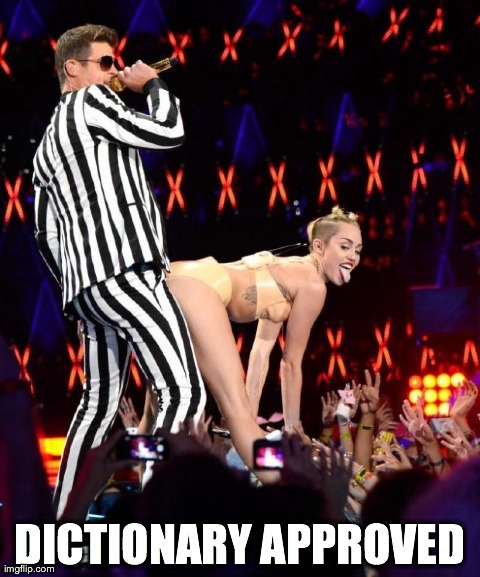
Thank goodness there is something to talk about besides “twerking.”

Oh wait, no, there’s not, because even the good ole’ dictionary is in on the butt-oscillation trend. It was announced yesterday that a bunch of internet-originated terms, including “twerk” of course, have been included in the Oxford Dictionary Online.

Twerk it.

Cue massive moaning and gnashing of teeth and cries about how the world is probably coming to an end, or worse, English is so over.

There’s a whole crop of “new” words that have been officially recognized by an official-sounding dictionary linked to an actually official dictionary; you can read the whole list here.

(But you probably won’t; it’s TL:DR. Oh well).

And, as always happens when dictionaries do this, people freaked out, because there’s a fundamental misunderstanding about the point of dictionaries and the validity of language.

Here’s the truth: Putting a word in a dictionary does not make it “official.” It does not make a word acceptable to use in all cases, and it doesn’t mean it’s more or less legitimate than other words people use. It just means it is a word that has reached an arbitrary threshold of use in pop culture and someone thought maybe you’d benefit from having a definition to help you in the event that you run into it in the wild and don’t know what someone is saying.

That’s it! That’s all it means!

As for appropriateness, you should use whatever words you need to in order to tell your story. If that means inventive, morphine-induced Jabberwockys–power forward, friend! If that means a carefully culled vocabulary from your Scrabble dictionary? Blessings be upon you. One of my favorite books of all time progressively eliminates letters, making it amazing and a challenge I can’t wrap my head around. And that’s great!

As an editor and a reader, I might flag something that I don’t think fits or makes sense, but I’ll never tell anyone they can’t use a word if they want to, dictionary-approved or not. Go ahead! Have a ball!

Actually, I think the Oxford Dictionary Online deserves props for lighting the internet (temporarily) on fire. I mean, how often do you get people to talk about a dictionary, anyway?

4 Comments

Filed under Editing, writing

Waiting Game

It feels like all I’m doing. Waiting. Waiting to hear back on the status of my works. On if it even “works.” Waiting for November, for the full-tilt NaNoWriMo madness I love and dread every year.

Last October, I entered my first book, Alt.World, a science-fiction dystopia, into the insane HarperVoyager open submissions cattle call. I figured, “why not?” I had it edited, had sent it around for queries and got lots of rejections, gotten disheartened and set it aside. But I still love it (do you ever not love your works, even if they don’t take off?) so I figured it was worth a shot at one of the 12 digital titles Harper Voyager crazily said they’d take from open calls.

Except they got way more of a response than they expected–more than 4,500 entries in two weeks. So that kind of blew their whole timeline, and they said it would take longer. So I put on my patience hat and worked more on Undead Rising, my second novel, a zombie-survival gamebook.

In May, they said they’d read through and rejected 3,595 of those submissions, leaving 948 in their “further review” pile. I hadn’t heard anything–I’m in the further review pile.  So that was exciting, and I was content to keep waiting. After all, they promised to check in more frequently.

It’s the end of August, and no further updates. I’m checking my junk email folders twice a day out of pure paranoia. The internet rumors say maybe they’re down to fewer than 400, but no one seems to know for sure and I won’t take it as gospel until they say so. Here’s hoping they haven’t forgotten/overlooked mine somehow.


Patience. Patience.

And then there’s the manuscript for Undead Rising, which two agents seemed excited about at DFW Writers’ Convention in May, resulting in two glorious requests for fulls. It’s hard not to pester them (okay, I pester a little. Just a “hey, how’s it going?” email once every month. Just one sentence, I swear. Teensy pester…).

It’s hard to wait.

My writing brain can’t live in the same space as my business brain, it seems; I have to switch one off to work on the other. And lately, with all this waiting, my business brain has been fussing at me a lot.

Any suggestions for winning at the Waiting Game, folks? I felt like I was doing well at patience, but it’s starting to wear on me by now. Let me know your advice in the comments.

4 Comments

Filed under Publishing, writing

You’re Equal to Me in Every Way…For A Lady

The full cast o’characters.

In fighting the late-summer heat, I recently picked up a new-t0-me video game: Dragon Age: Origins. It’s pretty cool; you are on a hero’s journey to become a Grey Warden and travel from town to town fighting monsters and trying to save the kingdom. There’s a lot of customization, and the choices you make throughout will affect the outcome of the game.

And you have to make a lot of choices. (It’s almost the Starbucks of video games: and would you like whip with that? (I’m easily overwhelmed by Starbucks….can you tell?))

The very very first choice, though, is building your character: Will you play as a male or a female?

In some ways, the fact that it’s even an option to play as female is a great thing; in some games, forget it. You’re just a white-ish athletic dude no matter what. So I always enjoy games that give you more versatility in that way.

The prompt as you choose your playable gender says Fereldon, the world, is a pretty equal place, with opportunities for both men and women in the three playable careers–warrior, mage, and rogue. That’s important, because I like to know when I’m cutting myself off from parts of the game with my choices.

So I built my female human mage with red hair and dark eyes and went happily on my way.

Except I was constantly reminded by other characters (non-playable characters, or NPCs, for you non-gamers out there) that woah, hey! You’re a lady!

In some cases, it made sense and fit with the story: when Morrigan the wild witch met me, she was more friendly because she carries a general dislike for men, having grown up in isolation.

But most of the time, it doesn’t. It’s more like “wow, you’re a fighter and a lady? Whodathunkit?!” In a world that is supposedly equal. And where I periodically see other female warrior/mage/rogues running around.

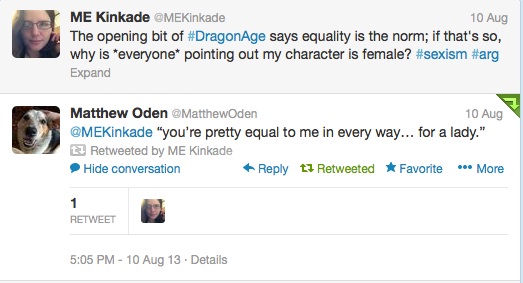
It just got tiresome. So this happened:

dragonage Twitter

Think about this in your writing. If your character is something different, that’s fantastic! We need more minority characters–not just female, but also non-white nationalities. And that should affect the story where appropriate–as in the case with Morrigan in Dragon Age.

But when all the “NPCs” in your book take time to comment on the difference, you aren’t showing that there’s equality. You may be telling the reader that there is, but what you’re showing is exceptionalism. And it’s pretty tiresome, both in our stories and just to read. (See: Repetition)

(There may be stories of exceptionalism where it is still relevant–“wow, she’s the only one who can do that!”–but I personally think the gender-based exceptions are played out. Do something different.)

Don’t tell me how equal I am: just let me get on with the monster-fighting and world-exploring. That’s how I KNOW I’m equal–because I can definitely kick some undead monster butt if you’ll just let me get on with it.


4 Comments

Filed under Feminism, video games, writing

Is There an Echo in Here? Editing Out Repetition

Inspiration can come from the damnedest places, and so today’s editing lesson comes from a rather old inspiration: the Bible. Specifically, the book of Daniel, chapter 3.

You’ve probably heard this one, the story of the three guys who refused to worship a golden idol and were thrown into a blazing furnace but didn’t die because God was down with their loyalty. (Veggie Tales has a pretty fun take on it if you want a refresher–Rack, Shack, and Benny).

But this is an editing lesson, not a Bible lesson. Bear with me here.

If you go read that first link, you’ll get a sense of what I’m talking about. Daniel Chapter 3 is really repetitive.

  • “the satraps, prefects, governors, advisers, treasurers, judges, magistrates and all the other provincial officials” –stated 3 times
  • “the sound of the horn, flute, zither, lyre, harp, pipe and all kinds of music” – stated 4 times
  • “Whoever does not fall down and worship will immediately be thrown into a blazing furnace.” -stated 4 times (one has a different tense, but close enough)
  • “Shadrach, Meshach and Abednego”–always listed together, just like that, is repeated 11 times.

To be clear, it’s not that long a chapter. Let’s just say the congregation got pretty restless during the reading. It was like “come ON already, get to the point!”

Shel Silverstein does repetition right. I love “Lazy Jane.”

Repetition has its place–it’s a fantastic way to provide emphasis, and you should certainly have repeating themes throughout your book. Stephen King in On Writing talks about how he specifically went back and added more mentions of blood and blood-related imagery to Carrie to help sneakily prepare the reader for the bloody mess at the end.

But often writers end up a bit more like the book of Daniel, just repeating things for the sake of it. I mean, I don’t think this chapter would have been changed at all had some of those “Shadrach, Meshach and Abednego”‘s been changed to “the three men” or, heaven forbid*, “they.”

A lot of the time, our repetitions are smaller: “crutch words.” Every writer has a certain proclivity to use the same word over and over and over and over. (Mine is “actually.” I shudder when I reread my manuscripts and find it everywhere. Bleah.) Another one I see a lot in my editing is “seemingly” or “seemed to.” (For the most part, if something “seems to be,” you can just cut it out entirely…if you’re locked into a character’s perspective, everything they perceive can just be reported.)

The problem with this kind of needless repetition is a) it bores your reader which b) makes them less likely to keep reading. It slows the pace down dramatically, which can kill your pivotal scene. Even if you don’t notice your crutch words, I guarantee the reader will.

Repetition, particularly of “crutch words” because they’re harder to notice when its fresh, is one of those things that justify an editor, or at least a second read after you’ve put it down for awhile. Your grammar and spelling can be perfect, but if you’ve got a bunch of repeated phrases, it’s going to throw the reader out of the flow. But take the time (and, often, money) to get it thoroughly edited, and you’ll cut down, if not outright cut out, a lot of the problematic repetition.


*This is a joke. Get it? Heaven forbid? Bible? I’m hilarious.

Leave a comment

Filed under Editing, writing

A Journalism Major Who Doesn’t Subscribe

Newspapers have been in the news lately, not just writing it. The sale of The Washington Post to Jeff Bezos and the Boston Globe to John Henry made serious ripples–and well it should have. The reversion of newspapers to private hands is a big shift from the publicly traded past.

In the midst of all this hubbub, I have a confession: I majored in journalism in college and worked for three newspapers… but I’ve never had a newspaper subscription in my name. And I don’t plan to.

It feels a bit traitorous to admit that, but it’s true. Now don’t get me wrong: I loved, loved working for a newspaper. I don’t know if I’ll ever be so happy with my work as I was at a copydesk just before deadline. It’s exhilarating, intense, heady work. You know your tiniest mistake will be nitpicked by hundreds if not thousands of readers, but you also know you can maybe change minds. You can certainly inform, and entertain. It’s intoxicating, and there is nothing like it.

And if you ask me if its The End of Newspapers, I’ll tell you no, probably not, and I’ll really hope that’s true. I think the world, if not the United States, needs a thriving Fourth Estate. I think it’s very important, highly undervalued work. Those people work very very hard for very little pay–unless you’re a bigwig, you’re barely making ends meet. No, people get into journalism because they are hungry for it; it’s a passion. And it’s a passion that is increasingly derided and pooh-pooh’d, and that’s a damn shame.

I do think newspapers will stick around, but they’ll probably shed some if not all of the paper. And that’s as it should be, really, though the Guys On Top have been really loathe to admit that. And that’s part of the reason that most news organizations have been very slow to adapt to the electronic revolution.

My EIC was strikingly like J. Jonah Jameson, the EIC from Spiderman. My first week of work, he dumped me out of my chair for sitting cross-legged.

I saw it. That’s why I got out. I saw my bosses working 14-hour shifts, literally never getting to see their children because of their hours; I saw them storing up their sick leave for years so they could have a needed surgery without losing their salary during recovery, only to have management put in a new policy just before the schedule surgery, wiping out all unused sick leave–to “save money.”  The people on the ground are miles away (sometimes literally) from the people making the financial and organizational decisions.

I worked with THE website guy (yeah, there was only one), who had to maintain the website, learn all the coding, and try to contain the fires in the comments section (unsurprisingly, he often failed). There was no way he could get ahead of the curve for online; the bigwigs wouldn’t let him. They had only begrudgingly created a website, anyway, why would they actually bother to staff it? (Nevermind that the website was the only way our readers could find out what was going on in their homes after they had to evacuate for a hurricane; print still came first).

It was infuriating to me when–in our rather low-morale workplace–the editor-in-chief, a guy who reminded me of no one so much as J. Jonah Jamison from Spiderman, rounded up the staff and told us that although our paper was the highest-earning publication in the company, it wasn’t enough, so more corners were going to have to be cut. So they cut, cut, cut from the very heart of the publication, the parts that made people care, and learn, and desire, to keep the stakeholders–stock holders on Wall Street–happy, while our newsroom became ever more empty, ever more decrepit.

It would be poetic if I said I quit out of moral outrage for the industry, but that’s not true. I left because I was terribly alone, worked weird hours in a small town and couldn’t meet anybody friendly, and I couldn’t stand the idea of riding out another hurricane after I’d been without power for 2.5 weeks. It just didn’t seem worth working so incredibly hard for an industry that didn’t love me back.

So I said goodbye. I didn’t want to work at the newspaper in my hometown after it went through three waves of layoffs; I knew it wouldn’t matter how good I was the next time someone upstairs felt the margins weren’t profitable enough. What was the point of building a career when it could be taken from me at any moment? So I moved on.

And so far, that has also meant saying goodbye to subscribing; for one, I can’t afford it, a cruel irony for the newspaper publishers, who have lost advertising and so “must” raise subscription fees.

I wish Jeff Bezos and John Henry, and the staffs of the highly regarded Washington Post and Boston Globe, much luck, and good leads. I hope that private owners can maintain the respect for good journalism without giving into the merciless bottom line.

I’m sorry I can’t be with you on that journey.

3 Comments

Filed under Publishing, Uncategorized