A Reviewing Problem: Women Genre Authors Less Likely to be Reviewed

From time to time, you’ll hear bouts of outrage from literary circles. Lately, the spats seem to be about who is getting reviewed.

Overwhelmingly, the arguments are that books by women are reviewed less frequently, particularly in the biggest platforms. Recently, there was another tiff, when a magazine showed that female genre authors (science fiction and fantasy) were having the same troubles (so it’s not just a “chick” book issue).

The most recent breakdown is a little confusing, and it’s hard to tell where the bias may be originating (is it because review publishers are picking books by men? Is it because men are reviewers? Is it because fewer women are getting published in the first place? I haven’t gotten good answers to those questions).

I have to say, as a genre writer who happens to be a woman? That sucks.

But I review what I read. My main way to choose a book to read (and therefore review) is  mostly “hey, what is lying around that I haven’t read yet”? Lately there have been subjects I’ve been researching, so that has meant that I picked certain books, but I did not choose them based on the author or their gender. It was all subject matter.

That said, out of the 12 books I’ve read so far this year (when I got serious about doing reviews regularly), only 3 were written by women (A Practical Wedding; Quiet; Publishing and Marketing Realities). If we’re stretching, we can add Saga, a comic I read religiously and which is drawn by Fiona Staples–but it’s written by Brian K. Vaughn, so that’s partial credit at best.

Should I be choosing my books to read based on the gender of the writer? I don’t think so. But then how can I–as someone who reviews things sometimes–help contribute to the review-pool for female genre writers like myself? It’s a tricky thing to think about.

What do you think about the problem of insufficient reviews for women writers?

6 Comments

Filed under Publishing, Reviews, writing

Path to Publishing: You Wrote a Book, Now What?

After the DFW Con, a family friend heard I had requests for manuscripts from agents (squee!) and asked what the process was. When you’re just starting out, it’s really hard to get a sense of how this whole crazy publishing thing works.

To help you out, here’s a summary.

  • Write a book.
  • Celebrate! You just wrote a book! That’s really freakin’ hard! Most people never even get that far, so bask for a bit.
  • Give it a rest, then go back and edit it with “fresh eyes.” Make it polished.
  • Consider giving it to someone else to edit. Or give it to a “beta reader” who will be honest with you.
  • Decide whether you want to self-publish or go the traditional route.

If you want to go the “traditional route”:

  • Write query letters. They’re like cover letters/resumes for you and your book.
  • Send your queries to agents after you’ve carefully researched them. (The internet is your friend).
    • An agent is the first gatekeeper. You need an agent to get a publisher. You should never have to pay any reputable agent anything to read your stuff. They get paid by taking a commission off of anything you eventually publish. Sort of like a real estate agent. Typical timeline for acquiring an agent? 6 months to a year or longer.
  • Go to events, like the conference I just attended. Turns out a risk I was taking in my query was the reason I was getting rejected. Meeting in person got me the attention I needed, and I got requests.
  • Find an agent you like (and who likes you) and sign a contract saying you’ll work together.
  • Your agent will then sell your manuscript to publishers. This can take 6 months to a year.
  • Then, if they want to publish you, you’ll get a contract, an advance, and (hopefully) royalties.
    • They’ll do edits, a cover design, prepare marketing materials, provide some advice on how to market yourself, and make all the decisions related to actually constructing a book. You’ll get the prestige of being published by a “big publisher,” (even if it’s not one of the “Big Six”**) and know that someone other than your mom and dad was interested in your work. You’re more likely to have your book sold in print form from a bookseller.
      • The “Big Six” are: Hatchette; Macmillan; Penguin Group; HarperCollins; Random House; Simon & Schuster

The self-publishing/indie path (they are separate, but overlap in a lot of ways):

  • Hire a reputable editor to look over your work. Yes, you’ve already edited it at this point, but the biggest distinguishing feature of a poorly constructed self-published work is bad editing. Do it again. Be willing to invest in your work.
  • Decide what format you’d like to publish. Is it a book that needs to have a physical copy? Is ebook-only ok? This really depends on your goals and the kind of book you have.
  • Hire a cover design artist. You need a cover even if you are publishing e-book only. I suggest looking somewhere like Writer.ly.
  • Here’s where it gets tricky. There are several places you can self-publish, and lots of resources about them. Do your homework before you give your book to anyone. While there are reputable places (Lightning Source, PubIt!, CreateSpace), there are also more sketchy places that aren’t suitable for a large-scale book production (Lulu, AuthorHouse, etc), and there are people who are outright looking to scam you. Don’t let them. Do your research first.
  • If you’ve got an ebook, format and upload your book to all the places you can (Smashwords, Amazon, Nook, Apple). Again, do your research, because this gets complicated. (If you don’t care about saturation, just upload it to Amazon. That’s the easiest and has a pretty solid market share.)
  • You make all your design, book construction, marketing, and pricing decisions yourself. You also get more of the royalties per book, but you’ll sink a lot of time into this process, and there’s still no guarantee that anyone will buy it. You get speed, and more per book, but may not end up with a printed copy to show off in your bookcase.

Leave a comment

Filed under Publishing

Review: Leviathan Wakes

Leviathan Wakes (Expanse, #1)Leviathan Wakes by James S.A. Corey

My rating: 5 of 5 stars

If you like space operas, you are going to LOVE this book. If you don’t know if you like space operas because you’ve never encountered one before (they’ve gotten to be a bit rare), that’s ok: If you like “Firefly,” or “Alien,” or “Armageddon,”and maybe a bit of “The Walking Dead” and “Law & Order: SVU,” you’re going to like this book. Heck, if you like “Star Trek: The Next Generation”‘s interaction with the Borg, or if Gaius on “Battlestar Galactica” was your favorite character, you’ll love this.

If you see “Leviathan Wakes” in the bookstore and are terribly intimidated because it’s a monstrously thick book, get over yourself and buy it anyway. Or buy the ebook. But you should absolutely read it.

“Leviathan” is a bit slow to get going. There’s a weird mystery from the very beginning, but it took me awhile to “get it” and to really understand the monstrosity of it. You’ll start out getting acquainted with the rough-and-ready crew of an ice hauler, just going about the normal efforts of transporting ice from Saturn to the colonies out in the asteroid belt. But of course, things go wrong.

You’ll also meet Detective Miller, who shows you a thing or two about how to deal with crime in a Belter colony. (Hint: Mess with the atmo, get thrown out an airlock). He’s a space version of your tired old tough-guy TV cop, and you’ll love him for it, even as he slowly breaks apart.

I don’t want to give too much away, but the rest of the book involves:
-terrifying monsters (hint: zombies)
-sentient alien weaponry
-the challenges of dating in space
-intra-galactic battles
-mystery
-crime
-cunning diplomats
-against-all-odds scenarios

I think that just about covers it–but, admit it, I had you at “sentient alien weaponry,” didn’t I?

This book is a heckuva lot of fun, and really defied my expectations. Just when I thought I knew what was coming, it took another shocking turn. I really appreciated the respect for the science; you get a really good look at the many challenges of living in/colonizing space, and how that would change not just the solar system, but the people, and how those challenges might be overcome.

Great read. Cannot praise this story enough. Go get it!

View all my reviews

Leave a comment

Filed under Reviews

Get a Hobby, You Bum!

For some aspiring authors, writing is serious business. And, sure, I get that. You want to do something well, you want others to like it, you want to get published and make all the money (or at least enough).

But after reading article after article about writing as a business, it starts to feel like this:

And that, I think, is a little much.

I don’t think writing or book-making or whatever should be your end-all-be-all. In fact, I think making it so would be a quick way to stifle your creativity. You need to do other things sometimes, too! Take on new experiences! In other words, get a hobby!

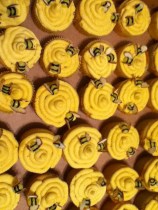
honeybee cupcakes

I have a couple of hobbies, and while that sometimes makes scheduling a bit tricky, I think it also makes my life richer.

For example, I bake overly complicated cupcakes.

(These had buttercream icing swirled, yellow jellybeans decorated with black icing, and almond slivers for the wings to make honey pots with bees for a baby shower.)

I also do a lot of random crafts. I went through a wreath phase earlier this year, and also made this door hanger.

The point is, do something else sometimes. It’s good for you.

And, you never know: you might get a great story idea while you’re AFK.Speak Friend and Enter

3 Comments

Filed under Uncategorized

Do the Shuffle: Zombie School

Whattya think? Could you make it through zombie school?

Leave a comment

May 11, 2013 · 10:08 am

Disconnecting from Constant Connectivity

It’s something of a joke, the amount of time I am on the internet. At my day job, much of my legitimate work requires me to be connected to the ethernet–and a great deal of my screwing-around time does, too. Then I come home, and…play on the internet some more. Or maybe I watch Netflix, through my internet connection. Or check the weather on my smart phone.

I’ve become one of those people.

In fact, three years ago, before this day job, before the smart phone, before Netflix, I had already identified myself as having an affinity for the online. It was part of what inspired me to write “Alt.World.”  I took the idea to some extremes in that book, and the three weeks I was completely cut off from the internet after a hurricane informed the story quite a bit. (What do you do when you can’t get the service to which you are addicted? Where literally your whole world exists? What do you do with yourself after that?)

That’s why I found this article, “I’m Still Here: Back Online After a Year Without the Internet,” so interesting.

The author, a guy about my age and with a similar background, decided he was too addicted to the internet, and decided to challenge himself by…not being addicted to the internet anymore. By quitting cold-turkey.

He was hoping for enlightenment, but didn’t find any. Or rather, he found some: he found out a lot of his problems didn’t exist because he was distracted by the internet–the way, I think, he was secretly hoping.

Things would certainly be harder without the internet. So much happens there, that one person opting out means they are opting out of a whole lot more than an information source. They’re opting out of casual friendships. Of contact with people from far away. Of easy-to-access navigation and dinner ideas and dating services.

I take internet sabbaticals. When I go on vacation, I don’t plan on taking my computer with me. I write things down in a paper-and-pen notebook, so I can remember the experience later. I don’t “check in” anywhere with any apps. I try to soak in the experience.

And I think those kinds of breaks are useful, and good. But I also spend at least an hour online, catching up, as soon as I get back in town.

Do you need the internet? Could you go without? What do you think would happen if, for some reason, society suddenly lost the internet?

Leave a comment

Filed under writing

You Are My Sunshine

sunshine-awardI’m an award-winning blogger now. That’s right. It’s true.

TheParasiteGuy “nominated” me for this bit of silliness.

The rules for the Sunshine Award:

  1. Post the sunshine award logo
  2. Accept the nomination and link back to the nominator
  3. Answer the questions
  4. Nominate ten other blogs(or sites) and inform them of the award

My answers
(the copyeditor in me really want to be pedantic and point out that none of the below are actually questions…)

Favorite color: Red

Favorite animal: Big cats (particularly caracals!)

Favorite number: 6. It’s curvy and sensuous.

Favorite non-alcoholic beverage: Tea, Irish breakfast, hot.

Favorite alcoholic beverage: Don’t know that I have one, but I prefer those that taste like candy.

Facebook or Twitter: Eh. I’m kinda unimpressed with both right now.

Passions: Baking adorable and delicious sweets, writing, editing, and doing crafts of all sorts.

Giving or receiving gifts: Both, of course!

Favorite city: Chicago was pretty swell.

Favorite TV shows: Alias; Star Trek: TNG or Voyager; My Little Pony: FIM (seriously, it’s fantastic)

5 Comments

Filed under Uncategorized

Total Recap: DFW Writers’ Conference

DFW Writers' ConventionOne of the things discussed in a session at DFW Writers’ Conference this year was not to blog about writing. I’m gonna go right on ahead and break that “rule,” because when I was first starting out, there were so many mixed messages and people with a bias making proclamations that it was hard to tell which way was up. I wish I’d had someone “in the thick of it” to tell me what was going on, so I’m going to provide that resource.

I’ve had a little bit of time to recover from the sugar-and-caffeine soaked two-day marathon that is DFW Writers’ Conference, and I’m here to tell you it is money well spent. I was a little nervous going in that I wouldn’t get as much out of it as I had last year, in my first visit, but this year was better. I was more comfortable, had better business cards (based on experience from the year prior), and knew to wear a sweater because some of those rooms are cold and because I sweat with nervousness during a pitch. All good lessons!

If you’re on the fence about attending a writing conference–maybe you’re worried about the cost–I’d recommend you do it. I can’t vouch for any but DFW Con, as it’s the only “big” conference I’ve attended, but if you even think there is something you’ll learn, go. And if you’re querying agents, DEFINITELY go.

On that note: My pitch session(s)
At DFW Con you get one pitch session with an agent included in the ticket price. You look through all the attending agents, pick your top three, and are assigned a pitch session.

A pitch session is basically like speed dating. And you’re speaking on behalf of your book. You have 10 minutes to convince the person across the table that you have something they could sell. If they’re interested, they may ask for you to query them, or for pages. Or, if you’re really lucky, for a full manuscript.

She asked for a full manuscript!

And then, at DFW Con anyway, you can pay $40 for a second pitch session. So I did that, with another agent who I’d seen around and who I thought maybe would like a zombie gamebook.

And then SHE asked for a full manuscript.

So I’m like:

That alone made the conference worth it to me. Especially when my query letter was read at the Gong Show at the end of the conference, and my letter got triple-gonged before they even read the third line (no, I’m not telling you which letter it was. I’m embarrassed. I swear it was going to be SO GOOD, if they had only read a little further!)

But that explains some of the trouble I’ve been having. I’ve gotten nothing but rejections from my letter. If I was only sending out that letter (continuing to make the mistake/take the risk), I may never have gotten the chance to put my manuscript in front of an agent. By going to DFW Con, I get to do it TWICE. That’s huge.

Even without those parts of the conference, there’s a lot to learn. I went to an incredible session on how to do your taxes as a writer. In fact, I wish I could explain it well enough to do a post on it, because it will be so useful. (The short version: It’s pretty complicated).

I also got to meet lots of other writers, of all kinds of backgrounds, and got to hang out with some pros. I took sessions on grammar and dialogue and social media. I got the inside scoop on the different royalty rates (and I WILL be blogging about that. That was too good not to share), and had an excellent session with Jenny Martin on finding your voice.

In short: Conferences do a lot for you. Go try one out.

And let’s dance a little more.

10 Comments

Filed under Conventional

Prepping for DFW Writers’ Con

This weekend I’ll be attending my second DFW Writers’ Convention, held in the Hurst Convention Center.

It’s the biggest gathering of writers of all sorts in my area, and–importantly!–is attended by authors of all stripes, as well as editors, marketers, agents, and other folks interested in books and writing. It’s kinda a big deal.

I went last year, and it pretty much scared the pants off me. Like, I don’t think I could have been more nervous if you’d told me it was a walking-on-hot-coals-over-a-volcano conference. But I went, met some nice people, got to chat with two agents, and felt it was overall a good experience.

So I’m trying to prep for this year. My goal last year was a) to show up (accomplished!) and b) talk to people, even though I found that really hard. This year, I’m going to try to “connect”/”network” with two people. That sounds low, but I’m not naturally comfortable with small talk, so my goal is basic: just make a connection with two people that can continue after the conference.

I bought two sets of business cards, one advertising my book and one advertising my editing business. I’m planning out my outfits and going to build my schedule of what I actually hope to attend and where (so hard to choose when good classes are simultaneous!).

I’ve been doing a bit of research on Louise Fury, who I’m lucky enough to have a pitch session with, trying to plan out what might appeal to her. I feel more relaxed about it than last year, because now that I’ve done it (twice!) I know a little more what to expect, and my expectations are a little lower. (I’m writing a genre that has fewer affiliated agents and guests, unfortunately, so I am not sure Ms. Fury will have a definite interest in my novel, but she has such a great reputation with her clients that I hope to get a lot out of our talk.)

Maybe it’s just because we’re still a few days out, but I’m feeling a little more zen about the conference. Perhaps it’s just the “calm before the storm.”

If you haven’t yet attended a writer’s conference in your area, I recommend it. It makes you feel so much more “official” and you’ll learn a lot. It can also be a humbling experience; you’re definitely not the only person with a great idea looking to get some attention.

If you have, what is your best advice?

6 Comments

Filed under Conventional, Publishing, writing

Review: A Practical Wedding

A Practical Wedding: Creative Ideas for Planning a Beautiful, Affordable, and Meaningful CelebrationA Practical Wedding: Creative Ideas for Planning a Beautiful, Affordable, and Meaningful Celebration by Meg Keene

My rating: 4 of 5 stars

I would like a pocket-size version of Meg Keene to carry with me as I go through the wedding planning process. She’d be amazing! Better than an angel and devil on your shoulder, my mini-Meg would tell me to breathe, not freak out over pretty pictures of things I can’t afford, and talk me through the inevitable tough moments as I plan my wedding bash. A little voice of sanity in an insane bridal world, if you will.

This book was outstanding, and I can’t recommend it enough. Compared to the others, which may claim to be about being budgeting while encouraging you to “splurge” on 100 different things, A Practical Wedding is, well, practical.

Look, if you want a book to make you feel princessy and floofy and special-snowflake and to reassure you that you HAVE to do a hundred million idiotic things, go read something–just about anything–else wedding-related. Heck, forget buying a book and just sign up for every wedding website out there. And then book your honeymoon to an asylum where the internet is blocked, because it will probably drive you Cra-ZY.

If you’d rather be realistic about your wedding and learn how to negotiate the challenges and fights that seem to come with the territory, pick up this book. Additionally, it doesn’t assume much about how things “have to be.” This is a book that would work well for an atheist couple, a gay couple (though a lot of the language is still habitually bride-centric), a Methodist couple, or a freewheeling-whatever-goes couple. In addition to the fantastic real-world bride stories (covering everything from weddings after tragedies to doing your own floral arrangements), I really appreciated that Keene included the actual history of weddings. Long story short: If someone says you “HAVE” to do it because “tradition,” odds are it’s an imaginary tradition.

I had originally planned to read this book then pass it on to another engaged friend…but now I’m not sure I can give it up. I can already see myself going back and rereading sections as it comes down to the wire to actually handle the issue for that chapter. I’ve already asked my groom to read the extremely sensible pre-marriage questions section with me. I’m considering passing this book on to my mom to ward off “tradition!” fights.

But you should definitely pick up a copy if you’re engaged and overwhelmed! (Or just read her website. But really, you’ll want the book, too!)

View all my reviews

2 Comments

Filed under Reviews