Category Archives: Publishing

Filling Buckets

It’s been an emotional year. I’ve attended two funerals, and wasn’t able to go to two more. These deaths were all unexpected, even for the elderly man and the friend who had cancer. No one was ready.

I’m not very good at talking about what these deaths have meant to me. Even though I know I should have gone to the receptions to support the families of the deceased, I couldn’t make myself do it. What could I possibly say? Instead, after accepting the well-intended but poorly timed greetings of those I hadn’t seen in a long time, those people who were brought back into my life only by our mutual sadness over the life of a friend, I retreated to my car, where I cried big hiccuping tears until my heart stopped hurting and I could breathe again.

I wasn’t particularly close to any of those who died this past year, but I cared for them, and those who loved them, deeply, and sometimes that empathy was like a knife to my heart. I continue to mourn for the sadness of those families still trying to recover from that pit of grief, some nearly a year later.

I don’t know if I am alone in this, but the thoughts of those who have, to put it euphemistically, passed on linger always on the edges of my mind. Sometimes I close my eyes and can see, perfectly clearly, my cousin, who died in an unnecessary and completely preventable drunk driving accident several years ago, lying unnaturally still in the coffin surrounded by perfumed white flowers. I’m starting to feel crowded in by thoughts of those who have passed; I think of them in the grocery store, in the morning as I get ready for work, in idle and unexpected moments.

I say all of this by way of explaining that I’ve been thinking about death a great deal this past year, about what causes it, whether we can understand it, what it means.

My Netflix DVD of “The Bucket List” arrived the same day that I was notified of the death of a family friend. Considering the content, I put it on a shelf and ignored it until I could wrangle my feelings.

As movies about an impending death go, it was pretty terrible. (Last Holiday was excellent, though, and I highly recommend it.) It was trite and predictable and completely lacking heart. But it, coupled with the weight of the funerals I’ve recently attended, did make me think about what things I want to do before I shake off this mortal coil.

One of those things was “write a book.” By now, fueled forward by NaNoWriMo, I’ve written three. I find it curious that, while I would like to be published — I would definitely like to be published! — that doesn’t make my list. I don’t feel like my life will be any less fulfilled if that doesn’t happen. Other things matter more, like seeing Ireland or getting married or controlling my career’s path. Writing the stories, that was the important thing.

I need to keep working on my bucket list; so much of it right now is very vague and undetermined. But I’m curious as to where ‘publishing’ falls on other writers’ lists?

And maybe, just maybe, I’ll change my mind about the importance of publishing when I’m not as melancholy. Maybe.

Is publishing an important life goal/bucket list item for you?

6 Comments

Filed under Publishing, writing

Whatever You Do, Don’t Push ‘Publish’

You’ve finished NaNoWriMo! You’ve completed a whole book in a month! You are seriously hot stuff! Go get a cookie. No wait, get two. You’ve earned it, kiddo.

“But wait,” you’re saying, “I’m busy right now. I was just about to publi–”

STOP RIGHT THERE, YOU! Yes, you.

Don’t push that button.

This post was originally going to be called “Advice to Past-Me,” because I have SO been there — and still step over there when the flights of fancy get a bit giddy — but I realized this feeling probably applies to a lot of people coming down off that writing euphoria.

I know the feeling, believe me I do. You have just written the most amazing piece of writing the world has ever known. You are going to be so famous. Your book is like the lovechild of J K Rowling, Isaac Asimov, and all the best parts of your favorite movies. It’s gonna be so big, you guys.

Coming down off that writing high is exactly like being a 15-year-old who just had a first date and held hands for the first time. OMG! That was, like, the best ever! Your heart is all fluttery and it feels like it must burst if you don’t show the world RIGHT NOW because this is your moment and you owned it and nobody understands.

But I beg you: Don’t publish right away.

You may be right. I hope you are! I hope your book really is the next best thing. But if it is, then it won’t be hurt by what I’m going to recommend, and it might save you from the pain of rejection.

The first thing you should do? Walk away from your work for a month, minimum. Go on, you’ve earned the break! And if you still want to keep writing, go do something else. NOT a sequel or whatever. Just something totally different.

After that month, gently crack open your manuscript again, give it a read. It may not look as shiny as it did when you put it down; that’s ok, just do some edits, put in the work. If it does look amazing, first of all, you are a lucky duck. Second, get another opinion. It can be the opinion of your mom or your husband or your kid or your neighbor down the hall, but do tell them to be honest with you.

They’re not going to be honest with you. They’re going to try to be nice to you. But they might try to gently tell you they didn’t “love love” that one little teensy part. This will feel like ultimate betrayal, but this is what you need. Go work on that part.

Then, share your work with someone else, someone less close to you, if you can. Someone who can more reliably destroy your feelings for the sake of good work. (Warning: these people are often hard to get to actually read the danged thing). Take it to a critique group, if you have one.

This is going to feel like someone is stepping on your heart, crushing it into jello. But that’s okay. Your work will be better for it.

Then get your work edited, by someone who is not you. If you are exceptionally lucky, you know someone who is gifted in this area who will do it for free, but these people are special snowflakes, so don’t be discouraged if you need to pay for it. In fact, I don’t trust any unpaid editors, personally. If your work really is the best thing ever, you want it to shine! Stories with typos do not shine, as a rule. Put your money where your mouth is!

(If you don’t know where to find an editor, start Googling. I like Writer.ly. I also happen to be a copy editor, and editing is one of the things I love to do… )

Now, after you have gotten your manuscript reviewed a few times and it’s edited, now maybe it really is the best work ever.

It’s also probably been at least six months since you finished writing it. Maybe it’s a year. But that’s okay! A novel is not a mayfly, emerging whole overnight. It’s an ant colony; it takes time and coordination and help to build it up into something incredible.

Now… now you can publish. Or you can start the process of contacting agents and trying to be traditionally published.

I know that all might sound mean and/or out of touch, because that initial excitement is SO heady. Don’t lose that excitement, but do try to put it in its correct context. That’s really hard to do, particularly when it’s your first rodeo. Slow your roll, new writer. It is more rewarding then publishing prematurely and facing the barrage of poor reviews.

Don’t do it. Not yet, anyway.

4 Comments

Filed under Editing, Publishing

Smooth Sailing Ahead

Thanks to all those who participated in my NaNoWriMo poll!

I got a range of votes, including the excellent write-in for “goblins” (really great idea!), but one thing really surprised me: The option “Don’t write a sequel to the book you haven’t sold yet.” got 0% of the votes.

I have a confession: That was really the question I was struggling to answer. My first book, Undead Rising, is still out with an agent. It’s been six months; I’m sending her an email next week to let her know I’m going to start sending it to other people. Everyone who has read that book has LOVED it, but the non-responses I’ve gotten from agents were deeply dispiriting, and I felt like maybe it wasn’t a good enough idea.

But everybody thought it was a good idea to keep writing gamebooks/interactive novels/monster stories. I’m floored, and uplifted (is that a contradiction? I don’t care.).

I’m grateful so many folks weighed in.

The winner: Pirates!
Which is super, because that’s a really ripe genre I can rob, and let’s be honest, I need a lot of material from which to plunder.

(Plunder. See what I did there? Brace for a whole passel of puns in this book, my friends!)

Yo-ho-ho, away we go!

Pirates!

2 Comments

Filed under Publishing, writing

Waiting Marathon: Harper Voyager Open Submissions Top 12%

I submitted my first book, Alt.World, to the Harper Voyager massive open submissions experiment back in October of last year. They were completely overwhelmed by the huge response–which just shows how many eager authors there are still struggling to get an agents’ attention–and their original plan to finish by January was completely abandoned. So we’ve been waiting awhile.

There was another update this week, which is great! They are now down to 550 submissions out of the original 4,543 (no wonder it’s taking awhile!), and–as far as I know*–I’m still under consideration.

For those rare birds who can do both math and English, that puts us at 12.1% remaining, and the odds of making the final cut (assuming they stick with keeping only twelve) have greatly improved, from a 0.264% chance to a 2.2% chance. So, woo!

Now I say “as far as I know” because they offered up an email address by which the contenders could ask the status. I did that months ago, and never heard back, and it turns out that the manuscript of one guy waiting patiently all this time hadn’t actually gotten into the system, so that’s scary. But I did get an email confirmation that it got to HV originally, so best I can do is keep hoping my dystopia stands a chance.

But no matter what, top 12% says something, right?

4 Comments

Filed under Publishing

Sweet Rejection

I guess I should have been careful what I wished for. Last week I was worrying that I hadn’t gotten any responses for various things I’ve sent out into the world. On Sunday, I got one.

Thank you so much for sending me your submission. I have carefully considered UNDEAD RISING for my list, but in the end it just wasn’t the right fit for me. And that’s not because I got eaten by the zombies lol 😦

I’m going to pass, but am so grateful for the opportunity to review your work. I appreciate how difficult this process can be and wish you all the best and much success in your search for the right agent.
That’s a rejection email from the inimitable Louise Fury, who had seemed particularly excited about my manuscript when I talked to her about it at DFW Con.
So now, as I’ve had experience as a lovesick teenage girl, I’m going to parse what she said for “hidden meanings.”
The first two sentences are obvious: She’s polite but saying no. The third one is killer, though–she must have at least somewhat enjoyed my tongue-in-cheek zombie gamebook (it’s inevitable you’ll die when reading it. That’s part of the fun, I swear!) She gave me a “lol”! She gave me a “:-(“. That tells me she was engaged in it.
That leaves the rest, standard ‘thanks-but-no-thanks’ language. That’s ok. It’s just hard to know what to do next.
I still have another full floating out there with an agent. I’m not sure what to do next (assuming I a) don’t hear from the other agent or b) she also rejects it); I know I sank my query battleship by trying to break the mold a little to be different (this was a catastrophic failure), so odds are good I could restart the query process.
OR, since it may just be that zombies are no longer seen as marketable but my book is still good, I may try to self-pub it and get it out around Halloween. (Probably wishful thinking at this point)
I don’t know. Tough decisions.
What’s your rejection advice?

8 Comments

Filed under Publishing, writing

Best Social Media Advice Ever

This post by the Bloggess is the best and truest advice about social media I have ever seen.

It was on the internet, so it must be true.

As a new-ish blogger, it’s easy to find tons of “advice” about how to be rich and famous and awesome. It’s freakin’ everywhere. I have to keep up with a high-level internet marketing blog that shall not be named for my 9-to-5, and it’s full of those shitty articles, except they aren’t kidding. And every time I look one over, I see gads of banal comments about how “OMG THIS is the best advice ever!”

Spare me.

At the day job, I can’t say anything for fear of pointing out the emperor is naked, but I have always held the belief that the incredible vast majority of internet stardom is generated by pure dumb luck. The internet is mostly about showing up and getting lucky. (Unrelated, but the internet is also the reason every time I hear that Daft Punk song I think it’s saying “Get Loki.” Which is fun).

Don’t trust anyone who says they know the answer; they’re lying.

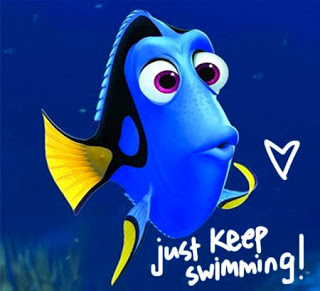
The best advice I have is better spoken by a Blue Tang…

Leave a comment

Filed under Publishing

Waiting Game

It feels like all I’m doing. Waiting. Waiting to hear back on the status of my works. On if it even “works.” Waiting for November, for the full-tilt NaNoWriMo madness I love and dread every year.

Last October, I entered my first book, Alt.World, a science-fiction dystopia, into the insane HarperVoyager open submissions cattle call. I figured, “why not?” I had it edited, had sent it around for queries and got lots of rejections, gotten disheartened and set it aside. But I still love it (do you ever not love your works, even if they don’t take off?) so I figured it was worth a shot at one of the 12 digital titles Harper Voyager crazily said they’d take from open calls.

Except they got way more of a response than they expected–more than 4,500 entries in two weeks. So that kind of blew their whole timeline, and they said it would take longer. So I put on my patience hat and worked more on Undead Rising, my second novel, a zombie-survival gamebook.

In May, they said they’d read through and rejected 3,595 of those submissions, leaving 948 in their “further review” pile. I hadn’t heard anything–I’m in the further review pile.  So that was exciting, and I was content to keep waiting. After all, they promised to check in more frequently.

It’s the end of August, and no further updates. I’m checking my junk email folders twice a day out of pure paranoia. The internet rumors say maybe they’re down to fewer than 400, but no one seems to know for sure and I won’t take it as gospel until they say so. Here’s hoping they haven’t forgotten/overlooked mine somehow.


Patience. Patience.

And then there’s the manuscript for Undead Rising, which two agents seemed excited about at DFW Writers’ Convention in May, resulting in two glorious requests for fulls. It’s hard not to pester them (okay, I pester a little. Just a “hey, how’s it going?” email once every month. Just one sentence, I swear. Teensy pester…).

It’s hard to wait.

My writing brain can’t live in the same space as my business brain, it seems; I have to switch one off to work on the other. And lately, with all this waiting, my business brain has been fussing at me a lot.

Any suggestions for winning at the Waiting Game, folks? I felt like I was doing well at patience, but it’s starting to wear on me by now. Let me know your advice in the comments.

4 Comments

Filed under Publishing, writing

A Journalism Major Who Doesn’t Subscribe

Newspapers have been in the news lately, not just writing it. The sale of The Washington Post to Jeff Bezos and the Boston Globe to John Henry made serious ripples–and well it should have. The reversion of newspapers to private hands is a big shift from the publicly traded past.

In the midst of all this hubbub, I have a confession: I majored in journalism in college and worked for three newspapers… but I’ve never had a newspaper subscription in my name. And I don’t plan to.

It feels a bit traitorous to admit that, but it’s true. Now don’t get me wrong: I loved, loved working for a newspaper. I don’t know if I’ll ever be so happy with my work as I was at a copydesk just before deadline. It’s exhilarating, intense, heady work. You know your tiniest mistake will be nitpicked by hundreds if not thousands of readers, but you also know you can maybe change minds. You can certainly inform, and entertain. It’s intoxicating, and there is nothing like it.

And if you ask me if its The End of Newspapers, I’ll tell you no, probably not, and I’ll really hope that’s true. I think the world, if not the United States, needs a thriving Fourth Estate. I think it’s very important, highly undervalued work. Those people work very very hard for very little pay–unless you’re a bigwig, you’re barely making ends meet. No, people get into journalism because they are hungry for it; it’s a passion. And it’s a passion that is increasingly derided and pooh-pooh’d, and that’s a damn shame.

I do think newspapers will stick around, but they’ll probably shed some if not all of the paper. And that’s as it should be, really, though the Guys On Top have been really loathe to admit that. And that’s part of the reason that most news organizations have been very slow to adapt to the electronic revolution.

My EIC was strikingly like J. Jonah Jameson, the EIC from Spiderman. My first week of work, he dumped me out of my chair for sitting cross-legged.

I saw it. That’s why I got out. I saw my bosses working 14-hour shifts, literally never getting to see their children because of their hours; I saw them storing up their sick leave for years so they could have a needed surgery without losing their salary during recovery, only to have management put in a new policy just before the schedule surgery, wiping out all unused sick leave–to “save money.”  The people on the ground are miles away (sometimes literally) from the people making the financial and organizational decisions.

I worked with THE website guy (yeah, there was only one), who had to maintain the website, learn all the coding, and try to contain the fires in the comments section (unsurprisingly, he often failed). There was no way he could get ahead of the curve for online; the bigwigs wouldn’t let him. They had only begrudgingly created a website, anyway, why would they actually bother to staff it? (Nevermind that the website was the only way our readers could find out what was going on in their homes after they had to evacuate for a hurricane; print still came first).

It was infuriating to me when–in our rather low-morale workplace–the editor-in-chief, a guy who reminded me of no one so much as J. Jonah Jamison from Spiderman, rounded up the staff and told us that although our paper was the highest-earning publication in the company, it wasn’t enough, so more corners were going to have to be cut. So they cut, cut, cut from the very heart of the publication, the parts that made people care, and learn, and desire, to keep the stakeholders–stock holders on Wall Street–happy, while our newsroom became ever more empty, ever more decrepit.

It would be poetic if I said I quit out of moral outrage for the industry, but that’s not true. I left because I was terribly alone, worked weird hours in a small town and couldn’t meet anybody friendly, and I couldn’t stand the idea of riding out another hurricane after I’d been without power for 2.5 weeks. It just didn’t seem worth working so incredibly hard for an industry that didn’t love me back.

So I said goodbye. I didn’t want to work at the newspaper in my hometown after it went through three waves of layoffs; I knew it wouldn’t matter how good I was the next time someone upstairs felt the margins weren’t profitable enough. What was the point of building a career when it could be taken from me at any moment? So I moved on.

And so far, that has also meant saying goodbye to subscribing; for one, I can’t afford it, a cruel irony for the newspaper publishers, who have lost advertising and so “must” raise subscription fees.

I wish Jeff Bezos and John Henry, and the staffs of the highly regarded Washington Post and Boston Globe, much luck, and good leads. I hope that private owners can maintain the respect for good journalism without giving into the merciless bottom line.

I’m sorry I can’t be with you on that journey.

3 Comments

Filed under Publishing, Uncategorized

Twitter’s Vapid Palaver

Social media–and Twitter in particular–is an amazing innovation. We can talk to people around the world! All the time! For practically free (thanks, unlimited texting!)! Twitter is like the telegram taken to the nth degree; maybe all we need now is to have it download directly to our brains for truly instantaneous communication.

It’s a good way of getting attention for yourself or for making friends or building a community. You can do amazing things with it and meet incredible people* (and “people”).

But–that’s not how most people are using Twitter. And let’s be honest, a lot of those people are writers, because they’re my peeps.

This isn’t the kind of inane “I’m eating breakfast!” tweeting that used to be the top complaint about Twitter users. No, thanks to the rising wave of “using Twitter for business,” now writers feel required to have a Twitter presence (to “build a platform”) and to use Twitter to try to sell books. And much of the advice on those subjects starts with “tweet; tweet a lot.” So what you get is a lot of empty-headed jibber jabber.

  • Every danged day, I see someone (sometimes even the same someone as yesterday!) trotting out Hemingway’s bleeding into a keyboard quote. We get it. Hemingway was melodramatic. Move on already.
  • Then there are the people who use programs to report how many new followers they’ve gained and how many lost–which I think is supposed to be some way of competitively “keeping score,” but always seems antisocial and weird when you read them.
  • There are the people who promote the same joke every day, or every week, because someone told them that it’s best if you can be funny on Twitter, because people like that. And people DO like that. But people really like original humor. As soon as I see someone repeating a joke verbatim they used last week, I unfollow them–I know they are trying to trick me into following a nothing account.
  • And perhaps those with the best intentions are those who are trying to sell a book. That’s great. Try to sell your book. I hope I can, one day. But don’t do it by constantly haranguing people on Twitter. I’m not on Twitter to buy your book, so why are you on Twitter to sell your book, and nothing else?

I’m by no means a power Twitter user (and the above complaints are big reasons why), but I really do want to be able to connect with people who have similar interests. That means I don’t want artifice. I don’t want bullsh*t, basically. I certainly tweet things that are inane–I saw someone running barefoot in the heat, and I felt that was tweetable–but that’s part of what life is. I’d prefer the “I’m eating breakfast and it’s great!” tweets to the crap I listed above, but it feels like 85% of my twitter feed is just churned out words, with no purpose and no meaning and no real person behind them.

I have a personal rule for my Twitter account: I don’t post anything that I don’t mean. If I can’t care enough about it to believe in my own statements, why should I expect a reader to? I go for authenticity in my social media, and if that makes me a bad Twitter user/platform-builder, well, so be it.

What kind of behavior on Twitter frustrates you the most?***


*Neil Gaiman once retweeted my tweet and it was possibly my best day ever. Until Margaret Atwood did the same thing a little while later. Then I had two best days ever–at least, social media-wise.

***I’ve read about the harassment/threatening/abuse button scandal currently gripping Twitter. It’s dreadful. So I’ll go ahead and assume everyone finds that kind of behavior frustrating. I’m talking about the less-mean-spirited stuff.

4 Comments

Filed under Publishing, writing

The Missed Tax Opportunity

I’ve got a beef. Now, it’s considered rude to discuss politics or religion in polite company, but y’all readers (who more likely than not are also writers) may share this beef, so I figure I might as well tell you.

It’s about everyone’s favorite thing to hate: Taxes.

First, let me be clear: I actually don’t mind paying taxes. I know, that sounds hard to believe, but it’s true. Taxes are good, in that stuff that the community at large needs gets paid for. I like having schools; I prefer it when my roads are well-maintained; I think it’s a good idea that our service men and women have sufficient armor.

But there is one tax that I think is just wrong-headed and counterproductive: self-employment taxes.

It’s a little tricky, so let me explain. When you work for someone else, some of your income is taken out to go to Social Security and Medicare and stuff like that.  Then, come tax time, you also pay any additional income taxes you may owe–this is set up in income brackets. Generally, it’s a percentage of your income. Mine is about 15% last I checked. At my last job, everyone in my general rate of pay wound up overpaying the IRS, resulting in a nice happy refund.

But I didn’t.

What was the difference? Self-employment taxes.

See, I had been honest on my taxes and reported that I’d earned a little bit of money from my side business as an editor. But I was only using one of those answer-the-questionnaire programs, so I never had any human to actually advise me. If I did, they would have explained this part for me.

Because, as a self-employed person, there is no one to take out those SS and Medicare-type taxes, the government puts that on for you come tax time. It’s aptly called the self-employment tax. It’s about 12-15%, depending on the year. And then, in addition, you pay income tax. And they stack, making my estimated taxes on my side business 30%. That’s a considerably more uncomfortable number, particularly because it’s a very small business.

On top of that, the IRS expects a check from self-employed folks 4x a year, so they are regularly getting the money needed to run the country. Rather than just paying taxes through an employer and once a year, a small business owner has to pay regularly. And if you don’t know that or miss a deadline, you get charged interest.

It can be quite surprising.

So last year, even though I made a very paltry sum in my side business, it threw off my total earnings and meant I had to pay Uncle Sam instead of getting a refund. This was disappointing, so I’ve been doing my homework this year to try to get ahead.

But like I said, I don’t mind paying taxes. My problem is: this kind of tax discourages people from starting their own businesses. And, considering a) how turbulent the economy has been and b) how we as employees can no longer trust that business loyalty between worker and owner goes both ways (ie. that you won’t be fired), encouraging more people to be self-employed–even just partially–is a great idea.

I had the privilege of hearing Dr. Muhammad Yunus, the founder of Grameen Bank, speak several years ago. Grameen Bank is all about providing small loans (microloans) to the poorest of the poor to help them start their own businesses. His work is literally transforming his home of Bangladesh, and his model has been adopted all over the world.

Unsurprisingly, Dr. Yunus is also a big fan of self-employment. It is safe to say that his talk and book inspired me to start my own business, too. But Grameen Bank is really struggling to work in the United States. Why? These kinds of taxes–even just the part about it being difficult to learn about what these taxes are–works against the very small entrepreneur. Sure, all the angel-funded entrepreneurs in Silicon Valley getting millions for an app that earns $0 fit right in, but the Etsy seller, writer/editor, or ice cream salesman struggles.

Personally, I think we need to lower that barrier to entry. We could encourage all those people who are on disability in rural areas to earn income, giving themselves a sense of purpose. It would encourage those who are currently hiding their non-9-to-5 income (you know who you are) to come out and be more honest. And it would give a boost to the overall economy, because, while self-employment isn’t for everyone, it can be as steady as the worker wants it to be. (I’ve found it often means I work more than when I’m working 9-to-5 only, because I’m more committed, more interested).

I think it’s just sort of a shame. Obviously it is important that the country’s bills be paid, but I think the current way self-employment tax is structured is a lost opportunity.

Am I the only one who feels this way?

Leave a comment

Filed under Editing, Publishing, writing