
Or, more correctly, won.
WOO! Third year winner!

To celebrate, I donated to the Office of Letters and Light to keep NaNoWriMo happenin’. You can too.

Dance party time.
Or, more correctly, won.
WOO! Third year winner!
To celebrate, I donated to the Office of Letters and Light to keep NaNoWriMo happenin’. You can too.
Dance party time.
Filed under writing
 Happy Thanksgiving, Americans! In addition to being a time for ret-conned history parables, overindulging on the gobbler that could have been our patriotic bird, watching football, hanging out with family, and making good use of our sweatpants, today is a day for being thankful, so I thought I’d take the time to remember things I am thankful for.
Thankful in 2013
What are you thankful for, today and every day?
(Also, happy extremely rare Hanukkah, everybody!)
Filed under Uncategorized, writing
This is one of those times that spoken English has messed up written English, because casually, we do not care. But in writing, sometimes this one actually matters. (You’ll hope your lawyer understands this grammar rule.)
“Like” means “similar to but not including.”
“Such as” means “similar to AND including.”
“Including” means… including, or, as the dictionary likes to say “containing as part of the whole being considered” (that’s Google’s dictionary, btw). And works as a more flexible catch-all when you’re confused about whether you should be using “like” or “such as”

Let’s just assume the pomegranate is behind the pear back there, ok? Ok.
So putting this to work, an example: If you are picking out a fruit to eat and know you like apples but aren’t in the mood for one right now, you might say “Give me something like an apple” and I might hand you a pomegranate. (Because a pomegranate is similar to, but not, an apple)
If you are picking out a fruit later but now are more flexible on what you’d like, you might say, “I’d like a fruit such as an apple, orange or banana” and I might hand you any of the three or I might hand you a pear. (Because you want something similar to the things you listed, as well as the specific fruit you mentioned.)
If I’m offering you fruit from my selection and just want to list them off, I’d go with “I have a variety of fruits for you to enjoy, including an apple, banana, pear, orange and pomegranate.” If you wanted a grapefruit, I’d have to send you down to the grocery store to buy one yourself.
Got it?
Hungry now? Man, I want a strawberry after all that fruit.
Filed under Editing

“Woman Writing” by Pablo Picasso. Yeah, that’s pretty much it.
Some people swear by the contact high they get from attending meet-ups during NaNoWriMo. Some of the stories about it on the NaNo site are really inspirational, about how connecting with other writers tackling the same incredible feat you are is so great and amazing.
Filed under writing
Thanks to all those who participated in my NaNoWriMo poll!
I got a range of votes, including the excellent write-in for “goblins” (really great idea!), but one thing really surprised me: The option “Don’t write a sequel to the book you haven’t sold yet.” got 0% of the votes.
I have a confession: That was really the question I was struggling to answer. My first book, Undead Rising, is still out with an agent. It’s been six months; I’m sending her an email next week to let her know I’m going to start sending it to other people. Everyone who has read that book has LOVED it, but the non-responses I’ve gotten from agents were deeply dispiriting, and I felt like maybe it wasn’t a good enough idea.
But everybody thought it was a good idea to keep writing gamebooks/interactive novels/monster stories. I’m floored, and uplifted (is that a contradiction? I don’t care.).
I’m grateful so many folks weighed in.
The winner: Pirates!
Which is super, because that’s a really ripe genre I can rob, and let’s be honest, I need a lot of material from which to plunder.
(Plunder. See what I did there? Brace for a whole passel of puns in this book, my friends!)
Yo-ho-ho, away we go!


Filed under Publishing, writing

Tomorrow begins writers’ best/worst month: National Novel Writing Month!
Filed under writing
Last year, completely without planning to, I spent NaNoWriMo writing a book about zombies. A gamebook about zombies, written for adults actually, called Undead Rising, where the reader has the option to choose her path along the way, changing the story for every reader. (You might have heard of a certain series of gamebooks for kids that carry a very catchy but copyrighted name…)
It was a ton of fun to write and I truly believe it stands a chance of getting published–and I even had two agents ask for full manuscripts six months ago (but I’m still waiting to hear back…)–and everyone I’ve allowed to read it has loved it. Even the two people who are friends-of-friends but are obsessed with zombies. Even they liked it, and that’s exactly who I’d want to like it, forget everyone else.
But now it is time for another National Novel Writing Month and… I’m not sure what to do. Help me pick?
If I’m going to try to keep to the same tongue-in-cheek style as Undead Rising, the monster/bad guys need to have a lot of pop culture that I can draw from (mock endlessly). I’m just not sure which one is best.
Filed under writing
 The Subversive Copy Editor: Advice from Chicago by Carol Fisher Saller
My rating: 4 of 5 stars
I picked up this book when I was first really starting But I am very well aware that not everyone is as privileged to be taught that fundamentals of editing from experienced professionals who also happen to be professors, as I was. (Shout-out to Maggie and Jake at Mizzou!) For you, I say: Read this book!
Saller tackled the difficult task of talking about a fairly dry subject while making it accessible to folks who knew nothing as well as folks who know a lot. And kept it interesting.
There are two parts: 1) How to work with the text in the readers’ best interest and 2) How to work.
The first section (How to work with the text) lays out the “subversive” approach Saller advocates: basically, do no harm… even if that means not adhering completely strictly to the stylebook. (*cue communal gasp of shock from the true pedants*)
This is my philosophy, and it’s great! I think it’s the best way to keep a story true to the author’s vision while making the story comprehensible to the reader.
But it’s tricky when you’re a new copyeditor, because it more or less requires you know all the rules and then willfully choose to ignore them when it is appropriate to the book. (There’s a big difference between not changing something because you don’t know it’s wrong and not changing something because it’s wrong but it makes sense for the story.) This means acknowledging that every story is different and will have distinct needs.
Personally, I think that’s a beautiful thing, but not every editor or writer will agree with me.
The second part–how to do the business stuff–was what I was really reading the book for, and that’s the half that earned this book only 4 stars instead of 5. It told me a lot of what I already knew here, too, but the difference was that it said stuff that I figure most business people should know. Things like “don’t pick needless fights,” and “be nice to others.” I realize that’s probably idealistic of me to think most people already know that kind of thing, and it certainly is good advice for the utterly clueless, but that wasn’t really what I was coming to the table for. Aside from the one chapter on freelancing, there wasn’t a lot that I found truly applicable to my career–especially as it is increasingly unlikely that publishing house jobs will continue to exist in the future (but I’ll knock on wood, anyway). And the freelancing chapter didn’t match the kind of freelancing I actually do, so even that wasn’t ideal.
That being said, this book was great. I think it might be particularly good for a writer who is fearful of handing her manuscript over to a copyeditor or doesn’t really understand why she should bother. (We can help, I promise! In fact, we LOVE to help!)
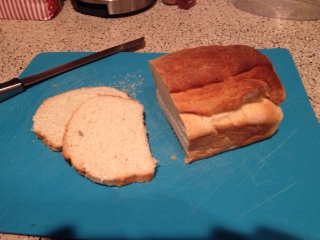
It looks nothing like store-bought, and tastes a million times better.
I’ve started making my own bread recently, and I think I’m in love.
Actually, my new fascination with bread-baking is Neil Gaiman’s fault. It’s true; my new obsession with warm homemade bread comes straight from a literary master. See, at his reading/signing event, he read from “The Ocean at the End of the Lane” and, as a special twist, from “Fortunately, the Milk.” By coincidence (or…design?) both books mentioned the incredible deliciousness of homemade bread. There’s a whole riff in “Ocean…” about how bread is “supposed” to taste like nothing, and the little boy is dismayed by the flavorful loaves his father brings home.
So I decided I wanted to get some flavor myself, because Neil Gaiman said so.
It turns out there is something better than sliced bread–a loaf straight from the oven, still warm when you take a bite. It’s amazing, I swear.
Everybody should try it. But I think it might be extra good for writers. Here’s why:
5. Fight Carpal-Tunnel
I spend way too much time at a computer, and so far I have refused to pick up one of those dorky wrist-rest thingys. I’m basically begging for carpal tunnel syndrome. But I don’t have any fancy baking supplies: I’m making these suckers by hand. Kneading dough is a great workout and great stress-relief. I mean, the recipe literally calls for you to “punch it.” Don’t mind if I do.
4. Time to Think
Studies of creativity have found that we do our best thinking when our minds can wander a little bit: that’s why all the best ideas show up when you’re on the can (or did, before smartphones were everywhere–that’s right, I know about your texting-while-pooing habit!). When you bake bread, your body is engaged but you don’t have to think about much. Let yourself get creative.
3. It’s Easy
I’d heard a lot of whining about bread being hard to do. Totally not true. There are about a gazillion recipes online, so you can find a flavor you like. It may take awhile, but–here’s a secret–most of that time you aren’t actually doing anything. You’re waiting while the loaf rises. While you wait, go do something else! Just set a timer and wash your hands when you get back. I start a loaf, then go clean my kitchen. By the time everything is spotless, it’s usually time to knead the loaf. Easy.
2. It’s Research
Bread is ubiquitous in stories (Note: If someone finds a recipe for Lembas, let me know). Once you know how it’s done–and how a good homemade loaf really tastes–you can transfer all those experiences right to your character. Since just about everybody has or does eat bread, it’s a pretty universal experience.
1. It Tastes Amazing
Ok, not writer-specific, but damn. It’s like I’ve never really tasted bread before. Everyone should have that experience. (Much like in writing, the quality of the original materials matters. Use good ingredients and follow a recipe and you’ll get a good result).
Eat up, scribblers! If you’ll excuse me, I think I need (another) slice. Yum.


 M.E. Kinkade