Tag Archives: writing

A Calendar of Twittery Tales

Fantastic author Neil Gaiman launched A Calendar of Tales, a short fiction project, this month. It combined prompts from his massive Twitter following, and now he’s soliciting art to illustrate the final calendar, a story for each month.

It’s a pretty impressive challenge, so I thought I’d grab on to his long, black, mysterious (very well-fashioned) coattails and have a crack at some short fiction, too. It’s good practice.

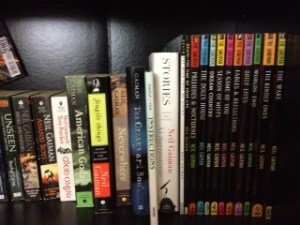
I love Neil Gaiman!

I’m only a *little bit* of a fan, as you can see.

To really emulate one of my absolute favorite authors, I’ll try to follow his rules:

  • Write a story off the Twitter prompts.
  • Don’t poach Neil’s ideas. I read his stories once, but I’m not going to peek again until after I’ve finished. They’ll use similar themes, I imagine, as I’m starting from the same prompts, but we’ll go different places.
  • Between 500 and 1,100 words (I did a word count on each of his stories to find this range).
  • Spend no more than 3 hours on each story. (This is gonna be tough! I got this figure by assuming he spent 12 hours per day writing for each of the three days it took him to complete this challenge. If I was able to write full-time, I might try the three-day sprint, but this is going to have to do.)

Thanks for the inspiration, Neil!

-ME

My first three stories are up!

January (Dangerous Veteran)
February (Grandma’s Pendant)
March (Anne Bonny Dreams)

Leave a comment

Filed under writing

A Calendar of Tales: March

“Anne Bonny and her rapscallion heart, dreaming for a ship of her very own.”

“First mate, how long until we shove off?” The captain strode across the deck of his iron warship, confident in the work of his men and the might of the Navy in which he served.

The first mate poked at the slime coating a rock with a twig.

“I said, First Mate Tom, how long until we shove off?” The Captain glared angrily at his delinquent second-in-command.

“Oh! Sorry, John. I mean, Captain John.” Tom clambered onto the giant hunk of Styrofoam, causing it to wobble dangerously in the grey-watered creek. His twin, the perspicacious Captain John, had to flap his arms to keep his balance, and he glared at his brother as the water soaked into his sneaker.

“Right!” The first mate strode confidently across the deck. “We are just shoving off now, sir! Will we be hunting for the treasure today, sir?”

“Of course!” the captain said. “It is our duty!”

There was a thunder of breaking twigs and dry leaves, and a toe-headed monster in purple leggings burst from the shade. “Hey John! Tom! Cool raft! Can I play?”

The Captain and First Mate glared at their little sister. Tom used his branch to push their warship farther from the shore.

“No, Annie.  Go back home,” Captain John said, sticking his tongue out at the 7-year-old. “You’re too little, and besides, girls can’t be in the Royal Navy.”

“Yeah!” First Mate Tom said, not wanting to be left out.

Annie stood at the crest of the little ditch and stared down at her big brothers, now drifting in the middle of the muddy creek. “I can be in your Navy, honest!” she pleaded.

“No! Go home. We don’t want to play with you,” Tom hollered. The boys turned to face downstream, ignoring Annie as she kicked at the leaves and started to cry.

“You’re mean!” she squeaked, her voice cracking and eyes watering. She stomped back out of the thicket, pouting so hard her bottom lip formed a perfect rounded n.

Mr. McGee looked up from his lilies as the second-grader marched by, flouncing her long lavender shirt with each huffy step. “Hey there, Annie,” he said. The girl, startled, turned sheepishly to find the voice. “What’s wrong?”

Annie’s lip quivered. “John and Tom said I can’t play because I’m too little and there aren’t girls in the Royal Navy.”

“Ah,” Mr. McGee said. “Well, why don’t you turn pirate? You know, there was a very famous pirate named Anne Bonny. She was the scourge of the Royal Navy, and was known for her fighting spirit.”

Mr. McGee inspected Annie carefully. “She had almost as much spunk as you, m’dear.”

“She did?” Anne sniffled. She did feel a little like a pirate, more than a Navy sailor, anyway.

“You know, I think that tree house of yours would make a fine pirate ship,” Mr. McGee said. “I’m not sure you kids should be playing in that crick.”

Annie wiped her nose with her shirtsleeve. “Momma says we’re not supposed to, but Tom and John do it all the time.”

“Best you listened to your mother, then. Now get goin’ girl, don’t you have a ship to sail?” Mr. McGee smiled, and Annie’s heart blazed with pirate glory. The hobby gardener returned to his blooms while Annie ran for her tree house, scampering up the step ladder like a squirrel on a burr oak in late fall.

Anne Bonny, captain of her sleek wooden ship, leaned into the wind over the sea. She checked the sky—clear sailing ahead—and demanded her scabby crew dress the sails.

When her mother came out at dusk, Anne Bonny cried out, “Not now, momma, there are whales trying to wreck my ship!”

“Well, okay Annie. But when you’re done with the whales, it’s time for dinner,” her mother said. “Would you like lemonade? And are your brothers up there with you?”

Anne Bonny leaned out the side of her craft. “Yes, lemonade! Pink! And John and Tom are at the crick.”

Her mother had turned to go back inside the house, but whipped her head around. “At the creek?! They know they aren’t allowed down there!” She slammed the wooden salad bowl on the patio table and stormed out of the backyard. The dreadful pirate Anne Bonny climbed down the tree house steps, giggling madly that they were in trouble but she wasn’t.

A wily pirate lass, she was.

Read the rest of the calendar tales.

2 Comments

Filed under Short Stories

A Calendar of Tales: February

“Met a girl on beach, searching for her grandma’s pendant, lost 50 years ago. I had it, found previous Feb.”

The waves were choppy today, a portent of the coming storm, but the sun was out and the black basalt beach was warm. I sat on a rock and watched the water come in, singing softly to myself as I watched the ships approach from the distance. My fingers caressed the golden pendant on its long chain.

I’d worn the pendant, with its little embossed scene of the three-masted ship, since I had found it on this same beach the year before. The glint of gold had called to me like a beacon, washed free after a hurricane. I’d strung it up on a chain from my collection and wore it always. I liked the way it nestled between my breasts as I swam. It reminded me of the man I’d loved, and distant dreams long past.

I was there, warming myself on the quiet beach and singing softly of my lost lover’s eyes, when a slim girl, perhaps barely a teenager, came sliding over the rocks.

My beach is quite isolated; most people fear the sharp, treacherous rocks between the shore and the sea. That was why I liked it. But here was this girl, her brilliant blue galoshes unhelpful in the climb, persevering toward the black shore. She made it over, and skidded on her rear into the sand with a WHOMPH. But she seemed unhurt, so I watched her from my perch.

She stood, brushed herself off, and walked in the shallows, boots splashing and slurping in the mud. She didn’t seem to notice me; her head was down, intent on the sand beneath her feet. She was methodical, swishing the wet sand with every step.

I waited for her to grow closer before calling out—I didn’t want to startle her. “Are you looking for something?” I asked.

She looked up and saw me for the first time. Her mouth went slightly slack, but she recovered gracefully. “I’m looking for something lost,” she said.

“Oh?” I asked. I swished my tail lightly in the foam. “Is it something I can help you with?”

The girl watched my tail in stark fascination. “It’s—um,” she looked up, away from the water, and seemed to refocus on my face. I tried not to smile. “I’m looking for a necklace. My grandmother lost it on this beach, a long time ago, when she was a girl, and it’s almost her birthday and I didn’t know what to get her so I thought maybe I might find it…”

“It’s true,” I say sweetly. “The ocean gives as much as it takes. It’s kind of you to look for it. I come here often. Perhaps I’ve seen it. Do you know what it looked like?”

The girl stared at me with eyes as grey as the sea. “I don’t mean to be rude, but… are you real?”

I smiled, again fingering the long chain absently. “I’m real enough dear.”

She took a step closer. “Hey!” she said, “that necklace. Where did you get it?”

“This?” I asked, pulling the chain over my head and letting the pendant dangle in the sunlight. “I found it, here, a year ago. Isn’t it pretty?”

“Does it have a ship on it, an old one like in the pirate movies?” the girl asked, coming another step nearer.

“I don’t know about these pirate movies, but it does have a ship,” I said, staring down at the beautiful little scene. “It reminds me of someone I used to know.”

“Ma’am,” the girl said, hesitantly. “May I see it?”

“You’ll have to come closer, love,” I said, smiling now so she could see my pointed teeth.

The girl pulled back, wary, but then stepped forward until she was standing just below my rock, reaching for the pendant. Capriciously, I let it drop into her hands, but held the long chain intertwined in my hand.

“Ma’am, I think this might be my grandmother’s necklace,” the girl said. “Please, may I have it? It was given to her by her father, and lost more than 50 years. It was the last thing he gave her before his ship was lost. It means the world to her.”

“Her father?” I flicked my tail in interest.

After a moment’s thought, I let the chain fall. “Take it. Tell her to be more careful with her treasures in the future.” The girl nodded and clutched the pendant to her chest.

I pushed off the warm rock and leapt into the cool embrace of the ocean, glad, at least, to have met my great-granddaughter. Perhaps the sea would call to her someday, too.

Read the rest of the calendar tales.
Leave a comment

Filed under Short Stories

A Calendar of Tales: January

“Because an aging veteran just retired, to be replaced by a dangerously unqualified youth, no more than a babe in arms.”

“Really, Gregory, this place just won’t be the same without you. But then, I’m sure you’ve got big plans for retirement, dontcha?” Bryan winked, as if in on a really good joke and not being part of a system that was forcing a man out of his livelihood after 37 years of dedicated service.

Gregory tried to smile as he accepted the middle-manager’s weak handshake. “Yeah, it’ll sure be somethin’ else,” he said.

He had already turned to leave when Bryan called, “Oh Gregory? Can you pack up your desk today? We’ve got your replacement coming in this afternoon.”

Gregory, open-mouthed, couldn’t find an acceptable answer. His shoulders slumped slightly as he walked back to his workspace. He stared at the trinkets and knickknacks, the “Exemplary Service” plaque he’d been given 6 years ago, and felt his heart break.

There was a knock at a door.  He stood, joints creaking, to answer it. His whole career sat in a photocopy box where he had been sorting through files, decades old.

Behind the door was a woman, a girl really, cheeks unmarred by a single sun-kissed wrinkle. Her tight-fitting clothing would have been, in Gregory’s youth, scandalous, something from a film you could only see behind a curtain in a shady building on the outskirts of town. Now it was expected business attire.

“Excuse me,” she said, “Is this room 408?” Gregory blinked at her.

She smiled and thrust out her hand. “I’m Genevieve. I’m the new Data Security Analyst.”

Apparently today was a day for unwanted handshakes. Gregory participated, grudgingly. “So you’re my replacement.” He was practically growling. This—this child, this girl—was supposed to protect the integrity of the data for the CIA?

The suggestion was ridiculous on its face. Without him, this place couldn’t survive. They seriously thought this little piss-ant could fill his shoes?

“Oh!” Genevieve said. “So nice to meet you. Seems like a nice office.” Her pleasantries grated. She leaned in the room, sizing it up. His room.

“How many years experience you got?” Gregory couldn’t hide the snide anger in his question, but the young woman didn’t seem to notice. She brushed past him, left smears in the dust on his desk as she trailed her fingers across the plastic wood grain.

“I graduated from Cornell three years ago, and I’ve been working with Lockheed since,” she said. “Do you think I could get an office plant? A little one, maybe?” Gregory could see her frou-frouing up his Spartan office. She’d probably be adding lounge chairs and pink lace by Tuesday.

“I’ve never had a plant,” Gregory said. He snorted. Three years. It was nothing. “I hope you can handle this job. It’s not like building a game of Tetris on your calculator.”

She turned and stared at him, suddenly cold. “I’m sure I’ll handle it just fine. They wouldn’t have hired me if I weren’t qualified, would they?” Her lips pressed into a thin line, and she looked much older.

“Thank you for showing me the space,” she said. “I’m going to get settled.”

Then, without a trace of hesitation, she picked up the box containing Gregory’s whole career and dropped it into his arms.  The plaque jangled to the bottom.

Genevieve pulled out the faux leather desk chair and sat down. Gregory was flabbergasted. He was being dismissed. By practically a babe in arms.

He shifted the box and glared at the girl. She didn’t even give him the satisfaction of noticing his displeasure. He stood and left the office where he’d defended his country from invasions, foreign and domestic, for nearly four decades.

He handed over his security badge and left the building for the last time.

Gregory scowled. Now he had plans for his retirement.

The CIA would be in danger, all right. They’d learn just how dangerous it was to get rid of Gregory Blunt—he’d see to it personally.

Read the rest of the calendar tales.

Leave a comment

Filed under Short Stories

IKEA, Masters of Manipulation

I love IKEA. I can maneuver through that twisty labyrinth they call a store in less than 10 minutes—I know all the shortcuts. I can sing most of Jonathan Colton’s “IKEA” from memory without a trace of irony. I think it’s amazing that I can get a dresser and a cheap-but-tasty lunch in one place. I love their inclusive advertising. And I love that feeling of sweaty accomplishment when I turn that tiny allen wrench one last rotation and stand back to revel in my newly constructed purchase of the week.

My home is truly a testament to IKEA. I go through the catalog with a loving but critical eye—what will be my next purchase? Will that coffee table fit in with the rest of my living room furniture (it’s all IKEA, so the answer, generally, is ‘yes’). I’ve finally developed a “grown-up” enough space that I could start buying “fancier” furniture, but I adore my IKEA products.

Come to find out, that’s all part of their master plan.

Well, maybe not master plan, but a nice side effect of their build-your-own furniture. Three psychologists studied the effect of labor on feelings of attachment. NPR did a great story on it.

To the shock of no one who has ever constructed a table from a pile of parts pulled from a warehouse, they found that it is not that we labor hard at things we love (though I’d argue we do that, too), but rather that we love things that we work for.

They offer a nice bunch of cheap jokes at the quality of IKEA furniture along the way (I’ll argue, however, that my furniture is, um, amazingly well-built. No crooked tables for me!…why no, I’m not possibly influenced by the IKEA effect, why do you ask?), but the authors also raise a good question: Does this apply to things besides self-constructed furniture?

Pow!

Because, of course, it does. Businessmen are more enamored with an idea—even if it’s universally seen as a bad idea—if they came up with it. You know that at least some of the people on Regretsy thought their hand-crafted whatever was amazing, even while strangers mocked it online.

And writers, of course, can fall prey to the same possibility. We tell ourselves and each other to “kill your darlings.” And we try, we really do, but that’s why just about everyone recommends finding an editor—you can’t see the quality (or lack thereof) of your own work.

I think that aspiring authors are perhaps more aware of this phenomenon and its dangers than other folks. We also tend to be our own worst critics. I know I can see-saw from boundless enthusiasm to despair over a piece. There is an abundance of quotes from authors describing their own inferiority.

We know we love it. But we also know we hate it. That’s one of the reasons writing can be so painful, but also such a joy.

I’ll continue filling my home with IKEA, and I’ll continue writing, but I’ll keep an eye out for flaws in both.

-ME

6 Comments

Filed under Uncategorized

Review: “Publishing & Marketing Realities for the Emerging Author”

Publishing & Marketing Realities for the Emerging AuthorPublishing & Marketing Realities for the Emerging Author by Christine Rose
My rating: 4 of 5 stars

The good thing about Christine Rose’s book is that she is telling the truth that she lived. The bad thing about this book is that, whether because the industry is changing too quickly or because Rose can only report on the way she’s done things, it can be inconsistent, daunting, and overwhelming.

I found a recommendation for “Publishing & Marketing Realities” on an agent’s blog, which seemed like a pretty solid endorsement. Right from the start, I was surprised by Rose’s definitively negative outlook on traditional publishing. It seemed to be a case of “the lady doth protest too much.” Granted, her concerns seem valid–long, slow process designed to slow incoming writers down and keep them out–but that negative view from the outset tainted my perception of the rest of the book.

She publishes through her own independent publisher, which she earnestly claims makes her something in between an “indie” publisher and a self-publisher, all while claiming that self-publishing no longer has such a stigma. Rose does an excellent job of listing out her perceived pros and cons of each style of publishing, and it was a great beginner’s guide to an overly complicated system.

I would have liked a more clear analysis of the amount of money she spent creating her own press and marketing herself. While she does drop dollar amounts periodically (and they all seem absolutely astronomical), it’s hard to get a sense of how much she is spending, on what, and whether she is even seeing a return on her investments–or if we should all just stay home and learn basket weaving instead.

The book really shines when it gets to the second part, explanations of all the marketing avenues available and how to use them. She has really done her research (though I had to laugh at the bit about how exciting a Kindle might be…while I was reading the book on a Kindle), and was extremely detailed in her how-to portions. It’s a great synopsis of what’s available (though, again, the industry is changing in great leaps and bounds right now).

I’m glad I read her book, but… I’m not sure I trust all of her advice. There are some inconsistencies throughout that make me question whether this is a “how to” book (as it is advertised) or more of a personal memoir of how she did it. The detail she devotes to her cross-country caravan to sell her books (at a cost of $65,000; don’t even get me started) is confusing when you realize later that she made more by staying local. Additionally, her schedule for marketing sounds exhausting, like a recipe for certain burnout. I’m okay with hard work, but this recommendation seems both expensive and improbable.

There’s just not a lot of “life” in her work-life balance.

There doesn’t even seem to be a lot of writing, for that matter.

Her chapters on working a day job while performing all these writing and marketing activities also seems ludicrous…until she reveals that her day job is as an English professor at a community college. That makes a little more sense.

I was also concerned about her revelations about her secondary persona, O.M. Grey. While earlier she says not to latch on to a trend just because it might be marketable, this is exactly what she does by adopting the Steampunk genre. I don’t participate in that culture, but I would be pretty insulted by the way she talks about it, particularly the conventions. I believe she means it to be endearing, while also showing authors who haven’t ever been to a genre con what it’s like, but her teasing references to men in superhero costumes struck me as unkind. Furthermore, she seems to have adopted the trappings of the Steampunk genre just for money-making purposes; she doesn’t seem to really “get” it. This rankled me; it seems to lack integrity to co-opt someone else’s interests, but apparently she’s been quite successful, so perhaps it is my compass that is wrong.

In summary, this book has a lot of information, but whether or not it will actually be useful is going to depend a great deal on the reader. That said, I thank Ms. Rose for her courageous and thorough work on how-to-be-a-writer, and I’d like to gently recommend she take a short vacation. It will be good for her mental health, and I’m sure she needs the rest.

View all my reviews

Leave a comment

Filed under Reviews

Review: “On Writing”

On WritingOn Writing by Stephen King
My rating: 5 of 5 stars

I was leery of this book: It was recommended a lot, and I don’t read Stephen King (it’s his fault, his stories scare the bejeezus out of me), and I was afraid it was going to be full of platitudes and useless, generic advice.

I have never before been unable to sleep because of a book, nor have I ever finished a book only to immediately go back and read it again — until now. This book is outstanding, both as a memoir and as practical advice for writers. I recommend it to everyone who is literate. I’m serious.

“On Writing” is 2/3 memoir and 1/3 writing advice, and it will leave you feeling as if you’ve just enjoyed a long and intimate chat with repeat-best-selling novelist Stevie King over a cup of tea on the back porch. In some cases, it’s as if he actually unzipped himself and let you step in and see the world from his eyes. It’s incredible.

While I loved the introductory “C.V” section on his childhood and his life up until the publication of “Carrie,” the book really endeared itself to me when King proclaims he does not believe every person can be a good writer, or that any good writer can become great. This was the first time in all of the many writing blogs, tools, etc., that I’ve read that someone has admitted that not everyone is cut out for this work.

WHAT A RELIEF! (Of course, I’m fervently hoping that I DO make the cut one day, but at least I can believe King because of his honesty). I am beyond exhausted with this “everyone can be a great storyteller!” meme because it’s so patently false–even in an age where loose spinoffs of “Twilight” see mass publication and sales, not everyone can get that (and in some cases, those that do shouldn’t).

He doesn’t say it is easy even for those who are writers, but he opens the door for hard work and practice. Even though this sounds like negative advice, I found it uplifting and energizing.

Even though much of his advice runs directly counter to other advice I’ve heard/read/picked up along the way, I believe him wholeheartedly. Perhaps it’s because I’m a wannabe writer born in the wrong time period, making my belief in his methods self-serving.

Some of his thoughts:
-He doesn’t put much stock in writing seminars or criticism groups.
-Write “with the door closed” (I interpret this as counter to the “post everything immediately!” trend in blogging)
-It’s ok to do your research after you’ve already completed a draft.
-You ought to expect to (sometimes) change your draft based on your first readers’ reactions.
-He recommends a general form letter for query letters (I have a feeling these would be rejected now, but my attempts to ask agents have gone unanswered so far. Still, it’s a relief that even those who know what they’re doing seem to have no idea how best to get an agent’s/publisher’s attention. It’s all a crapshoot).

And, which resonates most of all:
-Don’t write a story just because it’s currently popular or trendy or selling. Write it because you love it.

It’s possible that if Mr. King were an aspiring author today, his experiences would be different–but I hope that isn’t the case. This book invigorated and inspired me more than any other I’ve read, and I hope to replicate well the lessons here learned.

View all my reviews

4 Comments

Filed under Reviews