Tag Archives: publishing

Best Social Media Advice Ever

This post by the Bloggess is the best and truest advice about social media I have ever seen.

It was on the internet, so it must be true.

As a new-ish blogger, it’s easy to find tons of “advice” about how to be rich and famous and awesome. It’s freakin’ everywhere. I have to keep up with a high-level internet marketing blog that shall not be named for my 9-to-5, and it’s full of those shitty articles, except they aren’t kidding. And every time I look one over, I see gads of banal comments about how “OMG THIS is the best advice ever!”

Spare me.

At the day job, I can’t say anything for fear of pointing out the emperor is naked, but I have always held the belief that the incredible vast majority of internet stardom is generated by pure dumb luck. The internet is mostly about showing up and getting lucky. (Unrelated, but the internet is also the reason every time I hear that Daft Punk song I think it’s saying “Get Loki.” Which is fun).

Don’t trust anyone who says they know the answer; they’re lying.

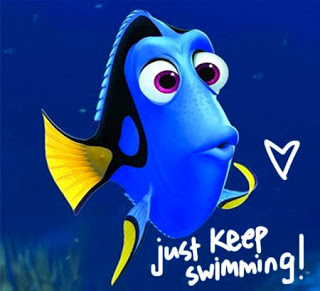
The best advice I have is better spoken by a Blue Tang…

Leave a comment

Filed under Publishing

Waiting Game

It feels like all I’m doing. Waiting. Waiting to hear back on the status of my works. On if it even “works.” Waiting for November, for the full-tilt NaNoWriMo madness I love and dread every year.

Last October, I entered my first book, Alt.World, a science-fiction dystopia, into the insane HarperVoyager open submissions cattle call. I figured, “why not?” I had it edited, had sent it around for queries and got lots of rejections, gotten disheartened and set it aside. But I still love it (do you ever not love your works, even if they don’t take off?) so I figured it was worth a shot at one of the 12 digital titles Harper Voyager crazily said they’d take from open calls.

Except they got way more of a response than they expected–more than 4,500 entries in two weeks. So that kind of blew their whole timeline, and they said it would take longer. So I put on my patience hat and worked more on Undead Rising, my second novel, a zombie-survival gamebook.

In May, they said they’d read through and rejected 3,595 of those submissions, leaving 948 in their “further review” pile. I hadn’t heard anything–I’m in the further review pile.  So that was exciting, and I was content to keep waiting. After all, they promised to check in more frequently.

It’s the end of August, and no further updates. I’m checking my junk email folders twice a day out of pure paranoia. The internet rumors say maybe they’re down to fewer than 400, but no one seems to know for sure and I won’t take it as gospel until they say so. Here’s hoping they haven’t forgotten/overlooked mine somehow.


Patience. Patience.

And then there’s the manuscript for Undead Rising, which two agents seemed excited about at DFW Writers’ Convention in May, resulting in two glorious requests for fulls. It’s hard not to pester them (okay, I pester a little. Just a “hey, how’s it going?” email once every month. Just one sentence, I swear. Teensy pester…).

It’s hard to wait.

My writing brain can’t live in the same space as my business brain, it seems; I have to switch one off to work on the other. And lately, with all this waiting, my business brain has been fussing at me a lot.

Any suggestions for winning at the Waiting Game, folks? I felt like I was doing well at patience, but it’s starting to wear on me by now. Let me know your advice in the comments.

4 Comments

Filed under Publishing, writing

Writers’ Rates by Type of Publication

This is big, guys. I got to attend a lecture on the “Economics of Publishing” led by agent Evan Gregory while at DFWCon. His talk was great, but this one slide was earth-shaking for me. I think I’m still quivering.

I’ve had to replicate it, as the photo I took with my phone illustrates said shaking.

Royalties By Edition

Publisher Book Price Royalty Author Receives
Amazon, self-pub $2.99 $2.05
Nook, self-pub $2.99 1.76
Smashwords, self-pub $2.99 $1.49-1.74
Hardcover, traditional pub $25.00 $2.50-$3.75
e-book, traditional pub $7.99 $1.40
Trade paperback, traditional pub $14.99 $1.12
Paperback $7.99 $0.64-$0.80

That’s a estimated breakdown of what an author will get, per book sold, using different publishing options.

Pretty sobering, isn’t it?

Now, I realize some people are going to look at this and instantly cry foul and say self-publishing is definitely and always the right way to go, because there’s a big difference between $2.05 and $0.64. And I don’t disagree. But Mr. Gregory had an excellent point: sure, you get more per book, but you are likely to sell fewer–because you have only whatever marketing efforts you personally can generate, without help–and you have a lot more up-front costs, like editing and cover art, and a huge amount of your time, so while this compares the profits you stand to get, it doesn’t accurately reflect the time-and-money investments for each arrangement.

Still, knowledge is power, and learning this figures really changed my perspective.

4 Comments

Filed under Publishing

A Reviewing Problem: Women Genre Authors Less Likely to be Reviewed

From time to time, you’ll hear bouts of outrage from literary circles. Lately, the spats seem to be about who is getting reviewed.

Overwhelmingly, the arguments are that books by women are reviewed less frequently, particularly in the biggest platforms. Recently, there was another tiff, when a magazine showed that female genre authors (science fiction and fantasy) were having the same troubles (so it’s not just a “chick” book issue).

The most recent breakdown is a little confusing, and it’s hard to tell where the bias may be originating (is it because review publishers are picking books by men? Is it because men are reviewers? Is it because fewer women are getting published in the first place? I haven’t gotten good answers to those questions).

I have to say, as a genre writer who happens to be a woman? That sucks.

But I review what I read. My main way to choose a book to read (and therefore review) is  mostly “hey, what is lying around that I haven’t read yet”? Lately there have been subjects I’ve been researching, so that has meant that I picked certain books, but I did not choose them based on the author or their gender. It was all subject matter.

That said, out of the 12 books I’ve read so far this year (when I got serious about doing reviews regularly), only 3 were written by women (A Practical Wedding; Quiet; Publishing and Marketing Realities). If we’re stretching, we can add Saga, a comic I read religiously and which is drawn by Fiona Staples–but it’s written by Brian K. Vaughn, so that’s partial credit at best.

Should I be choosing my books to read based on the gender of the writer? I don’t think so. But then how can I–as someone who reviews things sometimes–help contribute to the review-pool for female genre writers like myself? It’s a tricky thing to think about.

What do you think about the problem of insufficient reviews for women writers?

6 Comments

Filed under Publishing, Reviews, writing

Path to Publishing: You Wrote a Book, Now What?

After the DFW Con, a family friend heard I had requests for manuscripts from agents (squee!) and asked what the process was. When you’re just starting out, it’s really hard to get a sense of how this whole crazy publishing thing works.

To help you out, here’s a summary.

  • Write a book.
  • Celebrate! You just wrote a book! That’s really freakin’ hard! Most people never even get that far, so bask for a bit.
  • Give it a rest, then go back and edit it with “fresh eyes.” Make it polished.
  • Consider giving it to someone else to edit. Or give it to a “beta reader” who will be honest with you.
  • Decide whether you want to self-publish or go the traditional route.

If you want to go the “traditional route”:

  • Write query letters. They’re like cover letters/resumes for you and your book.
  • Send your queries to agents after you’ve carefully researched them. (The internet is your friend).
    • An agent is the first gatekeeper. You need an agent to get a publisher. You should never have to pay any reputable agent anything to read your stuff. They get paid by taking a commission off of anything you eventually publish. Sort of like a real estate agent. Typical timeline for acquiring an agent? 6 months to a year or longer.
  • Go to events, like the conference I just attended. Turns out a risk I was taking in my query was the reason I was getting rejected. Meeting in person got me the attention I needed, and I got requests.
  • Find an agent you like (and who likes you) and sign a contract saying you’ll work together.
  • Your agent will then sell your manuscript to publishers. This can take 6 months to a year.
  • Then, if they want to publish you, you’ll get a contract, an advance, and (hopefully) royalties.
    • They’ll do edits, a cover design, prepare marketing materials, provide some advice on how to market yourself, and make all the decisions related to actually constructing a book. You’ll get the prestige of being published by a “big publisher,” (even if it’s not one of the “Big Six”**) and know that someone other than your mom and dad was interested in your work. You’re more likely to have your book sold in print form from a bookseller.
      • The “Big Six” are: Hatchette; Macmillan; Penguin Group; HarperCollins; Random House; Simon & Schuster

The self-publishing/indie path (they are separate, but overlap in a lot of ways):

  • Hire a reputable editor to look over your work. Yes, you’ve already edited it at this point, but the biggest distinguishing feature of a poorly constructed self-published work is bad editing. Do it again. Be willing to invest in your work.
  • Decide what format you’d like to publish. Is it a book that needs to have a physical copy? Is ebook-only ok? This really depends on your goals and the kind of book you have.
  • Hire a cover design artist. You need a cover even if you are publishing e-book only. I suggest looking somewhere like Writer.ly.
  • Here’s where it gets tricky. There are several places you can self-publish, and lots of resources about them. Do your homework before you give your book to anyone. While there are reputable places (Lightning Source, PubIt!, CreateSpace), there are also more sketchy places that aren’t suitable for a large-scale book production (Lulu, AuthorHouse, etc), and there are people who are outright looking to scam you. Don’t let them. Do your research first.
  • If you’ve got an ebook, format and upload your book to all the places you can (Smashwords, Amazon, Nook, Apple). Again, do your research, because this gets complicated. (If you don’t care about saturation, just upload it to Amazon. That’s the easiest and has a pretty solid market share.)
  • You make all your design, book construction, marketing, and pricing decisions yourself. You also get more of the royalties per book, but you’ll sink a lot of time into this process, and there’s still no guarantee that anyone will buy it. You get speed, and more per book, but may not end up with a printed copy to show off in your bookcase.

Leave a comment

Filed under Publishing

Total Recap: DFW Writers’ Conference

DFW Writers' ConventionOne of the things discussed in a session at DFW Writers’ Conference this year was not to blog about writing. I’m gonna go right on ahead and break that “rule,” because when I was first starting out, there were so many mixed messages and people with a bias making proclamations that it was hard to tell which way was up. I wish I’d had someone “in the thick of it” to tell me what was going on, so I’m going to provide that resource.

I’ve had a little bit of time to recover from the sugar-and-caffeine soaked two-day marathon that is DFW Writers’ Conference, and I’m here to tell you it is money well spent. I was a little nervous going in that I wouldn’t get as much out of it as I had last year, in my first visit, but this year was better. I was more comfortable, had better business cards (based on experience from the year prior), and knew to wear a sweater because some of those rooms are cold and because I sweat with nervousness during a pitch. All good lessons!

If you’re on the fence about attending a writing conference–maybe you’re worried about the cost–I’d recommend you do it. I can’t vouch for any but DFW Con, as it’s the only “big” conference I’ve attended, but if you even think there is something you’ll learn, go. And if you’re querying agents, DEFINITELY go.

On that note: My pitch session(s)
At DFW Con you get one pitch session with an agent included in the ticket price. You look through all the attending agents, pick your top three, and are assigned a pitch session.

A pitch session is basically like speed dating. And you’re speaking on behalf of your book. You have 10 minutes to convince the person across the table that you have something they could sell. If they’re interested, they may ask for you to query them, or for pages. Or, if you’re really lucky, for a full manuscript.

She asked for a full manuscript!

And then, at DFW Con anyway, you can pay $40 for a second pitch session. So I did that, with another agent who I’d seen around and who I thought maybe would like a zombie gamebook.

And then SHE asked for a full manuscript.

So I’m like:

That alone made the conference worth it to me. Especially when my query letter was read at the Gong Show at the end of the conference, and my letter got triple-gonged before they even read the third line (no, I’m not telling you which letter it was. I’m embarrassed. I swear it was going to be SO GOOD, if they had only read a little further!)

But that explains some of the trouble I’ve been having. I’ve gotten nothing but rejections from my letter. If I was only sending out that letter (continuing to make the mistake/take the risk), I may never have gotten the chance to put my manuscript in front of an agent. By going to DFW Con, I get to do it TWICE. That’s huge.

Even without those parts of the conference, there’s a lot to learn. I went to an incredible session on how to do your taxes as a writer. In fact, I wish I could explain it well enough to do a post on it, because it will be so useful. (The short version: It’s pretty complicated).

I also got to meet lots of other writers, of all kinds of backgrounds, and got to hang out with some pros. I took sessions on grammar and dialogue and social media. I got the inside scoop on the different royalty rates (and I WILL be blogging about that. That was too good not to share), and had an excellent session with Jenny Martin on finding your voice.

In short: Conferences do a lot for you. Go try one out.

And let’s dance a little more.

10 Comments

Filed under Conventional

Prepping for DFW Writers’ Con

This weekend I’ll be attending my second DFW Writers’ Convention, held in the Hurst Convention Center.

It’s the biggest gathering of writers of all sorts in my area, and–importantly!–is attended by authors of all stripes, as well as editors, marketers, agents, and other folks interested in books and writing. It’s kinda a big deal.

I went last year, and it pretty much scared the pants off me. Like, I don’t think I could have been more nervous if you’d told me it was a walking-on-hot-coals-over-a-volcano conference. But I went, met some nice people, got to chat with two agents, and felt it was overall a good experience.

So I’m trying to prep for this year. My goal last year was a) to show up (accomplished!) and b) talk to people, even though I found that really hard. This year, I’m going to try to “connect”/”network” with two people. That sounds low, but I’m not naturally comfortable with small talk, so my goal is basic: just make a connection with two people that can continue after the conference.

I bought two sets of business cards, one advertising my book and one advertising my editing business. I’m planning out my outfits and going to build my schedule of what I actually hope to attend and where (so hard to choose when good classes are simultaneous!).

I’ve been doing a bit of research on Louise Fury, who I’m lucky enough to have a pitch session with, trying to plan out what might appeal to her. I feel more relaxed about it than last year, because now that I’ve done it (twice!) I know a little more what to expect, and my expectations are a little lower. (I’m writing a genre that has fewer affiliated agents and guests, unfortunately, so I am not sure Ms. Fury will have a definite interest in my novel, but she has such a great reputation with her clients that I hope to get a lot out of our talk.)

Maybe it’s just because we’re still a few days out, but I’m feeling a little more zen about the conference. Perhaps it’s just the “calm before the storm.”

If you haven’t yet attended a writer’s conference in your area, I recommend it. It makes you feel so much more “official” and you’ll learn a lot. It can also be a humbling experience; you’re definitely not the only person with a great idea looking to get some attention.

If you have, what is your best advice?

6 Comments

Filed under Conventional, Publishing, writing

Proper Motivation: Why Write a Book?

I was browsing a freelancer forum to find editing gigs, when I stumbled upon this post (name and site withheld to protect the guilty):

“I have written a novel and it came around 36,000 words.

To get published, a novel should have 60,000 words atleast and I fell short of words.

Now, I need someone who can write those additional words without actually disturbing the usual flow and without making it boring.

Most importantly it should be finished in a week.”

For this work, the job poster was offering $50-150.

My reaction:

Obviously, I didn’t apply for the job. (And I was gratified to see that the two people who HAD bid on it were asking thousands of dollars. At least they had some sense!)

But that job posting made me think about why people write books (I mean, why would you write a book and then not finish it and yet still want it finished? I was so perplexed).

I came up with three broad reasons:

  1. You’ve always wanted to write a book, and there’s a story inside you that you just HAVE to get out.
  2. You have a business of some kind and think writing a book would give you prestige, attention, sales, etc.
  3. You’re under the assumption that writing a book is really easy and you’ll get published and make a lot of money.

Yes, I put the above job posting in the third category. I don’t have a lot of advice for that guy. I mean, best of luck, I guess, but if you can’t do the right research or sit down to write your own work, well, there’s not much I can tell you, is there?

I do have things to say to those other two categories.

Now, if you’re a No. 2, you’re easy: best of luck to you. I don’t think it’s really the most productive way to sell a thing, and I personally hate reading your books, but I hope it works out for you. (How-to business books seem especially prone to being this sort; nothing really to tell me, just a lot of salesy jargon, typically unsupported by any actual facts besides your personal experience.) Not my bag, but apparently someone is buying them, so I guess that’s fine if you want to devote a lot of energy to a side project like a book.

If you’re a No. 1 (and I think most fiction writers are), there is a whole cavalcade of advice books out there for you. How to get published, what to do, what sells, who to talk to, etc. etc. etc. amen. (I’ve reviewed some of them). Depending on the book, they’ll help you write, help you edit, tell you how to get published traditionally, or try to convert you from a No. 1 into a No. 2, with the book the centerpiece of the thing you’re selling. And I guess that’s great for some people. But I’m just not wired that way.

I mean, don’t get me wrong: I would LOVE for something I have written to take off. But if it means quitting my day job, gallivanting around the country, shilling to different people and always talking about myself… well, that’s not why I wrote a book. I wrote a book because I wanted to tell a story.**

Sometimes it’s easy to lose sight of that, but that’s the original motive. It’s what I am trying to focus on every time I sit down to my laptop. If that means I don’t get to be a best seller…well, I’ll have to come to grips with that.

Why did you write and why do you want to get published?

**Some of those advice books insist that you can’t hold on to this idea if you want to be a publishing success. I think they are dead-wrong, but I don’t yet have the personal proof to come right out and say so.

4 Comments

Filed under Publishing, writing

The “Easy Path To Publishing” Myth

Since I’ve begun this blog and been contemplating self-publishing, I’ve read a lot–articles, blog posts, books–about “how” to do it. Some of these have been intensely practical how-to guides; some have purported to tell “the way” to do it, with the insinuation that if you follow these steps exactly, presto! your book will be a hit.

I’ve read a lot, and I think it’s time to blow the whistle: that ain’t the truth of it.

Rather, I contend, even amidst this publishing revolution, no one–not the Big Six publishers, not the editors, not readers, not how-to-get-published writers, and certainly not Susie-Q author–has a damned clue of what makes one book a success while the other oozes.

Sure, we have some rough ideas: well-edited copy, a nice book cover, a smattering of time spent on social media, an interesting story idea, write in a popular and accessible genre. But, it seems to me, you can have all of those things AND work your butt off AND spend a bunch of money on supposed aids to success and still not have it take off.

I don’t say this to disappoint you.

In fact, I find this liberating.

Because if the common thread in self-publishing success stories (read Hugh Howey’s excellent piece on his success here, or this short article about yet another rise-from-obscurity author here) is a random blessing from the universe, the pressure is off! I don’t have to follow the rigorous social media schedules, or do the 50-states-book-tour, or dress up in zany costumes. In fact, it almost seems that the opposite is more effective: work on something you love, even if it is sort of crazy (maybe especially so), and just send it out into the universe. Maybe it’ll pick up steam. Maybe it won’t. But you don’t have to stress and labor and allow yourself to work until you hate yourself and your work.

Isn’t that a revolutionary idea? If no one knows exactly how the magic happens, then you are free to find the magic that works for you!

There’s no 12-step plan. There’s just you, your stories you want to tell, and the universe.

Good luck.

4 Comments

Filed under Publishing

If You’ve Never Failed…

Found this excellent motivational video.

Channel Dory from Finding Nemo and just keep moving forward to your goals.

(I’ll have to remember to take my own advice!)

Leave a comment

April 13, 2013 · 9:00 am