Tag Archives: Neil Gaiman

Review: Fortunately, The Milk

Fortunately, the MilkFortunately, the Milk by Neil Gaiman

My rating: 5 of 5 stars

Bring a smile to your face, and go buy Fortunately, The Milk. This is a book that EVERYONE needs to enjoy. It is delightful, in every sense of the word.

Fortunately, The Milk is ostensibly a children’s book, in the same vein as Rudyard Kipling’s The Jungle Book or anything from Doctor Seuss. It would be good to think of it as the best combinations of both these literary gems. Not quite a chapter book but longer than a picture book, the hardcover edition has images on nearly every page, seamlessly interwoven with Neil Gaiman’s text. You’ll want to read it aloud; you’ll pore over every beautiful scribble by Eisner-winning artist Skottie Young**; you’ll laugh at the absurdity; you’ll ponder the ending with reverence.

This book is pure distilled happiness, and you need to have it.

I had the privilege of hearing Neil read from Fortunately, The Milk when it was still a twinkle in his publisher’s eye, at the book tour for The Ocean at the End of the Lane. Sure, everyone, reader and critic alike, is fawning over Ocean, but my favorite part was definitely Fortunately. It was just so fun.

It is a book that exalts fathers, and children, and, most of all, vibrant imaginations. The premise is sacchrine-simple: A family runs out of milk just before breakfast, and father goes to get some. He is gone what seems like an awfully long time. When he gets back, his hungry children wonder where he has been, so he answers them. The story involves pirates, piranhas, time-travel (someone is a Doctor Who fan, for sure!), a volcano god, the invention of the button, aliens, and more, because I’m probably forgetting someone or something.

You won’t be able to look at your everyday errands the same way.

Buy this book, then snuggle up to your kids (or your special friend, or your sweetest pet, or even just a really cozy blankie), and read. Make sure you do all the voices; that’s the way it really should be done.

View all my reviews

**This is amazing, but I have gotten to meet both Skottie and Neil. Neil at the aforementioned book tour, and Skottie at ComicCon, the day he won the Eisner. So wonderful, both of them!

Leave a comment

Filed under Reviews

5 Reasons Writers Should Bake

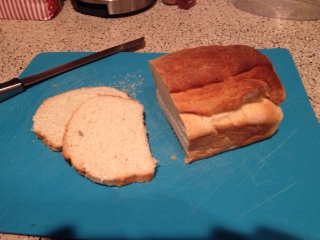
It looks nothing like store-bought, and tastes a million times better.

It looks nothing like store-bought, and tastes a million times better.

I’ve started making my own bread recently, and I think I’m in love.

Actually, my new fascination with bread-baking is Neil Gaiman’s fault. It’s true; my new obsession with warm homemade bread comes straight from a literary master. See, at his reading/signing event, he read from “The Ocean at the End of the Lane” and, as a special twist, from “Fortunately, the Milk.” By coincidence (or…design?) both books mentioned the incredible deliciousness of homemade bread. There’s a whole riff in “Ocean…” about how bread is “supposed” to taste like nothing, and the little boy is dismayed by the flavorful loaves his father brings home.

So I decided I wanted to get some flavor myself, because Neil Gaiman said so.

It turns out there is something better than sliced bread–a loaf straight from the oven, still warm when you take a bite. It’s amazing, I swear.

Everybody should try it. But I think it might be extra good for writers. Here’s why:

5. Fight Carpal-Tunnel

I spend way too much time at a computer, and so far I have refused to pick up one of those dorky wrist-rest thingys. I’m basically begging for carpal tunnel syndrome. But I don’t have any fancy baking supplies: I’m making these suckers by hand. Kneading dough is a great workout and great stress-relief. I mean, the recipe literally calls for you to “punch it.” Don’t mind if I do.

4. Time to Think

Studies of creativity have found that we do our best thinking when our minds can wander a little bit: that’s why all the best ideas show up when you’re on the can (or did, before smartphones were everywhere–that’s right, I know about your texting-while-pooing habit!). When you bake bread, your body is engaged but you don’t have to think about much. Let yourself get creative.

3. It’s Easy

I’d heard a lot of whining about bread being hard to do. Totally not true. There are about a gazillion recipes online, so you can find a flavor you like. It may take awhile, but–here’s a secret–most of that time you aren’t actually doing anything. You’re waiting while the loaf rises. While you wait, go do something else! Just set a timer and wash your hands when you get back. I start a loaf, then go clean my kitchen. By the time everything is spotless, it’s usually time to knead the loaf. Easy.

2. It’s Research

Bread is ubiquitous in stories (Note: If someone finds a recipe for Lembas, let me know). Once you know how it’s done–and how a good homemade loaf really tastes–you can transfer all those experiences right to your character. Since just about everybody has or does eat bread, it’s a pretty universal experience.

1. It Tastes Amazing

Ok, not writer-specific, but damn. It’s like I’ve never really tasted bread before. Everyone should have that experience. (Much like in writing, the quality of the original materials matters. Use good ingredients and follow a recipe and you’ll get a good result).

Eat up, scribblers! If you’ll excuse me, I think I need (another) slice. Yum.

2 Comments

Filed under Crafts, writing

Review: “The Ocean at the End of the Lane”

The Ocean at the End of the LaneThe Ocean at the End of the Lane by Neil Gaiman

My rating: 4 of 5 stars

It’s hard to describe The Ocean at the End of the Lane without revealing spoilers. Let’s start with this: This book is unlike any other I’ve ever read. It feels somewhat like a Grimm fairy tale, and any moral is similarly absent, or at least unobtrusive. Others have described it as having a 7-year-old narrator, but that’s only partially true. It’s a challenging, contemplative, but relatively quick read.

While at his book reading/signing, Gaiman noted with approval that one reviewer had called this a “book for readers,” meaning there is no real age distinction. I’m going to have to forcefully disagree. While most of this book is fairly all-ages, the horror-tinged parts are deeply scary. I wouldn’t give it to any child under 13, and then only if they were okay with being frightened. Unlike other horrors based in fantasy that can maybe be shrugged off, this one challenges the very core of a child’s (or adult’s!) feelings of safety and security. Proceed with caution.

A summary, trying to avoid any important spoilery bits: A man goes back to his childhood home, finding it much different. But the house down the lane looks shockingly similar to his memory of it. He feels compelled to go there, and sits and stares into the pond. From this vantage point, he remembers. He remembers the frights and thrills of his seventh year of life, and the monster he accidentally awoke, and the trials he and the girl from down the lane went through to try to overcome it.

I don’t think this book is for everyone. I really deeply enjoy Gaiman, and I still didn’t always enjoy this one in bits (I should have been prepared for the level of horror, perhaps, because of Sandman, but it took me by surprised anyway). It’s obviously deeply personal, drawing from elements of Gaiman’s real childhood and real life in ways his prior books. It feels as if we’ve unlocked some secret door in Gaiman’s mind, a parallel universe door in which this story is actually truth. The descriptions are vibrant and rich, and I very much wish I could go enjoy a meal with the Hempstock matriarchs.

Though this book debuted this summer, this feels more like a book for a dark and moody winter, when you’ve long forgotten the warmth of the sun.

View all my reviews

2 Comments

Filed under Reviews

Literary Summer

This month has been epic in a rather literary way. From the last week of May until this week, I have been lucky enough to hear and meet Martha Barnette and Grant Barrett from the A Way With Words radio show, author Margaret Atwood, and author Neil Gaiman.

I think I’ve hit some kind of trifecta there. I’m not sure of what, exactly, except perhaps the Jeopardy category of “People Who Make Your Heart and Brain Go Pitter-Pat.” I love the radio show (you can listen online!) and Atwood and Gaiman are both so high in my tier of favorite authors that I’m not even sure which gets the “best” appellation. Atwood was first and perhaps more influential to my personal writing style, but Gaiman is just so prolific and varied that I always feel like I’m discovering something else new (and often scary).

A Way With Words

If you haven’t heard it yet, A Way With Words is a nationally syndicated radio show about language. They do word jokes, explain the etymology of interesting words both colloquial and professorial, and, most of all, answer word questions from callers of all stripes. They have a philosophy of verbal flexibility (meaning that it’s ok that words change meanings and spellings over time and geography) and are incredibly kind and so shockingly learned. It’s like they’ve swallowed the OED and can now regurgitate on command.

I saw them at a special benefit for the Aberg Center for Literacy, an organization I’d not heard of previously, but they are advocates for literacy and therefore I like them. I had expected the show to be mostly a real-life version of the radio hour, but the organizers had mixed it up a bit. Greg and Martha each had a talk, with a game show format in the middle. Greg discussed the ways his young son was teaching him things about language and about how forgiveness is an important part of learning (and teaching). Martha’s talk was about a professor who really taught her to love language, and who became a teacher of more than academics, but of life. It was a very moving presentation.

They took questions from the audience, and I was stunned that my question was the first drawn. But it was too good a question, and they were stumped (“Does the phrase ‘brain-child’ have anything to do with the myth of Athena, who was born from the skull of Zeus?” Answer: “We dunno. Maybe? Sounds good, let’s say yes, sure, why not?”)

The question-and-answer bit really showed how much they knew off the top of their heads; they answered questions without any resources and without having known the questions ahead of time.

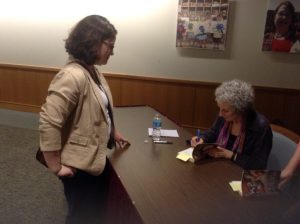
Atwood signing

Margaret Atwood

The first book of Atwood’s I discovered was “A Handmaid’s Tale,” arguably her most famous because it is both required reading and banned in schools, depending on your region. It was assigned in mine, and I did perhaps the most unconventional book report on record for it. Well, at least my most unconventional. I asked my teachers if I could “act it out.” They were very obliging souls, so they said yes.

When it was my turn to present my “report” on “A Handmaid’s Tale,” I solemnly walked to the front of the class, explained that the president and Congress were dead, and I was now in charge of the class. Several classmates turned and stared at our teachers, who just shrugged and said we’d all better listen. I broke up couples, confiscated religious jewelry, separated girls from boys, explained that the girls would now be divided into groups based on their ability to procreate and that the boys, if they were lucky and loyal enough, might one day get the privilege of a wife. One classmate protested my act, and I said that was fine, and he would be hanged. I had my “bodyguard” (who had previously volunteered, and thus got himself a wife) “execute” him, and he was mock-hanged in the front of the class, as an example for the rest.

Like I said, the most bizarre book report ever. I certainly won’t ever forget it.

I’ve since read and enjoyed many other of Atwood’s books (I have a particular fondness for “Oryx and Crake” and “The Penelopiad”), but “Handmaid” was revolutionary for me. It was bleak…really really bleak. Most of even the apocalyptic stories I’d read had shown a strong light of hope. It was all the worse because it was set in such a realistic version of our world, and it scared me on a level no book ever has.

Atwood came to speak as part of a Dallas Museum of Art Arts and Letters presentation. Ostensibly she was there to talk about mythology, but she did this only tangentially. She did show us lots of pictures of her drawings, at various ages. (Apparently she is also an illustrator, and I’m crushed that the copies of her books I have aren’t those she drew).

Mostly, she talked about her childhood. She grew up in the woods of Canada, and didn’t have running water or electricity for most of her childhood. Books were of preeminent importance because they needed things to do.

I think I told my dad that night that I was now upset that we’d had water and electricity, because how would I ever be a fantastic author now?

He didn’t seem that bothered by it.

Atwood took questions from the audience, and I happened to be sitting right by the microphone, so I leapt up and asked about her feelings on technology. She gave a very lovely and funny response about how her use of social media was like a biologist studying mosquitoes: she is offering her flesh up for consumption to test it out for the future benefit of authors and twitterers.

She was lovely and far funnier than I had ever expected and her brilliance really shown. And when I got up to the front of the signing line, I had no idea what to say and just sort of quietly thanked her for coming.

I still can’t believe it happened.

Gaiman signing

Neil Gaiman

And then, adding to the list of Things I Never Imagined Possible, I got to meet Neil Gaiman.

Well, me and about 1,500 other people (seriously. That theater was PACKED).

Gaiman is on his last-ever book signing tour, for “The Ocean at the End of the Lane,” his newest book that is sort-of fiction, sort-of adult, sort-of magical. (I’m only a third of the way in, because I had to do things besides reading today and I’m very very upset about that, but I’ll be finished this weekend for sure).

Gaiman read to us from his new book, and I wanted his lovely sonorous English talking to go on forever, particularly when he tried on different British accents as appropriate.

I just read, tonight, the passage he’d read to us last night, and I hope it always stays this way, but I heard him again in my head, each syllable rolling around between my ears.

He then took some questions from the audience, and unlike Atwood they were all previously written down and presented to him on cards (and I’m bummed because I was stuck in the interminable line and did not get the chance to even ask a question via card). He joked that a huge stack of them were all “What was it like to work on Doctor Who?” so he’d removed those.

He only answered a few questions, and I admit I was a little disappointed; I wanted him to keep talking. But he was lovely and so kind and humble.

Then we got lucky, and he read from his next children’s book “Fortunately, The Milk.” It’s about a dad who has gone off to get milk for his children’s breakfast and…encounters some rather odd difficulty along the way. It was hilarious and I found myself leaning forward, forward in my seat trying to soak up more of it. He’s delightful. I’m definitely going to buy that one when it comes out in September!

And I was lucky enough to be seated in one of the nearer rows, so I didn’t have to wait too long to get my books signed.

Again, I got up there and just gaped like a goldfish. What do you say to your idol? I just almost-whispered “Thank you for coming out.” And he drew a heart in my book and I was so happy I had a Kristen Bell sloth moment as soon as we walked out. Seriously. Neil Gaiman made me cry.


So that’s been this month. I don’t know that I will ever be able to top that.

Provided you’re actually able to speak when given the moment (since I wasn’t), what would you say to your idol? And who would it be?

2 Comments

Filed under Uncategorized

Love like Palmer/Gaiman

I had this whole other thing I was going to write about, and then Amanda Palmer happened.

Well, to be more accurate, Amanda Palmer has been happenin’ for quite awhile now, but what happened was I read her book/marriage review of her husband’s impending book: Neil Gaimain’s “The Ocean At the End of the Lane.”

It’s a beautiful, heart-rending piece, and despite her claiming she’s not much of a writer, she is so visceral and emotive that I can’t help but admire her. She’s like a rock star e.e. cummings.

I mean, just look at this:

and for a second i felt what it must feel like to wait in a line for five hours and have him sign a book that changed your life.
to stand not in admiration of the husband writer, the writer who wants his tea but not with the milk hot because then it’s just wrong, the writer who won’t remember what time he said he’d meet you, the writer who has to sign 12,000 copies of his new book that’s a bestseller before it hits the shelves and actually that’s really annoying because i’m slightly jealous of his instant success no matter what he does, the writer who gets irritated when i leave too many clothes on the floor and he can’t get to the bathroom, the writer who is awkward and has a hard time in party situations when he feels he doesn’t understand the social hierarchy, the writer who is not really a writer are you kidding me he’s just some snoring heap of flesh beside me, sweating and breathing and grinding his teeth and probably dreaming the kinds of dreams that neil gaimans dream, full of dreams and wishes and magic and wonder and all the shit that can drive me crazy if i’m not in the right mood for it….no…the WRITER. the man who actually takes a pen to a paper and writes things and creates a believable world that sucks you in and spits you out, its logic embedded in your mind forevermore. that. i saw THAT. and i love THAT so much, the fact that he can DO that…and i don’t get to see that most of the time. i’m too busy looking at the man. as it should be, i think.

Now I probably should just leave it at that because he’s one of my all-time favorite authors and I have the absolute privilege of being one of those people who gets to stand in line for 5 hours so he can sign my book next week when he comes to town to talk about his book on his last-ever book tour, and if I keep writing there’s a slim slim slim chance he might actually read what I say and then I’ll be embarrassed later.

But I’ve thought this awhile so I’m going to just go ahead and say it: I am in awe of that pair.

Neil Gaiman and Amanda Palmer. How can you not love them?

I’m pretty much in awe of them separately, of course.

I mean, Neil Gaiman, master of  your dreams and nightmares. He taps into literary visions you only wish you could grasp. He’s got an impossible mop of hair, a sonorous voice I wish I could bottle because I’d listen to it every night, a consistently black wardrobe, and a charming dry wit. He’s just precious, and yet also scary, like a beautiful snake that you think won’t bite you but seems like maybe it’s poisonous; at least, it’s been somewhere you’re afraid to go.

And then there’s Amanda Palmer. Frankly, she scares the pants off me. She’s so unafraid, unflinching in front of a crowd or a feeling. (Go watch her TED talk if you’re not sure about that). She does this beautiful zany thing with her eyebrows, and her music is so daring and interesting (ok, I admit that I don’t always get it. But I do always feel it). I’m terrified of her, but I also wish I could be like her, so avant-guard and free and magical.

And then they had to go and get together. And now they provide a whole ‘nother kind of inspiration.

Now, I’m not a big fan on spying on celebrity’s lives: I figure they probably deserve their peace just as much as any of us, thankyoukindly, and sometimes more. But I admit an intense fascination with these two. I don’t go seeking information on their relationship, but I’m always quietly thrilled when one of them writes something about the other, or someone posts a hypnotic picture of the pair, because I try to imagine what being in that relationship is like.

Like a pairing of two titans, I think. Electric.

Though Palmer talks about them having “rough” times, the part of their relationship I (and the rest of the internet, presumably) see is so effusive it’s grandiose. I want to be like that. I love my fiance dearly, and I wonder, if all our secret private talks were open to the world (and if someone cared to read them) would I sound as loving and intense as they do? Or is their affection for each other something special, out of reach for the rest of us?

If, by some slim chance, Mr. and Mrs. Palmer/Gaiman read this, I want to say thank you. Thank you for the courage to love with vivacity, with abandon, with depth, with honesty.

And thank you for giving us glimpses of that love. May the world be blessed with more like it.

2 Comments

Filed under Uncategorized

12 Months of Experimental Tales

This month, inspired by one of my absolute favorite authors, I set out to write 12 short stories, using prompts selected by Neil Gaiman. I later found out that this kind of short, quickly written fiction is known as “flash fiction.” (Look at that! I was part of a thing and I didn’t even know it!) I’ve never participated in this kind of writing exercise: the last time I wrote fiction in response to a prompt was in the one creative writing class I’ve ever had, which was in high school and acted mostly like a therapy group for teenage angst.

Twelve stories. It took me nearly a month to complete the challenge (though I never went over an hour in writing each one, so mission accomplished. Technically my writing time was the same as Gaiman’s, though I didn’t have the luxury of three consecutive days of writing–thank goodness I also didn’t have the camera crew). While I loved it, I’m also glad I don’t have these unfinished prompts hanging over my head anymore!

What I’ve Learned from the Calendar of Tales

  1. Prompts are great
    Like I said, I haven’t written from a prompt with any regularity in awhile. I don’t remember liking prompts, but these were nice and juicy and open-ended. I enjoyed having something percolating in the back of my mind. In fact, I often chose to work on the Calendar Tales because of the intriguing prompts..meaning I sometimes neglected my longer fiction pieces (I still love you guys, promise!)
  2. Short fiction can be liberating
    Maybe I’m just a little backwards, but I’ve heretofore preferred longer fiction. I just didn’t see the point in sitting down to write something I knew was going to be short; better to use that energy on a longer project that can pack more punch. But the short word count on these was great: I could say whatever I wanted! I didn’t have to bother explaining where everything came from or making sure each little loose bit was tied together. I just needed to say enough to establish the scene and the problem, and get out of the way. In a lot of the stories, I’m imagining a lot more that just didn’t fit, and I’m okay with that. I hope the reader enjoys filling in the broad strokes, too.
  3. Accents are hard
    For the August tale, I knew I wanted a twangy Texas grandma as the narrator. It’s an accent I thought I could fake pretty well, but I ended up spending the most time on that story out of all of them as I struggled to figure out how to spell the words the way they should be pronounced. I wanted her to be twangy and kind of like Gertrude Beasley, a plain-speaking sassy-as-hell real woman from the barren 1920s of west Texas (My First Thirty Years is a tough read sometimes, but it’s now available to download on Kindle, if you’re interested). I had the hardest time figuring out how you might say “child” with that accent! I think I got it, but it took a lot of trial and error. I have a lot more appreciation for those who write accents frequently.
  4. Ducks Can be Scary
    I don’t watch horror movies. I don’t read horror novels either (except for when I’ve started a book without realizing it’s horror but can’t stop because I have to know what happens), and I struggled to make it through 75% of Joe Hill’s excellent Horns on audiobook before I couldn’t take it anymore. So I didn’t really think I was going to be writing horror. But the April story–I just knew it needed to be terrifying, because the idea of scary ducks was both absurd and believable to me. I think it did a decent job at it, but I think the better lesson is that it’s good to try things even if you think it’s beyond your abilities.
  5. Beta readers are good people
    I fit the writer-as-hermit stereotype pretty well, but it’s something I know I need to work on. Just before starting this venture, I met some great folks at ConDFW, one of whom was just foolish enough to say he’d be a beta reader for me. (Hey there Bryan!) After I wrote each piece, I sent it over to him, giggling like a fiend and hoping he found it just as funny/clever/scary/whatever. And biting my nails when I didn’t get an email back instantly. I’ve been leery of sharing my work before, but this project was different. Bryan caught some dumb mistakes and I’m really grateful for his help. Lesson learned: Beta readers = good.

I’m glad I took on this challenge, and I think it produced some fun and interesting results. I hope readers enjoyed them, too! Read all of the calendar tales.

What writing challenges have you participated in lately? What do you learn from them?

1 Comment

Filed under Short Stories, writing

A Calendar of Tales: December

(Prompt: Who would you want to see again?)
“My 18 yo-runaway-self so I can show her that I find someone to love & own a home of my own – it did get better.”

This side of town is darker than I remembered, grungier. I remembered it as an artistic, safe-ish place, full of fun and interesting people; seeing it now, I wonder how this ever seemed appealing. I don’t go to areas like this, not at night.

But it’s December 1987, and I know I have a hard year behind and ahead of me. I’ve thought about it for a long time—these visits don’t come cheap—and this seems like the best time for me to come, to offer myself another chance. I’ll have another tough year after this, but I remember how terrible this winter was for me. I hope that coming now will mean I’m happier.

I pull my coat closer and step through the portal onto the street, remembering to close it behind me as I go. My younger self will be within 6 blocks of here; I never did travel far, those days.

I checked the store room of the Indian restaurant on 9th first; it’s warm there, and the owners sometimes gave me some rice at the end of the night. But the servers are still bustling, so I move down the block, in the sheltered alcove next to the Dumpster overlooking the park.

I see my boots first, two sizes too big and unlaced most of the way. How did I ever walk in those, anyway? I shake my head and make a noise in my throat, “ahem,” and stare down at my 18-year-old self.

Gawd was I a scrawny thing.

“I don’t know what you heard”—it’s shocking how pale I look—“but I don’t do that no more,” my young twin says diffidently.

“I’m not interested in anything you have to offer, Sam. I’m here to offer you something,” I say, extending a hand.

Young Sam glares up at me from under that beat-up old hat. I thought I looked killer in that hat; I still have it. “Who are you?” I sneer.

“I’m you, in the future. You’re me, in my past. I know, it’s hard to explain, but trust me on this. Time travel is invented in 2047, and it’s 2056 in my time now. I’ve—we’ve—led a good life, and I wanted to come tell you it’s going to be okay,” I say. I offer my hand again, hoping my younger self will take it and walk with me.

He disappoints me, mistrustful, but I understand. “Gawd I don’t age well,” he grimaces, disgusted.

“I thought I might show you how things are going to turn out,” I offer. “If you’ll come with me just here…”

I gesture toward the open wall. Young Sam stays out of arm’s reach, but gets up and follows me. Good enough for me. Fumbling with the switch, I activate the portal.

“That’s going to be your home, Sam. See? It’s beautiful, isn’t it? It’s got 5 bedrooms—five! I think sometimes I should sleep in all of them, just because I can…” I turn and look at my younger self, practically feeling the desperation in him. “You have a family; better than you’ve ever dreamed. You even get a respectable job, and it pays for two top-of-the-line hovercars, and vacations in Bermuda and Taipei and all over the world.”

He’s leaning in, as if he wants to grab the house right out of the portal. I can feel his longing; I remember its echoes in my own heart. “That’s my future, huh?” Young Sam says.

“Yes, Sam,” I say. “It’s all going to be alright.”

“So you’re telling me you came all the way from the future to show off all the cool stuff you’ve got?” He opens his arms, angry. “You came here to goddamn brag, old man?!”

“What? No,” I say, flabbergasted. “I remember how bad this year was, how bad the next was, and I thought if you saw that things were going to work out, you’d feel better and it wouldn’t be so hard.”

My younger self snorted. I don’t remember being so rude. “Man, I get stupid when I’m dumb. You think I want some crazy asshole to come up, tell me he’s from the future and show me a bunch of shit I can’t have? Well, no thanks. I’m not waitin’ around for no punk-ass future.” Out of nowhere, young Sam slams his open palm on my hat, pulling it down over my eyes. While I’m blinded, he yanks the portal fob from my hand and knocks me to the ground.

I look up just in time to see those stupid unlaced boots disappearing into the portal.

“Well, that didn’t go exactly as planned,” I say to the Dumpster, dusting off my hat and sighing. “Thank goodness I bought the time travel insurance.” I walked back to the sidewalk to wait for the time governors to pick me up and dump my stupid younger self back in 1987.

Kids in these days; no respect for their future elders.

Read more of the calendar tales.

1 Comment

Filed under Short Stories

A Calendar of Tales: November

“My medical records, but only if that would make it all go away.”

Roslin fiddled anxiously with her datapad. She’d been waiting for this meeting for nearly three years; so much hung in the balance. It was odd to be wishing she was sick enough, the sickest person they’d seen, really, but that was what she had to do, had to be, if she wanted priority placement in the program.

She breathed rapid, shallow breaths through her oxygen tube. Of course, Roslin always breathed poorly, limited by her faulty, broken, accursed lungs, but this was worse than usual. She flicked the regulator to increase the flow of the life-giving supply, and tried to slow her breathing. Too nervous. Had to calm down.

A nurse appeared at the door. “Roslin?” he called, mispronouncing her name.

“Here,” she answered, her voice hardly a whisper. “Here I am.”

Roslin guided her chair forward, careful on the hard turns that could disrupt her stabilizers. The nurse nodded and held the door open. “Follow me, please.”

He led her back into a sparse conference room. At the table placed perpendicularly to the entrance sat five people: the program representatives. The people who would determine her fate. Roslin could find no smiles, no reassuring looks. She sucked air nervously into her failing lungs.

“Ms. Roslin Miller?” A woman on the far right flicked through a datapad. “Cystic fibrosis patient, already rejected one set of donor lungs; also incompatible with all known synthetic lungs?”

“Yes, ma’am,” Roslin wheezed. “I’ve had a number of challenges.”

“That seems like an understatement.” The speaker this time was a man on the left. Roslin didn’t know how to respond, so just sat silently.

The man in the middle folded his fingers into a tent. “Do you understand the implications of what we are offering with this experimental program, Ms. Miller?”

“Yes,” Roslin said. She breathed deeply, trying to compensate for the difficulty of speech.

“And why should you be selected, Ms. Miller?” The man, this whole group that was weighing the fate of her life, seemed so indifferent. If her broken, disabled body was not enough, weren’t the detailed medical records they each read with such detachment?

“My only hope – left is to be – admitted. Please — accept my application. — I have already – more than – outlived – doctors’ expectations.” She panted for a moment, struggling. “I don’t know – how much more time – I have.”

“Thank you for your time, Ms. Miller,” said a new speaker, a petite woman sitting toward the left. “Please give us a few minutes to confer and we will have our response as soon as possible.”

With that, the five people stood and stepped out of the room.

The next five minutes were the longest of Roslin’s life. What if they said no? What was left for her then? She blinked her eyes closed against the depression lurking, and said a prayer. To anybody, anyone who would listen; God, the hospital, this panel. Please. Please let it work out this time.

When the door clicked open, Roslin froze with terror. The faces of the panelists were unreadable. Oh god—

“Ms. Miller,” the center man said, “We believe you are an excellent candidate for the process.”

Elation. Pure ecstatic elation.

The next hour was a blur. Fingerprinting datapads, releasing indemnity, contacting her mother, her emergency contacts, preparing for the procedure, settling in the chair in the shining metal hospital room.

“You understand all risks and possible side-effects from this procedure? You voluntarily agree to this experimental process?” the nurse asked the questions for what felt like the 10th time.

“Yes, yes,” Roslin said eagerly.

“Then the process will begin in a few moments.” He left the room, and Roslin heard the door behind her click closed.

The air filled with a buzzing hum, the temperature growing warmer, a too-hot coat worn in summer. Roslin sucked air into her impaired lungs, frightened of the heat, of the building pressure. The machine above her clicked on, and a blue light scanned her from head to foot and back again.

The mix of air in her breathing tube changed: the nanobots released into her system to reprogram her genetic code—to repair her body from the inside out.

Roslin screamed.

Every cell in her body burned with an internal fire, erasing the record of damage done, of every attempted and failed medical procedure, of each tortured breath.

Roslin burned as the Phoenix process remade her anew.

—–

“Roslin? Roslin, baby, wake up. Roslin?”

Roslin blinked slowly, eyes heavy. “Hello?”  She stretched and yawned, rolling toward the voice.

“Hey baby.” The woman smiling down at her looked kind, the wrinkles around her eyes relaxing at Roslin faced her.

“Hello,” Roslin said again. She took a deep breath and sat up, and the woman at the side of her bed gasped in surprise and covered her mouth with her hands. “Are… are you my mother?” Roslin said uncertainly.

“You can breathe!” The woman who might be her mother said. “Oh my god, baby, you can breathe!”

Roslin considered for a moment. “Yes, I can. Is that unusual?”

“The procedure worked! It’s a miracle!” The woman rushed forward, arms extended. Roslin balked, and the woman stopped. “Don’t you remember? You went through the Phoenix process? Just yesterday. You have—had!—cystic fibrosis, but they’ve cured you, baby!”

Roslin stared back. “I—I don’t remember.”

A nurse in green scrubs came in. “Mrs. Miller, come with me, please,” he said, and took the older woman aside.

“Mrs. Miller,” he said when they were out of the room with the door closed. “We’re finding that retrograde amnesia is associated with this kind of procedure. Roslin may not remember anything from her life before yesterday’s surgery. It seems…” he paused, pursing his lips. “It seems that her genetic deformity may have been interrelated with her memories of the illness. We cured the genetic mutation; it’s possible that we also rewrote her memories from the time of her illness.”

“What?” Roslin’s mother said. “My daughter has had cystic fibrosis her whole life. What does that mean? What will she remember?”

The nurse looked away. “She agreed to the Phoenix procedure. We have all the documents…She may not remember anything. It may all be gone.”

The elder Miller stared in shock. The nurse tried for a bright side: “It is possible, with time, that she will remember parts of her old life. But I recommend you focus on her rejuvenated future.”

Mrs. Miller wiped the tears from her eyes and walked back into the room that held her daughter, new-born at 43 years old.

Read more of the calendar tales.

(This story inspired by my friend David Miller, who has cystic fibrosis and as I was writing this was getting his new lung transplant after three years on the waiting list! Please consider being an organ donor to help people like David.)

2 Comments

Filed under Short Stories

A Calendar of Tales: October

“A djinn. Not to make a wish. But for the very best advice on how to be happy w/ what you already have.”

431. 433. 435…ah, there it is. David stopped in front of the sliding metal door marked 437. He savored the possibilities for a moment—what treasures might be held in this nondescript storage locker?–before fitting the small brass key to the padlock. The lock snicked open and David felt his back twinge a little as he pulled the door up.

Inside, the room was stacked with… boxes. Just cardboard boxes, smelling of old paper and dust.

Well, it’s not supposed to be obvious. David sighed and stepped in to open the boxes, carefully. His wife had been encouraging him to find some kind of hobby; he found fishing boring and he scored too high for golf. While watching TV one night, she’d suggested this: searching for treasures by buying abandoned storage units. She’d made it sound fun, exciting; an adventure!

This was not an adventure. This was an awful lot like work.

David went through the boxes, one by one. It seemed like the contents of a shabby apartment, mostly. Now that he was a quarter of the way in the room, he had revealed a beat-up couch with monstrous red rose fabric. It probably wasn’t sellable—he’d more likely have to burn it, it was so hideous—but it made a good place to rest for now. He flopped into it, sending up a cloud of dust that made him cough and sneeze.

He opened the next box. It held a bunch of knickknacks, mostly. One looked like a kids’ trophy; maybe he could Sherlock-Holmes it and find the kid and return his long-lost trophy!

David rubbed at the dust, trying to read the inscription.

“ALA-KAZAM!”

A voice boomed and echoed in the metal-walled locker, and David doubled-up, trying to clear the sudden smoke from his lungs and eyes.

“What the hell?!” David said.

“IT IS I, THE GREAT SAFWAT, DJINN OF ARABIA,” the blue smoke-monster grinned down at David from where it hovered. “WHAT IS IT YOU WISH OF ME, LORD AND MASTER?”

“Um,” David said. “Sorry, gin? I haven’t been drinking the right mix. I only get a hangover.”

“I AM NOT A BEVERAGE AND THIS IS NO LAUGHING MATTER,” Safwat said. “I MAY GRANT YOU THREE WISHES, AS YOU DESIRE.”

David scratched his head. “No kidding, wishes? Huh. What do other people wish for?”

“TREASURE BEYOND IMAGINING,” Safwat said. “POWER. LOVE. VENGEANCE. PEOPLE WISH FOR MANY THINGS.”

“And you just give it to them?” David shook his head. “Sorry, I’ve gotten a lot of junk mail in my day, and this frankly sounds too good to be true. Am I on a reality show? Where’s the camera? Don’t I have to sign a waiver or somethin’?”

“MY OFFER IS TRUE,” the djinn said.

“Rrriiight, sure it is. So the person you gave ‘treasure beyond imagining,’ what happened to him?”

“HE WAS SULTAN OF THE KINGDOM.”

“Well that sounds pretty good. Lived happily ever after, I suppose?”

“LIVED HAPPILY UNTIL HIS REIGN ENDED.”

“Long and happy life as a king? That sounds decent.”

“HIS REIGN WAS 4 DAYS. THE PRIOR SULTAN DID NOT APPROVE OF MY FORMER MASTER.”

“Heh, yeah, I can bet that didn’t go well. You didn’t say that he’d replaced another guy to take the king gig.” David shrugged. “So what about someone else—how about vengeance? How’d that one go?”

“MY LORD WISHED FOR HIS LIFE’S WORK TO BE REMEMBERED FOR ALL TIME, WHILE HIS PEERS WERE FORGOTTEN.”

David nodded. “That sounds like a pretty good wish. How’d it work out?”

“SHIPBUILDER THOMAS ANDREWS IS FEATURED IN MANY MUSEUMS AROUND THE WORLD, AND ALL KNOW THE NAME OF HIS PRIMARY VESSEL.”

“Oh? Which one was that? I’m not a big naval buff—“

“TITANIC,” the djinn interjected.

“—Oh. Yikes,” David tutted through his teeth. “Apparently these wishes need to be specific. So what did you give the last person you talked to?”

“HE WISHED TO BE REUNITED WITH HIS LOST LOVE,” Safwat said. His voice continued to echo in the small space; David hoped no one could hear it.

“And you did that for him?” David asked.

“YES.”

“And then they were, what, happily ever after?”

“I DO NOT KNOW THEIR EMOTIONS. BUT THEY ARE TOGETHER. FOREVER UNITED IN DEATH.”

David’s mouth hung open. “See, that’s just what I’m talking about. I bet the guy didn’t even know this ‘lost love’ of his was dead. And so he made that wish and you killed him and oh my god that’s why he stopped paying for the storage unit!”

David stood up and paced the room, then turned and shook a finger at Safwat. “That’s what we call a bad deal. You’re not really providing a good incentive to make wishes here.”

“IT IS MY PURPOSE,” Safwat said.

“Yeah, well, I think I’m good. All your wishes end in death! No thanks, I think I’m set. I’ve got a nice—small, but a realtor would call it ‘cozy’—house, a wife who cares about me and makes excellent pies; I’ve got a job that pays the bills. The only problem I had was a lack of a hobby. And I think I’ve found another one to cross off my list. This one’s no good either!” David threw up his hands.

“WOULD YOU LIKE TO WISH FOR ANOTHER ONE?” Safwat said, sounding almost pleading.

“No thanks, I’ll figure out the hobby on my own.” David approached the cloud of blue smoke with hand extended. “Nice meeting you Safwat. Can I drop you off somewhere or something?”

The cloud of smoke eyed David’s hand and continued hovering. “I DO NOT UNDERSTAND. EVERYONE WISHES.”

“Yeah, well, I’m good, thanks. I’m heading out now, so go back into your trophy or let me know where to take you. I’ve got gas for a good 50 miles.”

Safwat hesitated. “YOU WOULD ALLOW ME TO LEAVE MY VESSEL?”

“Sure, go ahead, why not. Nice talkin’ with ya, Safwat. Have a good life, or eternity, or whatever.”

The blue mist swirled and spiraled. David took that as a sign the conversation was over, and slid the door down, locking it again with the key. A moment later, a handsome man dressed in a blue tunic appeared outside the storage unit.

“Woah there, startled me,” David said. “That you Safwat?”

The man nodded. David smiled. “Well then, here, why don’t you take this key? You’ve got enough in there to set yourself up with a decent apartment.”

Safwat took the key uncertainly, and David went home. When he arrived, he kissed his wife and told her he’d give fishing a second chance.

Read more of the calendar tales.

1 Comment

Filed under Short Stories

A Calendar of Tales: August

“August would speak of its empire lasting forever whilst glancing, warily, at the leaves cooking on the trees.”

“’Course there ain’t no chupacabras. But that don’t mean they ain’t real. They usedta run all round these parts. No, chiyle, there ain’t no chupacabras no more cuz Lucky Lyra Riley done cooked ‘em all up good.

Now, if yer thinkin’ this is gonna be one-a dem Pecos Bill tall tales, don’t. My stories are all true. I ain’t got no time for bullshit like them stories. Who ever done hear of a blue ox anyhow? No, chiyle, this story is the truth, God’s honest. I done seen it with my own two eyes.

It happen one summer back when the whole family lived in west Texas, back when the plains was still wile’. Now I was just a little sweet thang, cuter even than you, if’n you can believe it.

It was August, back when there weren’t no school cuz the days was too hot. Sometime I’d sit out behind the dogs just to catch the breeze off their tails, true enough.

August in Texas lasts ferever. It’s jes’ like today, but worse by a million degrees. Ain’t nothing you can do about it back then, neither. You wake up hot, you sweat all day an’ taste like salt, you go to bed hot, and even the lightest sheet weighs heavy like 15 blankets. Mmm-mm. It was godawful hot. An’ this August was perticularly uncomfortable. It jes made you want to up and die already. Even if you went to tha bad place, you was probly better off.

We was all layin’ about on the porch, hidin’ from the sun and prayin’ for a breeze, when in to down comes Lucky Lyra Riley. She’s ridin’ her horse, the finest animal you ever did see, with eyes like rubies and hooves that could crush a man an’ keep on goin’. I ain’t never heard tell of no otha animal half as wondrous as that horse.

An’ there on top is Miss Lyra. Oooh-ee. She was a fine lookin’ woman, and brave, braver than 10 men, though you wouldn’t see them say so.

She was comin’ to town cuz she done heard tell we had a chupacabra problem. And boy did we! Every night we done had to wrangle up all the littlest kids and our animals  so’s that those dread beasts wouldna come suck up all their blood. That meant we had 5 people, 18 goats, and 14 chickins in our little 3-room shack when it was hotter than hell!

So we says ‘thank ya Miss Lyra,’ and invited her in fer dinner. She said she would mighty well like a bite, and she came in and tole’ us all her ‘ventures. Anyhow, Miss Lyra finishes eatin’ and she says ‘thank ya kindly’ and heads off into the night.

The nex’ mornin’, roundabout 10 a.m., we sees Miss Lyra come cloppin’ back to down. Her horses’ whithers is all foamy from runnin’ and it drinks up enough water for our whole herd-a goats. She tells us she done been chasin’ them chupacabras, but they’re wily, ohhh how wily they is.

She stayed an’ rested in the shade all day—us kids went fer rides on her great big horse—and at night she went off again into the wilderness. In the night we heard a mighty scuffle way off in the plains—barkin’ and shots fired an’ whatnot, and it was very excitin’ but we was all scared for Miss Lyra because we got bigger chupacabras than anywhere else in the whole state. We’re afraid she got et up.

But no, come mornin’ there she is, her horse walkin’ behind her. She got a bandage on her arm, but it’s ok, and she got a brace of jackalope to boot. She says them chupacabra’s built a trap fer her out in the wild places, an’ they nearly got her, but she is smart an’ got away.

We cooked up those jackalope fer dinner that night, and dem horned rabbits was the best tastin’ food I ever did et. You better believe it.

We kids knew what was comin’ next, and we was all so excited we couldn’t sleep none. Daddy let us sit on the porch an’ wait up. The moon was high and we could very nearly see all the way to El Paso, an’ we sat there an’ watched Miss Lyra ride off into the wilds.

It was a frightful scene. Them chupacabra ain’t nuthin’ like what you see on the tellyvision now; no sir. They was as big as a mule, but could shrink up real small, too, to sneak in and bite ya. Miss Lyra was out there with her mighty horse, and we can see she ropes the biggest one up good, but it pulls and pulls and pulls.

Her horse, it digs in its feet, but them chupacabras runs in packs, and they all get on up to the rope and pulls back. Well, Miss Lyra ain’t called Lucky fer nuthin’, cuz alla sudden, out comes a big ole’ rattler, angry at bein’ disturbed in his sleep. He jumps up and bites the chupacabra, and it lays down dead.

Now Miss Lyra only got the weaker chupacabras to deal with, and she sets  her horse up into an amazin’ gallop, draggin’ that dead blood-sucker all around the plain. The other beasts, seein’ their leader so shamed, come runnin’ along after it, howlin’ and barkin’, but see, that jes’ be part of Miss Lyra’s plan. She spurs her horse to run faster, faster than any beast ever did run, and the chupacabra draggin’ along behind. Well, the horse ran so fast, that chupacabra jes’ burst right into flame!

The others are quite surprised by this, as you might imagine, but they keep on chasin’ Miss Lyra. So she has ta keep runnin’, and her horse, it is draggin’ this fiery devil dog along behind.

My daddy, seein’ what’s comin’, rounds up all us kids in the wagon and we runs away, fast as we can. You see, Miss Lyra’s chupacabra chase done lit the west on fire!

Them dogs stayed on her heels all night long, and half the west got done burned right up, in a fire so fierce it made smoke thicker’n night—so we got the cool weather we had prayed for. Miss Lyra done ride off, right into the sunrise, and took them devil dogs with her.

And that’s why there ain’t no chupacabra ‘round no more. They all got burned up by Miss Lyra and the sun.

Now go run along to bed, ya hear? Go on, git!”

Read more of the calendar tales.

Leave a comment

Filed under Short Stories