Tag Archives: ME Kinkade

A Calendar of Tales: May

“An anonymous Mother’s Day gift. Think about that for a moment.”

The first card arrived in early June. The envelope was pink, with flowers drawn on in childish crayon. It stood out from the business-size white bills. It had no stamp or postal markings, though the address was written in neat print, surprisingly adult, in pen.

Though it was addressed to her, Beth opened the envelope hesitantly, careful not to rip the flap. Surely it was meant for an elementary child’s parent, and Beth was all alone. Probably just an incorrect address; she’d find out who it was from and deliver it. She still knew all the neighborhood children, so it would be easy to return it to the proper house.

The card showed a bouquet of flowers in yellow, pink, and lavender, dusted softly with glitter. The inside was a soft pink, with the words “Happy Mother’s Day!” in a cheery script.

There was no signature, but there was a child’s drawing of a sun in bright yellow crayon in the upper-left corner.

Beth sighed. How she wished for a card like that; but of course, it couldn’t be hers.

Fighting off the quiver in her lip, Beth laid the card on her kitchen countertop, telling herself to ask the neighborhood kids if it belonged to one of them. Besides, it would be good to see them again. They hardly came by for lemonade anymore.

—–

On July 7 Beth returned from her aunt’s beach house to find a page from a spelling tablet tucked between the storm door and the doorframe. Beth put down her suitcase for a moment to retrieve the paper, expecting it to be another charity plea from the local church.

It was a drawing of fireworks, over a stick figure family enjoying a picnic on a red-and-white checkered blanket. It was drawn in marker, and Beth could see where the green ink of the fluffy trees had smudged from the artist’s left-handed coloring.

Written in careful rows on the lined bottom-half of the page was “Hapy FoRth!”

Beth stared at the drawing for a long moment. The stick figure family was three smiling figures: a boy, a man in a red shirt, and a woman with brown hair in a ponytail. It reminded her of that lovely summer years ago, back before Jerry had left. Before…

She shook her head. None of the neighborhood children had claimed the wayward Mother’s Day card, but maybe sweet little Lisa from down the street had given out Fourth of July pictures to her next-door neighbor. Beth resolved to go over and thank the little girl as soon as she unpacked her bags.

—–

A loose pile of wild flowers—red, and pale yellow–and a bluebell from someone’s yard rested on Beth’s car windshield in August, wilted in the heat. Beth smiled at the little love-gift, and set the dying flowers in the grass next to the driveway so that the owner could reclaim them later.

She was surprised to still see them there when she got home from work, but then, children do forget things.

—-

It was just barely October when Beth found the chocolate bar. It had been set on her front porch sometime during the day, while she was at the office, and was mushy from the heat. There was a scratch-and-sniff sticker of a slice of pizza on it.

When she flipped the candy over, Beth found the other sticker: a jolly Santa laughing and clutching his belly. Written next to the “TO:” was “Mommy” in a child’s scrawl.

Beth threw the chocolate in the trash and called her ex-husband. “This has got to stop!” she screamed. “Why are you torturing me?! Do you think this is some kind of joke?”

He denied everything. Beth clicked the phone off, threw it against the couch, and sobbed.

—–

Beth was putting on lipstick, on the way out to a low-key birthday celebration with a few friends, when the doorbell rang. She pursed her lips to set the stain and hurried to the door.

She had expected it to be Dorothy, there to pick her up, but standing behind the glass of the storm door was a woman in a fitted business suit whom Beth did not know.

“Can I help you?” Beth asked.

The woman’s eyes went wide and she broke into a delirious smile. “Mommy!” she said in a childish voice. The woman extended her arms as if to hug Beth.

Beth backed away. “I’m sorry, I think you are confused.” She moved to close the door.

“Mommy, aren’t you happy to see me? Haven’t you missed me?” The woman sounded young, and confused.

Beth stared at her with alarm. The woman said, “Mommy, it’s me, Jamie.” The woman tugged at her blouse absently. “Oh, I forgot; this is Susan. She’s helping me talk to you today. Mommy, I have missed you so much. Didn’t you get my letters? And the candy? Isn’t chocolate the bestest?”

Beth backed away, shaking her head. “No no no, go away. Jamie’s dead. My son is dead, he died 3 years ago and you are a very cruel person. Why would you do this? I lost my son. You’re a horrible person, and I’m calling the police.” Beth was closing the door, but the woman with Jamie’s voice stepped forward and pressed her palm to the glass door.

“Mommy, I’m sorry I’ve upset you. I didn’t mean to make you sad. It’s just that I missed you so much,” Jamie said.

Beth’s eyes filled with tears. “Jamie? Baby, is that you?”

“It’s me mommy,” Jamie said. “If you don’t want me to come back anymore, I won’t. I don’t want to make you sad. But I missed you and wanted to tell you I love you. I am with you every day, mommy.”

“Jamie,” Beth said. She ran out and hugged the woman tightly, and Beth could almost imagine she was holding her son. “Jamie I love you, too. I didn’t know. I didn’t know you could come back. I’m so sorry, baby. I’m so sorry.”

“It’s okay, mommy,” Jaime said. The woman pulled back slightly. “Mommy, it’s time for me to go, okay? Susan has to go home now. But I’ll keep sending you letters sometimes, if you say I can.”

“Yes, baby,” Beth said, clutching the smaller woman’s shoulder. “I’ll always love you, Jamie.”

“I love you, too, mommy,” Jamie said. The woman stepped back, brushed down her blouse, now wet with tears, and breathed out slowly. Her breath left a fine white mist that hung in the air.
Read the rest of the calendar tales.

Leave a comment

Filed under Short Stories

A Calendar of Tales: April

“When the ducks would trust us again; my father & I fed them fresh bread stolen from the inn he worked at.”

I write this with trembling hands and anxious heart. Tonight, we attempt our escape; I fear we shall not make it. Though our plan seems sound, desperation drives us. I pray we have done enough. I pray we survive.

Though I know any who may find this—if any soul remains in that wide world—would scarce believe the words, still I must confess my tale, lest I perish tonight and no one ever know my story.

My father and I have been held captive here, in the inn where he worked, this whole bitter winter. That fateful night, the rooms, all 12, were full of laughter, with friendly visitors and warm hearths.

There was Benny, the innkeeper, a stern man, but always finding a spare room for a lost soul; also, his wife, Suzanna. They were cursed to a life without children, but made room in their lives instead for lost souls. It was through their kindness that my father found labor and a place for us to stay, though the hours were long and the work hard. Still, it was honest, and that was more than generous enough.

A blizzard was brewing that night, so the inn was full. I was busy all day with the many horses seeking shelter in the stable, and the guest rooms filled with travelers seeking solace.

Alas, they are no longer with us. After these long months of cold, our number is only two.

The storm blew wild and furious for three days, and none dared leave for fear of suffocation in the fast-driven snow, so thick it was a wall from heaven to earth. Once did I run the 15 feet from inn to stable to replenish the horses; it took me an hour to find my way back, and I managed it by luck alone.

We did not know the storm would guard our last moments of joy (for though the blizzard was mighty, the company was jovial and beer flowed).

On the fourth day, there came a knock at the door. In wonderment at who could travel in such abysmal weather, I opened the door to greet the visitor.

There before me were ducks. I hesitate to even call them so, though that was what they appeared to be. Monstrous ducks unlike any imaginable, with wattles of blood red, wings of mottled grey like ash from hell, yellow eyes, and curved claws that could rip out a man’s throat. Think not poorly of me; I am no cowardly man—at least I did not think myself to be so—but these were waterfowl of nightmares, tall and vicious.

I fell back, afraid, but the innkeeper, always kind toward travelers, welcomed the creatures in, despite their gruesome visage.

There were 8 of the creatures, and their entrance occupied a quarter of the large tavern hall. Aside from their incredible size and unusual appearance, nothing seemed out of sorts. The drake–Captain Jack, as he came to be known—thanked Benny for the welcome, complaining of a broken wing caused by the storm. Jack announced he and his flock would be staying at the inn.

Oh! Had I known what was to come, I would have fled into the snow right then!

The first trouble came that night. Jack and his flock (they were Kack, Lack, Mack, Nack, Ouack, Pack, and Quack; I imagine their kind had difficulty with other names, due to their peculiar snouts) asked for dinner. My father and I brought out all the bread prepared, and still the fowl demanded more. I pleaded that we would bake more, if only they would have patience, and retired to the kitchen.

What happened next I only know from hearsay, but one of the guests, a traveler from the watery south, made a joke at the ducks’ expense. I know not what he said, and dared not ask, because in two shakes of a tail Kack, Lack, Mack, Nack, Ouack, Pack, Quack, and Captain Jack fell upon the ill-fated man and ripped him limb from limb.

Blood dripping from their wattles, the ducks declared they would winter here, and that we should serve them or meet the same terrible fate, and far be it for us to stop them; and so we lived in constant tyranny.

After several more days of this treatment—and two more guests consumed–my father and Suzanne and I, weary from toil over the stove baking bread, hatched a plan to escape. Saying we needed ingredients located in an imaginary storeroom, we crept out. We reached only the edge of the ice-covered pond, and were there discussing our next move, when Ouack, Pack, and Kack came outside. Suzanne panicked, and ran, sliding, out over the ice.

The ducks beat their terrible wings and caught her. As they stained the ice with her entrails, my father and I ran back to our cruel prison, the ducks never the wiser of our attempt.

Supplies are now running low. Benny took his own life after Suzanne’s horrible murder, and the ducks, growing monstrously hungrier day by day, gobbled up everyone else. The horses, too. My father and I survive only by baking bread, day in and day out; though whether you can call this substance made from the ground bones of the dead bread I do not know—my father and I do not eat of it, so we grow thinner and wearier every day, as the fierce ducks grow fat on the blood of our fellows.

It has been several weeks. We think perhaps the ducks trust us now, we being the last. Why else would they keep us so long?

Deep in the cabinet we found the carcass of a rat, long dead from poison and deeply decayed. We prepared tonight’s bread for the ducks with this macabre feature, in hope it will disrupt their systems and buy us time to escape.

We feed the ducks their bread in mortal terror. If we succeed this night, we shall be free; if not, heed my words, oh ill-fated traveler: Trust not when the ducks come a-knocking.

Read the rest of the calendar tales.

2 Comments

Filed under Short Stories

A Calendar of Twittery Tales

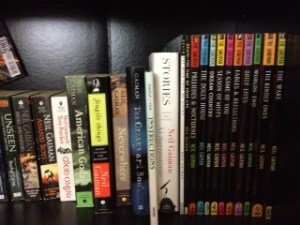
Fantastic author Neil Gaiman launched A Calendar of Tales, a short fiction project, this month. It combined prompts from his massive Twitter following, and now he’s soliciting art to illustrate the final calendar, a story for each month.

It’s a pretty impressive challenge, so I thought I’d grab on to his long, black, mysterious (very well-fashioned) coattails and have a crack at some short fiction, too. It’s good practice.

I love Neil Gaiman!

I’m only a *little bit* of a fan, as you can see.

To really emulate one of my absolute favorite authors, I’ll try to follow his rules:

  • Write a story off the Twitter prompts.
  • Don’t poach Neil’s ideas. I read his stories once, but I’m not going to peek again until after I’ve finished. They’ll use similar themes, I imagine, as I’m starting from the same prompts, but we’ll go different places.
  • Between 500 and 1,100 words (I did a word count on each of his stories to find this range).
  • Spend no more than 3 hours on each story. (This is gonna be tough! I got this figure by assuming he spent 12 hours per day writing for each of the three days it took him to complete this challenge. If I was able to write full-time, I might try the three-day sprint, but this is going to have to do.)

Thanks for the inspiration, Neil!

-ME

My first three stories are up!

January (Dangerous Veteran)
February (Grandma’s Pendant)
March (Anne Bonny Dreams)

Leave a comment

Filed under writing

A Calendar of Tales: March

“Anne Bonny and her rapscallion heart, dreaming for a ship of her very own.”

“First mate, how long until we shove off?” The captain strode across the deck of his iron warship, confident in the work of his men and the might of the Navy in which he served.

The first mate poked at the slime coating a rock with a twig.

“I said, First Mate Tom, how long until we shove off?” The Captain glared angrily at his delinquent second-in-command.

“Oh! Sorry, John. I mean, Captain John.” Tom clambered onto the giant hunk of Styrofoam, causing it to wobble dangerously in the grey-watered creek. His twin, the perspicacious Captain John, had to flap his arms to keep his balance, and he glared at his brother as the water soaked into his sneaker.

“Right!” The first mate strode confidently across the deck. “We are just shoving off now, sir! Will we be hunting for the treasure today, sir?”

“Of course!” the captain said. “It is our duty!”

There was a thunder of breaking twigs and dry leaves, and a toe-headed monster in purple leggings burst from the shade. “Hey John! Tom! Cool raft! Can I play?”

The Captain and First Mate glared at their little sister. Tom used his branch to push their warship farther from the shore.

“No, Annie.  Go back home,” Captain John said, sticking his tongue out at the 7-year-old. “You’re too little, and besides, girls can’t be in the Royal Navy.”

“Yeah!” First Mate Tom said, not wanting to be left out.

Annie stood at the crest of the little ditch and stared down at her big brothers, now drifting in the middle of the muddy creek. “I can be in your Navy, honest!” she pleaded.

“No! Go home. We don’t want to play with you,” Tom hollered. The boys turned to face downstream, ignoring Annie as she kicked at the leaves and started to cry.

“You’re mean!” she squeaked, her voice cracking and eyes watering. She stomped back out of the thicket, pouting so hard her bottom lip formed a perfect rounded n.

Mr. McGee looked up from his lilies as the second-grader marched by, flouncing her long lavender shirt with each huffy step. “Hey there, Annie,” he said. The girl, startled, turned sheepishly to find the voice. “What’s wrong?”

Annie’s lip quivered. “John and Tom said I can’t play because I’m too little and there aren’t girls in the Royal Navy.”

“Ah,” Mr. McGee said. “Well, why don’t you turn pirate? You know, there was a very famous pirate named Anne Bonny. She was the scourge of the Royal Navy, and was known for her fighting spirit.”

Mr. McGee inspected Annie carefully. “She had almost as much spunk as you, m’dear.”

“She did?” Anne sniffled. She did feel a little like a pirate, more than a Navy sailor, anyway.

“You know, I think that tree house of yours would make a fine pirate ship,” Mr. McGee said. “I’m not sure you kids should be playing in that crick.”

Annie wiped her nose with her shirtsleeve. “Momma says we’re not supposed to, but Tom and John do it all the time.”

“Best you listened to your mother, then. Now get goin’ girl, don’t you have a ship to sail?” Mr. McGee smiled, and Annie’s heart blazed with pirate glory. The hobby gardener returned to his blooms while Annie ran for her tree house, scampering up the step ladder like a squirrel on a burr oak in late fall.

Anne Bonny, captain of her sleek wooden ship, leaned into the wind over the sea. She checked the sky—clear sailing ahead—and demanded her scabby crew dress the sails.

When her mother came out at dusk, Anne Bonny cried out, “Not now, momma, there are whales trying to wreck my ship!”

“Well, okay Annie. But when you’re done with the whales, it’s time for dinner,” her mother said. “Would you like lemonade? And are your brothers up there with you?”

Anne Bonny leaned out the side of her craft. “Yes, lemonade! Pink! And John and Tom are at the crick.”

Her mother had turned to go back inside the house, but whipped her head around. “At the creek?! They know they aren’t allowed down there!” She slammed the wooden salad bowl on the patio table and stormed out of the backyard. The dreadful pirate Anne Bonny climbed down the tree house steps, giggling madly that they were in trouble but she wasn’t.

A wily pirate lass, she was.

Read the rest of the calendar tales.

2 Comments

Filed under Short Stories

A Calendar of Tales: February

“Met a girl on beach, searching for her grandma’s pendant, lost 50 years ago. I had it, found previous Feb.”

The waves were choppy today, a portent of the coming storm, but the sun was out and the black basalt beach was warm. I sat on a rock and watched the water come in, singing softly to myself as I watched the ships approach from the distance. My fingers caressed the golden pendant on its long chain.

I’d worn the pendant, with its little embossed scene of the three-masted ship, since I had found it on this same beach the year before. The glint of gold had called to me like a beacon, washed free after a hurricane. I’d strung it up on a chain from my collection and wore it always. I liked the way it nestled between my breasts as I swam. It reminded me of the man I’d loved, and distant dreams long past.

I was there, warming myself on the quiet beach and singing softly of my lost lover’s eyes, when a slim girl, perhaps barely a teenager, came sliding over the rocks.

My beach is quite isolated; most people fear the sharp, treacherous rocks between the shore and the sea. That was why I liked it. But here was this girl, her brilliant blue galoshes unhelpful in the climb, persevering toward the black shore. She made it over, and skidded on her rear into the sand with a WHOMPH. But she seemed unhurt, so I watched her from my perch.

She stood, brushed herself off, and walked in the shallows, boots splashing and slurping in the mud. She didn’t seem to notice me; her head was down, intent on the sand beneath her feet. She was methodical, swishing the wet sand with every step.

I waited for her to grow closer before calling out—I didn’t want to startle her. “Are you looking for something?” I asked.

She looked up and saw me for the first time. Her mouth went slightly slack, but she recovered gracefully. “I’m looking for something lost,” she said.

“Oh?” I asked. I swished my tail lightly in the foam. “Is it something I can help you with?”

The girl watched my tail in stark fascination. “It’s—um,” she looked up, away from the water, and seemed to refocus on my face. I tried not to smile. “I’m looking for a necklace. My grandmother lost it on this beach, a long time ago, when she was a girl, and it’s almost her birthday and I didn’t know what to get her so I thought maybe I might find it…”

“It’s true,” I say sweetly. “The ocean gives as much as it takes. It’s kind of you to look for it. I come here often. Perhaps I’ve seen it. Do you know what it looked like?”

The girl stared at me with eyes as grey as the sea. “I don’t mean to be rude, but… are you real?”

I smiled, again fingering the long chain absently. “I’m real enough dear.”

She took a step closer. “Hey!” she said, “that necklace. Where did you get it?”

“This?” I asked, pulling the chain over my head and letting the pendant dangle in the sunlight. “I found it, here, a year ago. Isn’t it pretty?”

“Does it have a ship on it, an old one like in the pirate movies?” the girl asked, coming another step nearer.

“I don’t know about these pirate movies, but it does have a ship,” I said, staring down at the beautiful little scene. “It reminds me of someone I used to know.”

“Ma’am,” the girl said, hesitantly. “May I see it?”

“You’ll have to come closer, love,” I said, smiling now so she could see my pointed teeth.

The girl pulled back, wary, but then stepped forward until she was standing just below my rock, reaching for the pendant. Capriciously, I let it drop into her hands, but held the long chain intertwined in my hand.

“Ma’am, I think this might be my grandmother’s necklace,” the girl said. “Please, may I have it? It was given to her by her father, and lost more than 50 years. It was the last thing he gave her before his ship was lost. It means the world to her.”

“Her father?” I flicked my tail in interest.

After a moment’s thought, I let the chain fall. “Take it. Tell her to be more careful with her treasures in the future.” The girl nodded and clutched the pendant to her chest.

I pushed off the warm rock and leapt into the cool embrace of the ocean, glad, at least, to have met my great-granddaughter. Perhaps the sea would call to her someday, too.

Read the rest of the calendar tales.

Leave a comment

Filed under Short Stories

A Calendar of Tales: January

“Because an aging veteran just retired, to be replaced by a dangerously unqualified youth, no more than a babe in arms.”

“Really, Gregory, this place just won’t be the same without you. But then, I’m sure you’ve got big plans for retirement, dontcha?” Bryan winked, as if in on a really good joke and not being part of a system that was forcing a man out of his livelihood after 37 years of dedicated service.

Gregory tried to smile as he accepted the middle-manager’s weak handshake. “Yeah, it’ll sure be somethin’ else,” he said.

He had already turned to leave when Bryan called, “Oh Gregory? Can you pack up your desk today? We’ve got your replacement coming in this afternoon.”

Gregory, open-mouthed, couldn’t find an acceptable answer. His shoulders slumped slightly as he walked back to his workspace. He stared at the trinkets and knickknacks, the “Exemplary Service” plaque he’d been given 6 years ago, and felt his heart break.

There was a knock at a door.  He stood, joints creaking, to answer it. His whole career sat in a photocopy box where he had been sorting through files, decades old.

Behind the door was a woman, a girl really, cheeks unmarred by a single sun-kissed wrinkle. Her tight-fitting clothing would have been, in Gregory’s youth, scandalous, something from a film you could only see behind a curtain in a shady building on the outskirts of town. Now it was expected business attire.

“Excuse me,” she said, “Is this room 408?” Gregory blinked at her.

She smiled and thrust out her hand. “I’m Genevieve. I’m the new Data Security Analyst.”

Apparently today was a day for unwanted handshakes. Gregory participated, grudgingly. “So you’re my replacement.” He was practically growling. This—this child, this girl—was supposed to protect the integrity of the data for the CIA?

The suggestion was ridiculous on its face. Without him, this place couldn’t survive. They seriously thought this little piss-ant could fill his shoes?

“Oh!” Genevieve said. “So nice to meet you. Seems like a nice office.” Her pleasantries grated. She leaned in the room, sizing it up. His room.

“How many years experience you got?” Gregory couldn’t hide the snide anger in his question, but the young woman didn’t seem to notice. She brushed past him, left smears in the dust on his desk as she trailed her fingers across the plastic wood grain.

“I graduated from Cornell three years ago, and I’ve been working with Lockheed since,” she said. “Do you think I could get an office plant? A little one, maybe?” Gregory could see her frou-frouing up his Spartan office. She’d probably be adding lounge chairs and pink lace by Tuesday.

“I’ve never had a plant,” Gregory said. He snorted. Three years. It was nothing. “I hope you can handle this job. It’s not like building a game of Tetris on your calculator.”

She turned and stared at him, suddenly cold. “I’m sure I’ll handle it just fine. They wouldn’t have hired me if I weren’t qualified, would they?” Her lips pressed into a thin line, and she looked much older.

“Thank you for showing me the space,” she said. “I’m going to get settled.”

Then, without a trace of hesitation, she picked up the box containing Gregory’s whole career and dropped it into his arms.  The plaque jangled to the bottom.

Genevieve pulled out the faux leather desk chair and sat down. Gregory was flabbergasted. He was being dismissed. By practically a babe in arms.

He shifted the box and glared at the girl. She didn’t even give him the satisfaction of noticing his displeasure. He stood and left the office where he’d defended his country from invasions, foreign and domestic, for nearly four decades.

He handed over his security badge and left the building for the last time.

Gregory scowled. Now he had plans for his retirement.

The CIA would be in danger, all right. They’d learn just how dangerous it was to get rid of Gregory Blunt—he’d see to it personally.

Read the rest of the calendar tales.

Leave a comment

Filed under Short Stories