Tag Archives: life

Quitting Cable Meant Losing Serendipity

There is just one thing — one thing — I miss about having cable television. It strikes me on long quiet afternoons or days when I’m home sick, and I haven’t yet figured out how to fill the gaping void it has left in my life.

See, for the most part, I don’t need cable at all. I don’t watch a lot of TV anymore (more time for writing! Back to NaNoWriMo, heathens!), and when I do get the urge to crash in front of the boob tube, I’ve got Netflix. (That’s how I’ve been bingeing on Buffy. I can’t believe I missed that show when I was a teenager!)

And 99% of the time, that’s perfect. But sometimes… sometimes you just want the wonder of discovery. That random clicking around through hundreds of pointless channels, most of which you never asked for and can’t decipher anyway, until you find something glorious. Or at least something adequate.

There is nothing like clicking randomly until you land on How The Grinch Stole Christmas (the original, of course!) when it’s just started. You have to watch that! Plus Law & Order is always on, so that’s a safe bet when your head feels like it’s exploding from the flu. Or if you’re just needing background noise, there was sports, Food Network, or, my favorite, HGTV.

Plus it was a great fall-back excuse if you got caught watching something you otherwise wouldn’t admit watching ever — what? Oh that? I just stopped on a random channel and it was on.

Yeah, that doesn’t work when you have to choose your show. (Plus it keeps track of what you’ve recently watched, so it’s extra-hard to hide your shame shows and guilty pleasures — I have no excuse for watching 40 episodes of Say Yes to the Dress.)

Netflix, Apple, Hulu and the rest don’t have anything like that. You have to be intentional about what you watch — which, of course, is actually why I dropped cable for those. But still, sometimes I miss it.

Oh well. More time for writing.

2 Comments

Filed under Uncategorized

Halloween is Ruined

Grown-ups have ruined the ultimate kids’ holiday. After it stopped being linked to religious holidays celebrating dark gods or the dead, Halloween became this awesome time where people got to dress up (mostly as something scary, but whatever) and walk door to door to ask for candy, sometimes also playing silly tricks on people or intentionally scaring themselves by doing something safely risky, like going to a haunted house. Even kids who were total chickens (like a certain writer who shall not be named) got to enjoy the holiday, feast on a ridiculous amount of candy and watch a slightly scary movie.

Some time in the past 15 years or so, though, grownups have absolutely ruined Halloween.

Driving down one of the main drags in my area, I can see no less than 5 signs for “Fall Festivals.” My office is wanting to throw a “Trunk or Treat” to offer a “safe, family friendly environment” to accept candy. Kids still dress up, but they’re almost universally cheap, poorly constructed costumes (and don’t even get me started on the pink explosion for girls’ costumes), and there is absolutely nothing scary left for under-15s.

The “Trunk or Treat” phenomenon particularly drives me crazy. Rather thank walking door to door in your neighborhood, full of strange people you call …”neighbors”…you meet up with people in  your own smaller community to get candy while walking the long and dangerous trek…of a parking lot. Woo, what a thrill.

And excuse me, what is there to be afraid of in your neighborhood anyway? Don’t tell me it’s that you’re worried about someone poisoning your kid; the only verified case of someone tampering with candy was ONE case, years ago, and it turned out the parent had done it. So as long as you aren’t planning to poison your own kid, trick-or-treating (with the parent walking nearby) is probably perfectly safe.

For the past 5 years, I’ve had candy for kids who come trick-or-treating. In 5 years’ time, I’ve had three trick-or-treaters. And that’s in several neighborhoods. So I’ve eaten a lot of leftover candy, and had time to build up some frustration.

Is it that we’re coddling kids (and the adults who go with them) by avoiding anything that might be scary? Well that’s foolish. Frankly, the world is a scary place, and being able to put fear in context — this is scary for a second, but you can be brave! I’m here with you! — is a valuable skill. Also? Fear can be fun. There’s a reason people intentionally go to scary movies or read horror novels or like watching bad TV shows (*cough* Once Upon a Time *cough*).

But I don’t think that’s all of it. I think we’re afraid of our community now. We don’t want to go door to door to talk to our neighbors because it might be the first and only time we see them. It’s “better” to just not have to ever face that other person, who might be different from you, might not like you, and to stay in our nice cozy little environments where we already know people and don’t have to do that terrifying “getting to know you” thing. It’s easier to be so afraid that we lock ourselves indoors.

That fear of connecting in a real way is far more insidious than any spookiness that Halloween might dredge up. And that’s a real tragedy.

8 Comments

Filed under Uncategorized

5 Reasons Writers Should Bake

It looks nothing like store-bought, and tastes a million times better.

It looks nothing like store-bought, and tastes a million times better.

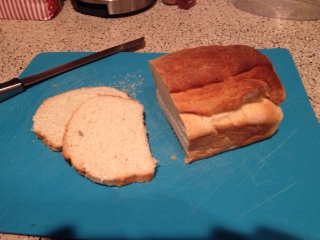
I’ve started making my own bread recently, and I think I’m in love.

Actually, my new fascination with bread-baking is Neil Gaiman’s fault. It’s true; my new obsession with warm homemade bread comes straight from a literary master. See, at his reading/signing event, he read from “The Ocean at the End of the Lane” and, as a special twist, from “Fortunately, the Milk.” By coincidence (or…design?) both books mentioned the incredible deliciousness of homemade bread. There’s a whole riff in “Ocean…” about how bread is “supposed” to taste like nothing, and the little boy is dismayed by the flavorful loaves his father brings home.

So I decided I wanted to get some flavor myself, because Neil Gaiman said so.

It turns out there is something better than sliced bread–a loaf straight from the oven, still warm when you take a bite. It’s amazing, I swear.

Everybody should try it. But I think it might be extra good for writers. Here’s why:

5. Fight Carpal-Tunnel

I spend way too much time at a computer, and so far I have refused to pick up one of those dorky wrist-rest thingys. I’m basically begging for carpal tunnel syndrome. But I don’t have any fancy baking supplies: I’m making these suckers by hand. Kneading dough is a great workout and great stress-relief. I mean, the recipe literally calls for you to “punch it.” Don’t mind if I do.

4. Time to Think

Studies of creativity have found that we do our best thinking when our minds can wander a little bit: that’s why all the best ideas show up when you’re on the can (or did, before smartphones were everywhere–that’s right, I know about your texting-while-pooing habit!). When you bake bread, your body is engaged but you don’t have to think about much. Let yourself get creative.

3. It’s Easy

I’d heard a lot of whining about bread being hard to do. Totally not true. There are about a gazillion recipes online, so you can find a flavor you like. It may take awhile, but–here’s a secret–most of that time you aren’t actually doing anything. You’re waiting while the loaf rises. While you wait, go do something else! Just set a timer and wash your hands when you get back. I start a loaf, then go clean my kitchen. By the time everything is spotless, it’s usually time to knead the loaf. Easy.

2. It’s Research

Bread is ubiquitous in stories (Note: If someone finds a recipe for Lembas, let me know). Once you know how it’s done–and how a good homemade loaf really tastes–you can transfer all those experiences right to your character. Since just about everybody has or does eat bread, it’s a pretty universal experience.

1. It Tastes Amazing

Ok, not writer-specific, but damn. It’s like I’ve never really tasted bread before. Everyone should have that experience. (Much like in writing, the quality of the original materials matters. Use good ingredients and follow a recipe and you’ll get a good result).

Eat up, scribblers! If you’ll excuse me, I think I need (another) slice. Yum.

2 Comments

Filed under Crafts, writing

A Journalism Major Who Doesn’t Subscribe

Newspapers have been in the news lately, not just writing it. The sale of The Washington Post to Jeff Bezos and the Boston Globe to John Henry made serious ripples–and well it should have. The reversion of newspapers to private hands is a big shift from the publicly traded past.

In the midst of all this hubbub, I have a confession: I majored in journalism in college and worked for three newspapers… but I’ve never had a newspaper subscription in my name. And I don’t plan to.

It feels a bit traitorous to admit that, but it’s true. Now don’t get me wrong: I loved, loved working for a newspaper. I don’t know if I’ll ever be so happy with my work as I was at a copydesk just before deadline. It’s exhilarating, intense, heady work. You know your tiniest mistake will be nitpicked by hundreds if not thousands of readers, but you also know you can maybe change minds. You can certainly inform, and entertain. It’s intoxicating, and there is nothing like it.

And if you ask me if its The End of Newspapers, I’ll tell you no, probably not, and I’ll really hope that’s true. I think the world, if not the United States, needs a thriving Fourth Estate. I think it’s very important, highly undervalued work. Those people work very very hard for very little pay–unless you’re a bigwig, you’re barely making ends meet. No, people get into journalism because they are hungry for it; it’s a passion. And it’s a passion that is increasingly derided and pooh-pooh’d, and that’s a damn shame.

I do think newspapers will stick around, but they’ll probably shed some if not all of the paper. And that’s as it should be, really, though the Guys On Top have been really loathe to admit that. And that’s part of the reason that most news organizations have been very slow to adapt to the electronic revolution.

My EIC was strikingly like J. Jonah Jameson, the EIC from Spiderman. My first week of work, he dumped me out of my chair for sitting cross-legged.

I saw it. That’s why I got out. I saw my bosses working 14-hour shifts, literally never getting to see their children because of their hours; I saw them storing up their sick leave for years so they could have a needed surgery without losing their salary during recovery, only to have management put in a new policy just before the schedule surgery, wiping out all unused sick leave–to “save money.”  The people on the ground are miles away (sometimes literally) from the people making the financial and organizational decisions.

I worked with THE website guy (yeah, there was only one), who had to maintain the website, learn all the coding, and try to contain the fires in the comments section (unsurprisingly, he often failed). There was no way he could get ahead of the curve for online; the bigwigs wouldn’t let him. They had only begrudgingly created a website, anyway, why would they actually bother to staff it? (Nevermind that the website was the only way our readers could find out what was going on in their homes after they had to evacuate for a hurricane; print still came first).

It was infuriating to me when–in our rather low-morale workplace–the editor-in-chief, a guy who reminded me of no one so much as J. Jonah Jamison from Spiderman, rounded up the staff and told us that although our paper was the highest-earning publication in the company, it wasn’t enough, so more corners were going to have to be cut. So they cut, cut, cut from the very heart of the publication, the parts that made people care, and learn, and desire, to keep the stakeholders–stock holders on Wall Street–happy, while our newsroom became ever more empty, ever more decrepit.

It would be poetic if I said I quit out of moral outrage for the industry, but that’s not true. I left because I was terribly alone, worked weird hours in a small town and couldn’t meet anybody friendly, and I couldn’t stand the idea of riding out another hurricane after I’d been without power for 2.5 weeks. It just didn’t seem worth working so incredibly hard for an industry that didn’t love me back.

So I said goodbye. I didn’t want to work at the newspaper in my hometown after it went through three waves of layoffs; I knew it wouldn’t matter how good I was the next time someone upstairs felt the margins weren’t profitable enough. What was the point of building a career when it could be taken from me at any moment? So I moved on.

And so far, that has also meant saying goodbye to subscribing; for one, I can’t afford it, a cruel irony for the newspaper publishers, who have lost advertising and so “must” raise subscription fees.

I wish Jeff Bezos and John Henry, and the staffs of the highly regarded Washington Post and Boston Globe, much luck, and good leads. I hope that private owners can maintain the respect for good journalism without giving into the merciless bottom line.

I’m sorry I can’t be with you on that journey.

3 Comments

Filed under Publishing, Uncategorized

Literary Summer

This month has been epic in a rather literary way. From the last week of May until this week, I have been lucky enough to hear and meet Martha Barnette and Grant Barrett from the A Way With Words radio show, author Margaret Atwood, and author Neil Gaiman.

I think I’ve hit some kind of trifecta there. I’m not sure of what, exactly, except perhaps the Jeopardy category of “People Who Make Your Heart and Brain Go Pitter-Pat.” I love the radio show (you can listen online!) and Atwood and Gaiman are both so high in my tier of favorite authors that I’m not even sure which gets the “best” appellation. Atwood was first and perhaps more influential to my personal writing style, but Gaiman is just so prolific and varied that I always feel like I’m discovering something else new (and often scary).

A Way With Words

If you haven’t heard it yet, A Way With Words is a nationally syndicated radio show about language. They do word jokes, explain the etymology of interesting words both colloquial and professorial, and, most of all, answer word questions from callers of all stripes. They have a philosophy of verbal flexibility (meaning that it’s ok that words change meanings and spellings over time and geography) and are incredibly kind and so shockingly learned. It’s like they’ve swallowed the OED and can now regurgitate on command.

I saw them at a special benefit for the Aberg Center for Literacy, an organization I’d not heard of previously, but they are advocates for literacy and therefore I like them. I had expected the show to be mostly a real-life version of the radio hour, but the organizers had mixed it up a bit. Greg and Martha each had a talk, with a game show format in the middle. Greg discussed the ways his young son was teaching him things about language and about how forgiveness is an important part of learning (and teaching). Martha’s talk was about a professor who really taught her to love language, and who became a teacher of more than academics, but of life. It was a very moving presentation.

They took questions from the audience, and I was stunned that my question was the first drawn. But it was too good a question, and they were stumped (“Does the phrase ‘brain-child’ have anything to do with the myth of Athena, who was born from the skull of Zeus?” Answer: “We dunno. Maybe? Sounds good, let’s say yes, sure, why not?”)

The question-and-answer bit really showed how much they knew off the top of their heads; they answered questions without any resources and without having known the questions ahead of time.
Atwood signing

Margaret Atwood

The first book of Atwood’s I discovered was “A Handmaid’s Tale,” arguably her most famous because it is both required reading and banned in schools, depending on your region. It was assigned in mine, and I did perhaps the most unconventional book report on record for it. Well, at least my most unconventional. I asked my teachers if I could “act it out.” They were very obliging souls, so they said yes.

When it was my turn to present my “report” on “A Handmaid’s Tale,” I solemnly walked to the front of the class, explained that the president and Congress were dead, and I was now in charge of the class. Several classmates turned and stared at our teachers, who just shrugged and said we’d all better listen. I broke up couples, confiscated religious jewelry, separated girls from boys, explained that the girls would now be divided into groups based on their ability to procreate and that the boys, if they were lucky and loyal enough, might one day get the privilege of a wife. One classmate protested my act, and I said that was fine, and he would be hanged. I had my “bodyguard” (who had previously volunteered, and thus got himself a wife) “execute” him, and he was mock-hanged in the front of the class, as an example for the rest.

Like I said, the most bizarre book report ever. I certainly won’t ever forget it.

I’ve since read and enjoyed many other of Atwood’s books (I have a particular fondness for “Oryx and Crake” and “The Penelopiad”), but “Handmaid” was revolutionary for me. It was bleak…really really bleak. Most of even the apocalyptic stories I’d read had shown a strong light of hope. It was all the worse because it was set in such a realistic version of our world, and it scared me on a level no book ever has.

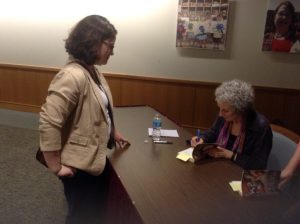
Atwood came to speak as part of a Dallas Museum of Art Arts and Letters presentation. Ostensibly she was there to talk about mythology, but she did this only tangentially. She did show us lots of pictures of her drawings, at various ages. (Apparently she is also an illustrator, and I’m crushed that the copies of her books I have aren’t those she drew).

Mostly, she talked about her childhood. She grew up in the woods of Canada, and didn’t have running water or electricity for most of her childhood. Books were of preeminent importance because they needed things to do.

I think I told my dad that night that I was now upset that we’d had water and electricity, because how would I ever be a fantastic author now?

He didn’t seem that bothered by it.

Atwood took questions from the audience, and I happened to be sitting right by the microphone, so I leapt up and asked about her feelings on technology. She gave a very lovely and funny response about how her use of social media was like a biologist studying mosquitoes: she is offering her flesh up for consumption to test it out for the future benefit of authors and twitterers.

She was lovely and far funnier than I had ever expected and her brilliance really shown. And when I got up to the front of the signing line, I had no idea what to say and just sort of quietly thanked her for coming.

I still can’t believe it happened.

Gaiman signing

Neil Gaiman

And then, adding to the list of Things I Never Imagined Possible, I got to meet Neil Gaiman.

Well, me and about 1,500 other people (seriously. That theater was PACKED).

Gaiman is on his last-ever book signing tour, for “The Ocean at the End of the Lane,” his newest book that is sort-of fiction, sort-of adult, sort-of magical. (I’m only a third of the way in, because I had to do things besides reading today and I’m very very upset about that, but I’ll be finished this weekend for sure).

Gaiman read to us from his new book, and I wanted his lovely sonorous English talking to go on forever, particularly when he tried on different British accents as appropriate.

I just read, tonight, the passage he’d read to us last night, and I hope it always stays this way, but I heard him again in my head, each syllable rolling around between my ears.

He then took some questions from the audience, and unlike Atwood they were all previously written down and presented to him on cards (and I’m bummed because I was stuck in the interminable line and did not get the chance to even ask a question via card). He joked that a huge stack of them were all “What was it like to work on Doctor Who?” so he’d removed those.

He only answered a few questions, and I admit I was a little disappointed; I wanted him to keep talking. But he was lovely and so kind and humble.

Then we got lucky, and he read from his next children’s book “Fortunately, The Milk.” It’s about a dad who has gone off to get milk for his children’s breakfast and…encounters some rather odd difficulty along the way. It was hilarious and I found myself leaning forward, forward in my seat trying to soak up more of it. He’s delightful. I’m definitely going to buy that one when it comes out in September!

And I was lucky enough to be seated in one of the nearer rows, so I didn’t have to wait too long to get my books signed.

Again, I got up there and just gaped like a goldfish. What do you say to your idol? I just almost-whispered “Thank you for coming out.” And he drew a heart in my book and I was so happy I had a Kristen Bell sloth moment as soon as we walked out. Seriously. Neil Gaiman made me cry.


So that’s been this month. I don’t know that I will ever be able to top that.

Provided you’re actually able to speak when given the moment (since I wasn’t), what would you say to your idol? And who would it be?

2 Comments

Filed under Uncategorized

Review: Tuesdays with Morrie

Tuesdays With MorrieTuesdays With Morrie by Mitch Albom

My rating: 4 of 5 stars

Though I previously read The Five People You Meet in Heaven, I somehow managed to miss Albom’s smash hit “Tuesdays with Morrie” until this week, when a colleague mentioned it as reference material I scrambled for the library (all praise the mighty haven of books!).
It’s safe to say that Albom’s career as a novelist would not have happened had he taken a different class in college. “Tuesdays With Morrie” is the discussion of “big questions” with Professor Morrie Schwartz. Albom had been in Morrie’s class in college–had taken all of his classes, in fact–and, when he heard about Morrie’s terminal illness, he had gone to visit his favorite professor, 16 years after they’d last seen each other. Week by week, the pair discussed the big scary questions that plague everyone, and Morrie, having the unique perspective perhaps only the terminally ill can claim, acts as the Wise Seer; Albom, and the reader, the disciples traveling afar.
Albom is clearly a talented writer, carefully folding in each bit of information about Morrie’s past as it becomes relevant to the story, but Albom would undoubtedly be just another talented fast-moving sportswriter without Morrie.
The book is poetic, a comfortable bedside-table read if you want to dream about a life beyond the mundane. It’s full of things we should all already know, but because there are so many books telling us we’re living wrong, we must not be getting the message.
Aphorisms aside, this is a good book about a teacher and the impression he can have on the lives around him. Mark this down as “possible end-of-year teacher gift.” I think most people, but teachers in particular, would like to feel they had lived as inspiring a life as Morrie Schwartz.
In the meantime, sometimes the best we can do is read about it, and take a moment to think on our own dreams and goals.

View all my reviews

Leave a comment

Filed under Reviews

Love like Palmer/Gaiman

I had this whole other thing I was going to write about, and then Amanda Palmer happened.

Well, to be more accurate, Amanda Palmer has been happenin’ for quite awhile now, but what happened was I read her book/marriage review of her husband’s impending book: Neil Gaimain’s “The Ocean At the End of the Lane.”

It’s a beautiful, heart-rending piece, and despite her claiming she’s not much of a writer, she is so visceral and emotive that I can’t help but admire her. She’s like a rock star e.e. cummings.

I mean, just look at this:

and for a second i felt what it must feel like to wait in a line for five hours and have him sign a book that changed your life.
to stand not in admiration of the husband writer, the writer who wants his tea but not with the milk hot because then it’s just wrong, the writer who won’t remember what time he said he’d meet you, the writer who has to sign 12,000 copies of his new book that’s a bestseller before it hits the shelves and actually that’s really annoying because i’m slightly jealous of his instant success no matter what he does, the writer who gets irritated when i leave too many clothes on the floor and he can’t get to the bathroom, the writer who is awkward and has a hard time in party situations when he feels he doesn’t understand the social hierarchy, the writer who is not really a writer are you kidding me he’s just some snoring heap of flesh beside me, sweating and breathing and grinding his teeth and probably dreaming the kinds of dreams that neil gaimans dream, full of dreams and wishes and magic and wonder and all the shit that can drive me crazy if i’m not in the right mood for it….no…the WRITER. the man who actually takes a pen to a paper and writes things and creates a believable world that sucks you in and spits you out, its logic embedded in your mind forevermore. that. i saw THAT. and i love THAT so much, the fact that he can DO that…and i don’t get to see that most of the time. i’m too busy looking at the man. as it should be, i think.

Now I probably should just leave it at that because he’s one of my all-time favorite authors and I have the absolute privilege of being one of those people who gets to stand in line for 5 hours so he can sign my book next week when he comes to town to talk about his book on his last-ever book tour, and if I keep writing there’s a slim slim slim chance he might actually read what I say and then I’ll be embarrassed later.

But I’ve thought this awhile so I’m going to just go ahead and say it: I am in awe of that pair.

Neil Gaiman and Amanda Palmer. How can you not love them?

I’m pretty much in awe of them separately, of course.

I mean, Neil Gaiman, master of  your dreams and nightmares. He taps into literary visions you only wish you could grasp. He’s got an impossible mop of hair, a sonorous voice I wish I could bottle because I’d listen to it every night, a consistently black wardrobe, and a charming dry wit. He’s just precious, and yet also scary, like a beautiful snake that you think won’t bite you but seems like maybe it’s poisonous; at least, it’s been somewhere you’re afraid to go.

And then there’s Amanda Palmer. Frankly, she scares the pants off me. She’s so unafraid, unflinching in front of a crowd or a feeling. (Go watch her TED talk if you’re not sure about that). She does this beautiful zany thing with her eyebrows, and her music is so daring and interesting (ok, I admit that I don’t always get it. But I do always feel it). I’m terrified of her, but I also wish I could be like her, so avant-guard and free and magical.

And then they had to go and get together. And now they provide a whole ‘nother kind of inspiration.

Now, I’m not a big fan on spying on celebrity’s lives: I figure they probably deserve their peace just as much as any of us, thankyoukindly, and sometimes more. But I admit an intense fascination with these two. I don’t go seeking information on their relationship, but I’m always quietly thrilled when one of them writes something about the other, or someone posts a hypnotic picture of the pair, because I try to imagine what being in that relationship is like.

Like a pairing of two titans, I think. Electric.

Though Palmer talks about them having “rough” times, the part of their relationship I (and the rest of the internet, presumably) see is so effusive it’s grandiose. I want to be like that. I love my fiance dearly, and I wonder, if all our secret private talks were open to the world (and if someone cared to read them) would I sound as loving and intense as they do? Or is their affection for each other something special, out of reach for the rest of us?

If, by some slim chance, Mr. and Mrs. Palmer/Gaiman read this, I want to say thank you. Thank you for the courage to love with vivacity, with abandon, with depth, with honesty.

And thank you for giving us glimpses of that love. May the world be blessed with more like it.

2 Comments

Filed under Uncategorized

In Light of Tragedy, Do a Good Turn

I’ve been thinking a lot about the tragedy in Newtown. It’s horrible, and it leaves me feeling horrible, scared, and helpless. I can’t control the frightening, terrible things in this world, but I can control what I do and how I act. I’ve resolved to be on the lookout for the things I can do to spread love, kindness, and generosity.  Not just today, or this week, or until we reach an arbitrary number of good things, but in my life, all the time.

It’s easy, sometimes, to contribute to a “showy” charity or volunteer event, like a Fun Run benefiting disease research. We make it particularly easy at Christmastime, when Angel trees show up even in the malls, and Santas ring bells outside of the grocery store, and we ostentatiously pile gifts up for people in need. And the financial donations pour in to the Red Cross after huge disasters of all kinds. And those are all good things, but I think we can always make more room for good deeds in our lives.  Giving money, or items, or time are all important, but we—or at least I—can do those things from a comfortable distance.

It’s too easy to get secluded and ignore others when we can help, or make someone’s day in a small way. It doesn’t have to be anything big—in fact, I think it’s probably better that we offer up many small things than only one big thing—but I think, in light of these kinds of tragedies, the best we can do is to reach out and connect with other human beings in our world. Not via indirect donations (but those are good, too, and worth continuing!), but also through personal, human, interactions.

I’m going to watch for the Good Turns I can do. I hope maybe you’ll keep an eye out for the Good Turn you can do, too.

-ME

Leave a comment

Filed under Uncategorized