Tag Archives: characters

You’re Equal to Me in Every Way…For A Lady

The full cast o’characters.

In fighting the late-summer heat, I recently picked up a new-t0-me video game: Dragon Age: Origins. It’s pretty cool; you are on a hero’s journey to become a Grey Warden and travel from town to town fighting monsters and trying to save the kingdom. There’s a lot of customization, and the choices you make throughout will affect the outcome of the game.

And you have to make a lot of choices. (It’s almost the Starbucks of video games: and would you like whip with that? (I’m easily overwhelmed by Starbucks….can you tell?))

The very very first choice, though, is building your character: Will you play as a male or a female?

In some ways, the fact that it’s even an option to play as female is a great thing; in some games, forget it. You’re just a white-ish athletic dude no matter what. So I always enjoy games that give you more versatility in that way.

The prompt as you choose your playable gender says Fereldon, the world, is a pretty equal place, with opportunities for both men and women in the three playable careers–warrior, mage, and rogue. That’s important, because I like to know when I’m cutting myself off from parts of the game with my choices.

So I built my female human mage with red hair and dark eyes and went happily on my way.

Except I was constantly reminded by other characters (non-playable characters, or NPCs, for you non-gamers out there) that woah, hey! You’re a lady!

In some cases, it made sense and fit with the story: when Morrigan the wild witch met me, she was more friendly because she carries a general dislike for men, having grown up in isolation.

But most of the time, it doesn’t. It’s more like “wow, you’re a fighter and a lady? Whodathunkit?!” In a world that is supposedly equal. And where I periodically see other female warrior/mage/rogues running around.

It just got tiresome. So this happened:
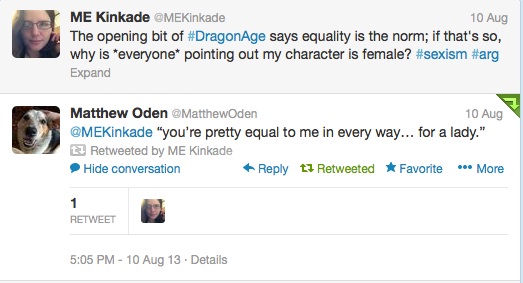
dragonage Twitter

Think about this in your writing. If your character is something different, that’s fantastic! We need more minority characters–not just female, but also non-white nationalities. And that should affect the story where appropriate–as in the case with Morrigan in Dragon Age.

But when all the “NPCs” in your book take time to comment on the difference, you aren’t showing that there’s equality. You may be telling the reader that there is, but what you’re showing is exceptionalism. And it’s pretty tiresome, both in our stories and just to read. (See: Repetition)

(There may be stories of exceptionalism where it is still relevant–“wow, she’s the only one who can do that!”–but I personally think the gender-based exceptions are played out. Do something different.)

Don’t tell me how equal I am: just let me get on with the monster-fighting and world-exploring. That’s how I KNOW I’m equal–because I can definitely kick some undead monster butt if you’ll just let me get on with it.


4 Comments

Filed under Feminism, video games, writing

Review: The Inner Circle

The Inner CircleThe Inner Circle by Brad Meltzer

My rating: 3 of 5 stars

I listened to this book as an audiobook, and that may have affected my perception of it. I really wanted to like it–I loved the overarching mystery, and Meltzer clearly knows his stuff when it comes to little-known White House/Washington, D.C., history. But for every point in which he awed me with delicately folded in historical detail, there were two points where he had characters speaking or acting clunkily.
I mean, I know there needs to be an explanatory character in a mystery, just in case the audience really doesn’t get it, but characters who are otherwise repeatedly heralded as really smart cookies end up acting like total morons, with no apparent rational behind it. Additionally–and maybe this was just because of the audiobook that it stuck out more–but Meltzer uses the phrase “eyes locked” a gazillion times (I started counting, but the number got too big for me). Build the drama with another phrase, please!

As a writer, I found the unusual use of tense to tell the story very interesting: the main character speaks in present tense, while every other characters’ perspective is told in past tense. It took awhile to get used to, but ultimately allowed the reader (listener) to bond a bit more with Beacher, the lead character, while allowing Meltzer to continue with a broader omniscient view.

It was a great way to pass about 12 hours in a road trip, especially because I didn’t mind dozing through the stupid or boring bits. I feel like I know a lot more about the National Archive, and I loved the idea of a quiet detail-oriented archivist finding himself in the midst of a dangerous political intrigue–it just didn’t quite come together for me. I would recommend this book if you’re looking for a light political mystery and are a huge history nerd, but I won’t be giving the sequel my attention.

View all my reviews

Leave a comment

Filed under Reviews

A World Without Gender

Image from http://raredeadly.tumblr.com/post/1473774370/tilda-swinton-as-80s-bowie-its-the-hair

Try writing your MC as if you don’t know the gender. Just like Tilda Swinton here demonstrates, it doesn’t always matter–your MC can be incredible either way.

Gender is a pretty fundamental part of a character description. Even the name you pick generally gives you a hint of who this person you’re reading about is going to be. Failing that, you can fall back on the physical description; dresses tend to indicate women (sorry Scotland!), while a manly man might wear weathered boots and heft an axe. And if even that is pretty vague, at least you’ve got pronouns to rely on when the author gets tired of calling the character by name.

But in interactive fiction and gamebooks, you, as the author can’t utilize those standbys. After all, your reader could be male, female, old, young, or, heck, even an alien. And since they are taking on your story from the driver’s seat, so to speak, the author can’t be telling them too much about who they are. After all, you can’t address the reader using “he” or “him” without thereby cutting out or annoying half of your prospective audience.

My novel, Undead Rising, is a gamebook for adults. The challenge of gender was one of the most interesting parts of writing it, because it stripped me of so many descriptive options. It was a helluva fun book to write, and I think all writers should give writing without gender a shot. It’s illuminating.

Of course, Undead Rising isn’t completely without gender; all the characters besides the reader’s perspective have gendered names, physical descriptions, and pronouns. But writing dialogue gets extra tricky when your No. 2 character can’t ever say “She did it!” in reference to your MC. And figuring out how to deal with pockets was surprisingly hard; luckily, it’s fairly common for women to also wear trousers, or my MC would never have carried anything around.

I resolved many of the direct references between characters and my MC with filler phrases like “dude”: “Dude, what have you been up to in here?” or “Wow, dude, you are such a great friend.” (I realize “dude” is technically gendered, but, at least among my friends, it’s used for either gender, not just men). The name problem wasn’t too hard, as the novel was written in second-person perspective. Anytime another character is introduced to the MC, I plugged in something like “You say your name.”

I even managed to write in a romantic interlude without any reference to the gender of the main character. That was a sticky wicket!

Gender is typically important to a character, but my experiment in writing a genderless character was very powerful. It really showed me how many things are universal. While writing, I imagined the character as male or female, sometimes one, sometimes the other. I hope that no matter who reads Undead Rising, they feel they are fairly represented.

How important are gender roles and gendered descriptions in your writing? Could you write a whole character without a gender?

(To see a real pro try it, read The Left Hand of Darkness, which is partially about an alien species whose gender shifts based on several factors, but most of the time is genderless.)

6 Comments

Filed under writing