Review: The Disappearing Spoon

The Disappearing Spoon: And Other True Tales of Madness, Love, and the History of the World from the Periodic Table of the ElementsThe Disappearing Spoon: And Other True Tales of Madness, Love, and the History of the World from the Periodic Table of the Elements by Sam Kean

My rating: 4 of 5 stars

The Disappearing Spoon is a history of the periodic table of elements.

Some of you are going “ohhh goody!” and immediately adding it to your reading lists. (Let’s be friends!)

For everyone else, who perhaps needs a little convincing, let me tell you that you should most definitely read this book if any of the below apply:
* You work in some kind (any kind, really) of scientific research field
* You enjoy nonfiction history books
* Bill Nye the Science Guy is your hero
* You really enjoy being able to dish out random facts at parties
* You like science in a vague way but didn’t like all that memorization or math stuff

The Disappearing Spoon is a feat like no other. Sam Kean needs an award for his incredible dissolution of complex scientific ideas into information the smart but non-sciencey reader can absorb–things like packing oranges in crates as an analogy for the atomic structure of tin in its alpha and beta forms. It’s complex stuff, but he kept it both scientifically accurate AND interesting. I’ve known a number of researchers… lemme tell you, that is a feat.

And Kean really did his homework. In fact, you’re going to need two bookmarks to read this one. I struggled for about half of it before getting a second one; it makes a difference. You see, this book is heavily footnoted, and you really don’t want to miss out on the extra information. Sometimes it’s just a citation, but for the most part, it’s extra information that will make you say “WOW.” So get yourself a second bookmark to hold your place in the back, too.

Kean covers every element in the table (and yes, there’s a lot) so this book, while completely fascinating, is a bit of a slog at times. It’s challenging to maintain that thread, so for the busy reader, I’d recommend making this your before-bed book (or, more scandalously, your bathroom-time book), because you’re going to put it down a lot anyway. But you do want to complete it.

You’ll learn jaw-dropping facts like:
-the disappearing spoon is a real thing
-One Nobel Prize winner was referred to as “S.D. Mother” in the newspaper when she won
-Marie Curie was better known in her day for her impropriety and turbulent personal life than for her science
-some people drink silver as a health aid…with disastrous bright-blue results
-we really are all made of the same stuff as stars
-how, exactly, some of the deadly elements kill you
-one vest was worn by three Nobel Prize winners over the years
-the first “computers” were the women who worked on the Manhattan Project, running computations long-hand
-there are people who are absolutely obsessive about kilograms

You’ll get more science in this one book than you got in a year of high school education, but it will be freshly delivered on a gleaming plate of intrigue, personalities, and incredulity. It’s well worth your time to learn more than you ever thought possible.

View all my reviews

Leave a comment

Filed under Reviews, Science

He Said/She Said: Why Attribution Matters

I have not seen this movie and have no idea what it’s about, but hey, Kevin Bacon!

Readers have a problem: they cannot read your mind.

For the most part, this is to the authors’ benefit. You get to write it all down, instead of people just downloading the story directly from your creative little noggin (*note: that’s a terrifying sci-fi idea, actually…). I imagine that whole readers-aren’t-mind-readers thing has proved quite lucrative for George R.R. Martin lately, else everyone would know that he was planning to off somebody long before they got too attached.

But it can also lead to problems. Lately, I’ve seen a lot of mind-reading foul-ups involving attribution.

Attribution is quite simply “who said that thing.”

Now I come from a journalism background, and it’s quite important that everything is said by somebody; you can’t just go bandying about quotes without giving the reader context, and you’ll get quite the wrist slap if you try (regardless of what you think of “the media,” there are certain standards).

And yet somewhere in your English education, someone probably told you that it’s ok to not always put a “said” at the end of every quote–it can get a bit tiring. That is entirely true! However–you can go too far. You have to have at least some attribution, because the reader cannot read your mind and it’s tricky to follow a conversation when you can’t tell who is speaking.

For example:

Suzy, Jaime, Bob, and Fernando were talking at recess. Suzy heard an ice cream truck. “Hey, you want to go get an ice cream?”

“I’d love ice cream!”

Sullenly, Bob stared at the ground. “I can’t.”

“Why not?”

Fernando started laughing.

“You can’t have ice cream!” he teased.

“Don’t you like ice cream?” Then she walked toward the ice cream truck.

So I just made up this lovely little ice cream vignette, but I’ve seen this kind of passage written a lot. Let’s dissect it. Who is speaking first? We can guess that Suzy is the one who asks about the ice cream truck, but we aren’t sure. Still, it’s a reasonable guess because she was mentioned in the line before–but keep that uncertainty in mind.

Who loves ice cream? Is it Suzy? Is it one of the boys? No idea. No way to know, either.

It’s probably not Bob. Poor Bob, he’s staring sullenly at the ground. We can be pretty danged sure that Bob made the statement, because he is talked about in the sentence prior AND because the statement goes with the feeling expressed pretty clearly. Unlike the uncertainty with Suzy’s question, we can reasonably pair these two together. So that’s good.

Who asked “Why not?” Also, is Fernando the one teasing Bob? It’s likely, because he started laughing, but we have a large group here, so it’s possible that one of the other boys is teasing Bob AND that Fernando is laughing. It’s ambiguous.

And then we have the question at the end. The writer clearly wants us to know that Suzy said it, because of the “she” in the statement, but it feels disjointed. This could be clearer for the reader, because someone else could be saying this and then Suzy could walk. It’s hard to tell.

Let’s try again, with attribution in the right spots:

Suzy, Jaime, Bob, and Fernando were talking at recess. Suzy heard an ice cream truck. “Hey, you want to go get an ice cream?” she asked the boys.

“I’d love ice cream!” Jaime said.

Sullenly, Bob stared at the ground. “I can’t.”

Looking at his friend with concern, Jaime said, “Why not?”

Fernando started laughing. “You can’t have ice cream!” he teased.

“Don’t you like ice cream?” Suzy asked. Then she walked toward the ice cream truck.

Now we have a much clearer picture of the action here. Fernando is kinda a bully, Jaime is rather exuberant, and Suzy just wants an ice cream already.  Notice that not all of the attributions are the same; it doesn’t get boring to have to read them. In fact, you probably slid right over them without much notice. (This is also why “said” is the preferred unobtrusive attribution. It’s very utilitarian.)

If you aren’t sure if you need attribution or not, try reading your section as if you were a reader and knew nothing about the story–just going off the attribution. If you have a long back-and-forth without attribution, odds are good you’ll need to add some to avoid confusion. (It can be done, but in very rare and unusual circumstances).

Of course, if you’re really not sure, you can always hire an editor to help you straighten it out.

2 Comments

Filed under Editing, writing

Seeking Advice: Overcoming Stress

Lately, things in my day-to-day non-writing personal life have gotten a bit hectic. Things completely out of my control happened and caught me by surprise, plus I had a great big list of Things That Must Get Done.

Shockingly, this change actually left me with more free time, but a great deal more stress, too. I managed to blog during my vacation (thank you, delayed posting!) but after I got back, and facing a scary look at the future, the spinning plates I’d been maintaining for awhile (including updating the blog regularly) started to slip.

I had time to write, so I can’t beg off with that excuse, but I had absolutely no inclination. It was like I had been zapped by a writer’s block ray gun. But more than that–I didn’t even want to write. I started to resent my laptop, even, skirting the room and glaring at it hatefully, because a tiny easy-to-ignore part of me was insisting that I needed to be there, writing away, keeping to “the schedule,” when I wanted nothing more but to go be a gypsy or something. (“Something” often meaning “lying pathetically on the couch in a hot sweaty puddle”–this is Texas, after all, and it’s bloody hot.)

Eventually, the stress abated, which is why I’m here again, writing, and similarly why I yet again have clean dishes to eat off of, freshly painted fingernails, and some well-organized personal files.

Every time I turn to the internet or Twitter for support, it seems I just find more “soldier on,” “write every day or else!” type posts, which just leaves me feeling sort of bad about myself. But I keep thinking: I can’t be the only one this has happened to. I can’t be alone in being paralyzed, rather than invigorated by, stress.

Or can I? Tell me, and tell me true.

Have you ever faced a time of stress that affected your writing? How did you handle it? Do you really believe in those “write every day” aphorisms?

5 Comments

Filed under writing

Internet Famous

The inimitable Tex Thompson, who I met at DFW Con this year (she gave a killer presentation on grammar) does this brilliant thing I her blog: Grammaticats.
That’s right. She teaches good grammar through funny captioned cats, despite their storied Internet history as grammatically inventive ruffians.

And I am proud to say that one of my two is now Internet Famous. Here is my cat Sawyer, the orange striped rogue in the third image, in a new role as teaching aid in grammatical ellipses.

I can safely say this is the most brilliant he will ever be (which admittedly isn’t saying much; this is the cat who enjoys chewing through electrical cords, leading Amazon to assume I have infants in the house because I keep buying electrical covers).

So go, get your learn on!

20130706-184551.jpg

Leave a comment

Filed under Conventional, Editing, Uncategorized

Review: “The Ocean at the End of the Lane”

The Ocean at the End of the LaneThe Ocean at the End of the Lane by Neil Gaiman

My rating: 4 of 5 stars

It’s hard to describe The Ocean at the End of the Lane without revealing spoilers. Let’s start with this: This book is unlike any other I’ve ever read. It feels somewhat like a Grimm fairy tale, and any moral is similarly absent, or at least unobtrusive. Others have described it as having a 7-year-old narrator, but that’s only partially true. It’s a challenging, contemplative, but relatively quick read.

While at his book reading/signing, Gaiman noted with approval that one reviewer had called this a “book for readers,” meaning there is no real age distinction. I’m going to have to forcefully disagree. While most of this book is fairly all-ages, the horror-tinged parts are deeply scary. I wouldn’t give it to any child under 13, and then only if they were okay with being frightened. Unlike other horrors based in fantasy that can maybe be shrugged off, this one challenges the very core of a child’s (or adult’s!) feelings of safety and security. Proceed with caution.

A summary, trying to avoid any important spoilery bits: A man goes back to his childhood home, finding it much different. But the house down the lane looks shockingly similar to his memory of it. He feels compelled to go there, and sits and stares into the pond. From this vantage point, he remembers. He remembers the frights and thrills of his seventh year of life, and the monster he accidentally awoke, and the trials he and the girl from down the lane went through to try to overcome it.

I don’t think this book is for everyone. I really deeply enjoy Gaiman, and I still didn’t always enjoy this one in bits (I should have been prepared for the level of horror, perhaps, because of Sandman, but it took me by surprised anyway). It’s obviously deeply personal, drawing from elements of Gaiman’s real childhood and real life in ways his prior books. It feels as if we’ve unlocked some secret door in Gaiman’s mind, a parallel universe door in which this story is actually truth. The descriptions are vibrant and rich, and I very much wish I could go enjoy a meal with the Hempstock matriarchs.

Though this book debuted this summer, this feels more like a book for a dark and moody winter, when you’ve long forgotten the warmth of the sun.

View all my reviews

2 Comments

Filed under Reviews

Literary Summer

This month has been epic in a rather literary way. From the last week of May until this week, I have been lucky enough to hear and meet Martha Barnette and Grant Barrett from the A Way With Words radio show, author Margaret Atwood, and author Neil Gaiman.

I think I’ve hit some kind of trifecta there. I’m not sure of what, exactly, except perhaps the Jeopardy category of “People Who Make Your Heart and Brain Go Pitter-Pat.” I love the radio show (you can listen online!) and Atwood and Gaiman are both so high in my tier of favorite authors that I’m not even sure which gets the “best” appellation. Atwood was first and perhaps more influential to my personal writing style, but Gaiman is just so prolific and varied that I always feel like I’m discovering something else new (and often scary).

A Way With Words

If you haven’t heard it yet, A Way With Words is a nationally syndicated radio show about language. They do word jokes, explain the etymology of interesting words both colloquial and professorial, and, most of all, answer word questions from callers of all stripes. They have a philosophy of verbal flexibility (meaning that it’s ok that words change meanings and spellings over time and geography) and are incredibly kind and so shockingly learned. It’s like they’ve swallowed the OED and can now regurgitate on command.

I saw them at a special benefit for the Aberg Center for Literacy, an organization I’d not heard of previously, but they are advocates for literacy and therefore I like them. I had expected the show to be mostly a real-life version of the radio hour, but the organizers had mixed it up a bit. Greg and Martha each had a talk, with a game show format in the middle. Greg discussed the ways his young son was teaching him things about language and about how forgiveness is an important part of learning (and teaching). Martha’s talk was about a professor who really taught her to love language, and who became a teacher of more than academics, but of life. It was a very moving presentation.

They took questions from the audience, and I was stunned that my question was the first drawn. But it was too good a question, and they were stumped (“Does the phrase ‘brain-child’ have anything to do with the myth of Athena, who was born from the skull of Zeus?” Answer: “We dunno. Maybe? Sounds good, let’s say yes, sure, why not?”)

The question-and-answer bit really showed how much they knew off the top of their heads; they answered questions without any resources and without having known the questions ahead of time.
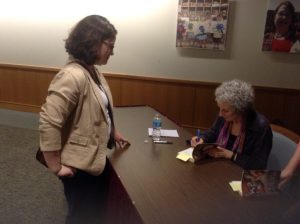
Atwood signing

Margaret Atwood

The first book of Atwood’s I discovered was “A Handmaid’s Tale,” arguably her most famous because it is both required reading and banned in schools, depending on your region. It was assigned in mine, and I did perhaps the most unconventional book report on record for it. Well, at least my most unconventional. I asked my teachers if I could “act it out.” They were very obliging souls, so they said yes.

When it was my turn to present my “report” on “A Handmaid’s Tale,” I solemnly walked to the front of the class, explained that the president and Congress were dead, and I was now in charge of the class. Several classmates turned and stared at our teachers, who just shrugged and said we’d all better listen. I broke up couples, confiscated religious jewelry, separated girls from boys, explained that the girls would now be divided into groups based on their ability to procreate and that the boys, if they were lucky and loyal enough, might one day get the privilege of a wife. One classmate protested my act, and I said that was fine, and he would be hanged. I had my “bodyguard” (who had previously volunteered, and thus got himself a wife) “execute” him, and he was mock-hanged in the front of the class, as an example for the rest.

Like I said, the most bizarre book report ever. I certainly won’t ever forget it.

I’ve since read and enjoyed many other of Atwood’s books (I have a particular fondness for “Oryx and Crake” and “The Penelopiad”), but “Handmaid” was revolutionary for me. It was bleak…really really bleak. Most of even the apocalyptic stories I’d read had shown a strong light of hope. It was all the worse because it was set in such a realistic version of our world, and it scared me on a level no book ever has.

Atwood came to speak as part of a Dallas Museum of Art Arts and Letters presentation. Ostensibly she was there to talk about mythology, but she did this only tangentially. She did show us lots of pictures of her drawings, at various ages. (Apparently she is also an illustrator, and I’m crushed that the copies of her books I have aren’t those she drew).

Mostly, she talked about her childhood. She grew up in the woods of Canada, and didn’t have running water or electricity for most of her childhood. Books were of preeminent importance because they needed things to do.

I think I told my dad that night that I was now upset that we’d had water and electricity, because how would I ever be a fantastic author now?

He didn’t seem that bothered by it.

Atwood took questions from the audience, and I happened to be sitting right by the microphone, so I leapt up and asked about her feelings on technology. She gave a very lovely and funny response about how her use of social media was like a biologist studying mosquitoes: she is offering her flesh up for consumption to test it out for the future benefit of authors and twitterers.

She was lovely and far funnier than I had ever expected and her brilliance really shown. And when I got up to the front of the signing line, I had no idea what to say and just sort of quietly thanked her for coming.

I still can’t believe it happened.

Gaiman signing

Neil Gaiman

And then, adding to the list of Things I Never Imagined Possible, I got to meet Neil Gaiman.

Well, me and about 1,500 other people (seriously. That theater was PACKED).

Gaiman is on his last-ever book signing tour, for “The Ocean at the End of the Lane,” his newest book that is sort-of fiction, sort-of adult, sort-of magical. (I’m only a third of the way in, because I had to do things besides reading today and I’m very very upset about that, but I’ll be finished this weekend for sure).

Gaiman read to us from his new book, and I wanted his lovely sonorous English talking to go on forever, particularly when he tried on different British accents as appropriate.

I just read, tonight, the passage he’d read to us last night, and I hope it always stays this way, but I heard him again in my head, each syllable rolling around between my ears.

He then took some questions from the audience, and unlike Atwood they were all previously written down and presented to him on cards (and I’m bummed because I was stuck in the interminable line and did not get the chance to even ask a question via card). He joked that a huge stack of them were all “What was it like to work on Doctor Who?” so he’d removed those.

He only answered a few questions, and I admit I was a little disappointed; I wanted him to keep talking. But he was lovely and so kind and humble.

Then we got lucky, and he read from his next children’s book “Fortunately, The Milk.” It’s about a dad who has gone off to get milk for his children’s breakfast and…encounters some rather odd difficulty along the way. It was hilarious and I found myself leaning forward, forward in my seat trying to soak up more of it. He’s delightful. I’m definitely going to buy that one when it comes out in September!

And I was lucky enough to be seated in one of the nearer rows, so I didn’t have to wait too long to get my books signed.

Again, I got up there and just gaped like a goldfish. What do you say to your idol? I just almost-whispered “Thank you for coming out.” And he drew a heart in my book and I was so happy I had a Kristen Bell sloth moment as soon as we walked out. Seriously. Neil Gaiman made me cry.


So that’s been this month. I don’t know that I will ever be able to top that.

Provided you’re actually able to speak when given the moment (since I wasn’t), what would you say to your idol? And who would it be?

2 Comments

Filed under Uncategorized

Review: Tuesdays with Morrie

Tuesdays With MorrieTuesdays With Morrie by Mitch Albom

My rating: 4 of 5 stars

Though I previously read The Five People You Meet in Heaven, I somehow managed to miss Albom’s smash hit “Tuesdays with Morrie” until this week, when a colleague mentioned it as reference material I scrambled for the library (all praise the mighty haven of books!).
It’s safe to say that Albom’s career as a novelist would not have happened had he taken a different class in college. “Tuesdays With Morrie” is the discussion of “big questions” with Professor Morrie Schwartz. Albom had been in Morrie’s class in college–had taken all of his classes, in fact–and, when he heard about Morrie’s terminal illness, he had gone to visit his favorite professor, 16 years after they’d last seen each other. Week by week, the pair discussed the big scary questions that plague everyone, and Morrie, having the unique perspective perhaps only the terminally ill can claim, acts as the Wise Seer; Albom, and the reader, the disciples traveling afar.
Albom is clearly a talented writer, carefully folding in each bit of information about Morrie’s past as it becomes relevant to the story, but Albom would undoubtedly be just another talented fast-moving sportswriter without Morrie.
The book is poetic, a comfortable bedside-table read if you want to dream about a life beyond the mundane. It’s full of things we should all already know, but because there are so many books telling us we’re living wrong, we must not be getting the message.
Aphorisms aside, this is a good book about a teacher and the impression he can have on the lives around him. Mark this down as “possible end-of-year teacher gift.” I think most people, but teachers in particular, would like to feel they had lived as inspiring a life as Morrie Schwartz.
In the meantime, sometimes the best we can do is read about it, and take a moment to think on our own dreams and goals.

View all my reviews

Leave a comment

Filed under Reviews

Love like Palmer/Gaiman

I had this whole other thing I was going to write about, and then Amanda Palmer happened.

Well, to be more accurate, Amanda Palmer has been happenin’ for quite awhile now, but what happened was I read her book/marriage review of her husband’s impending book: Neil Gaimain’s “The Ocean At the End of the Lane.”

It’s a beautiful, heart-rending piece, and despite her claiming she’s not much of a writer, she is so visceral and emotive that I can’t help but admire her. She’s like a rock star e.e. cummings.

I mean, just look at this:

and for a second i felt what it must feel like to wait in a line for five hours and have him sign a book that changed your life.
to stand not in admiration of the husband writer, the writer who wants his tea but not with the milk hot because then it’s just wrong, the writer who won’t remember what time he said he’d meet you, the writer who has to sign 12,000 copies of his new book that’s a bestseller before it hits the shelves and actually that’s really annoying because i’m slightly jealous of his instant success no matter what he does, the writer who gets irritated when i leave too many clothes on the floor and he can’t get to the bathroom, the writer who is awkward and has a hard time in party situations when he feels he doesn’t understand the social hierarchy, the writer who is not really a writer are you kidding me he’s just some snoring heap of flesh beside me, sweating and breathing and grinding his teeth and probably dreaming the kinds of dreams that neil gaimans dream, full of dreams and wishes and magic and wonder and all the shit that can drive me crazy if i’m not in the right mood for it….no…the WRITER. the man who actually takes a pen to a paper and writes things and creates a believable world that sucks you in and spits you out, its logic embedded in your mind forevermore. that. i saw THAT. and i love THAT so much, the fact that he can DO that…and i don’t get to see that most of the time. i’m too busy looking at the man. as it should be, i think.

Now I probably should just leave it at that because he’s one of my all-time favorite authors and I have the absolute privilege of being one of those people who gets to stand in line for 5 hours so he can sign my book next week when he comes to town to talk about his book on his last-ever book tour, and if I keep writing there’s a slim slim slim chance he might actually read what I say and then I’ll be embarrassed later.

But I’ve thought this awhile so I’m going to just go ahead and say it: I am in awe of that pair.

Neil Gaiman and Amanda Palmer. How can you not love them?

I’m pretty much in awe of them separately, of course.

I mean, Neil Gaiman, master of  your dreams and nightmares. He taps into literary visions you only wish you could grasp. He’s got an impossible mop of hair, a sonorous voice I wish I could bottle because I’d listen to it every night, a consistently black wardrobe, and a charming dry wit. He’s just precious, and yet also scary, like a beautiful snake that you think won’t bite you but seems like maybe it’s poisonous; at least, it’s been somewhere you’re afraid to go.

And then there’s Amanda Palmer. Frankly, she scares the pants off me. She’s so unafraid, unflinching in front of a crowd or a feeling. (Go watch her TED talk if you’re not sure about that). She does this beautiful zany thing with her eyebrows, and her music is so daring and interesting (ok, I admit that I don’t always get it. But I do always feel it). I’m terrified of her, but I also wish I could be like her, so avant-guard and free and magical.

And then they had to go and get together. And now they provide a whole ‘nother kind of inspiration.

Now, I’m not a big fan on spying on celebrity’s lives: I figure they probably deserve their peace just as much as any of us, thankyoukindly, and sometimes more. But I admit an intense fascination with these two. I don’t go seeking information on their relationship, but I’m always quietly thrilled when one of them writes something about the other, or someone posts a hypnotic picture of the pair, because I try to imagine what being in that relationship is like.

Like a pairing of two titans, I think. Electric.

Though Palmer talks about them having “rough” times, the part of their relationship I (and the rest of the internet, presumably) see is so effusive it’s grandiose. I want to be like that. I love my fiance dearly, and I wonder, if all our secret private talks were open to the world (and if someone cared to read them) would I sound as loving and intense as they do? Or is their affection for each other something special, out of reach for the rest of us?

If, by some slim chance, Mr. and Mrs. Palmer/Gaiman read this, I want to say thank you. Thank you for the courage to love with vivacity, with abandon, with depth, with honesty.

And thank you for giving us glimpses of that love. May the world be blessed with more like it.

2 Comments

Filed under Uncategorized

Fun with Grammar: Lessons from DFWCon

This is my cat, Tavi. He is not a Grammaticat. Maybe one day. We all need dreams.

This is my cat, Tavi. He is not a Grammaticat. Maybe one day. We all need dreams.

Five weeks ago (wow, has it been that long already?) I had the privilege of attending DFWCon, where I got to meet Tex Thompson, grammar-clarifier-extraordinaire. She runs www.thetexfiles.com, which, in addition to general greatness, is where she posts “Grammaticats”–cats teaching lessons in grammar.

I know. My mind was blown, too.

It is no surprise, then, that she led an excellent presentation on Grammar and Style. I hadn’t planned on attending, but my schedule worked out and I made it, and I am so glad I did.

I’ve been a copyeditor and proofreader for years, but I’ll tell you a secret: when editing stuff, we don’t typically talk about it in fancy grammarian-speak. Mostly we just say “ugh, you did that wrong.” For that reason, it was great to brush up on my grammar in Tex’s class: I don’t think I’ve heard some of the fancy titles since high school (if then).

Mostly for my own benefit (and because, who knows? Maybe it’ll help you out, too), here are my notes from Tex’s class.

  • modifier:
  • non-restrictive modifying phrase:
    • 1) Can be deleted
    • 2) must be close to the thing it modifies
    • 3) needs a matched set of commas or dashes
  • Types of modifiers and errors: relative clauses; restrictive vs. nonrestrictive modifying phrases; dangling modifiers; misplaced modifiers; ambiguous modifiers (the phrase being modified could be interpreted two different ways); implied simultenaety (which is fine as long as the actions being given really could be happening at the same time, eg. “Sally walked while talking to Jim.”)
  • Pronoun: subs in for a noun or noun phrase
    • Pronoun case error: using the wrong form of the pronoun (I/me, for example)
    • pronoun antecedent agreement: the pronoun needs to go with the thing it refers to (a group = them; he = Bryan)
    • pronoun reference error: it’s not clear what the pronoun is referring to (“I took my boat and my girlfriend for a ride. She’s a real beaut!” –the boat or the girlfriend?!)
    • wandering body parts (this one’s my favorite)-when anatomy causes confusing issues (is the eye literally falling on the jacket? Ew)
    • dialogue tag: said/ asked/hissed/etc. – it should describe how something is said
    • comma splice
  • Fragment: an incomplete sentence; it needs a subject
    • implied subject (ie. “Run!” The “You” is implied)
    • coordinating vs. subordinating conjunctions (rules for whether or not to use commas)
    • Fragments are often okay if you are writing in deep POV–we don’t always think in complete sentences.

Look at all the words you learned! Don’t you feel like a smart cookie now?

2 Comments

Filed under Conventional, Editing, writing

Writers’ Rates by Type of Publication

This is big, guys. I got to attend a lecture on the “Economics of Publishing” led by agent Evan Gregory while at DFWCon. His talk was great, but this one slide was earth-shaking for me. I think I’m still quivering.

I’ve had to replicate it, as the photo I took with my phone illustrates said shaking.

Royalties By Edition

Publisher Book Price Royalty Author Receives
Amazon, self-pub $2.99 $2.05
Nook, self-pub $2.99 1.76
Smashwords, self-pub $2.99 $1.49-1.74
Hardcover, traditional pub $25.00 $2.50-$3.75
e-book, traditional pub $7.99 $1.40
Trade paperback, traditional pub $14.99 $1.12
Paperback $7.99 $0.64-$0.80

That’s a estimated breakdown of what an author will get, per book sold, using different publishing options.

Pretty sobering, isn’t it?

Now, I realize some people are going to look at this and instantly cry foul and say self-publishing is definitely and always the right way to go, because there’s a big difference between $2.05 and $0.64. And I don’t disagree. But Mr. Gregory had an excellent point: sure, you get more per book, but you are likely to sell fewer–because you have only whatever marketing efforts you personally can generate, without help–and you have a lot more up-front costs, like editing and cover art, and a huge amount of your time, so while this compares the profits you stand to get, it doesn’t accurately reflect the time-and-money investments for each arrangement.

Still, knowledge is power, and learning this figures really changed my perspective.

4 Comments

Filed under Publishing