Category Archives: writing

It Adds Up: The “Real” Cost of Self-publishing

I found this Bloomberg article on the costs that (can) go into self-publishing really interesting. I don’t think it’s 100% accurate in all cases (for example, some of their steps are skippable or there are cheaper options out there), but it is a good snapshot. Just like the article I found about how much you can expect to earn at each “level” of self-publishing success, I felt this article provided a good benchmark.

In summary:

  • Editing: $500 – $1,460
  • Cover art: $200
  • Interior design: $0 – $1,400
  • Book printing: $6.77/book -> $8,800
  • eReader formatting software: $39
  • Single ISBN: $125
  • Kirkus Review: $550
  • Website: $2,300
  • Color business cards: $45
  • Press release printing: $100
  • Facebook announcement: $300
  • Direct mail: $1,000
  • Distribution: $200 up front (plus a cut)
  • One-stop shop: $5,000 – $6,000

Potential total (leaving out distribution and one-stop shop figures): $13,959 – $16,219

Ouch.

Even considering that I wouldn’t do some of the above, or would do them much more cheaply, those numbers are very scary.

If you are self-publishing, what do you expect it to cost? How do you plan on paying for it? Because I seriously doubt most “starving writers” would front even that $5,000 cost, but then, maybe it’s my sensibilities that are off.

29 Comments

Filed under writing

Verbal Migration: UK English and its American Cousin

I had the excellent fortune a few years ago to make a friend in England (the marvels of the internet!) who, after listening to me whine about wanting to go abroad long enough, invited me over.

And wonder of wonders, he actually meant it.

Much to my mother’s chagrin, I went. Yes, I spent 12 days in a foreign country with a stranger I met online. And it was the best thing I’ve ever done.

I hadn’t been able to study abroad in college because of time (and money) restrictions, but, having spoken to a lot of people who have, I think my experience was even better, because I was able to hang out with people just going about their daily lives, giving me a very real and personal welcome to their country. (Okay, those lucky folks who can spend months abroad maybe have it better, but still!)

I kept a journal of my trip (I highly recommend it!), and one day while on the Tube to London I made a list of all the English-y words I was learning that I would never get to use at home in Texas.

This week I found this lovely Wikipedia page—List of American Words not Widely Used in the United Kingdom—and was reminded of my little list of British Words Not Widely Used in the United States. (Maybe it’ll be of some use to Doctor Who, Downton Abby, and Harry Potter fans.)

Englishisms (and my understanding of their meanings**)

  • biscuit > cookie
  • black pudding > not pudding, best not to ask; doesn’t taste bad, though
  • blimey > an exclamation, mostly of surprise
  • Bubble & squeak > dish made with leftovers, potato, cabbage, and onion (also peas and carrots); like a hash brown potato
  • cashpoint > ATM
  • chips > fries (but thicker)
  • chuffed > pleased, thrilled, excited
  • city > a populated place that has a cathedral
  • cream tea > hot tea served with scones, butter, jam and clotted cream
  • crisps > chips
  • cuppa > a cup of (hot) tea (correct use: “do-ya wanna cuppa?”)
  • curry > all Indian food
  • downs > hills, an old English deriviation
  • dual/single carriageway > highway
  • feck (Irish) > shockingly not a curse word, but used for mild frustration…used liberally
  • fings > Welsh accent for “things”
  • footpath > trail/path
  • hamlet > a small village without a church
  • half-seven (ie. time) > “half” and a number indicates it is half-PAST the following number; ex. Half-seven = 7:30 (note: they’ll also tell time in either 12-hour or 24-hour increments without any trouble at all)
  • holiday  > vacation
  • HP sauce > A-1 steak sauce, served with a full English breakfast
  • innit/indidn’t > “isn’t it,” particularly heard in the West London accent
  • knackered > tired/tuckered out
  • Lockets > a brand of lozenge, only available at a candy store (rather than at a pharmacy as in America)
  • mate > friend/pal/chum
  • mental (gone mental) > crazy
  • moor > upland hilly area with acidic soil
  • myself (Irish) > dropped frequently instead of I or me or my
  • pavement > sidewalk
  • petrol > gasoline
  • (feeling) poorly > to be sick, ill
  • posh > fancy
  • queue > line you wait in
  • quid > pound (like “buck” for dollar) whether in paper notes or coins
  • Rock > hard stick candy found in Brighton; has words inside
  • roundabout > circular road switch point in which is recommended you pray for the right exit
  • scone/scon > deliciousness in breaded form, eaten with butter, jam, and clotted cream
  • spend a penny > to go potty/use the restroom. Comes from penny-pay public bathrooms
  • Sunday roast > roasted meat (beef, lamb, chicken, or pork) served with peas, carrots, broccoli/cabbage, roast potatoes, Yorkshire pudding, and gravy
  • scrumping > old word for stealing apples
  • tat > cheap crap
  • tings > Irish accent for “things”
  • toilet/loo > restroom/bathroom
  • Tube/Underground > subway
  • twee > over-the-top whimsy, so overdone and fake it loses any real charm
  • village > populated place that has a church
  • weald > a certain flat plain in the middle of hills
  • Yorkshire pudding > not at all like pudding, actually; resembles a bread bowl
**Any mistakes are either my own doing…or because my host willfully misled me. But they’re probably right. He’s a good bloke.
Yes, it’s true; I mostly ate my way through South England. Can you tell?

What words have you picked up in your travels?

Leave a comment

Filed under writing

A Calendar of Tales: August

“August would speak of its empire lasting forever whilst glancing, warily, at the leaves cooking on the trees.”

“’Course there ain’t no chupacabras. But that don’t mean they ain’t real. They usedta run all round these parts. No, chiyle, there ain’t no chupacabras no more cuz Lucky Lyra Riley done cooked ‘em all up good.

Now, if yer thinkin’ this is gonna be one-a dem Pecos Bill tall tales, don’t. My stories are all true. I ain’t got no time for bullshit like them stories. Who ever done hear of a blue ox anyhow? No, chiyle, this story is the truth, God’s honest. I done seen it with my own two eyes.

It happen one summer back when the whole family lived in west Texas, back when the plains was still wile’. Now I was just a little sweet thang, cuter even than you, if’n you can believe it.

It was August, back when there weren’t no school cuz the days was too hot. Sometime I’d sit out behind the dogs just to catch the breeze off their tails, true enough.

August in Texas lasts ferever. It’s jes’ like today, but worse by a million degrees. Ain’t nothing you can do about it back then, neither. You wake up hot, you sweat all day an’ taste like salt, you go to bed hot, and even the lightest sheet weighs heavy like 15 blankets. Mmm-mm. It was godawful hot. An’ this August was perticularly uncomfortable. It jes made you want to up and die already. Even if you went to tha bad place, you was probly better off.

We was all layin’ about on the porch, hidin’ from the sun and prayin’ for a breeze, when in to down comes Lucky Lyra Riley. She’s ridin’ her horse, the finest animal you ever did see, with eyes like rubies and hooves that could crush a man an’ keep on goin’. I ain’t never heard tell of no otha animal half as wondrous as that horse.

An’ there on top is Miss Lyra. Oooh-ee. She was a fine lookin’ woman, and brave, braver than 10 men, though you wouldn’t see them say so.

She was comin’ to town cuz she done heard tell we had a chupacabra problem. And boy did we! Every night we done had to wrangle up all the littlest kids and our animals  so’s that those dread beasts wouldna come suck up all their blood. That meant we had 5 people, 18 goats, and 14 chickins in our little 3-room shack when it was hotter than hell!

So we says ‘thank ya Miss Lyra,’ and invited her in fer dinner. She said she would mighty well like a bite, and she came in and tole’ us all her ‘ventures. Anyhow, Miss Lyra finishes eatin’ and she says ‘thank ya kindly’ and heads off into the night.

The nex’ mornin’, roundabout 10 a.m., we sees Miss Lyra come cloppin’ back to down. Her horses’ whithers is all foamy from runnin’ and it drinks up enough water for our whole herd-a goats. She tells us she done been chasin’ them chupacabras, but they’re wily, ohhh how wily they is.

She stayed an’ rested in the shade all day—us kids went fer rides on her great big horse—and at night she went off again into the wilderness. In the night we heard a mighty scuffle way off in the plains—barkin’ and shots fired an’ whatnot, and it was very excitin’ but we was all scared for Miss Lyra because we got bigger chupacabras than anywhere else in the whole state. We’re afraid she got et up.

But no, come mornin’ there she is, her horse walkin’ behind her. She got a bandage on her arm, but it’s ok, and she got a brace of jackalope to boot. She says them chupacabra’s built a trap fer her out in the wild places, an’ they nearly got her, but she is smart an’ got away.

We cooked up those jackalope fer dinner that night, and dem horned rabbits was the best tastin’ food I ever did et. You better believe it.

We kids knew what was comin’ next, and we was all so excited we couldn’t sleep none. Daddy let us sit on the porch an’ wait up. The moon was high and we could very nearly see all the way to El Paso, an’ we sat there an’ watched Miss Lyra ride off into the wilds.

It was a frightful scene. Them chupacabra ain’t nuthin’ like what you see on the tellyvision now; no sir. They was as big as a mule, but could shrink up real small, too, to sneak in and bite ya. Miss Lyra was out there with her mighty horse, and we can see she ropes the biggest one up good, but it pulls and pulls and pulls.

Her horse, it digs in its feet, but them chupacabras runs in packs, and they all get on up to the rope and pulls back. Well, Miss Lyra ain’t called Lucky fer nuthin’, cuz alla sudden, out comes a big ole’ rattler, angry at bein’ disturbed in his sleep. He jumps up and bites the chupacabra, and it lays down dead.

Now Miss Lyra only got the weaker chupacabras to deal with, and she sets  her horse up into an amazin’ gallop, draggin’ that dead blood-sucker all around the plain. The other beasts, seein’ their leader so shamed, come runnin’ along after it, howlin’ and barkin’, but see, that jes’ be part of Miss Lyra’s plan. She spurs her horse to run faster, faster than any beast ever did run, and the chupacabra draggin’ along behind. Well, the horse ran so fast, that chupacabra jes’ burst right into flame!

The others are quite surprised by this, as you might imagine, but they keep on chasin’ Miss Lyra. So she has ta keep runnin’, and her horse, it is draggin’ this fiery devil dog along behind.

My daddy, seein’ what’s comin’, rounds up all us kids in the wagon and we runs away, fast as we can. You see, Miss Lyra’s chupacabra chase done lit the west on fire!

Them dogs stayed on her heels all night long, and half the west got done burned right up, in a fire so fierce it made smoke thicker’n night—so we got the cool weather we had prayed for. Miss Lyra done ride off, right into the sunrise, and took them devil dogs with her.

And that’s why there ain’t no chupacabra ‘round no more. They all got burned up by Miss Lyra and the sun.

Now go run along to bed, ya hear? Go on, git!”

Read more of the calendar tales.

Leave a comment

Filed under Short Stories

Identifying Writing Success

From http://public.wsu.edu/~hughesc/1990.24

That is one fine lion coat, sir.

Since writing my first novel two years ago, I’ve learned a lot about the publishing industry. I’ve learned that writing a book–while a Herculean task in its own right sometimes–is barely the beginning. (Don’t forget, Hercules had to deal with 12 labors, including mucking out a seriously grody stable and killing or capturing a bunch of murderous monster-animals. But he did wind up with a nice fancy lion-coat! So that’s something, right?)

I’ve learned about query letters, networking, meeting agents and publishers, and the several varied paths to publishing. I knew it wasn’t as easy as “write book, get published,” but even with the wonders of the Internet and mass communication, the actual process of getting published is mysterious. It’s been hard for me to figure out which way is up, who is honest, and how to avoid hucksters.

That’s why I was so excited when I found this post (Measuring Success via IndieReCon) so reassuring: it’s a pretty clear road map for what it means to be a financial success as a self-published author.

Author Susan Kaye Quinn breaks down indie success with actual dollar amounts. If I decide to self-publish someday, I’ll be grateful to have this as a guide to understanding what I should be aiming for. Heck, even if I find some success in the traditional publishing route, I find these numbers reassuring. I’ve read many resources, in print and online, and most of the time, dollar amounts and sales targets have just been hinted at. While making my own goals is essential, having a sense of the industry’s markers helps me feel grounded, and I hope it will help me make reasonable decisions.

I’ve yet to decide which publishing path is right for me (though I am currently seeking agent representation!), but I will be using that Measuring Success post to help me suss out my personal writing goals.

What are your goals for your writing?

10 Comments

Filed under writing

A Calendar of Tales: July

“…an igloo made of books.”

Abby’s shoe, one of the sparkly ones with horses that lit up when she stepped, was untied. The flopping pink lace got snagged under her other foot as she turned out of the lunch line, and Abby WHOOMPHed flat on her face, scraping her knee and sending jambalaya flying. It landed in her hair and on her back, and she jumped up—Ow! Ow! OW!—hollering as the hot mush seeped through her shirt.

All 324 other kids in her grade pointed and laughed.   Mrs. Turner, the lunch lady with purple old-lady hair, took Abby to the main office and gave her a new T-shirt. It was too big and hung almost to Abby’s bleeding knees, but Mrs. Turner said it was better than wearing your lunch all day. She also tied Abby’s shoe laces, so tight Abby thought her feet were going to pop.

When Abby made it back through the line, a new helping of brown lunch mush on her tray, the other kids kept teasing her. She stared at her classmates, now nearly finished eating, and found no one inviting her to sit down. She sat alone at the end of one of the long tables after a group of boys raced off to recess. She ate half the meal, even though it was her favorite at the cafeteria, and slumped to the playground.

She didn’t have anyone to play with. Twice she approached a group playing tag or bouncing a ball, and they laughed. “Ha ha, Abby dontcha know you’re not sapposed to put food in your hair?! Ha ha, Abby’s so gross! Abby, why are you so dumb?!”

Abby sat on a swing and cried, head buried in her too-big ugly t-shirt, until the bell rang to go inside.
____

Tuesday was no better. At least it was pizza day, Abby thought, because if she fell now the pizza wouldn’t make a mess or anything. She sat next to a group of girls whose desks were near hers and picked off the pepperoni squares.

No one talked to her.

At recess she climbed to the top of a rickety old wooden fort that most of the kids didn’t like anymore—they played on the new metal playset with the monkey bars and the twisty slide.

She pretended she was on a desserted island. No one would ever find her out here, and there was all the ice cream and cake she could eat.

—–

It rained on Wednesday, so all the kids were sent to the library after finishing lunch. Abby gave her cookie to Katy, one of the cool kids, and Katy took it but then went and sat on the beanbags with girls with new hairbows and pens that wrote in different colors.

Abby wandered into the library stacks and built an igloo out of books. She crawled in and talked with a polar bear and a penguin. She told them about the cartoon she had watched last night, how the unicorn knew friendly ponies and they all had adventures together. The penguin told Abby she could have adventures, too, but Abby fretted that she needed magic at least.

When the bell rang, the librarian found Abby sitting in her circle of books, and made Abby late to class because she had to put them all back. The librarian gave her teacher a note, and Abby slunk back to her seat.

Timmy whispered to Katy behind his hand, and Katy giggled while sneaking glances at Abby. Abby hid behind a book.
___

The next day the weather was fine and Abby felt pretty in her green jumper. She was wearing the plastic hair clips with cat faces that her aunt had given her for Hanukkah. AND the cafeteria had peach slices, yum. She talked with Sue-Ellen, who had drawn a butterfly on her wrist with marker and was saying it was a tattoo, in the lunch line, and followed her to the long tables.

They sat together, talking about the art project the class had worked on that morning. Abby waited until Sue-Ellen was done, and followed her outside. No one teased her, and that was good.

Abby pretended to be a jaguar. Sue-Ellen hung upside-down and was a monkey throwing bananas at the scary, spotted cat.
___

On Friday, Abby and Sue-Ellen waited in the lunch line together. Abby gave her chocolate pudding to Sue-Ellen in trade for her strawberry fruit leather. They were arguing fiercely about whether or not they might find buried treasure on the playground. (Sue-Ellen thought maybe if they dug in the sandbox deep enough.)

When they were putting up their trays by the trash cans, Sue-Ellen slipped on a crumpled napkin. Her arms flailed as she fell, and Abby caught her elbow, steadying her.

Abby smiled.

Sue-Ellen smiled back.

They raced each other to the playground.

Read more of the calendar tales.

Leave a comment

Filed under Short Stories

A Calendar of Tales: June

“A refrigerator. Summertime always makes me wish they’d make large refrigerators that people could squeeze in.”

Sarah stared in dismay at the stacks of applications on the desk. She’d joined the DHS because of her love for the animals, but most of her job was this: sitting at the front desk, waiting for someone to turn up, and filing—in triplicate!—the endless applications.

And hardly anyone filled them out correctly. She sighed, and pulled out her red pen.

Sarah had used her big red “Rejected” stamp 6 times before she came to an application that did not require it. She held up the application in joyous surprise. They seemed to have done their homework, had all the proper background.

She picked up the phone and dialed. “Hello, Mr. Vasquez? This is Sarah at the Dragon Humane Society. We’ve received your application and I’m happy to say you’re approved to come in for an interview. Can you come by today, by any chance? Yes, 3 o’clock will be just fine, thank you. You have our address? Great, see you then!”

Sarah hung up the phone with satisfaction. She didn’t get to make enough of those calls. She hoped the Vasquez family was as good as they seemed on paper.

The bell jangled on the door, minutes before 3 p.m. They were prompt; Sarah made a note on the file—that was good. There were five of them; a tall, handsome man with lightly tanned skin; a woman with soft curves and long dark hair; a girl, about 15; and two boys, anxiously clinging to each other’s hand’s. Sarah made a note to ask about the boys’ ages; they looked rather young.

“Hello,” the man said. “Are you Sarah? We’re here for our adoption interview?”

“Mr. Vasquez? Yes, I’m Sarah. Is this the whole family?” Sarah said brightly, picking up her clipboard and walking around the desk to shake hands, even with the boys.

“Yes, this is all of us. I’m Emilio, this is my wife Juanita, my daughter Serena, my sons Luke and Javier,” Emilio Vasquez squeezed Sarah’s hand. “We’re just so excited at the prospect of bringing a new friend into the family.”

Sarah liked them. They had an earnest wholesomeness about them. But she forced down her smile. She had to remain impartial. “Just a quick interview to ensure you can provide a good home.” She led them into a small room with a table and three chairs. Serena stood behind her parents, and the boys sat on the floor.

“Now,” Sarah said, settling into her chair and poising her pen above the clipboard. “Where will you keep your dragon? Inside or outside?”

“Inside,” Juanita said. “I’m at home with the boys most of the time, so it would stay with me. But we have a lovely backyard for it to enjoy on nice days.”

Sarah chewed the inside of her lip and made a note on the clipboard. “Are you aware of the fencing requirements?”

“Yes ma’am,” Emilio said. “In fact, I finished covering the yard with some high-quality fencing wire just yesterday.”

“Mm hm,” Sarah said. They were sailing through the interview. That was so unusual that Sarah felt wary. “How old are your boys? Will they understand how to treat an animal of this caliber?”

The small boys looked up. “Yes!” one of them cried. “We’ll be good!”

“Hush, Javier,” Juanita said. “They’re 7 and 5. But Luke will be 6 next month; I read on your website that that’s your cutoff, but frankly, we didn’t think we’d hear back so quickly.”

“Well, that may be a problem,” Sarah pursed her lips together and decided, to hell with it, she’d ignore regulations. “You are aware of the $350 adoption fee? That includes the shots and neuter, of course.”

“Yes, I can write you a check right away,” Juanita said, digging into her purse.

Sarah finally allowed herself to smile. “Then let’s go pick out your new friend.”

She led the family to the refrigeration room, and handed out jackets and gloves. The jackets were cartoonishly large on the boys, who drowned in even the smallest sizes. “Why do we need coats?” Serena said with her teenaged rancor. “Aren’t they naturally hot?”

“We keep them in refrigeration while they’re here at the center. We couldn’t contain 25 dragons if they were allowed to roam as normal. The cold slows them down; it also keeps them from growing up as quickly,” Sarah said, pulling open the door. “The sad truth is the kits do get adopted more often, so we try to keep them young as long as possible. Here we go.”

The door swung wide, revealing rows of cages all along the room. Sarah ushered them all inside, careful to close the door. “Any in particular you are interested in? Here at the DHS we’ve got several colors. I’m fond of the iridescent ones, myself.” She gestured to one cage, where a palm-sized dragon yawned. Its scales shimmered like a pearl in shallow water.

The boys ran down to the back of the room, pointing and clamoring excitedly at each new potential pet. Emilio and Juanita followed, considering each infant dragon in turn. Serena stuck her fingers through the cage of an ebony dragon, its back curling away from the bars of the cage.

“They will get to be about 45 pounds, and you’ll need to harness train them right away, before they learn to fly. They make excellent companions; superb burglar deterrents,” Sarah said. “We’ll make a home visit in a few weeks to ensure you’re doing alright, and do call if you have any trouble.”

“Mom, dad, can we get this one?” Serena stroked the head of a little brick-red dragon. It cooed and licked her finger with its forked tongue. “She’s sweet.”

“Aw, that’s Agnes. She came here from a hoarder’s house, very sad case, but we’ve patched her up.” Sarah dropped her voice to speak only to Serena. “She’s one of my favorites.”

“She’s lovely,” Juanita said. “Boys, what do you think?”

“Yeah, she’s great! Agnes, here Agnes,” Javier stuck his fingers through the bars, but they were too short to reach the dragon.

“It seems you’re all in agreement,” Sarah said. She unlocked the door and gently placed the little red dragon in Serena’s arms. “Careful, don’t pinch her wings.”

Sarah led them out of the refrigeration room and reclaimed their jackets. Juanita passed Sarah the adoption fee, and the family walked back out to their car, new friend curled happily in Serena’s arms.

Sarah used her green “Approved” stamp for the first time in weeks, grinning madly.

Read the rest of the calendar tales.

Leave a comment

Filed under Short Stories

A Calendar of Tales: May

“An anonymous Mother’s Day gift. Think about that for a moment.”

The first card arrived in early June. The envelope was pink, with flowers drawn on in childish crayon. It stood out from the business-size white bills. It had no stamp or postal markings, though the address was written in neat print, surprisingly adult, in pen.

Though it was addressed to her, Beth opened the envelope hesitantly, careful not to rip the flap. Surely it was meant for an elementary child’s parent, and Beth was all alone. Probably just an incorrect address; she’d find out who it was from and deliver it. She still knew all the neighborhood children, so it would be easy to return it to the proper house.

The card showed a bouquet of flowers in yellow, pink, and lavender, dusted softly with glitter. The inside was a soft pink, with the words “Happy Mother’s Day!” in a cheery script.

There was no signature, but there was a child’s drawing of a sun in bright yellow crayon in the upper-left corner.

Beth sighed. How she wished for a card like that; but of course, it couldn’t be hers.

Fighting off the quiver in her lip, Beth laid the card on her kitchen countertop, telling herself to ask the neighborhood kids if it belonged to one of them. Besides, it would be good to see them again. They hardly came by for lemonade anymore.

—–

On July 7 Beth returned from her aunt’s beach house to find a page from a spelling tablet tucked between the storm door and the doorframe. Beth put down her suitcase for a moment to retrieve the paper, expecting it to be another charity plea from the local church.

It was a drawing of fireworks, over a stick figure family enjoying a picnic on a red-and-white checkered blanket. It was drawn in marker, and Beth could see where the green ink of the fluffy trees had smudged from the artist’s left-handed coloring.

Written in careful rows on the lined bottom-half of the page was “Hapy FoRth!”

Beth stared at the drawing for a long moment. The stick figure family was three smiling figures: a boy, a man in a red shirt, and a woman with brown hair in a ponytail. It reminded her of that lovely summer years ago, back before Jerry had left. Before…

She shook her head. None of the neighborhood children had claimed the wayward Mother’s Day card, but maybe sweet little Lisa from down the street had given out Fourth of July pictures to her next-door neighbor. Beth resolved to go over and thank the little girl as soon as she unpacked her bags.

—–

A loose pile of wild flowers—red, and pale yellow–and a bluebell from someone’s yard rested on Beth’s car windshield in August, wilted in the heat. Beth smiled at the little love-gift, and set the dying flowers in the grass next to the driveway so that the owner could reclaim them later.

She was surprised to still see them there when she got home from work, but then, children do forget things.

—-

It was just barely October when Beth found the chocolate bar. It had been set on her front porch sometime during the day, while she was at the office, and was mushy from the heat. There was a scratch-and-sniff sticker of a slice of pizza on it.

When she flipped the candy over, Beth found the other sticker: a jolly Santa laughing and clutching his belly. Written next to the “TO:” was “Mommy” in a child’s scrawl.

Beth threw the chocolate in the trash and called her ex-husband. “This has got to stop!” she screamed. “Why are you torturing me?! Do you think this is some kind of joke?”

He denied everything. Beth clicked the phone off, threw it against the couch, and sobbed.

—–

Beth was putting on lipstick, on the way out to a low-key birthday celebration with a few friends, when the doorbell rang. She pursed her lips to set the stain and hurried to the door.

She had expected it to be Dorothy, there to pick her up, but standing behind the glass of the storm door was a woman in a fitted business suit whom Beth did not know.

“Can I help you?” Beth asked.

The woman’s eyes went wide and she broke into a delirious smile. “Mommy!” she said in a childish voice. The woman extended her arms as if to hug Beth.

Beth backed away. “I’m sorry, I think you are confused.” She moved to close the door.

“Mommy, aren’t you happy to see me? Haven’t you missed me?” The woman sounded young, and confused.

Beth stared at her with alarm. The woman said, “Mommy, it’s me, Jamie.” The woman tugged at her blouse absently. “Oh, I forgot; this is Susan. She’s helping me talk to you today. Mommy, I have missed you so much. Didn’t you get my letters? And the candy? Isn’t chocolate the bestest?”

Beth backed away, shaking her head. “No no no, go away. Jamie’s dead. My son is dead, he died 3 years ago and you are a very cruel person. Why would you do this? I lost my son. You’re a horrible person, and I’m calling the police.” Beth was closing the door, but the woman with Jamie’s voice stepped forward and pressed her palm to the glass door.

“Mommy, I’m sorry I’ve upset you. I didn’t mean to make you sad. It’s just that I missed you so much,” Jamie said.

Beth’s eyes filled with tears. “Jamie? Baby, is that you?”

“It’s me mommy,” Jamie said. “If you don’t want me to come back anymore, I won’t. I don’t want to make you sad. But I missed you and wanted to tell you I love you. I am with you every day, mommy.”

“Jamie,” Beth said. She ran out and hugged the woman tightly, and Beth could almost imagine she was holding her son. “Jamie I love you, too. I didn’t know. I didn’t know you could come back. I’m so sorry, baby. I’m so sorry.”

“It’s okay, mommy,” Jaime said. The woman pulled back slightly. “Mommy, it’s time for me to go, okay? Susan has to go home now. But I’ll keep sending you letters sometimes, if you say I can.”

“Yes, baby,” Beth said, clutching the smaller woman’s shoulder. “I’ll always love you, Jamie.”

“I love you, too, mommy,” Jamie said. The woman stepped back, brushed down her blouse, now wet with tears, and breathed out slowly. Her breath left a fine white mist that hung in the air.

Read the rest of the calendar tales.

Leave a comment

Filed under Short Stories

A Calendar of Tales: April

“When the ducks would trust us again; my father & I fed them fresh bread stolen from the inn he worked at.”

I write this with trembling hands and anxious heart. Tonight, we attempt our escape; I fear we shall not make it. Though our plan seems sound, desperation drives us. I pray we have done enough. I pray we survive.

Though I know any who may find this—if any soul remains in that wide world—would scarce believe the words, still I must confess my tale, lest I perish tonight and no one ever know my story.

My father and I have been held captive here, in the inn where he worked, this whole bitter winter. That fateful night, the rooms, all 12, were full of laughter, with friendly visitors and warm hearths.

There was Benny, the innkeeper, a stern man, but always finding a spare room for a lost soul; also, his wife, Suzanna. They were cursed to a life without children, but made room in their lives instead for lost souls. It was through their kindness that my father found labor and a place for us to stay, though the hours were long and the work hard. Still, it was honest, and that was more than generous enough.

A blizzard was brewing that night, so the inn was full. I was busy all day with the many horses seeking shelter in the stable, and the guest rooms filled with travelers seeking solace.

Alas, they are no longer with us. After these long months of cold, our number is only two.

The storm blew wild and furious for three days, and none dared leave for fear of suffocation in the fast-driven snow, so thick it was a wall from heaven to earth. Once did I run the 15 feet from inn to stable to replenish the horses; it took me an hour to find my way back, and I managed it by luck alone.

We did not know the storm would guard our last moments of joy (for though the blizzard was mighty, the company was jovial and beer flowed).

On the fourth day, there came a knock at the door. In wonderment at who could travel in such abysmal weather, I opened the door to greet the visitor.

There before me were ducks. I hesitate to even call them so, though that was what they appeared to be. Monstrous ducks unlike any imaginable, with wattles of blood red, wings of mottled grey like ash from hell, yellow eyes, and curved claws that could rip out a man’s throat. Think not poorly of me; I am no cowardly man—at least I did not think myself to be so—but these were waterfowl of nightmares, tall and vicious.

I fell back, afraid, but the innkeeper, always kind toward travelers, welcomed the creatures in, despite their gruesome visage.

There were 8 of the creatures, and their entrance occupied a quarter of the large tavern hall. Aside from their incredible size and unusual appearance, nothing seemed out of sorts. The drake–Captain Jack, as he came to be known—thanked Benny for the welcome, complaining of a broken wing caused by the storm. Jack announced he and his flock would be staying at the inn.

Oh! Had I known what was to come, I would have fled into the snow right then!

The first trouble came that night. Jack and his flock (they were Kack, Lack, Mack, Nack, Ouack, Pack, and Quack; I imagine their kind had difficulty with other names, due to their peculiar snouts) asked for dinner. My father and I brought out all the bread prepared, and still the fowl demanded more. I pleaded that we would bake more, if only they would have patience, and retired to the kitchen.

What happened next I only know from hearsay, but one of the guests, a traveler from the watery south, made a joke at the ducks’ expense. I know not what he said, and dared not ask, because in two shakes of a tail Kack, Lack, Mack, Nack, Ouack, Pack, Quack, and Captain Jack fell upon the ill-fated man and ripped him limb from limb.

Blood dripping from their wattles, the ducks declared they would winter here, and that we should serve them or meet the same terrible fate, and far be it for us to stop them; and so we lived in constant tyranny.

After several more days of this treatment—and two more guests consumed–my father and Suzanne and I, weary from toil over the stove baking bread, hatched a plan to escape. Saying we needed ingredients located in an imaginary storeroom, we crept out. We reached only the edge of the ice-covered pond, and were there discussing our next move, when Ouack, Pack, and Kack came outside. Suzanne panicked, and ran, sliding, out over the ice.

The ducks beat their terrible wings and caught her. As they stained the ice with her entrails, my father and I ran back to our cruel prison, the ducks never the wiser of our attempt.

Supplies are now running low. Benny took his own life after Suzanne’s horrible murder, and the ducks, growing monstrously hungrier day by day, gobbled up everyone else. The horses, too. My father and I survive only by baking bread, day in and day out; though whether you can call this substance made from the ground bones of the dead bread I do not know—my father and I do not eat of it, so we grow thinner and wearier every day, as the fierce ducks grow fat on the blood of our fellows.

It has been several weeks. We think perhaps the ducks trust us now, we being the last. Why else would they keep us so long?

Deep in the cabinet we found the carcass of a rat, long dead from poison and deeply decayed. We prepared tonight’s bread for the ducks with this macabre feature, in hope it will disrupt their systems and buy us time to escape.

We feed the ducks their bread in mortal terror. If we succeed this night, we shall be free; if not, heed my words, oh ill-fated traveler: Trust not when the ducks come a-knocking.

Read the rest of the calendar tales.
2 Comments

Filed under Short Stories

A World Without Gender

Image from http://raredeadly.tumblr.com/post/1473774370/tilda-swinton-as-80s-bowie-its-the-hair

Try writing your MC as if you don’t know the gender. Just like Tilda Swinton here demonstrates, it doesn’t always matter–your MC can be incredible either way.

Gender is a pretty fundamental part of a character description. Even the name you pick generally gives you a hint of who this person you’re reading about is going to be. Failing that, you can fall back on the physical description; dresses tend to indicate women (sorry Scotland!), while a manly man might wear weathered boots and heft an axe. And if even that is pretty vague, at least you’ve got pronouns to rely on when the author gets tired of calling the character by name.

But in interactive fiction and gamebooks, you, as the author can’t utilize those standbys. After all, your reader could be male, female, old, young, or, heck, even an alien. And since they are taking on your story from the driver’s seat, so to speak, the author can’t be telling them too much about who they are. After all, you can’t address the reader using “he” or “him” without thereby cutting out or annoying half of your prospective audience.

My novel, Undead Rising, is a gamebook for adults. The challenge of gender was one of the most interesting parts of writing it, because it stripped me of so many descriptive options. It was a helluva fun book to write, and I think all writers should give writing without gender a shot. It’s illuminating.

Of course, Undead Rising isn’t completely without gender; all the characters besides the reader’s perspective have gendered names, physical descriptions, and pronouns. But writing dialogue gets extra tricky when your No. 2 character can’t ever say “She did it!” in reference to your MC. And figuring out how to deal with pockets was surprisingly hard; luckily, it’s fairly common for women to also wear trousers, or my MC would never have carried anything around.

I resolved many of the direct references between characters and my MC with filler phrases like “dude”: “Dude, what have you been up to in here?” or “Wow, dude, you are such a great friend.” (I realize “dude” is technically gendered, but, at least among my friends, it’s used for either gender, not just men). The name problem wasn’t too hard, as the novel was written in second-person perspective. Anytime another character is introduced to the MC, I plugged in something like “You say your name.”

I even managed to write in a romantic interlude without any reference to the gender of the main character. That was a sticky wicket!

Gender is typically important to a character, but my experiment in writing a genderless character was very powerful. It really showed me how many things are universal. While writing, I imagined the character as male or female, sometimes one, sometimes the other. I hope that no matter who reads Undead Rising, they feel they are fairly represented.

How important are gender roles and gendered descriptions in your writing? Could you write a whole character without a gender?

(To see a real pro try it, read The Left Hand of Darkness, which is partially about an alien species whose gender shifts based on several factors, but most of the time is genderless.)

6 Comments

Filed under writing

A Calendar of Twittery Tales

Fantastic author Neil Gaiman launched A Calendar of Tales, a short fiction project, this month. It combined prompts from his massive Twitter following, and now he’s soliciting art to illustrate the final calendar, a story for each month.

It’s a pretty impressive challenge, so I thought I’d grab on to his long, black, mysterious (very well-fashioned) coattails and have a crack at some short fiction, too. It’s good practice.

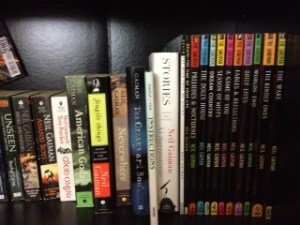
I love Neil Gaiman!

I’m only a *little bit* of a fan, as you can see.

To really emulate one of my absolute favorite authors, I’ll try to follow his rules:

  • Write a story off the Twitter prompts.
  • Don’t poach Neil’s ideas. I read his stories once, but I’m not going to peek again until after I’ve finished. They’ll use similar themes, I imagine, as I’m starting from the same prompts, but we’ll go different places.
  • Between 500 and 1,100 words (I did a word count on each of his stories to find this range).
  • Spend no more than 3 hours on each story. (This is gonna be tough! I got this figure by assuming he spent 12 hours per day writing for each of the three days it took him to complete this challenge. If I was able to write full-time, I might try the three-day sprint, but this is going to have to do.)

Thanks for the inspiration, Neil!

-ME

My first three stories are up!

January (Dangerous Veteran)
February (Grandma’s Pendant)
March (Anne Bonny Dreams)

Leave a comment

Filed under writing