Category Archives: Feminism

Time Travel: Sorry, No Girls Allowed

The Guardian (among others) raised a fantastic point recently: females who travel through time are practically non-existent.

I think time-travel is one of those really awesome science fiction concepts that can range so delightfully from glorious cheesiness to romantic to heart-pounding. It’s a genre I enjoy. But I realized…they’re right.

The time travelers/time travel media I could name:

  • H.G. Wells’ The Time Machine
  • Doctor Who (twelve incarnations, all presenting as male)
  • Marty McFly (Back to the Future)
  • Captains Kirk, Picard, Sisko* (Star Trek: The Next Generation)
  • The Kid in King Arthur’s Court
  • Looper
  • Hot Tub Time Machine
  • Kate and Leopold
  • The Time Traveler’s Wife (I don’t know if I’ve actually seen this or just saw the trailers…)
  • Bill & Ted’s Excellent Adventures  (Be Awesome to One Another)
  • Terminator
  • Groundhog Day (I don’t know that it’s technically time travel though)
  • 13 Going on 30
  • Hermione Granger in Harry Potter and the Prisoner of Azkaban

Props to you, Hermione, as a main-screen female time traveler. And why did you travel through time? More time to do homework, of course!

Out of that whole list, only 13 Going on 30 and Harry Potter have ladies. And I don’t really think 13 Going on 30 should even count, because she doesn’t just time travel, she also inhabits an older hot-bod version of herself.

That means the only time-traveling lady I can think of is Hermione Granger. And, let it be noted, unlike a lot of the guys who are motivated to time travel by wanting to get a girl, Hermione is into time travel so she can study. Like a boss.

That’s a pretty sad list. Why aren’t women given the chance to travel through time? Is it the cultural notion that explorer = male? In other words, we’re sending men to travel through time because they’re the hunters?

Well that sucks.

It is in this spirit that I issue a challenge: Write a time travel short story in which the lead is female.

That’s it. Take her wherever you like. Explore new worlds and the same world but in different times. Make her good, make her bad, make her lovesick, make her vengeful, make her confused. I don’t care! Just make her!

Leave a comment here when you’ve written one to let me know!

*Granted, I do know that time travel as a concept occurs fairly frequently in Star Trek, in several of the movies and shows. And I think I’ve seen every episode of the original, TNG and Voyager. But the only times it seemed really significant were the Tribble episode of Deep Space Nine (Sisko), Star Trek Generations (Picard), and Star Trek IV: The Voyage Home (Kirk). And it’s the menfolk who are the focus of all those episodes.

16 Comments

Filed under Feminism, writing

You’re Equal to Me in Every Way…For A Lady

The full cast o’characters.

In fighting the late-summer heat, I recently picked up a new-t0-me video game: Dragon Age: Origins. It’s pretty cool; you are on a hero’s journey to become a Grey Warden and travel from town to town fighting monsters and trying to save the kingdom. There’s a lot of customization, and the choices you make throughout will affect the outcome of the game.

And you have to make a lot of choices. (It’s almost the Starbucks of video games: and would you like whip with that? (I’m easily overwhelmed by Starbucks….can you tell?))

The very very first choice, though, is building your character: Will you play as a male or a female?

In some ways, the fact that it’s even an option to play as female is a great thing; in some games, forget it. You’re just a white-ish athletic dude no matter what. So I always enjoy games that give you more versatility in that way.

The prompt as you choose your playable gender says Fereldon, the world, is a pretty equal place, with opportunities for both men and women in the three playable careers–warrior, mage, and rogue. That’s important, because I like to know when I’m cutting myself off from parts of the game with my choices.

So I built my female human mage with red hair and dark eyes and went happily on my way.

Except I was constantly reminded by other characters (non-playable characters, or NPCs, for you non-gamers out there) that woah, hey! You’re a lady!

In some cases, it made sense and fit with the story: when Morrigan the wild witch met me, she was more friendly because she carries a general dislike for men, having grown up in isolation.

But most of the time, it doesn’t. It’s more like “wow, you’re a fighter and a lady? Whodathunkit?!” In a world that is supposedly equal. And where I periodically see other female warrior/mage/rogues running around.

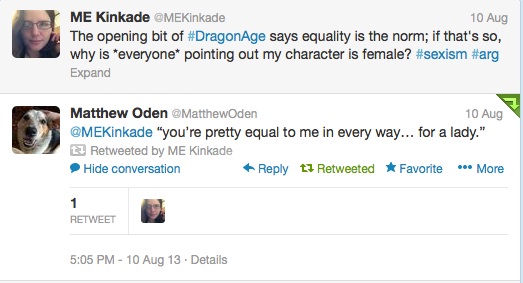
It just got tiresome. So this happened:

dragonage Twitter

Think about this in your writing. If your character is something different, that’s fantastic! We need more minority characters–not just female, but also non-white nationalities. And that should affect the story where appropriate–as in the case with Morrigan in Dragon Age.

But when all the “NPCs” in your book take time to comment on the difference, you aren’t showing that there’s equality. You may be telling the reader that there is, but what you’re showing is exceptionalism. And it’s pretty tiresome, both in our stories and just to read. (See: Repetition)

(There may be stories of exceptionalism where it is still relevant–“wow, she’s the only one who can do that!”–but I personally think the gender-based exceptions are played out. Do something different.)

Don’t tell me how equal I am: just let me get on with the monster-fighting and world-exploring. That’s how I KNOW I’m equal–because I can definitely kick some undead monster butt if you’ll just let me get on with it.


4 Comments

Filed under Feminism, video games, writing

Where Are The Super-Moms?

Hollywood/Marvel/DC, I’ve got a beef with you guys.

See, I finally got around to seeing Man of Steel, a movie I’ve been looking forward to because Superman, duh. And it was a fun movie and a worthy inclusion in the Superman films.

And I noticed something.

Kal-El’s dad, Jor-El, is really important. He’s got big dreams for his son, and is willing to sacrifice himself to make those dreams happen. And Jor-El can’t be stopped from helping his son even in death, because he magically imported his unconscious into a memory stick (or something. I wasn’t really clear on the how of that part).

And Jonathan Kent, as ever, is hugely important. He’s full of practical, hard-knock advice for this son that fell from the heavens to be his boy. And he is willing to sacrifice himself to save the family dog and to protect Clark’s secret. It’s Jonathan’s death that could be said to motivate Clark/Superman/Kal-El to greatness and noble sense of duty.

Martha Kent is looking for any sign of a superhero movie mom who is really important, not just supportive. I think she’s going to be disappointed.

But CK’s two moms? Well, Lara-El (is that how you’d do her name?) quite nobly …pushed a button…to launch her son to Earth. And stood…nobly? …while politicians sentenced the bad guys to jail time. And then she…nobly?…died when her planet blew up.

Martha Kent is every bit as practical as her husband, but CK leaves her to go grow a beard and play on boats. And she’s very supportive, but doesn’t have a lot of advice. Her biggest moment is talking to Clark through a panic attack. And she does that from the other side of a door. She, um…knows the value of her family photo album? Has a natural mistrust for Lois Lane?

Lara’s subconscious couldn’t be imported into that memory stick? Did that not even occur to ol’ Jor-El, there? And what the hell, Martha, you didn’t even try to rescue your husband! You didn’t even seem all that upset when aliens blew up your barn! You didn’t even seem upset that your son wandered off without leaving an address for, apparently, years! I mean, running a farm alone must be hard work…couldn’t you use a strong back? Or company, at least?

In other words, Man of Steel has two moms that could potentially be really significant in Clark Kent’s life, and both, in the movie, are reduced to being complete background characters. I can’t think of a single action that either of them does that had any real effect on the movie.

And Supes has four parents, so he’s got double as many chances to have a meaningful and significant moment from his mother. Judging from the movie, though, all he gets from mom is clean laundry and cookies when he comes home after long trips.

Seriously? That’s sad. I mean, I got more from my mom than that. I learned all sorts of life lessons from my mom, and I’d guess most people have. So what is going on here?

The bad news? It’s not just Man of Steel. It’s not even just Superman.

Moms in Movies

Luckily, there have been a lot of really awesome superhero movies in the past decade. Surely we can find an awesome mom-character in one of them.

Okay, Spider-Man. Peter Parker doesn’t have a mom around, but he’s got Aunt May, arguably the nicest woman alive. But… it’s Uncle Ben who utters that incredible quote, “With great power comes great responsibility.” And it’s Uncle Ben’s death that spurs Peter to become Spider-Man. In the first movie, all Aunt May does is cook a mean Thanksgiving turkey and struggle to pay for her house. Oh, and get kidnapped.

She doesn’t even get a single genuinely important line.

She fares a little better in the next movie, Spider-Man 2, when she talks about why people need heroes, but …she doesn’t even know Peter is Spider-Man, so while this is a lovely moral statement, she doesn’t do much.

Batman: Everyone knows Batman’s parents die early on and it’s very sad and makes him want to fight crime his whole life. But do you even remember Batman’s mom in Batman Begins? I didn’t even remember her name, if that tells you anything. Martha Wayne has three lines in Batman Begins, and one of them is “Dear…”! Thomas Wayne is a doctor! He’s a philanthropist! He is a business man! He saves his son from a well and tells him not to be afraid of the bats, and that we fall to learn how to pick ourselves up!

Martha Wayne worries about nightmares and screams as she is shot by Joe Chill. *sigh*

Thor: I couldn’t even remember Freyja’s name. She doesn’t say anything, anyway.

Captain America: Sarah Rogers wasn’t in the movie. In comics, she died in Steve’s teens.

Fantastic Four: No parents.

Wolverine: No parents.

Iron Man: Maria Stark isn’t in the movie. Her husband, Howard, is very distant and yet still manages to be a major motivator for Tony.

X-Men: Okay, we’ve got a group film here, lots of potential. Magneto’s mom is ripped away from him during the Holocaust–I guess that makes her significant, but she’s not the instigator so I don’t think it counts. We don’t see Storm’s, Professor X’s, Wolverine’s, or Cyclops’ parents, so we can’t analyze them at all.

Rogue’s mom (Mystique) is in the movie, but considering she’s evil and abandoned Rogue at birth, I think we can leave her out.

Iceman’s got a mom, but neither of his parents do much other than send him away to school. No moms to speak of in X-Men.

Green Lantern: I had to look this one up, because, like the rest of America, I didn’t see this movie. But the internet tells me Janice Jordan has zero quotes in that movie, though there is at least an actress listed and she is named (unlike Rogue’s adopted parents, who don’t even get movie names).

That covers all the superhero films since 2000, and frankly, it’s getting depressing, so any further will have to wait. Besides, I think I’ve made my point.

What Do They Do?

The moms in these movies do share some characteristics, despite being overwhelmingly background characters. They don’t serve as the moral guidance that their husbands do, and they aren’t the ones who set the hero on his journey, but they do provide emotional “care packages” along the way–a reassuring word, a cookie, a hug after they’ve nearly been blown up by the bad guy.

These “care packages” have the potential to be important and significant, but for the most part, they are just the sort of throwaway comments that sound good but have very little impact.

These moms are universally patient and kind. And supportive, loving, and loyal to their (often dead) husbands. (Actually, that’s pretty sad, too–can no super-moms date after their husbands die?)

Those are indeed characteristics often assigned culturally–we expect “good moms” to kiss our boo-boos and ask us if we’ve found a nice boy/girl to date. But I find it odd that, in super-cinema at least, moms can’t be the moral tentpole–can’t even really have enough initiative to do something themselves at all, really.

Super Comics Moms

The thing is, Hollywood/Marvel/DC, you DO have great material to pull from if you want to make some legitimately super moms. You could start with Aunt May and Martha Kent, each who in TV shows and comics have managed to be incredibly significant to their sons.

I understand Diana Prince/Wonder Woman has a pretty awesome mom–probably expected in an Amazon society where she’s queen, but still–so you could go ahead and make that Wonder Woman movie already.

Hippolyta crafted Diana from clay. Despite being Queen, it’s good to know she has time for art.

And I consulted my SO, who has read a lot more comics than I have so far, and he says there are some other epic moms you could look into:

  • Steve Rogers/Captain America– In canon, he has an abusive dad. It’s his mom who teaches Steve Rogers to “get back up” after a fight. (In the movie, that moral moment was erased, and Steve gets back up just because.)
  • Genis-Vell/Captain Marvel-His mom’s a single parent, having impregnated herself with baby Marvel using her futuristic technology. (It’s comic canon, that stuff can be really weird, okay?)
  • Kyle Rayner/Green Lantern-His dad abandoned the family when his mom was pregnant, so he’s also the son of a single mom.

We Need Strong Moms

But maybe you’ll notice the problem with all the above moms in that “good mom” section: They’re all single parents. In that sense, it can be assumed that those moms have to pull double parent-duty–they didn’t get the strong mom stuff because they are inherently strong characters, they got it because there isn’t a dad around to do it. And that’s stupid.

While positive portrayals of single moms are really important and worthy of inclusion, there is a distinct dearth of strong-mom figures in a two-parent household. Either there’s no dad around to give our hero his “hero moment,” leaving it to mom, or mom is a supportive background character only. (Even Martha Kent and Aunt May fit into that analysis, as they both only really pick up the leadership slack after their husbands die).

That is a damn shame.

It’s bad enough that we can’t get a female superhero movie made: why can’t we have a super mom?

5 Comments

Filed under Feminism, Uncategorized, writing

Lessons in Companionship

I’ve been playing BioShock: Infinite since it came out last Tuesday, and it is phenomenal. It is beautiful, challenging, has a great story, excellent mechanics, and pretty much makes me want to spend all my time there.

For non-gamers, BioShock Infinite is the third in a series of dystopian first-person shooter (or FPS) games, where you play as the shooter–basically, you are the main character. (Here’s my quick explanation from before the game came out). In this story, you are a mysterious guy sent to retrieve a girl, Elizabeth, from a sky-city. It’s 1912 and everything has a bit of a steampunk vibe. You get guns to shoot bad guys with and superpowers to help you interact with this city.

I’m only about halfway through, so I’m not sure how it’s going to end, but this game is already standing out for me, all because of Elizabeth.

Elizabeth is a sassy character who is NOT afraid to beat you over the head with a heavy physics book.

She is hands-down the BEST companion I have ever seen in a video game. And maybe in a TV show. And she’s one of the best I’ve ever seen in a book, too, (excepting maybe The Lord of the Rings, because hobbits).

Compared to the other media, video games have a few extra challenges with their companions: they have to not get killed in combat; they have to have a bunch of replies/interactions depending on what the player does; and they have to be able to keep up (any gamer can tell you horror stories about glitches where they have “lost” a companion character because the game warped them ahead or behind, and they had to go back and start from a save point to try to recover them. It’s not fun).

Not only does Elizabeth manage to do all of these things well, she’s got serious personality. And she’s genuinely helpful. And, above all, she is not a damsel in distress (though she does start out locked in a tower and you have to rescue her). Check out that video if you want to see the problems with ladies trapped in towers: it can get ugly.

But no; though you do start out as Elizabeth’s rescuer, she later chooses to stay with you. (She might later choose to stab the player in the back, for all I know. We’ll find out!) This completely changes the dynamic! Now she’s not just a helpless girl following her big, heavily armed hero around because she has to: she made a choice.

Woah.

And then here’s where she really starts to be cooler than many TV companion characters (I’m looking at you, Doctor Who)–she’s not helpless. She has at least three sets of abilities that help you BOTH get through the game. Unlike other games where the companion character is really just something for the character to lug around from place to place (*ahem* Rose Tyler***; *ahem*Princess Peach; *ahem* 007 Goldeneye’s Natalya), you could not survive this game without Elizabeth.

Sure, she needs you; but you need her, too.

I’m not going to go too much into her powers (because, spoilers!), but Elizabeth provides a potent lesson for other game designers and writers in general: your supporting characters need to be fully developed characters in their own right.

Things I can tell you about Elizabeth:

  • She has three extremely helpful abilities.
  • She’s missing part of her little finger on her right hand. (Mysterious!)
  • She wants to go to Paris, France.
  • She enjoys painting and reading.
  • She was locked in a tower for most of her life.
  • She has a joie de vive about her, but can be a little naive.
  • She’s certainly intelligent, like, quantum physics intelligent.
  • She can fight back.
  • If you leave her alone, she’ll explore and interact with her environment, showcasing her creativity.
  • She doesn’t very much approve of your character’s morality, but she’s willing to go along with you if it’ll benefit her.

Wow. I’m only maybe halfway through the game! There’s a lot more I can learn, plus some of her abilities are growing to change with the flow of the game. I think I know more about Elizabeth than I know about my playable character.

She’s incredible. Props to 2K for creating such a fantastic character.

Other people: Be more like this. It makes me more interested in the story and more invested in your creation.

***I’ve only watched about half of the Rose Tyler episodes. Yes, I know, I’m behind. So I admit she might get better, but so far? She doesn’t really contribute much.

4 Comments

Filed under Feminism, video games

Patrick Stewart on Violence Against Women

I just discovered this video, created in 2009. It features everybody’s esteemed captain* and knight, Sir Patrick Stewart, talking about his childhood, and the effect of his father’s violence against his mother on Patrick and his brother. It is mesmerizing. Please, take a moment to watch.

*We can argue best Trek captain later. But you’ve got to admit he’s not a bad one to follow into the great unknowns of space.

Leave a comment

March 5, 2013 · 10:00 am