Tag Archives: writing

Black Cat Salon

As soon as she stepped through the door of the Black Cat Beauty Salon, Madge knew something was wrong with her 3 o’clock appointment. It wasn’t just the young woman’s dour looks or moping demeanor, though those were good enough hints. No, Madge had been in this business long enough to know a heartbroken lover when she saw one.

“Hello there,” she said cheerily. The girl started, as if surprised that she’d been noticed. “In search of a bit of pampering?”

She nodded, her loose bangs flopping off and quickly over her downcast eyes. “Yes please,” she said.

“Do you have an appointment?” Madge asked, in her chipper-saleswoman voice.

“N-no,” the girl stammered.

“Well, you’re in luck, I’ve got openings,” Madge said, coming around the counter to take the girl by the arm. In another era she would have commented on how nice and meaty the girl’s arm was, but those days were behind her now. Leading the customer toward the worn but plush seat, Madge said, “what can I do for you today, dearie? Haircut? Eyebrow threading, maybe?”

The girl winced. Not the right tactic. “Oh, I know. Manicure. Just the ticket,” she said firmly. “Go browse the colors while I get set up.”

Her client looked briefly bewildered, but then got up and scanned the wall of polishes. Madge watched her from the back room as she picked up first one, then another pale pink or shimmering gold. She let the girl linger, and busied herself with pretending her supplies weren’t already ready.

“Find one ya like?” Madge finally asked, beckoning the girl over.

“Oh, I dunno,” she said, shy. “I like both of these, and it’s just so hard to choose.” She showed Madge the two shining bottles, one a deep lusty red and the other a pale grey. Interesting, Madge thought. The colors they pick are always so telling.

“Ah, that it is dearie, that it is sometimes. ‘ow ‘bout we use that one?” she asked, pointing out the red bottle. “I find it has a bit of a magical effect on a girl.”

“Does it?” the girl asked, brightening only momentarily, before saying gloomily, “I could use some magic.” She sighed in that melodramatic way only the young seem to manage.

“Sure does. It’s called Bewitched, ain’t it?” Madge said, winking conspiratorially.

“Oh, ha,” the girl said, the “ha” closer to a cry than a laugh. “That’s too bad.”

Madge took the girl’s hands and led her back to the chair. “What’s your name, dearie?”

“Sam. Samantha,” she said, leaning back into the firm little chair.

“Well, good, Miss Sam, just you let me take care of you now and you’ll see things are better for it in no time,” Madge said as she took out her clippers and began snip snipping at Samantha’s long tattered nails.

Sam stared off into space until Madge said, “So, dearie, are you going to tell me what’s troublin’ you or not?” She put down the clippers and held Samantha’s thumb firmly, sanding off the rough edges with a lavender nail file.

“Oh, it’s not a big deal or anything,” Sam said. And sighed again.

Madge stopped filing and looked Sam in the eye. “I’ve been around long enough, missy, that I know that kind of moping ain’t fer nothing. No sir. It’s about a boy, isn’t it?”

She went back to filing, barely glancing down at Sam’s fingers as she worked, and Sam gaped at her. “Is it that obvious?” she asked.

“’Course it is, dear. Might as well out with it. It’s part of my job, listening is, you know.” Madge rounded off another corner on Samantha’s pinkie, and turned her attention to buffing the nails.

The girl mournfully told her story while Madge worked on beautifying and painting her nails. It was a story she’d heard frequently enough over the years: there was a charming lad at the girls’ workplace, totally out of her league, and she was pining away while he didn’t even notice her. Madge just listened, and pursed her lips as she focused, applying two even coats of Bewitched red.

When Samantha had run out of lamentations, Madge looked up and said, “Well, dearie, I’m sure it won’t be that way for long. Why, I bet you’ll have a run-in with him real soon now, and you’ll find he’s been just as heartsick all this time. Now put your hands here to let this little light work its magic.”

Samantha obediently slipped her hands under the ultraviolet light, and said “Really? You think so?” Maybe it was just the little bit of pampering, but she felt happier than she had when she’d come in.

“Darlin’, I know so,” Madge said.

Six minutes later, the timer went off, and Samantha paid for her manicure (leaving a more substantial tip than she might have at another salon) and went off with a smiling gracing her face and a lightness to her manner.

Madrigal sighed as she watched the girl go. Witchcraft sure wasn’t what it used to be.


—-

I really like this concept for a character, preferably a main character rather than a background character, but I’m a bit stumped. What problems could a witchy beautician resolve, do you think? What trouble could she get into?

Leave a comment

Filed under Short Stories, writing

Seeking Advice: Overcoming Stress

Lately, things in my day-to-day non-writing personal life have gotten a bit hectic. Things completely out of my control happened and caught me by surprise, plus I had a great big list of Things That Must Get Done.

Shockingly, this change actually left me with more free time, but a great deal more stress, too. I managed to blog during my vacation (thank you, delayed posting!) but after I got back, and facing a scary look at the future, the spinning plates I’d been maintaining for awhile (including updating the blog regularly) started to slip.

I had time to write, so I can’t beg off with that excuse, but I had absolutely no inclination. It was like I had been zapped by a writer’s block ray gun. But more than that–I didn’t even want to write. I started to resent my laptop, even, skirting the room and glaring at it hatefully, because a tiny easy-to-ignore part of me was insisting that I needed to be there, writing away, keeping to “the schedule,” when I wanted nothing more but to go be a gypsy or something. (“Something” often meaning “lying pathetically on the couch in a hot sweaty puddle”–this is Texas, after all, and it’s bloody hot.)

Eventually, the stress abated, which is why I’m here again, writing, and similarly why I yet again have clean dishes to eat off of, freshly painted fingernails, and some well-organized personal files.

Every time I turn to the internet or Twitter for support, it seems I just find more “soldier on,” “write every day or else!” type posts, which just leaves me feeling sort of bad about myself. But I keep thinking: I can’t be the only one this has happened to. I can’t be alone in being paralyzed, rather than invigorated by, stress.

Or can I? Tell me, and tell me true.

Have you ever faced a time of stress that affected your writing? How did you handle it? Do you really believe in those “write every day” aphorisms?

5 Comments

Filed under writing

Internet Famous

The inimitable Tex Thompson, who I met at DFW Con this year (she gave a killer presentation on grammar) does this brilliant thing I her blog: Grammaticats.
That’s right. She teaches good grammar through funny captioned cats, despite their storied Internet history as grammatically inventive ruffians.

And I am proud to say that one of my two is now Internet Famous. Here is my cat Sawyer, the orange striped rogue in the third image, in a new role as teaching aid in grammatical ellipses.

I can safely say this is the most brilliant he will ever be (which admittedly isn’t saying much; this is the cat who enjoys chewing through electrical cords, leading Amazon to assume I have infants in the house because I keep buying electrical covers).

So go, get your learn on!

20130706-184551.jpg

Leave a comment

Filed under Conventional, Editing, Uncategorized

Literary Summer

This month has been epic in a rather literary way. From the last week of May until this week, I have been lucky enough to hear and meet Martha Barnette and Grant Barrett from the A Way With Words radio show, author Margaret Atwood, and author Neil Gaiman.

I think I’ve hit some kind of trifecta there. I’m not sure of what, exactly, except perhaps the Jeopardy category of “People Who Make Your Heart and Brain Go Pitter-Pat.” I love the radio show (you can listen online!) and Atwood and Gaiman are both so high in my tier of favorite authors that I’m not even sure which gets the “best” appellation. Atwood was first and perhaps more influential to my personal writing style, but Gaiman is just so prolific and varied that I always feel like I’m discovering something else new (and often scary).

A Way With Words

If you haven’t heard it yet, A Way With Words is a nationally syndicated radio show about language. They do word jokes, explain the etymology of interesting words both colloquial and professorial, and, most of all, answer word questions from callers of all stripes. They have a philosophy of verbal flexibility (meaning that it’s ok that words change meanings and spellings over time and geography) and are incredibly kind and so shockingly learned. It’s like they’ve swallowed the OED and can now regurgitate on command.

I saw them at a special benefit for the Aberg Center for Literacy, an organization I’d not heard of previously, but they are advocates for literacy and therefore I like them. I had expected the show to be mostly a real-life version of the radio hour, but the organizers had mixed it up a bit. Greg and Martha each had a talk, with a game show format in the middle. Greg discussed the ways his young son was teaching him things about language and about how forgiveness is an important part of learning (and teaching). Martha’s talk was about a professor who really taught her to love language, and who became a teacher of more than academics, but of life. It was a very moving presentation.

They took questions from the audience, and I was stunned that my question was the first drawn. But it was too good a question, and they were stumped (“Does the phrase ‘brain-child’ have anything to do with the myth of Athena, who was born from the skull of Zeus?” Answer: “We dunno. Maybe? Sounds good, let’s say yes, sure, why not?”)

The question-and-answer bit really showed how much they knew off the top of their heads; they answered questions without any resources and without having known the questions ahead of time.

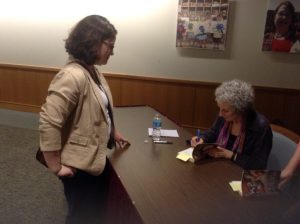
Atwood signing

Margaret Atwood

The first book of Atwood’s I discovered was “A Handmaid’s Tale,” arguably her most famous because it is both required reading and banned in schools, depending on your region. It was assigned in mine, and I did perhaps the most unconventional book report on record for it. Well, at least my most unconventional. I asked my teachers if I could “act it out.” They were very obliging souls, so they said yes.

When it was my turn to present my “report” on “A Handmaid’s Tale,” I solemnly walked to the front of the class, explained that the president and Congress were dead, and I was now in charge of the class. Several classmates turned and stared at our teachers, who just shrugged and said we’d all better listen. I broke up couples, confiscated religious jewelry, separated girls from boys, explained that the girls would now be divided into groups based on their ability to procreate and that the boys, if they were lucky and loyal enough, might one day get the privilege of a wife. One classmate protested my act, and I said that was fine, and he would be hanged. I had my “bodyguard” (who had previously volunteered, and thus got himself a wife) “execute” him, and he was mock-hanged in the front of the class, as an example for the rest.

Like I said, the most bizarre book report ever. I certainly won’t ever forget it.

I’ve since read and enjoyed many other of Atwood’s books (I have a particular fondness for “Oryx and Crake” and “The Penelopiad”), but “Handmaid” was revolutionary for me. It was bleak…really really bleak. Most of even the apocalyptic stories I’d read had shown a strong light of hope. It was all the worse because it was set in such a realistic version of our world, and it scared me on a level no book ever has.

Atwood came to speak as part of a Dallas Museum of Art Arts and Letters presentation. Ostensibly she was there to talk about mythology, but she did this only tangentially. She did show us lots of pictures of her drawings, at various ages. (Apparently she is also an illustrator, and I’m crushed that the copies of her books I have aren’t those she drew).

Mostly, she talked about her childhood. She grew up in the woods of Canada, and didn’t have running water or electricity for most of her childhood. Books were of preeminent importance because they needed things to do.

I think I told my dad that night that I was now upset that we’d had water and electricity, because how would I ever be a fantastic author now?

He didn’t seem that bothered by it.

Atwood took questions from the audience, and I happened to be sitting right by the microphone, so I leapt up and asked about her feelings on technology. She gave a very lovely and funny response about how her use of social media was like a biologist studying mosquitoes: she is offering her flesh up for consumption to test it out for the future benefit of authors and twitterers.

She was lovely and far funnier than I had ever expected and her brilliance really shown. And when I got up to the front of the signing line, I had no idea what to say and just sort of quietly thanked her for coming.

I still can’t believe it happened.

Gaiman signing

Neil Gaiman

And then, adding to the list of Things I Never Imagined Possible, I got to meet Neil Gaiman.

Well, me and about 1,500 other people (seriously. That theater was PACKED).

Gaiman is on his last-ever book signing tour, for “The Ocean at the End of the Lane,” his newest book that is sort-of fiction, sort-of adult, sort-of magical. (I’m only a third of the way in, because I had to do things besides reading today and I’m very very upset about that, but I’ll be finished this weekend for sure).

Gaiman read to us from his new book, and I wanted his lovely sonorous English talking to go on forever, particularly when he tried on different British accents as appropriate.

I just read, tonight, the passage he’d read to us last night, and I hope it always stays this way, but I heard him again in my head, each syllable rolling around between my ears.

He then took some questions from the audience, and unlike Atwood they were all previously written down and presented to him on cards (and I’m bummed because I was stuck in the interminable line and did not get the chance to even ask a question via card). He joked that a huge stack of them were all “What was it like to work on Doctor Who?” so he’d removed those.

He only answered a few questions, and I admit I was a little disappointed; I wanted him to keep talking. But he was lovely and so kind and humble.

Then we got lucky, and he read from his next children’s book “Fortunately, The Milk.” It’s about a dad who has gone off to get milk for his children’s breakfast and…encounters some rather odd difficulty along the way. It was hilarious and I found myself leaning forward, forward in my seat trying to soak up more of it. He’s delightful. I’m definitely going to buy that one when it comes out in September!

And I was lucky enough to be seated in one of the nearer rows, so I didn’t have to wait too long to get my books signed.

Again, I got up there and just gaped like a goldfish. What do you say to your idol? I just almost-whispered “Thank you for coming out.” And he drew a heart in my book and I was so happy I had a Kristen Bell sloth moment as soon as we walked out. Seriously. Neil Gaiman made me cry.


So that’s been this month. I don’t know that I will ever be able to top that.

Provided you’re actually able to speak when given the moment (since I wasn’t), what would you say to your idol? And who would it be?

2 Comments

Filed under Uncategorized

Fun with Grammar: Lessons from DFWCon

This is my cat, Tavi. He is not a Grammaticat. Maybe one day. We all need dreams.

This is my cat, Tavi. He is not a Grammaticat. Maybe one day. We all need dreams.

Five weeks ago (wow, has it been that long already?) I had the privilege of attending DFWCon, where I got to meet Tex Thompson, grammar-clarifier-extraordinaire. She runs www.thetexfiles.com, which, in addition to general greatness, is where she posts “Grammaticats”–cats teaching lessons in grammar.

I know. My mind was blown, too.

It is no surprise, then, that she led an excellent presentation on Grammar and Style. I hadn’t planned on attending, but my schedule worked out and I made it, and I am so glad I did.

I’ve been a copyeditor and proofreader for years, but I’ll tell you a secret: when editing stuff, we don’t typically talk about it in fancy grammarian-speak. Mostly we just say “ugh, you did that wrong.” For that reason, it was great to brush up on my grammar in Tex’s class: I don’t think I’ve heard some of the fancy titles since high school (if then).

Mostly for my own benefit (and because, who knows? Maybe it’ll help you out, too), here are my notes from Tex’s class.

  • modifier:
  • non-restrictive modifying phrase:
    • 1) Can be deleted
    • 2) must be close to the thing it modifies
    • 3) needs a matched set of commas or dashes
  • Types of modifiers and errors: relative clauses; restrictive vs. nonrestrictive modifying phrases; dangling modifiers; misplaced modifiers; ambiguous modifiers (the phrase being modified could be interpreted two different ways); implied simultenaety (which is fine as long as the actions being given really could be happening at the same time, eg. “Sally walked while talking to Jim.”)
  • Pronoun: subs in for a noun or noun phrase
    • Pronoun case error: using the wrong form of the pronoun (I/me, for example)
    • pronoun antecedent agreement: the pronoun needs to go with the thing it refers to (a group = them; he = Bryan)
    • pronoun reference error: it’s not clear what the pronoun is referring to (“I took my boat and my girlfriend for a ride. She’s a real beaut!” –the boat or the girlfriend?!)
    • wandering body parts (this one’s my favorite)-when anatomy causes confusing issues (is the eye literally falling on the jacket? Ew)
    • dialogue tag: said/ asked/hissed/etc. – it should describe how something is said
    • comma splice
  • Fragment: an incomplete sentence; it needs a subject
    • implied subject (ie. “Run!” The “You” is implied)
    • coordinating vs. subordinating conjunctions (rules for whether or not to use commas)
    • Fragments are often okay if you are writing in deep POV–we don’t always think in complete sentences.

Look at all the words you learned! Don’t you feel like a smart cookie now?

2 Comments

Filed under Conventional, Editing, writing

Writers’ Rates by Type of Publication

This is big, guys. I got to attend a lecture on the “Economics of Publishing” led by agent Evan Gregory while at DFWCon. His talk was great, but this one slide was earth-shaking for me. I think I’m still quivering.

I’ve had to replicate it, as the photo I took with my phone illustrates said shaking.

Royalties By Edition

Publisher Book Price Royalty Author Receives
Amazon, self-pub $2.99 $2.05
Nook, self-pub $2.99 1.76
Smashwords, self-pub $2.99 $1.49-1.74
Hardcover, traditional pub $25.00 $2.50-$3.75
e-book, traditional pub $7.99 $1.40
Trade paperback, traditional pub $14.99 $1.12
Paperback $7.99 $0.64-$0.80

That’s a estimated breakdown of what an author will get, per book sold, using different publishing options.

Pretty sobering, isn’t it?

Now, I realize some people are going to look at this and instantly cry foul and say self-publishing is definitely and always the right way to go, because there’s a big difference between $2.05 and $0.64. And I don’t disagree. But Mr. Gregory had an excellent point: sure, you get more per book, but you are likely to sell fewer–because you have only whatever marketing efforts you personally can generate, without help–and you have a lot more up-front costs, like editing and cover art, and a huge amount of your time, so while this compares the profits you stand to get, it doesn’t accurately reflect the time-and-money investments for each arrangement.

Still, knowledge is power, and learning this figures really changed my perspective.

4 Comments

Filed under Publishing

High School as Hell: Buffy the Vampire Slayer

This summer, I’m taking time to do something I should have done a long time ago: watch “Buffy the Vampire Slayer.” I know, I know, I’m way behind on this one. The first season came out in 1997, when I was not cool enough to watch amazing television, apparently.

So I’m making up for lost time, thanks to the wonders of Netflix and the ability to binge-watch shows.

Years ago–probably when everyone else was busy watching good TV–I remember hearing Joss Whedon say his vampire-slaying, demon-fighting, world-saving show was actually about normal high school drama. I remember smirking and being all “pssh, whatevs. The only vampires in my high school are teachers who suck out our lives with too much homework.”

Well, Mr. Whedon, I finally get it, and I apologize for my teenaged smart-aleck sass. This show really IS about high school being hell. For every vampire-related monster-of-the-week catastrophe, Whedon folded in some kind of completely normal high school problem.

So, to distract me from the crop tops I’m developing an unnatural desire for thanks to this show, I’ve made a list. For your viewing pleasure, this is all the episodes of the first season; the monster story and it’s real-world allegory.

  1. “Welcome to the Hellmouth”– discovering a den of vampires/being the new girl at school
  2. “The Harvest”- group of vampires have some kind of prophecy/making friends
  3. “Witch”– body-snatching voodoo-working witch/dealing with parental expectations and fitting in
  4. “Teacher’s Pet”– teacher eaten by a mantis monster/struggling with schoolwork
  5. “Never Kill a Boy on the First Date”– pack of vampires are after you/struggling to balance dating vs. friendships
  6. “The Pack”-demonic hyenas eat the principal/changing friend groups and dealing with bullying
  7. “Angel”-falling for a vampire who claims he no longer feeds/developing a crush on and trusting a “bad boy”
  8. “I, Robot…You, Jane”– internet demon bent on taking over the world/online dating and the obsessive use of computers (guilty!)
  9. “The Puppet Show”– being bullied by your ventriloquist dummy/stage fright and mandatory school participation activities
  10. “Nightmares”– nightmares become literally real/test anxiety and fear of abandonment because of parents’ divorce
  11. “Out of Mind, Out of Sight”– invisible girl on a rampage/cliques and feeling like an outsider
  12. “Prophecy Girl”– fear of a deadly prophecy/not having a date to the big dance

Crop tops! So many crop tops! And ugly sweaters for Xander. At least Willow is *supposed* to look kinda dorky.

Not only is watching this show a lot of fun, it’s been helpful to remember these kinds of teen pressures as I start a YA story. I’m not much older than the YA audience, but those years might as well be decades in terms of how my priorities have changed (and hormones settled down!).

It’s also great to see a master creator like Joss Whedon develop his work. I’m a familiar Whedon-ite by now, and he was certainly already good in the Buffy days, but this show isn’t as developed from the get-go as some of his work. It’s nice to know that even the pros can learn and grow.

It’s also a helpful reminder that no great story is just about the surface level. If Buffy were really about slaying vampires–and only that–I wouldn’t be looking forward to season two. But there’s a lot of emotional depth beneath each monster fight because of this “high school as hell” subtext. Sure, she may be in a fistfight with an invisible girl, but really she’s dealing with feelings of loneliness and isolation. And I’m not much of a fighter, but I can relate to feeling invisible.

I look forward to the rest of the show!

4 Comments

Filed under Uncategorized, writing

The Grammarian’s Five Daughters

I found this fabulous short story that uses a fairy tale/fable structure to examine the values of different types of words. It’s beautiful.

Once there was a grammarian who lived in a great city that no longer exists, so we don’t have to name it. Although she was learned and industrious and had a house full of books, she did not prosper. To make the situation worse, she had five daughters. Her husband, a diligent scholar with no head for business, died soon after the fifth daughter was born, and the grammarian had to raise them alone. It was a struggle, but she managed to give each an adequate education, though a dowry — essential in the grammarian’s culture — was impossible. There was no way for her daughters to marry. They would become old maids, eking (their mother thought) a miserable living as scribes in the city market. The grammarian fretted and worried, until the oldest daughter was fifteen years old.

Then the girl came to her mother and said, “You can’t possibly support me, along with my sisters. Give me what you can, and I’ll go out and seek my fortune. No matter what happens, you’ll have one less mouth to feed.”

The mother thought for a while, then produced a bag. “In here are nouns, which I consider the solid core and treasure of language. I give them to you because you’re the oldest. Take them and do what you can with them.”…

I’ll let you find out what happens next, but do go read it. It’s delightful.

It made me wish there was a similar story about punctuation. Maybe there is! I’m a fan of the way commas herd words together in small-but-appropriate-sized bunches, and the way periods are always there to give us a break. The interrobang (?!) is rare but mighty, and apostrophes help us cut the crap.

Leave a comment

Filed under Editing, Short Stories, writing

Small-town Girl, Livin’ in a Lonely World

First, go ahead and get the song good and stuck in your head. You know you want to.

Now that that’s taken care of, keep clickin’ and read this great list of the appeal of small towns as settings for a story. Basically, in summary, small towns:

  • Harbor undercurrents of deep emotion
  • Have lots of secrets (because anything that’s not a secret is common knowledge)
  • Are really interconnected
  • Are friendly but also distant toward new folks
  • Are an easy snapshot every reader has built-in
  • Have a limited number of suspects but lots of motives*

*I suspect the last part is why “Murder, She Wrote” worked so well!

I think this is a great post, but these things extend not just to a small town, but to any small community. I grew up in a big suburb, but it might as well have been a town of 200 because everyone at my church knew everything that was going on (or that they assumed was going on), and you couldn’t get away with anything. High school is often the same way; you’ve got a small population that is heavily involved in itself. (I’m finally watching “Buffy the Vampire Slayer,” and you can always tell when someone is going to die because they’re a new person to the cast for that episode.)

I did live in a small town, or two, and I think this list did leave a few things out. Small towns often:

  • Aren’t up-to-date on current trends (in other words, are “a little bubble of the past”)
  • Don’t have as many resources
  • Are small for a reason
  • The pace is slower, but the emotional stakes are higher

My observations have a lot less to do with people than Elizabeth’s, but can really inform the world and the options available. Unless it’s a really big crisis, the CIA aren’t likely to come to a small town in Wisconsin; the people there are just gonna have to handle their problems themselves, and they probably like it that way.

What is unique about your setting? What made you choose that place for your story?

Leave a comment

Filed under writing

Oxford Comma: What is it, and how do I use it?

I’ve had a lot of book reviews lately; sorry about that! I’ve gotten a lot of reading done lately, and that doesn’t even include my recent re-reading (via audiobook) of The Hitchhiker’s Guide to the Galaxy, as read by Stephen Fry (short version: it’s great!).

But a friend today was moaning over people who didn’t understand the merits of the Oxford comma, and I said “Aha!” When I worked in newspapers, I never used the Oxford comma–and I may have even snubbed my nose at it a time or two (it’s true! Forgive me!). But when I worked in academia, it was required, and I came to love that little bugger.

The Oxford comma confuses people, but it’s actually very simple: When making a list, include a comma before the “and” in front of the final list item. Example: “Buy apples, oranges, and bananas.” The sweet little comma between “oranges” and “and”? That’s the Oxford comma.

Some people don’t use the Oxford comma–AP style, used by media organizations, rejects it–and that’s fine, most of the time. As long as the list still makes sense, it’s ok to drop it. The list “Buy apples, oranges and bananas” still makes sense without the Oxford comma! As long as you are consistent in your non-use of that third comma, you’re fine.

Except.

Sometimes you really do need that last comma for the sentence to make sense.

This fun little graphic does a good job explaining it:

If you don’t get it at first, read the second version aloud, pausing to take a breath at the comma.

But this is my absolute favorite visual explanation of the Oxford comma. It’s… a little less safe-for-all-audiences.

This has floated around the internet so much, I have no idea of the original source. Whoever you are, thank you! This is my favorite grammar comic of all time.

Strippers JFK and Stalin are just so fabulous.

Anyway, that’s the gist of the Oxford comma. Use it to make your writing clearer, or use it all the time, if you like. It’s just a helpful little tool to keep your lists organized.

And if you need some advanced grammar or style help, you can always hire a pro.

4 Comments

Filed under Editing, writing