Tag Archives: reviews
Review: Rat Queens: Sass and Sorcery
Rat Queens, Vol. 1: Sass & Sorcery by Kurtis J. Wiebe
My rating: 3 of 5 stars
When you’re looking for an afternoon of ribald violence featuring sharp-dressed ladies, Rat Queens is the comic for you!
Abandon all illusions you may have of comics/graphic novels as being the province of children, or any idea that a female character must act like a “proper lady,” because Rat Queens goes out of its way to demolish both concepts. In addition to featuring Dungeons & Dragons-style questing and violence, Rat Queens is rife with drunken, foul-mouthed, wantonly sexual storylines and images. It’s delightful because of that, of course, because there just aren’t a lot of books at all that would allow every female character in their book to have some kind of vice, but it also suffers because it sometimes feels like it’s pushing it a little too far.
The art is genuinely great. I love that the characters are each so different, so fab, and so feminine, with so much diversity. I love that they have big hips and broad shoulders and that I believe they could really heft a sword. Rat Queens highlights the many stereotypes we see again and again and again in other art by just being different. It’s beautiful.
I’m a little bit of a terrible comic book fan, because I really prefer to read them as complete volumes, like this one, even though such volume would never exist if someone didn’t buy the weekly trades. But I dramatically enjoy buying a thing just once and getting to follow the complete flow of a storyline. Weekly trades just don’t do it for me.
That said, even as a collection, Rat Queens is unusually abrupt, lacking much transition between characters and leaving me frequently wondering if my pages were stuck together or something (they weren’t. It just does that). You’ll be following one character when boom, we’re with someone else, doing something else, with nary a “Back at the Batcave” to warn you.
Overall, Rat Queens was a fun light afternoon read. I don’t know if I would buy more of it, but I would absolutely borrow it from a library/bum it off my more comic-inclined friend.
Review: Cat Out of Hell
Cat Out of Hell by Lynne Truss
My rating: 5 of 5 stars
It’s only the end of April and I think I can safely say I have found my favorite book of the year. Cat Out of Hell is dryly hilarious, surprising, riveting, and–most of all–utterly charming.
It’s a quick read featuring an unlikely protagonist and a believable-if-unexpected villain. Alec is a librarian who has just lost his wife and retired (rather early, by American standards) from his job. While trying to distract himself from his grief, he is sent a curious set of documents…about a talking cat. Alec is thrown, quite unwillingly and yet headlong, into a great grisly mystery dating back at least a hundred years.
The story format itself is unique: it is a combination of diary-ish entries, descriptions of photos and audio files, email exchanges, attempted screenplays, and at least one incidence of “emiaow”–cat telepathic communications, of course. Utterly charming, as I said.
One challenge for some readers may be that it is Very British, with absolutely no Harry Potter-like accommodations for American readers. That means you’ll just have to accept (or Google) the many Britishisms and pop culture references, or miss out on a lot of the fun. The sense of humor is also resolutely British in flavor, with our artless protagonist feeling a little bad about winning even when he is completely justified. It’s so incredibly, delightfully, downplayed.
Cat lovers will adore this book for its adroit insight into the feline mind, and cat haters will walk away certain they are correct to dislike our independent little companions. (Oh, dog lovers, don’t worry, there are some nice bits for you, too.) I can’t recommend it enough!
Review: Ship of Destiny
My rating: 4 of 5 stars
I’ve been waiting to read this book for something like 15 years. Robin Hobb‘s Liveship Traders series was the first to make me desperate for the next book…but it wasn’t written yet. But I also didn’t have much patience, so when I couldn’t get my hands on the book for a month, I gave up, moved on to other things, and forgot about it.
Until I saw Ship of Destiny in a used bookstore! Despite the long wait, Ship of Destiny did not disappoint!
Ship of Destiny is an epic fantasy that features stunning dragons, angsty/crazy talking ships, a horrible pirate, a fierce and bold woman, and desperate policitians. It’s fantastic. Robin Hobb’s knowledge of wooden galleys is incredible and makes it feel like you’re really there, feeling the sway of the swell and lash of the wind. Though the story is incredibly complex–following many paths simultaneously–it is easy to follow and all comes together beautifully.
It is one of those books that you’re both eager finish and sad to put down. It’s an epic conclusion to a great series, and I’m glad to finally have closure on it.
Review: When Bad Things Happen to Good People
When Bad Things Happen to Good People by Harold S. Kushner
My rating: 3 of 5 stars
This is one of the books on the “must-read” list for people struggling with grief of some kind (if there is such a list; dreadful). In it, Rabbi Harold Kushner endeavors to explain why, exactly, bad things happen to good people, and how we should react to it.
It’s clearly a book that has resonated with many people, and with good reason: Kushner doesn’t seem to be talking down to the audience at all, for he has known deep grief. The impetus for the book was the death of his son at 14 years old, having lived his short life with a terrible rare illness known as progeria. As a man of faith, a teacher in his community, and a man who has suffered great personal loss, he is uniquely positioned to address these questions from the same vantage as the reader.
He does an incredible job nailing the kinds of things people say in an attempt to make the suffering person feel better; perhaps an even better job explaining why these things are hurtful, and how they make the grieving person feel. I found myself nodding along; yes, yes, that is how it feels when that happens.
The crux of Kushner’s argument is that the story of Job is a blueprint of grief, and it posits three things:
1) God is all-powerful.
2) God is just.
3) Job (and humans in general) is good.
His theory says that all three things cannot be true: if God is all-powerful, his actions toward Job are unjust or Job is not actually good. If God is just, he may not be all-powerful. If Job is good, then God cannot be both just and all-powerful.
Kushner solves this riddle by deciding that God is in fact not all-powerful, that there are limitations on His power, some self-imposed in the form of allowing free will, and some created by the ambiguously named force “Fate.”
He says that his understanding of God is that God does not give people terrible wasting fatal illnesses, does not kill babies when they are new-born, does not test people’s faith with unbearable suffering for no reason. His understanding of God is that He gives the strength to go on despite these troubles, to encourage compassion and kindness.
For the first half of the book, I felt like this was a book every person of faith should read. But then we got to the second half, and I found myself disagreeing with Kushner, even while I liked what he said. I just can’t get behind it. For one thing, Kushner holds that God does not give people illnesses or kill people off: I have to wonder if he remembers anything from Exodus–the plagues, perhaps? He also seems to say that God doesn’t interfere with people’s lives directly, which is a fine enough thing to believe, I guess, but that also is directly contradicted by several Biblical stories–Elijah, Samuel, David, Moses, Noah, Ruth….lots of stories of direct intervention.
For me, Kushner’s argument just doesn’t quite hold up, for those reasons.
I hope this book gives comfort to those who seek it, but it just left me unsettled.
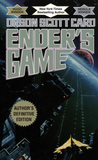
Review: Ender’s Game
Ender’s Game by Orson Scott Card
My rating: 3 of 5 stars
Ender’s Game is one of those books that everyone just assumes you read in school as assigned reading, then they look shocked when they discover you hadn’t. Well, now I have.
It’s an interesting science-fiction book, and definitely would be classified as “young adult” now. The story–in case you also are late to the party–is about Ender Wiggen, a genius-level boy who is selected by mysterious government men to join the Battle School. These men are entrusted with the care of many such excellent children, with the goal of training them to be perfect soldiers, and, in Ender’s case, the perfect commander, in the human fight against the alien buggers. Because of this, Ender is subjected to trial after trial, both interpersonal as well as intellectual. He is isolated and suffers much. Meanwhile, back at home, his also-genius and somewhat sociopathic siblings Valentine and Peter concoct their own schemes to meddle in Earth politics and gain power…even as children.
The book really shines in the zero-G/null gravity tactical battles, which, according to the preface written by author Orson Scott Card, was what started the whole thing anyway. Card tackles the challenges of combat–distance and hand-to-hand–in three dimensions, adding challenges we just won’t face on Earth (hopefully). It’s easy to see why directors thought this would make a great movie; these scenes are vivid and enthralling.
Otherwise, I found the story a little far-fetched. Ender a super-duper genius at just 6? He certainly doesn’t have interactions like a 6-year-old. I’ll accede that possibly he could be really smart and particularly verbal and accept the language as it is, but even super-geniuses need a certain level of human companionship. I also don’t know that I ever fully bought into the validity of the scheme of isolation to produce leadership, that having no friends was explicitly what was going to make Ender a good leader. Which is one of the main conceits of the book…
Card notes in his preface that, when the book was first published, he received angry letters from parents who claimed no gifted child would talk like that. I’m not sure I see anything that seems totally out of the realm of possibility…not just for gifted children, but for any children. Kids can be sadistic bastards, yo. (And I think we as a culture may have gotten over that squeamishness some, at least in fiction, with Harry Potter and Katniss Everdeen, among many others, being highly cogent.)
I love the space stuff, but don’t particularly love the overall message and themes of this book. Perhaps I’m too old to really appreciate the tortured-youth of it; the adults just seem like unforgivable assholes to me.
The ending–the final ending, after the buggers have been defeated–felt so horribly tacked-on and unformed that it really took a lot away from the book for me. It felt like Card desperately wanted a happy ending for this character he unduly tortured but didn’t know how to get there, so slapped together 20 pages of falderal so he can write sequels. While I’m glad I finally read this book, I don’t think I’ll be pursuing the others.
Card’s highly controversial/offensive personal views–he is an active Mormon and has been outspoken about his disgust toward homosexuality, and has been a generous donor to anti-gay marriage folks–is interesting. I bought this book second-hand because I don’t support his views personally and therefore didn’t want extra money going to him, and perhaps that made it top-of-mind for me…but for all that he was anti-homosexuality, his book could very easily be read as including it in a positive way. It’s something the reader would have to bring to the book, so to speak, but there’s an awful lot of male nudity (I wish I’d kept tabs on how often the word “naked” was used!) and there’s a fight scene in a shower featuring highly lathered and soapy naked teenage boys. There are barely two female characters in the whole book; it’s not a huge leap. Worth thinking about, anyway.
(Related: I found it interesting/odd that religion is apparently gone from this Earth at the beginning of the book–banned, it seems–except that Jews are held in high regard, and by the end Ender has inadvertently created a religion? That seemed inconsistent.)
2014 Year in Books

Filed under Reading
Review: Kushiel’s Dart
Kushiel’s Dart by Jacqueline Carey
My rating: 4 of 5 stars
Kushiel’s Dart is the most engaging and detailed fantasy world I’ve encountered in years. It’s brilliantly plotted, highly original, well-paced, and shows both immense and believable character change over time. It’s a great book.
But I won’t be reading any more of the series, and it’s not a book I could recommend to most readers.
As good as it is, the subject matter made the book a little hard for me to read, and I imagine a lot of readers would be similarly uncomfortable. You see, the lead character is an anguisette: she feels pain as pleasure, leading her to become groomed as a courtesan-spy specializing in those who like to inflict pain.
Which can lead to some fairly uncomfortable descriptions.
To be fair, Jacqueline Cary doesn’t get obscene in her descriptions at all. They are artful in revealing just enough to paint a picture in your mind’s eye, guiding the direction but not actually getting too explicit. But it’s enough to make me uncomfortable reading those scenes (and there are many). That being said, I think many Fifty Shades of Grey detractors would LOVE this book, because it does a lot of what “Fifty Shades” failed to do: a) stress the importance and sanctity of the safety signal, b) clarify that even if it looks like it is abuse, the protagonist is enjoying herself intensely, c) shows concern from partners when something seems to go wrong, and d) demonstrates a clearly defined relationship (there’s even a literal contract!). If that weren’t enough, the “rules” of the submission are made clear when another character attempts to violate the protagonist; it’s a clearly horrible thing, outside of her normal business.
All that really endeared the book to me. As did the rich character background of the the narrator, Phredre. She is selected for her destiny when barely a child, and the reader follows her as she grows, develops, and discovers that she has been chosen by the angel Kushiel to be his Dart, a one-in-a-million creature who fully experiences pain as pleasure. She learns her way as a servant, then as courtesan, then begins her service. On the surface, she is merely pleasing her clients for money; more deeply, though, she is using them–and being used–to discover secrets, part of a plot she doesn’t fully understand until her whole world is shattered suddenly, forcing her on her own to seek vengeance.
It’s powerful, and Carey masterfully transforms Phredre and truly demonstrates how “all those who yield are not weak.” It’s brilliantly done.
The world itself is even more complex. Based on a near-earth world, the land of Terre d’Ange exists near versions of England, Ireland, Greece, and Russia. The real brilliance here is Carey draws from the real-life mythologies and tropes of these lands as she forms the distinctive cultures for each area. This helps make them seem realistic, and yet they remain laced with the fantastical. The reader with an appreciation for history and mythology will find shadows of the real-life counterparts in each region within the novel. And yet the mythologies and culture of Terre d’Ange is like none other.
Were it not for my own personal discomfort with the dominance-submissive theme, I would rate this book 5 stars. It’s fantastic. But it’s not for all readers–including me. As such, I look forward to reading some other series Carey may produce.
Filed under Reviews
Review: Medusa’s Gaze and Vampire’s Bite
Medusa’s Gaze and Vampire’s Bite: The Science of Monsters by Matt Kaplan
My rating: 2 of 5 stars
I had really looked forward to this book. Mythical monsters plus informative history, what’s not to love? I bought it for my husband as a gift and was delighted when I found it idling on his nightstand. But now I see why. It’s interesting in places, sure (hey, wanna read some kooky accounts about real zombies? I know I do!) but it’s a struggle to hold your interest. The story is artificially paced (why start an explanation with the wrong answer only to correct it a page later?), leans heavily on modern movies, and cherry picks when it will refer to social sciences.
If you love mythical beasts and know much about Greco-Roman literature, you’re going to come away from this book bored and/or annoyed.
The problem seems to stem from author Matt Kaplan’s unyielding insistence on two things: 1) all mythical beasts must be directly related to something observed in the natural world, and 2) once science has a logical explanation for something, it ceases to be frightening. I disagree with him on both counts.
While I agree that the original storytellers probably did see something that sparked a story in their minds, I disagree that there has to be some kind of one-to-one relationship. For example, Kaplan explains in length that massive boar mentioned in Greek mythology probably never existed, that there is no evidence of an actual super-boar who was impervious to weapons. I believe I speak for all the readers when I say: “no shit.” But why would there even have to be? Is it such a stretch to believe and accept that a creative thinker might have concocted the story entirely?
The boar and the Nemean lion, are, of course, just the most basic examples. I don’t need to believe anything remotely chimeric actually existed for me to believe that a storyteller could come up with the idea. Why the concept that a person found a pile of mismatched fossils in a stream bed and came to believe it was a terrible monster, is it not just as plausible that a storyteller looked around and invented the creature from the characteristics of other natural beasts? That perhaps this explanation came not from literal physical creatures but from symbolism? (Medusa is a great example as a symbol: a woman so beautiful she attracts a god’s unwanted assault is reborn–hence snakes–into a monster who drives all men away and can destroy them with but a look. We don’t need actual snake-haired people!)
I guess I’m offended that Kaplan has left so little room for human ingenuity. Particularly when there is so much evidence of it all around.
My second issue is that he believes people aren’t afraid of monsters that no longer seem realistic thanks to scientific discoveries. Perhaps they aren’t as prominent as monsters as we discover new things to be afraid of, but that discounts the many people who ARE afraid of those things and context. What do I mean by context? I mean, yes, if you ask me in the middle of the day what I’m afraid of, a big scary animal is not going to be the top of my list. But you bet when I’m in the dark in the woods I suddenly begin imagining I’m being stalked by a huge and terrifying predator (despite knowing full-well in my human brain how unlikely it is that a tiger is stalking me in the parking lot). Most irksome is that Kaplan’s evidence for the lack of fear-factor is overwhelmingly modern TV and movies. … Except he’s not watching the same stuff I am, apparently. I mean, Supernatural has many frightening episodes and chilling stories, for example, and I know it’s fiction. Just because Twilight told a different, non-scary story about vampires does not mean that the vampires in True Blood aren’t decidedly scary (ok, in moments. That show is all over the place). And Interview with a Vampire, which he cites in the book, was quite scary to me!
So I don’t know. I think this book might be a good lazy read for a TV and movie buff who has a light interest in Classics, or maybe for the Classics nerd who wants something different. But I don’t recommend seeking a deep understanding or passion from this monster montage.
Want better monsters? Go buy Undead Rising: Decide Your Destiny, available in print and on Kindle. Your choices shape the story! When you die in the book, sometimes you rise again as a zombie, unlocking new adventures.