Tag Archives: reviews

Review: Eric

Eric (Discworld, #9)Eric by Terry Pratchett
My rating: 4 of 5 stars

Goodreads doesn’t aptly display the cover of this book, so let me describe it. It has “Faust” written in normal typography, crossed out with fat red marker and “Eric” written in its place. And that perfectly well sets you up for this misguided teenager’s wish-fulfillment disaster.
As always, Pratchett is insightful and hilarious. This time he takes on Homer, which not enough authors are brave enough to do. This is the line that made me love the book: “He tried to remember what little he knew of classical history, but it was just a confusion of battles, one-eyed giants and women launching thousands of ships with their faces.”
Glorious!
Anyway, this short little jaunt is about a jerky prepubescent teenager, Eric, who manages to call up the hapless/cowardly/useless wizard Rincewind, convinced Rincewind is a demon who can grant wishes. Eric makes wishes–bad ones, of course, or rather traditional ones that come to bad ends–and much to his surprise, Rincewind hurtles him toward it. Or at least, seems to.
Goethe, Homer, and Dante all get a thorough Pratchett treatment, and it’s a delight. Plus it’s only about 200 pages, so it’s a quick read. You’ll be giggling right through bedtime.
That old blind classical guy doesn’t get teased enough, I say. Pratchett to the rescue!

View all my reviews

Leave a comment

Filed under Reading, Reviews

Review: Abaddon’s Gate

Abaddon's Gate (Expanse, #3)Abaddon’s Gate by James S.A. Corey

My rating: 3 of 5 stars

Another riveting book in the Expanse series! Only pick these books up when you’ve got some time to read, because otherwise you’ll stay up too late to read “just one more page.”
Abaddon’s Gate follows in the footsteps of Caliban’s War, dealing with the ongoing repercussions of the discovery of the protomolecule by Capt. James Holden and his crew.

And, as is now typical, things get bad fast—the mysterious molecule has constructed a large portal. To where?

For what purpose? Is something coming…or are humans being called?
We’re introduced to a new set of characters for this group, including a no-nonsense security chief, an annoying socialite along for the ride, and a minister who just can’t stop helping people, even when it means putting her life at risk. Through these characters–particularly Pastor Anna–Abaddon’s Gate reaches out to try to explore some of the greater mysteries of life: what is our purpose? How should we interact with each other? Is there a God in all the great expanse of the universe? If there are hyper-intelligent alien species, what does it mean for Earth and for religion?

Sidenote: I love that a character is gay with a family and that it is absolutely no big deal at all. Hurrah for a more inclusive future!

It’s an interesting book, if a little more philosophical and yet action-oriented than the prior two. While I still very much enjoyed it and would recommend it to sci-fi fans, this story just didn’t resonate with me quite as much as the first two. I even found a handful of glaring editing mistakes, adding to my feeling that this one was a smidge rushed. I miss some of the characters we’ve met before (though they do get notable mentions). Some parts were a little far-out, which is hard to believe when we’re dealing with hyper-advanced space-zombie-making molecules.

It’s still absolutely worth the read, but I’m hoping the next book in the series “gels” a little better.

View all my reviews

Leave a comment

Filed under Reviews

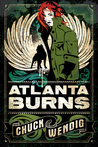
Review: Atlanta Burns

Atlanta Burns (Atlanta Burns #1-2)Atlanta Burns by Chuck Wendig

My rating: 3 of 5 stars

Atlanta Burns is what Veronica Mars would have been if, instead of growing up in sunny California with an understanding father, she’d been transplanted suddenly into “Pennsyltucky”—the rural/backwoods center of Pennsylvania—with an impoverished lost-soul mother and no one to fall back on. Atlanta Burns is Veronica Mars with red hair, a cut lip, dirt all over her face, and the vocabulary your momma wouldn’t approve of.

The story is good, but rough, hard to take. Atlanta is still recovering from the sexual assault she suffered at the hands of her mother’s boyfriend, and her unwanted legendary status she earned with a well-placed shotgun hit to his bait-and-tackle. It is in part because of this reputation, however, that she attracts the downtrodden, the friendless, and begins to help them fight back, too.

The only thing you can really say Atlanta has going for her is grit. She’s not always the smartest girl; she’s into way more drugs than I am even familiar with, often in tandem; she makes really shitty decisions and has a hard time remembering who her friends are. But she doesn’t give up, doesn’t back down, even as she stumbles into bigger and greater crimes against those who can’t fight back.

Chuck Wendig spins a good story, but I think he inserts a little bit too much of himself sometimes, making his agenda too clear and creating a gap in the fourth wall, like when his drug-dealing lowlife happens to be a frequent reader of Margaret Atwood. I don’t disagree with his message, and, true, it’s one of these clear agenda items that makes up the overall story arch, but there were times it drew me out of the story and had me rolling my eyes.

Overall, Wendig does good work here: it doesn’t always get better. Sometimes the bad guys are too big to fight. Sometimes you’re the dog in the ring, just having to fight to survive. It’s a good story, with a hard message to swallow, but it’s a bit too gritty and intense for me. Tread carefully, readers; this is a solid book but you’re going to need a steel stomach to get through it.

View all my reviews

Leave a comment

Filed under Reading, Reviews

Review: The Martian

The MartianThe Martian by Andy Weir

My rating: 5 of 5 stars

The Martian is a gem, an instant science-fiction classic that will blow your mind and make you long for (and fear) space travel. If this book (and its soon-to-be-produced movie) isn’t enough to reignite interest in NASA’s Mars mission, I don’t know what will.

The plot is simple: Mars astronaut Mark Watney is left behind on Mars after an accident; he is on his own to survive until NASA can figure out a way to pick him up…years later.

What’s particularly amazing is that with any other author, this book could have been an exhausting, emotionally-draining beat-down. It could have focused on how much it would suck to be totally alone on Mars; Watney could have spent the whole book being a pathetic, barely-surviving drag.

But “The Martian” is surprisingly funny, the kind of funny that means you’ll be laughing aloud and poking your spouse to share it with him. Watney is completely sarcastic, a naturally buoyant personality who, when faced with adversity, says, This is going to suck, but I am going to survive, damnit.
And then he’ll name rock formations on Mars after himself and declare himself King of Mars. And maybe institute worship of duct tape.

Another way this book distinguishes itself from pretty much all fiction is how clearly it was written by a science- and math-inclined mind. Author Andy Weir saves the reader from all the equations, but it is no less clear that there is intense math right under the surface; he even provides the variables used, in case another math-inclined person wants to try to figure it out, too. Most science-fiction, it need not be said, is more of the fiction, less of the science. But Weir is a world-class nerd of the best kind, and the hard science backbone to “The Martian” is what makes it so utterly believable.

“The Martian” is an outstanding book. What may make it truly great is its ability to transcend normal book-readers and reach those who care about hard numbers, math, and science, as well as those who could use a good laugh. It’s first-class writing that makes me believe we can send a man to Mars (but hopefully not leave him there).

View all my reviews

Leave a comment

Filed under Reading, Reviews, Science

Review: Bossypants

BossypantsBossypants by Tina Fey

My rating: 4 of 5 stars

I’m late to the Bossypants party, but luckily Tina Fey knows how to keep the party thumpin’. Bossypants is hilarious, smart, and deeply insightful. But mostly it’s hilarious.

Bossypants is less a biography and more a brilliant stream-of-consciousness into the life of Hollywood-stomping Fey. It’s loosely organized by periods in her life, with a brief bit on her childhood, including irreverent stories about who she met on the first day of school, all the way up into her ongoing surprise that “30 Rock” turned out to be a sleeper hit. She’s humble about her achievements, making Fey seem even more like the person you’d most like to have a beer with. This sounds stupid, but she really is “just like everyone else,” and it seems that maybe a little of that midwestern awareness of the ridiculousness of NYC culture/TV writing insanity is what makes her brand of humor so fresh and entertaining. She’s the girl next door who makes you laugh so hard you nearly pee.

But just because it’s funny—and it IS funny, the kind of funny that’ll have you tapping your husband on the shoulder at midnight to read “just one more line” aloud—doesn’t mean this is an idle book. Fey wraps her humor around sometimes biting criticism, particularly about gender roles. She’s a feminist icon for a reason, and she’s very aware of the limitations (and benefits) of being a woman who is also funny.

The only criticism I have is that I wish there were more, particularly about the writing process for “Mean Girls,” the smash-success movie about teenage girls’ social structure that has, for me at least, left lasting ripples. There’s a scant reference to it, with a lot more time devoted to “30 Rock,” which I have been negligent about seeing (I’ll be fixing that soon).
More, Ms. Fey, always more. I love you and can’t wait for more.

View all my reviews

2 Comments

Filed under Reading, Reviews

Review: America in So Many Words

America in So Many Words: Words That Have Shaped AmericaAmerica in So Many Words: Words That Have Shaped America by Allan Metcalf

My rating: 4 of 5 stars

A book for word nerds if there ever was one! America in So Many Words is a marvelous diversion for those who love both history and language. It examines particularly American words and phrases from the colonies’ founding up through 1998, explaining a bit of etymology, usage, and sometimes an example of it in original writing. It is extensively researched and just downright delightful. It even features two appendices, one organized by year and one by word.(Ex. 1998’s word is “millennium bug,” even though it probably should have been the much-catchier “Y2K bug.” But it had enough foresight to explain the term two years early!)
I’m marking this book as “read” even though it’s actually a work-in-progress. It’s just not a book you’re going to sit down and read straight through in one sitting. It reads like a cross between an encyclopedia and a dictionary, except you’ve probably never chuckled or said “ah ha!” from either one as much as you will with this book. I’m keeping it in my bathroom, to be honest, because one to two entries provide more diversion than any magazine could, with the added bonus of making that time educational and productive.
Though you may prefer to put it on your desk, I do recommend American language-lovers at least page through it. It’s been my go-to source for watercooler conversation and “did you know” questions. If you even think you may be intrigued by the true origins of “hot dog” or the critical place the phrase “log cabin” has in the American presidency, you’ll need this book in your collection.

View all my reviews

Leave a comment

Filed under Reading

Review: The Hobbit

The Hobbit (Middle-Earth Universe)The Hobbit by J.R.R. Tolkien

My rating: 4 of 5 stars

I first read The Hobbit when I was in third grade (it took me the entire school year to get through The Lord of the Rings), but I haven’t reread it since. It was good to look at it fresh, with almost-new perspective (I admit, my view was slightly tainted by the Peter Jackson movies).
What I found was delightful storytelling, a really long hike, memorable characters…and sloppy or abbreviated action and a lot of out-of-nowhere problems and solutions. The deus ex machina really went wild for this book!

In case you’ve been living in a hole (hobbit or otherwise), The Hobbit is the prequel to J.R.R. Tolkien’s The Lord of the Rings trilogy. It features hobbit Bilbo Baggins, a comfortable chap who gets roped into a burglary quest for dwarven treasure guarded by the fierce dragon Smaug. He and his 13 dwarven companions (and occasional wizard friend Gandalf) undergo many trials just to get to the Lonely Mountain, and many more trying to get the gold and secure their victory. It’s particularly important in that it describes how the One Ring comes to Bilbo Baggins’ ownership, setting his nephew Frodo Baggins on his path in the subsequent books.

I know that pointing out some weaknesses in the story seems like blasphemy for a lot of people in the fantasy realm, or even loosely on the fantasy realm, but I’m just not sure The Hobbit held up compared to my idea of what The Hobbit was. I hadn’t remembered most of the end of the book, and I think there’s a good reason: the Battle of the Five Armies is just a handful of pages with little description, there are super-magical creatures coming out of nowhere to save the heroes, and then an overly detailed recap of a walk back that doesn’t really amount to anything. I thought I remembered a story with a lot more Smaug dragon awesomeness, but was disappointed to see that much of the action with Smaug is fairly minimal: it’s a lot of the dwarves or Bilbo guessing at what the dragon is doing while they cower in a dark tunnel.

In short, I can see why Peter Jackson felt the need to diverge from the source: it would have made a terrible movie (here are the dwarves, hiding in a cave. Meanwhile at Laketown, some guy you’ve never seen before is trying to be brave. Also, did you know there are talking crows?!)

It often seems like Tolkien didn’t know what he wanted to do with the story, or had written himself into a corner, so he just tossed in some other element and hoped it worked out. And it does, sort of, but when it happens again and again and again… it seems less convincing. Comparing the troll scene in the beginning of the book with the Battle of the Five Armies at the end–which ought to be much more epic and thus detailed–they are about the same descriptively. While the foundation is there, much of the major things are left entirely to the reader. (It’s odd, actually, what is described in detail and what is brushed over. War buffs need to look elsewhere for their reenactments, but if you want to know the full contents of a hobbit’s larder, you’re in the right place.) And, of course, if you’re in a tight spot, the Eagles will probably be along shortly.

Another flaw the movies tried to amend is the complete and utter lack of female characters. I think the only time women were even mentioned were in crowd scenes, mostly involving the desolation of Laketown. Oh good, they’re cowering in boats…. do women have nothing at all to contribute? I remember this bothered me even as a kid. Obviously The Hobbit was written in a different era, but it does make it a smidgeon harder to swallow as a modern reader.

I still very much enjoy this story. I miss this kind of narration style, where the author frequently interjects, speaking directly to the reader about things that have happened or will. It’s charming. Let’s bring that back. It makes it seem most like a story that needs to be read aloud over many dark nights next to a fire. Perhaps in the flickering flames, the listeners can better imagine the gold reflecting off a dragon’s hoard, or relate to the anxiety caused by a long trip far from home. Maybe those listeners will be able to feel more fond of this fantasy classic, unclouded with concerns about the structural issues.

Still, I don’t regret heading there and back again.

View all my reviews

Leave a comment

Filed under Reviews

Review: I Am Jackie Robinson

I am Jackie RobinsonI am Jackie Robinson by Brad Meltzer

My rating: 5 of 5 stars

If you have kids, or love history, or just love great books, you need to read all of Brad Meltzer’s “I Am…”/Ordinary People Change the World books. It won’t take you long, and it’s so worth it.

I bought “I Am Jackie Robinson” and “I Am Abraham Lincoln” as gifts for a baby shower, but I’m one of those people that reads anything she can get her hands on, so upon picking them up I immediately read them. They are powerful, colorful, accessible, historically accurate (works cited at the end, even!), and inspiring.

Each book features an American hero telling their life story from their perspective. The hero is drawn as a little-kid version of themselves, even as the people they interact with move from children to adults. In addition to the more serious story type, characters talk with each other through cartoon bubbles, leading to both poignant and funny details that would be fun for a kid to read aloud while a parent/friend reads the main text.

The hero talks about an experience he/she had as a child (in Jackie’s case, not being allowed to swim in the local pool because he was black; for Lincoln, it was kids abusing a turtle) that has resonance in their later life. Jackie’s sense of injustice helped him learn to be brave, the character value that “I Am Jackie Robinson” teaches; Abraham Lincoln learned to use his voice to have an impact.

Out of these two books, I most enjoyed the Jackie Robinson book. It does nothing to diminish the difficulty of discrimination; in fact, it will be a good vehicle for modern kids to understand the unfairness of segregation. Jackie’s sadness grabbed my heart and twisted; I cried a little at the end of the story.

Maybe Jackie’s story was just particularly powerful for me because of a small amount of family history: my grandfather met Jackie while Jackie was playing college ball. He tells the story like it was no big deal at all–my Pop was more interested in the ballfield owners’ daughter–but it’s a connection to the past that makes him more important in my mind. And his courage and resilience–as well his athletic excellence!–are just undeniable.

I look forward to buying more of these books for all the kids in my life, and I hope you’ll read and share them with a young (or old!) reader in your house, too.

View all my reviews


And then I got to meet Brad Meltzer! He’s on tour for his new book, President’s Shadow. We picked up a copy and I’m really excited to read it, but my husband called dibs. That’s fair, he “discovered” Meltzer for our household. Meltzer was incredibly nice, gregarious, and full of incredible facts. He seems like he’d make a great drinking buddy!

Meeting Brad Meltzer

I’m making my “OMG I’ve just met Brad Meltzer” face; he’s making the “OMG a reader” face!

2 Comments

Filed under Reviews

How NOT to Deal With a Bad Review

Being an author comes with a lot of challenges, but one of the hardest may be managing our own egos. Namely, having the restraint to accept that bad reviews will happen, and the wherewithal to keep yourself from trying to argue.

Because every once in awhile an author comes along, and does that, and serves as a horrific example of what can happen.

It’s like watching a train wreck sliding into the Titanic at the instant it impacts an iceberg. It’s painful to watch but you are so struck that it still is happening that you can’t look away.

His first response to the negative review (which, remember, on Goodreads means “didn’t like it,” not “literally the worst”):

“This review is not good for my business, so unless your desire is to ruin my dreams, it would mean a great deal if you could remove this review from my work and forget about it. But if it’s your desire to hurt me financially and ruin my business, then it’s understandable why you would post such a harmful review.”

In addition to responding to the review at all, this guy really screws up when he implies that this person’s review was posted out of “desire to hurt [him] financially.” What? One bad review certainly won’t be your ruin. But he’s not done. The reviewer politely responded (more politely than I would have) and explained she would not be removing her review, as is her right, and went so far as to compliment aspects of his book. But he came back again:

“Leaving a 1 star review on a book says much more about what kind of person does such a thing, and then attacks it for being “pretentious,” which is an erroneous statement that is defamation at best.”

And then it goes steeply downhill from there. Let’s be clear: a review is about the content, not the author. I mean, no one is leaving a review to just be hurtful to some stranger they’ve never met. I review every book I read; all that says about me as a person is that I read a lot, and that I like to give reviews about it. There’s no moral judgement. Also this guy has no idea what “defamation” is (hint: 100% totally not that).

This schmuck just can’t stop digging a hole, though. He goes on, for another 11 posts, with his rants getting more and more loopy. Worse, he seems to make a bit of a habit of doing this. And may have scared of this (and who knows how many other) readers from ever trying out a new, indie author. That’s just unfortunate.

Now, I commiserate with the author a smidge; I had one one-star review show up on Goodreads. It didn’t even have a review for me to nit-pick and pout over, but it had been created at the same time as like 37 other reviews. I ranted to my husband for 20 minutes, then I closed the page and went to bed and didn’t think about it anymore. And you know what? The next morning, I had two 5-star reviews.

The winds of popularity can change that fast, which is why it’s important to keep perspective. A negative review isn’t the end of the world. And even if it was disastrous for your book, remember, even failure has its values.

But there isn’t anything to be gained from acting out. In fact, it looks like this particular author’s rant lowered his Goodreads rating from a solid 4 stars to a dismal 2 (and falling) in less than two days.

This is one of those lessons it’s good to learn from watching someone else go through it.

Don’t make this guy’s mistake; have some dignity and leave reviews—especially bad ones—alone.

3 Comments

Filed under Publishing, writing

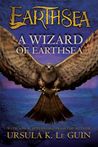
Review: A Wizard of Earthsea

A Wizard of Earthsea (Earthsea Cycle, #1)A Wizard of Earthsea by Ursula K. Le Guin

My rating: 2 of 5 stars

This classic fantasy novel, written in 1967 by one of the world’s top sci-fi/fantasy authors… just didn’t grab me. It’s well-composed, with a nicely fleshed-out world and an interesting power structure for the wizards and some cultural details, but the story of the Sparrowhawk’s beginnings left me wondering, “so why should I care?”
I think I’m ruined for this book by the Harry Potter era. It’s just hard to get attached to a boy wizard in this style, after I’ve gotten accustomed to the very feelings, friendships, and trials of a different, more relatable wizard. The whole “true name” thing may have been a cool storytelling concept, but it just serves as one more layer between the reader and the character–what’s his name again? (The main character has no less than three different names throughout the book!). It’s also told in a rather detached third-person; we only vaguely get a sense of Sparrowhawk/Ged’s feelings at any given time, and we are invited not to feel with him but to watch as he fumbles around. Throw in the jumpy time setting (following not a calendar but whenever the action seems likely to hit) and you’ve got a story I just never felt comfortable in.
I finished the book for the lessons of the craft I could learn, not from any deep affinity for it. In fact, I found the author’s afterward far, far more compelling and approachable than the rest of the story–I’d have rated THAT 5-stars!
Maybe it’s me. Maybe it’s just that this book had its heyday in a different time, in a very different genre fiction landscape. It’s certainly not LeGuin’s fault; she’s a beautiful, if impassive, author who has my utmost respect. But I’m not sure I’ll bother picking up the rest of the series.

View all my reviews

2 Comments

Filed under Reviews