Tag Archives: publishing

Enter to Win a Pitch Critique

I just got an email about this–the NaNoWriMo Pitchapalooza. It’s a quick contest (partially luck) to get your book pitch reviewed by “The Book Doctors,” to have it improved online as an example of what makes a good pitch, and then to possibly get a personal introduction to an editor in the genre of your book. Past winners are now published, which is incredible!

It’s almost over, so enter soon! Just check it out here.

I’ve not used them personally, but they have really informative emails and seem to have a great track record. And really, why not enter? You could win!


Leave a comment

Filed under Publishing

As If It Never Was: What Happens to Writing on the Internet?

We tend to act like once something it put on the internet, it is there forever (and in some cases–most often things we wish weren’t around forever, it seems to be).

But the truth is, online writing is far more erasable and intangible than most other generations of the written word. An article published recently, All My Blogs Are Dead, explains what it can really be like, particularly if you write for other people.

In the article, the blogger explains that he’s written more than 2,000 blog posts since 2009… but there’s no evidence of them at all. The sites he wrote for, in a string of freelance positions, have all ceased to exist or were purposely overwritten. Poof. There went his whole career and all the examples of his work.

When I was in college, the internet was just really starting to take hold and make its presence known. Professors were distressed by the idea that a story might never actually be put on physical paper. Our clipbooks–compendiums of our work used to earn our final grade–had to be painstakingly cut out of the print newspapers and glued in for final presentations. No internet print-outs were acceptable. (I wonder what they have them do now; they’ve switched the school to internet-first publishing…) We were advised to save the URL of any articles we wrote, as well as the HTML, so at least we’d have proof that we published something, somewhere.

I’ve since switched overwhelmingly to PDFs when I want to document work I’ve done for a blog or site or other internet project, but it’s still distressing to think that my work could be so thoroughly wiped from existence. I imagine I’d have to do the same with any fiction work. (I wonder, would I need to print that out, too?)

Bloggers in particular are susceptible to this problem: if you stop paying for your blog space, stop updating for a long time, your blog could just vanish into the void. I know I’m not backing up each post as I go…what would happen to all that writing?

Do you think about this kind of problem? What do you do to protect the longevity of your work?

Leave a comment

Filed under Publishing, writing

Writing Despite The Bills

A recent piece on Salon highlighted one of the murky secrets of the writing life: who is paying the bills?

The piece, provocatively titled “‘Sponsored’ by my husband” (and the response “The price I pay to write“) discusses one of the topics a Southerner just isn’t supposed to discuss: finances. The first discusses how hard it was to try to have a regular life while also writing; the author is only able to currently manage hers because she married someone whose salary is “hefty.” The second piece has an infatuation with the HBO show girls but at least is taking a crack at working 9-to-5 while also being a writer.

But the nitty-gritty is one of the cruxes of a writing career: you still need something to eat, somewhere to sleep, and probably (at least in America) health care of some kind. Where ya gonna get that?

In the first article, Ann Bauer points out that several authors recently published talk like they’ve done it all themselves but really benefited either from inherited money or deep familial connections.

I practically swooned with jealousy: undeniably, both would help me a great deal. Particularly the connections—since getting an agent/publisher/people with purse strings to pay attention to you is the first obstacle to publication.

But the “having enough money to live off of” is a huge component, too. I talked about this when Hugh Howey, of Wool fame, first hit the radar. Yes he worked hard, yes he is more workaday than a millionaire, but he also had a wife who was mostly able to support them while he took a low-paying part-time bookselling job to give himself time to write. That is a huge luxury (and, luckily for them, it paid off big time.).

At conferences and online, I see a lot more of the kind of writer I am: fitting writing around everything else. And that kind of juggling is trying, at times. I have a full-time job, a spouse with a job he finds rewarding but which won’t pay the bills alone, a part-time career as a freelance editor, AND I have written three books I’m working on getting published. I’ve said it before: how exactly am I supposed to do those things and actually have a life of any kind? It feels overwhelming.

(Side note: I think a bunch of people who cater to authors are taking advantage, selling “must-have” products that “guarantee” success. They disgust me; I hope the people buying those products are independently wealthy.)

However, I have made my choice in how to get money to live while also being a writer. While, sure, I’d love to win the lottery next month or something, I don’t think I’d ever feel comfortable being “sponsored” by my husband or another patron; we are partners, and it is my responsibility to carry my weight in our relationship, financially, in the household, and otherwise. One of the main reasons I have an editing side business is that I can feel confident using the resulting income to pay for resources in my own publishing dreams (also, it is SUCH a kick to see a book I’ve edited actually go on sale. Some have even won wards!).

For me, the juggling is worth it, even if it’s challenging at times. I need to feel like I’m helping my family forward, even if that means my books don’t churn out as quickly. That’s a choice I’ve made.

What about you? How do you manage your household while writing? Do you wish you could do it differently?

Leave a comment

Filed under Publishing, writing

Something’s Hinky About The “New” Book by Harper Lee

To kill a mockingbird

Like everyone with a soul and a 4th-grade reading level, I love Harper Lee’s iconic book To Kill a Mockingbird. It’s a classic for good reason.

But I just can’t jump on the enthusiasm train for the news that HarperCollins will soon be publishing a “long lost” sequel.

Harper Lee is a notoriously private author, the exceptional writer who resisted publishing any further Mockingbird spinoffs for 50 years. What changed?

I’m not the only one to feel suspicious: some journalists have been digging up dirt and connecting the dots. Dots like the death of Lee’s sister and estate-guardian only three months ago, and Lee’s forgetfulness and confusion following a stroke in 2007.

You can read the article here.

I hope I’m wrong, but my gut feeling is this is a money grab that may harm the legacy of one of the most beloved American authors of all time.

I won’t be preordering.

Leave a comment

Filed under Publishing, Reading

Authors, Stop Your Blogging

It’s that time of year where everything is fresh and cold and you think, “yes, this time I shall do it! Really!”
Well, authors, allow me to help you strike something off your list of intended resolutions: forget about blogging.
Maybe it seems disingenuous for me–who has had this blog for over two years, with two posts minimum a week–to say that. But I’m just trying to keep you from the treacherous path I was put on. (Save yourselves!)
When I started this blog, it was partially because I liked the habit of it and wanted a place to say things. But it was ALSO because everyone at the time, via other blogs, how-to-get-published books, authors on Twitter, and people I met at conferences, everyone said a blog was essential for a writer wanting to be published.
Why? To “gain a following” and “demonstrate your niche.”
Frankly, that honestly isn’t that good a reason to start a blog. So I’m going to talk you out of it.
Reasons You Should Not Blog
1. It’s hard. Particularly if you’re the kind of person who is frequently setting resolutions and then abandoning them. The number one thing about a blog is consistency: posting regularly, preferably about your niche subject matter. And that, honestly, is hard to do. Ostensibly this blog was supposed to be focused on finding the audience who would be into choose-your-own-adventure zombie novels for adults. I don’t know about you, but I have limited interest and motivation in spending all my time coming up with CYOA/zombie posts.
2. You can’t let up. You’ve got to write stuff all the time. Something big happening at work? You can’t stop blogging. Got married and left the country for more than a week? Better work extra hard so you have posts happen while you’re not there. Having a bad day? Suck it up, cupcake, and write another blog post.
It’s like resolving to go to the gym, every week. Ok, sure; you can probably do it for awhile, but eventually, it’s going to get hard…then what?
3. No one wants to read your stories. I know, I know; you want to disregard this because people WILL want to read your stories when they discover how BRILLIANT you are. Maybe so. It’s certainly happened before. But a lot more aspiring authors put out works that a) they’d rather sell for money rather than giving it away for free or b) aren’t really finished or polished yet. You just shoot yourself in the foot with the first and you can lose credibility with the second. By and large, people who are browsing stuff online are looking for something to help them–why should they want to help you?
4. You’d rather work on the stuff you want to get formally published. If you don’t want to blog…don’t blog! You’ll have more time and more creative energy for the stuff you really want to work on.
5. It won’t get you a platform/audience. Admittedly, it has happened sometimes. But from what I can see, the authors for whom blogging created a platform already had things published.* Rather than being a place to gather a prospective audience, the blog becomes a place for the existing audience to congregate. That’s a big difference. *Exception: Food blogs. Man, I’ve seen more food blogs become cookbooks than anything else. That seems to be a recipe for success (har har). However, that’s also a ridiculously crowded marketplace, so you have to really stand out.
Now, if you still want to blog after all that…go ahead. It can be fun. It can be nice to communicate with other authors, to push the boundaries of your abilities, to have physical proof that you’ve been doing something productive. Just don’t believe a lot of the notions put out there as “must dos.”
The worst thing you could do, really, is to start a blog… and then peter out, leaving it to die on the vine, forgotten but still ranking high on Google for your pen name. So if you start a blog and decide it’s not working as you wish, be sure to close it out, too.
Good luck in 2015.

Leave a comment

Filed under Publishing, writing

Which Way to the Ladies’ Library? Turns Out Even Reading Is Gendered

Book-reading cataloguer Goodreads made some waves when they recently released a study about the gender of a reader compared to the gender of the authors they typically read.

Lots of good data to chew on there: men and women read about the same number of books, collectively rate their Goodreads books at an average of 3.94, women read a lot more new fiction, and men write a lot more really long fiction (500+ pages).

Here’s a stat I stumbled over, though: in the first year of publication, 80% of a female author’s audience will be women; 50% of a male author’s audience will be women. Interesting….

Women authors’ books were also rated, on average, a teensy bit higher than male authored books (just by 0.1, though).

But the 50 most-read books for each gender fall on starkly gendered lines: Of the 50 books published in 2014 that were most read by men, 45 are written by men. Of the 50 books published in 2014 that were most read by women, 45 (46 if you count stealth J.K. Rowling, which you should) were written by women.

That’s the odd one, to me.

A lot of commenters jumped in with “well I never pick a book based on the author.” Assuming that is true, what may be going on here? I’m guessing there are quite a few factors:

  • gendered genre: it’s pretty well-understood that certain genres traditionally tilt to one gender or the other–romance is heavily read and written by women, while “literary” fiction and science fiction both heavily favor men. It stands to reason that these topics would pull the average one way or another.
  • cover design: there’s been some funny/interesting looks lately at the way a book cover is gendered when it goes through a publisher. This is intentional; they’re trying to attract an audience, so they market the book–typically by old and stereotypical methods–to whomever they think it will appeal to. But that also means that a book that both genders really may enjoy equally could get shunted in one direction or the other just because of which photo someone decided to put on the cover. Lots to think about there.
  • the “Oprah effect”: book clubs. From what I can tell, book clubs are overwhelmingly female, tend to pick new authors, and follow recommendations from talk show hosts like Oprah in order to find their next “it” topic. This may be having a powerful effect. (Sue Monk Kidd has said book clubs were the driving force behind her book, The Secret Life of Bees, becoming a best-seller.) The downside may be that book clubs try to pick a certain kind of book…most authors may not be able to harvest the “Oprah effect.”
  • maybe people really do like reading someone of their own gender; maybe they are, even subconsciously, actively selecting for a gendered read.

Personally, I find this kind of breakdown fascinating…and a little scary. I want to read a variety of backgrounds, so sometimes I do actively try to mix up my reading list and get a different genre, gender of author, etc. But there are times I’ve noticed that I’ve read a lot of books written by, say, white males in the 1950s. That’s not a bad thing, but it probably is flavoring my tastes and my writing voice.

But it also worries me as a writer: I’m interested in sci-fi–the male-dominated genre unpopular with book clubs. Uh-oh.

What do you think about the “gendering” of books? Is it an issue at all? Is it surprising?

2 Comments

Filed under Reading, writing

Will You NaNoWriMo?

I’m an ardent fan of NaNoWriMo, or National Novel Writing Month. The website and community offers an incredible motivation to writers of all kinds to stop talking about writing a novel and just sitting down and actually doing it. I love getting their pep talks in my inbox (here’s one of my absolute favorites, from Lemony Snicket), I love the word count tools to track my progress, and I love the way it gets everyone excited about writing!

But…I’m not sure I can participate this year. I’ve competed as a writer twice, and one year used the motivation as incentive to finish editing a novel that had been collecting dust. I’m so proud of those finished works, even while I figure out what to do next in publishing them. But I’ve got more of “real life” on my plate this year, between work things, family things, editing projects, and trying to keep myself in balance. I’m not sure I can push any of those other things off, to wait for a month, like I’ve been able to in the past.

I’m not going to step away from NaNo completely; like I said, I love it to bits and I think it provides more motivation in a month than I can generate in a year. So I’m going to try to compromise: I won’t officially take on the challenge this year, but I am going to try to use my spare time well, writing what I can when I’m able and otherwise trying to push forward on Undead Rising.

Because, even though I forget sometimes, NaNoWriMo isn’t the only time I can write a novel. I can write all year: I just have to make it a priority.

Will you be participating this year? What are your obstacles and how will you try to overcome or manage them?

4 Comments

Filed under writing

Editing Quick Hit: How Many Sentences to a Paragraph?

What I tell you next is going to make some English teachers hate me, but it will make you a better writer, so I’m willing to risk it: You’re doing paragraphs wrong.

In third grade, you were probably taught that a paragraph was required to be three to five sentences long. If your paragraphs were NOT sufficiently long–or, heaven forbid!–were longer than five sentences, no smiley face stamp for you!

And then the internet came along and writers started chucking paragraphs right out the window. In fact, it’s practically blogging 101: keep it short, stupid. (Even me! Look at all these paragraphs! So short!)

Between these two influences, some writers have given up on having paragraphs at all, cleaving to just one or two sentences jammed together.

And it’s deplorable.

Look, blogging is one thing, but a blog is not a book, nor should it be (if I can get the exact same information out of reading one blog that I can get out of reading your whole multi-chapter book, the world doesn’t need your book).

Paragraphs are there to help the reader decipher your text. The line breaks make it easier to read. (Ease of reading is exactly why bloggers are told to keep it short. The sans-serif typeface used on most internet sites is a bit harder to read when grouped together, plus you’ve got the backlighting on the screen adding strain, too.)

But paragraphs are also a tool used to show what parts go together.

Let me give an example, with every sentence given its own line:

Bob the butterfly loved to dither in the field of flowers.

Being a butterfly, he didn’t have many cares in the world, but he was absolutely fascinated by the myriad colors, smells and delightful flavors.

He flew from one flower to the next, lost in a whirl of enthusiasm.

His attention span was short–he didn’t have much of a brain, if you could even call it that–and so was quick to taste, then fly to the next, on and on.

But he could have been paying more attention.

While he was busy drinking nectar from the One-Eyed Susan, a sparrow zoomed down and ate him.

That kind of reads like a poem, doesn’t it? Which is great, if that’s what you’re going for. But if you’re writing prose, it is more commonly formatted like this:

Bob the butterfly loved to dither in the field of flowers. Being a butterfly, he didn’t have many cares in the world, but he was absolutely fascinated by the myriad colors, smells and delightful flavors. He flew from one flower to the next, lost in a whirl of enthusiasm. His attention span was short–he didn’t have much of a brain, if you could even call it that–and so was quick to taste, then fly to the next, on and on. But he could have been paying more attention. While he was busy drinking nectar from the One-Eyed Susan, a sparrow zoomed down and ate him.

A punchy little narrative, perhaps a fable, in six sentences.  But there are other ways to format it, too, which may be even more powerful:

Bob the butterfly loved to dither in the field of flowers. Being a butterfly, he didn’t have many cares in the world, but he was absolutely fascinated by the myriad colors, smells and delightful flavors. He flew from one flower to the next, lost in a whirl of enthusiasm. His attention span was short–he didn’t have much of a brain, if you could even call it that–and so was quick to taste, then fly to the next, on and on. But he could have been paying more attention.

While he was busy drinking nectar from the One-Eyed Susan, a sparrow zoomed down and ate him.

The separation between the paragraph and the surprise ending in the last line gives the reader a moment of pause, and can heighten the zing.

So–how long should your paragraphs be?

As long as they need to be.

I know, radical! Throw out the rulebooks and use your well-honed subjective judgement–but be prepared to defend your reasoning if someone challenges you. Why do you want it that way? If you don’t know, or are falling back on old rules, you may want to rethink your formatting.

**Special note: In my opinion, you get less opportunity to be loosey-goosey about paragraphs when it’s in dialogue, but I think the misunderstanding comes from the same place. Here’s the rule for dialogue: If it is all being spoken at once, by the same speaker, 9/10 you need it to be all in the same paragraph. If someone is giving a speech, it’s perfectly fine to create a big ol’ text wall. Breaking it into chunks, particularly in a back-and-forth conversation, can create gads of confusion for the reader.

(If you really want to break it into chunks, the natural place would be whenever commentary is added, such as “he shuffled his feet awkwardly” or “she giggled” or “The cat did not care an ounce for the story, but tolerated it nonetheless.” In other words, stuff that’s related to the dialogue but isn’t actually being said aloud.)

2 Comments

Filed under Editing

Published Young: Famous Folks Published Before They Turned 25

If you want to feel bad about yourself today, take a moment to read through this list of people who published great works of fiction before they turned 25.

Though it doesn’t always include the masterworks people eventually became famous for, this list is long enough and covers enough people you were forced to read about in school to make you feel a bit off about yourself. For example, both Mr. and Mrs. Shelley–of Frankenstein and Queen Mab lore–F. Scott Fitzgerald, Truman Capote, Brett Easton Ellis, Michael Chabon, Norman Mailer, Jane Austen, Gore Vidal, and more that I hadn’t heard of previously.

While it’s important, and in some ways helpful, to remember that youth does not have to be an impediment to success–that it can be the fire that burns the writer on to greatness–don’t beat yourself up too much if you’re older than 25 and still haven’t published or made it big yet. Remember, you’re the majority.

Plus, a lot of those folks didn’t live that long, anyway: Percy Bysshe Shelley got to be 29; Mary Shelley only hit 54; F. Scott Fitzgerald scraped by to 44; and Austen only cracked 42. Read a different way, they got published only at the middle of their lives.

Here’s to many more birthdays!

Leave a comment

Filed under Publishing, writing

Gardening Your Words

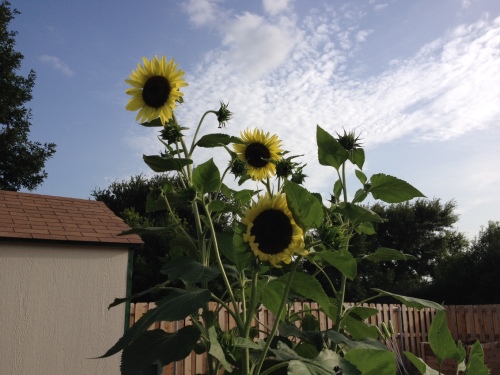
sunflowers

I have a plot at a community garden (though the garden journal-ing hasn’t been going too well lately), and it makes me contemplative. Gardening has been used as an allegory for so many things–not that it’s surprising, with growing our own food being so important through most of civilization. So here’s my allegory: Gardening as the publishing process.

  • Gardens start with relatively few raw materials: you’ve got good dirt, a spot with sun, some seeds and some water. Hopefully you’ve got a trowel.
    • Similarly, it takes relatively little in “things” to start writing. You need a computer or just a paper and pen. Maybe a good “writing chair,” if you’re lucky.
  • The beginning of a garden is full of mystery. You stick some seeds in the ground and water them, but nothing happens. You just hope that they’ll grow. And for days–if not weeks–nothing seems to be happening. You just have to keep showing up, watering and checking for weeds, and hope that the seeds you planted weren’t duds. I found this incredibly frustrating. What were they doing down there?! Other people started their plots with starter-plants bought from the garden center, but sunflowers have to come from seed. And it looked, for at least 2 and a half weeks, like nothing was going to come from it.
    • We don’t know the outcomes when we write. First, we face that terror of the blank page. Then, even if we manage to fill it, we don’t know if it’s any good, or if we’ll get anything out of it. It’s all a big gamble at first, then a lot of waiting. Being a writer of any kind takes simultaneous constant work and patience.
  • Without warning, though, things just start to grow. The little heads of my sunflowers were just the tiniest little hints of green one day, and by the end of the week they were over two feet tall. By the time they were fully grown, they were taller than me and had flowers the size of saucers (see photo above!). But not everything in my garden grew evenly, and other people had a lot more produce than I did. All season, I’ve produced a total of three tomatoes! Little ones!
    • Comparing yourself to others is natural, but it doesn’t always help. Sure, I only have three tomatoes, but I had killer sunflowers that no one else could boast. The same is with my writing; I’m strong in some areas where others may be weak. Even though we’re doing the same things, we have different strengths.
  • Things outside of your control can have a big effect on your outcomes. In the garden, that was a sudden and devastating infestation of squash bugs. No matter what we did to squash them or spray them or make our plots seem unappealing, they proliferated. Everyone in the garden was forced to pull out every squash plant. I even had to sacrifice my cucumber plant–the squash bugs didn’t know they weren’t supposed to like eating that, too.
    • You can do literally everything right and still not have success. I have a zombie book I think has great potential, but zombies are considered passe now; the trend-mobile has already moved on. Does that mean my book isn’t good or that I’m a bad writer? No, it just means there’s something else going on. (Besides, it doesn’t mean I have to tear it up forever. I’ve held on to it, and now maybe it’s time to publish after all.)
  • Gardening takes a lot of work that doesn’t look like work. I’ve been by every day this week: 100+ degree days are not good for growing vegetables, and it’s all I can do to keep my plot watered. But it doesn’t look like I’m doing much; all this watering doesn’t have a lot to show for it. Today I planted potatoes, and hauled two wheelbarrows full of fresh mulch into the bed. You can’t tell at all; it’s just more dirt.
    • Day-to-day, writing doesn’t look like much. It’s a lot of sitting behind a keyboard. It can be tough when someone says “so, what have you written?” and you know there is nothing you can point them to. But that doesn’t mean you haven’t been hard at work.

I’ve decided to think of my writing process as a garden: tend it well, and it will reap rewards…eventually. How do you think of your writing career? How do you keep yourself motivated?

1 Comment

Filed under Publishing, writing