Tag Archives: good fun books
A Book That Keeps On Giving
Filed under Uncategorized
A Year in Books
At the beginning of last year, I had just finished reading Stephen King’s On Writing, in which he, among other fascinating things, discusses how gargantuan of a reader he is. He said he read 80 books a year, easily, which I found mind-blowing.
I wanted to see how many books I could read this year. Thankfully, Goodreads has a Reading Challenge Widget, so this was easy (plus it reminded me to write a review after I read something).
I have a day job, a small business, a fiance and a small social life, in addition to any personal writing I want to get done, so King’s goal was stupidly out of reach. No, for me, I needed to lower that bar a little bit. So I picked a goal of 26 books, a book for every two weeks.
The other day, Goodreads let me know that I had met my goal! (Hey, Goodreads, the year isn’t actually over yet…?)
In 2013, I logged 27 books, and if I finish The Shipping News by the first, I’ll have 28 official books for the year. Of the 27 books logged in Goodreads, that is apparently 8,479 pages.
That’s pretty good! But it’s not actually the full picture. The Wool Omnibus would have otherwise counted as three novels (or novellas; I’m not sure how Goodreads makes that distinction). I also read two books for work that I didn’t log, because they were poorly written business aphorisms that I was forced to read and never want to acknowledge actually existed. Plus I read a sizable stack of comic books (Star Wars, four issues of the Avatar comic, and Saga. Go read Saga. It’s amazing.) and I felt like it was weird to log comic books because they are generally only 12 pages long (I finally included Saga in my reviews, sort of, after I had read the whole first collection, making it sort of book-length.)
That means, without changing my habits at all, I read about 35 books in a year (and that includes some stupidly thick books like Leviathan Wakes and The Forgotten Garden. Don’t read those if you’re going for a speed challenge, kids).
35 books a year? Not too shabby!
I really enjoyed logging my books. It’s a good way to reflect on what I’ve read and what it means to me, so I’ll definitely be participating in the reading challenge for next year. Let’s clock it at officially 30 books this year.
Will you join my reading challenge? How many books would you like to read in 2014?
Review: Wicked Plants
Wicked Plants: The Weed That Killed Lincoln’s Mother & Other Botanical Atrocities by Amy Stewart
My rating: 5 of 5 stars
I picked up Wicked Plants as a brain-break after NaNoWriMo, and it was a great decision!
It turns out much of the natural world is trying to kill us. This book will permanently banish the idea that “natural” means “good for you.” Plants are downright homicidal, and they’re quite creative with all the ways they are out to poke, poison, incapacitate, intoxicate, inflame, nauseate, and kill us.
While it’s not exactly written as a chapter book, I choose to read it straight through as if it were. It is organized loosely alphabetically by plant name, with occasional breaks for themed sections. While the named areas go into detail and history on one particular plant, the themed sections pile in a bunch of plants with only short descriptions. The inclusion of these “quick-hits” is fantastic, because you really get more information, but they are also what make this book useless as any identification guide.
The plants are labeled with markers like “illegal,” “dangerous,” “offensive,” “deadly,” and “intoxicating,” so you’ll know exactly what kind of trouble you’re getting yourself into. The information included is basic locational and taxonomical stuff, with anecdotes about people who were killed or drugged or in some way related to this plant (including the detail about Lincoln’s mother).
One of the added pluses for this book is the detailed and beautiful cover. It’s a hardback with old-book style, and really lights up your bookshelf. It comes with a ribbon bookmark sewn into the spine and a light gold shimmer on the light parts of the cover. The interior is just as lavish, with black-and-white etchings of the plants, just in case you really need to identify something, and morbid or garish illustrations of all the ways we’re going to be murdered by our flowering foe. The pages have a faux-aged patina that looks really great. This book is an attention-getter, for sure.
This book is a riot. It’s educational, beautiful, and fun. Triple-whammy. I’ll be dipping into it for trivia night for sure. Plus, any writer worth his salt needs this book; it’s chock-full of incredible, natural, believable ways to kill off your characters.
Filed under Reviews
Review: Zombies, Run! 5K Training
I typically exclusively review books, but…I’m gonna make an exception for Zombies, Run! Yeah, it’s an app, but it’s an app that tells a story — it just also happens to teach you how to get in shape and motivates you to run.
It turns out, someone yelling “zombies, run!” in your ear is powerful motivation to get running.
Zombies, Run! is an app for iPhone/iPod and Android devices. I, being a complete non-runner and couch-potato enthusiast, just finished with the beginner level, Zombies, Run! 5K Training. When I bought it, it was $2.99 — the best $2.99 I’ve ever spent.
Basically, it’s a interactive story, in that the voices in your head(phones) will tell you to do things and you’re expected to actually do them. In participating, you unlock more of the story. It’s great motivation if you a) like zombies, b) like British accents, c) have no idea how to run and d) are bored by normal workouts.
In other words, what’s not to love?
Zombies, Run! 5K Training begins when your helicopter crash-lands outside one of the few remaining human settlements. You’ve got to shuffle to the base before the zombs get you. From there, the doctor looks you over and breaks the news: everyone on the base has to earn their keep somehow. Luckily (or, unfortunately, depending on perspective) a slot among the runners has just opened up. Over the next 8 weeks, you will train 3x a week with the doctor until you’re in prime getting-supplies-and-fleeing-from-zombies condition.
Fun, yeah? It’s great. Zombies, Run! 5K Training has action, adventure, romance, tragedy, mystery and tons of humor. It’s so good, I started having dreams that the base needed me on the days I wasn’t running. I hate having to skip a day because I want to know what’s going to happen next.
If you think you have even an inkling that you might like learning how to run while hearing a zombie story, download it. Right now. You won’t regret it.
—–
Now, because I was a total newbie to all things running, I screwed up a couple of times. I’ve made notes that might help someone else. Learn from my mistakes, people!
- Don’t try to run when the temperature is over 105 degrees.
I didn’t finish the program in 2 months, as scheduled, because Texas summers are so hot you feel like dying every time you inhale. I had to take a break for a few weeks to let things cool down, totally throwing off my momentum. - Buy some cheap athletic clothes.
When I first started, I had the attitude “I’m just going to sweat in it, who cares what it looks like?” Well, it turns out that stuff made for running is actually more comfortable to run in. Who knew, right? Besides, if you only have one shirt, you are not going to want to put it on by the third workout after it’s been twice christened by sweat. Buy yourself some shirts. - Don’t run on uneven paths.Another mistake that delayed my workout–in trying to hide from the painfully scorching sun, I once switched my jogging path to the unpaved, but far shadier, one nearby. Turns out your ankles aren’t supposed to move horizontally when you step down. I was limping for weeks. Don’t do it, kids.
- Download some heavy-bass music.
In between story sections, you’ll be able to listen to music. You want to pick something that has a beat you can fall into step with. Look up some running music suggestions — the internet is full of them–and pick the ones that make you happy; you’ll be hearing them a lot. My personal favorites (it’s possible I had a theme in mind):- “Bad Moon Rising” -Creedence Clearwater Revival
- “Toxic” – Britney Spears
- “Another One Bites the Dust” – Queen
- “I Ran (So Far Away)” – Flock of Seagulls
- Buy yourself a case so you don’t have to hold anything.
The one time I had to hold my phone while I ran was the most stressful sucktastic thing ever. Don’t do it. Besides, you’ll get your sweat all over it. It’s not worth it. - Do it!
It’ll be great, seriously. I feel so much stronger than I did before I started, and I have more energy, too. I can’t recommend this app enough.
Filed under Reviews
Review: A Long Way Down
A Long Way Down by Nick Hornby
My rating: 4 of 5 stars
This is the best book about four people not dying that you’ll ever read.
I didn’t know what A Long Way Down was about before I picked it up based on a recommendation. Now that I’ve read it, I’m struggling to describe it. It’s a book about suicide, but it’s not very depressing; it’s also not deeply inspirational–it is very real. It’s a good book, and I think you should read it, and maybe that’s enough of a description.
A Long Way Down centers on four people who each independently decide they would like to kill themselves by jumping off a tall building on New Year’s Eve. Except their individual sojourns are interrupted when the others have the same idea, and they all agree to come down from the building that night. But that’s not really a happy thing; now they’ve even failed at suicide and don’t know what to do with themselves.
It was purely by coincidence that I read this book during Suicide Prevention Week. While I found this book to be an excellent portrayal of deep sadness, it does have its funny parts. That being said, that doesn’t mean suicide is a funny topic, and if you are feeling like ending your life, please seek help. I hesitate to suggest that this book would help you if you were feeling that way, but it might.
Now an aside for writers: Stop what you are doing and pick this book up NOW. You’ll get a look at realistic characters like nothing else. I worship Nick Hornby for this skill. He created four completely individual characters who have very little in common and who feel completely separate.
You’ve got: a narcissistic former TV personality who can’t stop himself from being a screw up; a teenager who is decidedly unhinged and drug-addled; a sad-sack older woman who really needs to get out more; and a wayward American musician who has lost track of his life’s purpose. And it’s amazing.
Another brilliant portion of this book is the way Hornby gives voice to each character, as it is told from four distinct perspectives. This allows the reader to ‘hear’ what a character thinks of himself…and what everyone else thinks of him. It’s genius, and incredibly revealing.
And that says a lot, because I’m struggling to think of much that actually HAPPENS in this book. It never drags–on the contrary, I always looked forward to reading the next page–but an action-filled drama this is not. It’s amazing that so much story could be packed into so little motion. Great swaths of this story take place with people just sitting around a room together awkwardly, and it’s brilliant and perfect.
A Long Way Down is a rather unexpected book, but it provides a great lesson in empathy. In fact, I think that’s the biggest thing I got from this book: the deep and abiding selfishness of suicide. All teenagers and self-absorbed persons should have to read it to learn what this kind of navel-gazing looks like from the outside. It’s marvelous.
A Long Way Down is a great book and I’d recommend it to anybody. I can’t imagine, however, that a non-famous author could ever have gotten this book off the ground–how do you pitch a story about people not dying? Luckily for us, Hornby managed it
Filed under Reviews
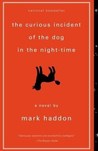
Review: The Curious Incident of the Dog in the Night-Time
The Curious Incident of the Dog in the Night-Time by Mark Haddon
My rating: 4 of 5 stars
A lot of the time when we talk about writing, we say it’s because we “want to get into someone else’s head.”
But that’s not true, is it? A lot of the time, we want to be ourselves, but in someone else’s life. You want to stop being a truck driver who takes the same route to work every day, day after day, and be a prince fighting faeries instead; you want to not be a frazzled mother of three young kids and instead be a footloose woman who can pick up and find herself in countries totally different from your real world; you want to not be a lost teenager in a scary world with things out of your control, because you’d rather be a boy wizard who has amazing friends and literally saves the world.
The Curious Incident of the Dog in the Night-Time is a rare book that literally puts you inside someone else’s mind. And it’s incredibly disorienting at first, but all the more powerful for this transformation.
The Curious Incident of the Dog in the Night-Time is a story about a deeply autistic boy, Christopher, who discovers his neighbor’s dog is dead and decides to be a detective like the Sherlock Holmes stories he likes to read, and he writes down everything that happens in a book he began making as a class assignment.
Because he is autistic (and because author Mark Haddon is very good at what he does and has worked with special needs kids), Christopher’s writings are not like anything else. There’s very little emotion, not much introspection. There are math problems. Chapters are numbered with sequential prime numbers. There are very precise drawings of the patterns of the fabric of a new chair.
The presumably non-autistic reader is left to fill in a lot of the gaps in the story, because while Christopher is perhaps the most literal narrator in some senses (describing even the number of holes in someone’s shoe, and the exact color of the beans on the plate), his perceptual lapses means he truly can’t understand some things. But the reader can, making this book a lot more interactive between the character and the reader than most.
It’s hard to relate directly to Christopher, and that’s what makes this book so compelling. You see through his eyes and are frustrated that he misinterprets information that seems so obvious. The people all around him–even his pet rat sometimes!–are more like the reader than Christopher, and you feel their frustration with dealing with Christopher’s many needs, with his seeming dichotomy between a kid who is stunning at some things and completely empty in others.
It’s a lesson in empathy, if nothing else.
This book isn’t an easy read, and it’s not a happy read, either, and I’m mystified by the quotes on the cover exclaiming the “bleak humor” within, because I found nothing funny–just sad. Because as more children are diagnosed with autism and society finds ways to cope, much of what happens in the book is barely fiction for many parents and teachers and caregivers. I can’t imagine the pain it must cause those real parents who have to find strategies to manage real Christophers.
The Curious Incident of the Dog in the Night-Time is a fantastically written book, but be prepared for something a bit more weighty than your average fare.
Filed under Reviews
Review: The Disappearing Spoon
The Disappearing Spoon: And Other True Tales of Madness, Love, and the History of the World from the Periodic Table of the Elements by Sam Kean
My rating: 4 of 5 stars
The Disappearing Spoon is a history of the periodic table of elements.
Some of you are going “ohhh goody!” and immediately adding it to your reading lists. (Let’s be friends!)
For everyone else, who perhaps needs a little convincing, let me tell you that you should most definitely read this book if any of the below apply:
* You work in some kind (any kind, really) of scientific research field
* You enjoy nonfiction history books
* Bill Nye the Science Guy is your hero
* You really enjoy being able to dish out random facts at parties
* You like science in a vague way but didn’t like all that memorization or math stuff
The Disappearing Spoon is a feat like no other. Sam Kean needs an award for his incredible dissolution of complex scientific ideas into information the smart but non-sciencey reader can absorb–things like packing oranges in crates as an analogy for the atomic structure of tin in its alpha and beta forms. It’s complex stuff, but he kept it both scientifically accurate AND interesting. I’ve known a number of researchers… lemme tell you, that is a feat.
And Kean really did his homework. In fact, you’re going to need two bookmarks to read this one. I struggled for about half of it before getting a second one; it makes a difference. You see, this book is heavily footnoted, and you really don’t want to miss out on the extra information. Sometimes it’s just a citation, but for the most part, it’s extra information that will make you say “WOW.” So get yourself a second bookmark to hold your place in the back, too.
Kean covers every element in the table (and yes, there’s a lot) so this book, while completely fascinating, is a bit of a slog at times. It’s challenging to maintain that thread, so for the busy reader, I’d recommend making this your before-bed book (or, more scandalously, your bathroom-time book), because you’re going to put it down a lot anyway. But you do want to complete it.
You’ll learn jaw-dropping facts like:
-the disappearing spoon is a real thing
-One Nobel Prize winner was referred to as “S.D. Mother” in the newspaper when she won
-Marie Curie was better known in her day for her impropriety and turbulent personal life than for her science
-some people drink silver as a health aid…with disastrous bright-blue results
-we really are all made of the same stuff as stars
-how, exactly, some of the deadly elements kill you
-one vest was worn by three Nobel Prize winners over the years
-the first “computers” were the women who worked on the Manhattan Project, running computations long-hand
-there are people who are absolutely obsessive about kilograms
You’ll get more science in this one book than you got in a year of high school education, but it will be freshly delivered on a gleaming plate of intrigue, personalities, and incredulity. It’s well worth your time to learn more than you ever thought possible.
Review: “The Ocean at the End of the Lane”
The Ocean at the End of the Lane by Neil Gaiman
My rating: 4 of 5 stars
It’s hard to describe The Ocean at the End of the Lane without revealing spoilers. Let’s start with this: This book is unlike any other I’ve ever read. It feels somewhat like a Grimm fairy tale, and any moral is similarly absent, or at least unobtrusive. Others have described it as having a 7-year-old narrator, but that’s only partially true. It’s a challenging, contemplative, but relatively quick read.
While at his book reading/signing, Gaiman noted with approval that one reviewer had called this a “book for readers,” meaning there is no real age distinction. I’m going to have to forcefully disagree. While most of this book is fairly all-ages, the horror-tinged parts are deeply scary. I wouldn’t give it to any child under 13, and then only if they were okay with being frightened. Unlike other horrors based in fantasy that can maybe be shrugged off, this one challenges the very core of a child’s (or adult’s!) feelings of safety and security. Proceed with caution.
A summary, trying to avoid any important spoilery bits: A man goes back to his childhood home, finding it much different. But the house down the lane looks shockingly similar to his memory of it. He feels compelled to go there, and sits and stares into the pond. From this vantage point, he remembers. He remembers the frights and thrills of his seventh year of life, and the monster he accidentally awoke, and the trials he and the girl from down the lane went through to try to overcome it.
I don’t think this book is for everyone. I really deeply enjoy Gaiman, and I still didn’t always enjoy this one in bits (I should have been prepared for the level of horror, perhaps, because of Sandman, but it took me by surprised anyway). It’s obviously deeply personal, drawing from elements of Gaiman’s real childhood and real life in ways his prior books. It feels as if we’ve unlocked some secret door in Gaiman’s mind, a parallel universe door in which this story is actually truth. The descriptions are vibrant and rich, and I very much wish I could go enjoy a meal with the Hempstock matriarchs.
Though this book debuted this summer, this feels more like a book for a dark and moody winter, when you’ve long forgotten the warmth of the sun.
Filed under Reviews