Tag Archives: books

Review: Gone Girl

Gone GirlGone Girl by Gillian Flynn

My rating: 5 of 5 stars

“Gone Girl” is without a doubt the best, most original book I’ve read all year. Maybe in the past few years. It’s outstanding, and if you even remotely like crime novels or TV shows, you need to read this book.

I know, it’s super-hyped and sometimes you may not want to read a book because it can’t possibly be that good and books sometimes get popular because of some unquantifiable zeitgeist. Worry not: “Gone Girl” is just genuinely good and surprising.

It’s the kind of book that makes you say, “OMIGOD, you HAVE to read this book!” because you desperately want someone to talk to about it.

It’s a book that says, “Oh, you think you’ve seen this on “Law & Order” that one time? You think you know what’s coming? WHAM! YOU KNOW NOTHING!”

It’s the kind of book that made me wonder, initially, if my newly acquired husband could ever turn out to be a murderer. And then it made me wonder if maybe I had it in me to be a murderer.

“Gone Girl” really takes the crime novel standards and turns them on their ear. It’s revolutionary in a lot of ways. I mean, how often are you allowed to view the story from the perspective of suspect #1–and yet don’t know if he did it or not?

The set-up is that it is Nick and Amy’s fifth wedding anniversary, and their marriage has started to unravel. Nothing major, just bits here and there; it’s not what it was. And then Amy goes missing. As is so common in crime shows and books and in real life, suspicion automatically falls on Nick.

I won’t reveal more than that, because as much as I want to talk about this book, the surprises are worth keeping secret for other readers–they’ll hit you like a club to the head.

The story is incredible for the writing alone (excluding the truly brilliant plot for a moment). It’s told from both Nick’s perspective–he talks to you as if you’re perhaps his little mental Jiminy Cricket, or an audio diary–and from excerpts from Amy’s diary, which retells parts of their lives, leading up to the cataclysm, from their first meeting all the way up to the collapse of their marriage. The tone is spot-on: it sounds just like normal people. I’ve never seen real-life captured so thoroughly on the page, so intimately intertwining the reader and the author’s voice. Gillian Flynn is a helluva writer. Plus, I used to live in Missouri, where the book is set, and I am astounded by the little details only a Missourian would pick up on, little things like the blanket adoration for the Cardinals baseball team–things that make these people seem very much alive.

I guarantee, no matter how much a TruCrime connoisseur you think you are, you will be surprised, pleased, disturbed and amazed by this book. I absolutely cannot recommend it enough.

View all my reviews

3 Comments

Filed under Reading, Reviews

My Top 10 Most Influential Books

I was challenged to the silly “book duel” on Facebook by an acquaintance, and though I typically don’t like those sorts of “pass it on” challenge deals, this was good to think about.

So here are the top ten books that have the most influenced me thus far:

I’ve been challenged to a “book duel,” which sadly doesn’t mean throwing books at other people. But it does mean listing 10 of the books that most influenced me. (I will be opting out of the “challenging” of others. Answer if you wish.) My top 10 most influential books, in no particular order:

1. The Power of One, by Bryce Courtenay
2. The Handmaid’s Tale, by Margaret Atwood
3. Grimm’s Fairy Tales, by the Brothers Grimm –the older, far scarier and more demented versions
4. Sandman comics, all of them, by Neil Gaiman
5. The Bible, without the context of which I wouldn’t understand much of modern literature, in addition to any faith-related benefits
6. Ella Minnow Pea, by Mark Dunn, for showing me how flexible and creative writing can be.
7. Eats, Shoots & Leaves, by Lynne Truss, for my early editing education and one good panda joke
8. The Weather Wardens series by Rachel Caine, because she’s a local author who started young and made it big.
9. Black Beauty, by Anna Sewell. I just love that book.
10. Jane Eyre, by Charlotte Bronte.

Also, it wasn’t until I wrote this up that I realized I’ve MET three out of the 10 authors on this list; if we exclude the ones that are long dead, my percent leaps up to 50%! Wow!

What would make your list? What do you recommend?

2 Comments

Filed under Reading

Review: Skeleton Crew

Skeleton CrewSkeleton Crew by Stephen King

My rating: 3 of 5 stars

For a collection of short stories, this book took me forever to read. It’s an interesting peek behind the curtain of the famous writer while also being chock-full of scary, interesting, and mysterious tales. It’s a lot of fun, but I wouldn’t recommend trying to read it on your relaxing vacation (see: took me 3.5 months to read it all).

If you’ve read King’s famous “On Writing,” you may find this book extra interesting. He can’t help but reveal himself in these short stories, and when they are all collected together, it’s easy to see commonalities. For one, I feel like I have a real roadmap to Bangor, Maine (King’s beloved hometown). The laundry where he worked before he found a teaching job (and then became a writer) makes several appearances, and country roads in the vicinity twist and tangle until some of the more unruly characters appear. I have to wonder if King’s drug addiction lies behind some of the more nauseating and skin-crawling horrors: the rat-person in “Mona” in particular, and certainly the methodology in “Survivor Type.”

It’s interesting to read “The Mist” and King’s thoughts on it in the decades before it became a movie (his son Joe Hill even being “cast” as the precocious little kid in the story). The story, which opens the book, is one of the best, but is not the most frightening, by far. “The Jaunt” is a cheerful attempt at science-fiction, with the ending practically obvious from the get-go. The final story, “The Reach,” wasn’t horror in the slightest; it’s more of a quiet contemplation.

I found it intriguing that the horror factor in several of the stories (“The Mist,” “The Raft,” “The Monkey,” “Morning Deliveries (Milkman #2)”) is never clearly defined, explained, or even resolved. Particularly in “The Mist” and “The Raft,” bad things just sort of happen, and there isn’t a lot anyone–reader, character, perhaps writer?–can do about it.

While I enjoyed reading these stories because it allowed me to study King while he was at work (or, as he says, “my muse shat on my head–this happened as it always does, suddenly, with no warning.”), it reads like the grab-bag off his desk: a little of this, a little of that, some worth more, some not worth writing on the back of a napkin. It’s a ragtag bunch of stories, and shows the breadth of King’s talent and interests, but may not be for every reader.

View all my reviews

3 Comments

Filed under Reviews, Short Stories

Don’t Let Rejection Weigh You Down

This New York Times article is…weirdly composed. It’s a bit of a Frankenstein’s monster (what do odd resume’s and rejection lists have in common?), but I’m glad it brought the rejection list to my attention.

Basically, author Monica Byrne has kept track of every single rejection she has ever gotten. There are more than 500 now on her list, compiled over 6 years. Which just has to be brutal. But I found her comments about it inspiring:

“Of all the things I’d ever submitted to or applied for,” she writes at The Washington Post, “I’d gotten only 3 percent of them. That’s a 97 percent rejection rate. That means I got 32 rejections for every acceptance.”

But she DOES have acceptances, including a book deal and a sold-out play. I also liked this quote:

“The anti-résumé remains my deceptively simple answer to the question, ‘How do you do it?’: that I persisted during all those years of rejection for no other reason than that I loved writing so much I wanted to spend all my time doing it. Writing must be its own reward, even for the most talented and hardworking writers, or they’re going to have a tough time.”

I’ve not had much success with courting agents. I’ve gotten some nice comments, a few requests for manuscripts, but nothing has really gelled. And it’s been frustrating. Sometimes I think back on my rejection list and wonder if maybe I’m “doing it wrong”–“it” in this case being “everything.” But Byrne reminds me that this is sort of just how it is. Just keep going for it.

2 Comments

Filed under Publishing, writing

Real Costs of Self-Publishing

I found this excellent peek behind-the-scenes of self-publishing from Writer.ly’s CEO Abigail Carter.** It’s the kind of information that is just hard to come by, and I found it really useful.

She describes not just the costs she has put into the book pre-launch, but also the struggle to get recognition via reviews. It’s a good reminder that self-publishing means you have to take on a lot more than you would if you were picked up by an agent and publisher (though the difference in your royalties may be worth it to you).

Before launch, Carter spent $2,570 to get the book ready (yeah, that number rocked me back a bit, too, but it’s so great to have actual hard numbers). In a week, she made… $75.41.

She followed up recently with another post, detailing more of her expenses, in particular her hard work to get those vital Amazon reviews. She got 102 reviews and more sales, and her expenses went up to $3,183. With sales at only $441.94. Yikes, that’s a big cost. Hopefully it will pan out for her.

If you’ve self-published, have you “broken even” yet? What did it take to get those early reviews?

**Full disclosure: I work with Abby sometimes through Writer.ly, because I find it to be an excellent resource for writers, editors, and illustrators. She’s a nice person. No one paid me to write about this, however.

5 Comments

Filed under Publishing, writing

Review: The Lies of Locke Lamora

The Lies of Locke Lamora (Gentleman Bastard #1)The Lies of Locke Lamora by Scott Lynch

My rating: 3 of 5 stars

I’m not sure I’ve ever had such trouble rating a book with such excellent writing. The truth, though, is that, while it is exceedingly well-written, it’s convoluted and faces so many different plot options it is hard to stick with the story.

Let’s start with the good stuff: Lynch has wrought a fantasy-tinged world in greater detail and clarity than the real world. His Camorr has layer upon layer of complexity, beauty, grime, seediness, character, and mystery. Despite the ample attention to detail, I wanted more. I wanted to know about the incredible Elderglass towers and how they were created, and how humans came to occupy them. I wanted a calendar of all the holidays in the city and descriptions of each festivity. I wanted to peek inside the temples of each of the 13 gods. It is rich and detailed and effortless; characters curse and revel in this very real world without a hint that this is fiction.

I’m also quite pleased with the confidence schemes that Lynch has concocted. They are as much of a joy to the reader as the characters committing them upon unwitting folk. Locke Lamora sells his false-face activities well, and I hungered for more of the like. In fact, I wished the whole book were nothing but a testament to the way Locke got himself in and out of one scrape after another.

That’s also the problem: from the first 1/3-1/2 of the book, that was what I thought I was reading: a lighthearted and amusing tale of a con men pulling a con. And I liked that. It was great fun trying to guess how Locke was going to manage the next touch against his enemy, wondering how close he could get to being caught.

But then the book took a sudden and dark turn, literally out of nowhere. It felt like this was not really one book, but three, smooshed together. To the point that, as much as I liked the characters and the overall world, I’m not sure I want to read any more adventures. I felt like the book I started and the book I finished were not at all related; the plot got twisty, and not always in a good way.

Possible spoilers to follow. Read at your own risk.

In vague terms, here are the major plot intersections I can identify:

  • Locke, as a child, is taken up by the Thiefmaker.
  • Locke, as a child, finds a new home with Chains.
  • Locke and his gang, now grown, are pulling a big con on some wealthy folks.
  • It seems the secret police are onto the con… oh no! Oh wait, no, that’s just more of Locke’s cleverness at work.
  • While doing a typical errand, Locke is encumbered by a marriage engagement he can’t easily escape. What will ever become of him?
  • A bad guy, heretofore unknown to the story, kidnaps Locke and requires he perform an impossible task.
  • OUT OF FREAKING NOWHERE, the bad guy kills the girl Locke was supposed to be engaged to, less than two chapters after it was introduced, forcing his boss to require Locke to help him fight the bad guy.
  • Double-cross by the bad guy. Things are not going at all according to plan.
  • Everyone you love is murdered. Locke swears revenge.
  • More murder, almost excessive. Bad guy takes over.
  • Other villain only previously hinted at turns out to be real and hatches a plan to get Locke.
  • Locke overcomes multiple obstacles and difficult situations to win the day, much the worse for wear.


I gotta say, I felt like I couldn’t really enjoy the book after the marriage-proposal feint. I’m not even sure what point it served; it feels like that could be cut entirely from the book without a mark of incident. It just seems too convoluted, and it made it hard to know what I was supposed to be cheering for at any given moment. Plus, dark-revenge-tale is deeply different from the lighthearted caper we were enjoying at first.

My other beef is the situation with female characters. Though there are ample women used as setpieces and secondary characters, some even with some mild action, this book is a sausage-fest. There’s even plenty of opportunity for a female character: one is mentioned repeatedly but never shows up. You could change one (or more) of the characters in Locke’s gang into women without at all changing the story. A few women toward the very end of the book see some action, but it seems half-hearted. Though characters–even a whole chapter!–claimed that women were not to be trifled with, it seemed more sentiment than truth, and made me wonder if Lynch was somehow afraid to write women characters (which is foolish, because his background ladies were really interesting! Just…not a lot to them.)

I’m not sure I would recommend this book. It feels like those who would like a fantasy caper might not like the end (like me) and those who might like a gore-heavy revenge story might not get through the lighter beginning material to see the stuff they liked. But it is incredibly well-written and I’m impressed with Lynch as a whole. Perhaps I’d like one of his books that ran shorter than 720 pages.

View all my reviews

Leave a comment

Filed under Reviews

Review: Ill Wind

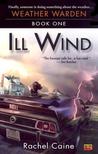
Ill Wind (Weather Warden, #1)Ill Wind by Rachel Caine

My rating: 4 of 5 stars

Some books are warm cozy blankets that you just want to snuggle into again and again. That’s Ill Wind for me. Rachel Caine writes with a welcoming, conversational style that makes it easy to forget you’re reading. This is the book (and series) that I most like to imagine as a TV show–it would make a damned good one.

The concept is so great, you’ll wish you’d thought of it first: the natural forces in the world are not entirely science–they’re a little bit magic. And so there are teams of Wardens who can manipulate those magics, whose only jobs are to keep Mother Nature from killing us all. Humans using magic + science to stop sentient storms from destroying the earth? Why hasn’t this show been made already!? (Weather Channel should pick it up; it has a 100% chance of awesomeness.)

Our hero is Joanne Baldwin, a Weather Warden who is in way over her head. She’s too young yet to have earned her Djinn helper, but it is urgent that she get someone more powerful to aid her. Chased by Wardens who don’t know the whole story and hunted by an unknown rival, Joanne sprints off to an intense race to survive. Along the way, she discovers that everything she has been led to believe about the supernatural Djinn is way off: humans are enslaving them, twisting them to their will.
Besides, when they’re wild, they can be damn sexy–well, at least one of them, with scenes so hot it’ll make your skin sizzle.
This is my second or third read of this book, and it doesn’t stop being fun and enthralling. I can’t recommend it enough.

It’s the first in the series, and they really do get better from here.

View all my reviews

Leave a comment

Filed under Reviews

A Complete Listing of the Gods in ‘American Gods’

Keep this link handy the next time you pick up Neil Gaiman’s “American Gods”: it’s a complete list of all the gods mentioned, interacted with, or referred to in the novel (even theories on who “the forgotten god” may be).

It’s a hobby site, and a damned impressive one at that. Even Neil said so, and the Hill House edition of the novel even came with a paper version of the site. That’s some great research!

If you haven’t read “American Gods,” I think you should. It’s a challenging book, and, in my opinion, a great example of the way fantasy can mingle with literary fiction. It isn’t for everyone, though. But if you do read it, this incredible site will help you muddle through all the gods. Gaiman pulled from all sorts of mythologies to create the book, and it’s pretty hard to wrap your head around all of it.

Anyway, a really cool research project that I appreciated and hope to utilize when I read the book again.

4 Comments

Filed under Reading

Review: Dave Ramsey’s Complete Guide to Money

Dave Ramsey's Complete Guide to Money: The Handbook of Financial Peace UniversityDave Ramsey’s Complete Guide to Money: The Handbook of Financial Peace University by Dave Ramsey

My rating: 3 of 5 stars

If you’re unsure about how to manage money, or have already made some big mistakes and are trying to recover, or just want to brush up on some obscure things, this book will likely help you out.

HOWEVER…it has its flaws, despite the enthusiastic baying of many of Ramsey’s constituents.

I received this book as a very well-intentioned gift to help my new husband and I get our marriage started on the right foot. I’m already persnickety about how I manage my money, so I may not be the ideal audience for this book, but as much as I read about personal finance, I figure there is always room for a little more knowledge.

I did find it practical. Ramsey uses folksy analogies and down-to-earth language to explain the sometimes high-falutin’ financial language that can be a barrier. His strategies are fundamentally simple: don’t be in debt, save money before you buy something. He has undoubtedly helped many people find a workable strategy to put themselves on a path to financial security, and that is to be commended.

But I found parts of the book deeply distasteful. My concerns:

It’s Self-Serving.
You’ve probably heard of Dave Ramsey by now. He has a radio show, a whole series of classes and DVDs, and several books. This book aims to make sure you know who he is–the appearance of his name TWICE on the front cover, as well as the plug-in for his class “Financial Peace University,” is just another way to build his personal brand.

Now, that may be unavoidable–it is a self-help book, after all–but the repeated references back to Ramsey’s personal products, other books, and stuff he’s selling started to make me feel like I was at a flea market (want this? How about this? No? Well, you definitely need one of these!). Ramsey’s a smart marketer; if he can get his hooks into you with this book, he hopes you’ll buy everything he’s ever made.

He Doesn’t Think Much of Women
I’m sure if you spoke to Ramsey–and he seems like a very affable and likeable guy–he would insist that he loves women and that I’m crazy for suggesting this, but his own book would be great evidence against him. Ramsey may like women well enough, but the book repeatedly takes a “that’s nice, little lady” tone. Women are called out repeatedly based on negative female stereotypes–“stop shopping ladies!”–and reminded that they are best in the home with the kids, whereas men are repeatedly held up as the providers, the “real men” who “take care of their families,” the ones who are the responsible ones.

Even when he praises women (mostly via his wife) he is slighting them with more aw-shucks patronizing: following an apocryphal tale of President George H.W. Bush wherein Barbara supposedly gets the upper-hand, Ramsey discusses the way decisions are made in his family–he makes decisions and “if I’m not careful, I’ll just roll right over her when it’s time to make a decision. It’s not that she doesn’t want to contribute…”

Let me finish the line for him: it’s that he’s already made up his mind and his wife’s vote isn’t as important.

This is further shown in his advice, including that married couples have one bank account and one only. That may work out very well for some people, and the more power to them, but having one bank account and no money of their own is one of the most common ways women end up poor: husband leaves, takes all the money and there is nothing in her name (or, she wants to leave, husband takes all the money, etc.) I feel strongly that both spouses need some way to access at least some money without involving the other.

Evangelical
Ramsey does a good job of talking to the reader as if you are just like him. Which is great, and is a sign of excellent persuasive writing! Except. Ramsey is an evangelical Christian, and you may want to avoid this book if you aren’t as well.

Even though I’m a Christian, I must not be the same variety as Ramsey. I felt that I was being beaten over the head with the Bible every other page for awhile there.

And while I am happy that folks have a spiritual life they can tend and enrich themselves with, Ramsey doesn’t even cater to the idea that you may not be the same. The chapter on giving never mentions how to give to charity except through your church. Further, his example about giving exorbitant tips to waitresses on Christmas Eve fell flat with me. He says the only reason a waitress might work that day is because she really needs the money. Well, Dave, I came up with a few other reasons:
-Her boss won’t let her have the day off, and while she doesn’t need the money so much this month, she needs long-term job security, and that means she doesn’t get to pick.
-She’s Jewish/Muslim/Buddhist/FSM-ist and doesn’t celebrate Christmas.
-She’s Christian, but is celebrating Christmas in two weeks because that’s when her family can all get together.
-She thinks she’ll get extra tips from the travelers desperate for a meal on Christmas Eve. And besides, it’s generally quiet.

Four reasons I just thought off on the spot! Not everyone is the same as you, man.

Additionally, as an intellectual-type person, it is useless to me when he provides a Bible verse as the reason why I should do something. Sorry, I want evidence. History has shown that Bible verses can be made to fit just about any situation.

Anathema to Debt or Help
This is tricky, because I almost agree with him here, but he takes it to extremes that I find uncomfortable. Ramsey repeatedly insinuates that money should not come to people from the government, and further suggests that putting “burdens” on wealthy people will “make the golden eggs dry up.” I see your Trickle-Down Economics at work, sir. Let’s just say I disagree and found his mixing of politics with finances when it isn’t needed.

But further than that, he is completely 100% opposed to debt. On paper, I agree with him: debt is not a positive, and, particularly for people struggling under a mountain of debt problems, his strategies will be effective. But I think it’s short-sighted.

Debt, in my opinion, is like a pit bull: Sure, it can be awful, but it can also be useful tool when used properly. Much like a pit bull can be one of the meanest fighting dogs out there in the hands of an abusive animal, debt can turn on you quick. But a pit bull well cared-for and attended to will be the sweetest dog in the neighborhood.

I think his “no debt at all” view is problematic in particular for young people. Ramsey’s quite a bit older than me, so perhaps he doesn’t remember, but having zero credit history (yes, that means zero history of debt) will make it hard to get: an apartment to rent; a job (they sometimes check the scores); a car; and, eventually, a mortgage on a house. Zero credit history is treated the same as bad credit history, and refusing to teach people how to handle credit responsibly means young people who end up in a bad spot. Additionally, his “pay cash for everything” strategy is an effective way to get him something else he rails against: kids coming back after college.

One of the things that most upset me in this book was a story from a reader about how her son was going to school, the Dave Ramsey way! It is featured as an example of doing things right, and it hit me like a brick. In this story, a boy works hard in school, gets several scholarships, and his parents have saved money for some of his tuition for college…but it’s not enough. Because they are following Ramsey’s preachings, they don’t get a loan of any kind, but instead pull their son out of college. He was already accepted, but he is forced to withdraw (wiping out, by the way, all that prepaid tuition money).

He goes to community college (which has a drop-out rate of well over 50% right now) and then…drops out after one semester and joins the Navy. The story was submitted before the boy finished, but supposedly he was working on college classes while he was in the Navy. (This story is on page 251)

This story just breaks my heart. It’s not a triumph. This kid was on a path to go to a good school in his state, but his parents dropped him rather than let him take on a loan. As a result, he is working on a ship somewhere far from home. I have a dear friend who went to the Navy, and…it’s not easy. It wasn’t this kid’s real choice. He learned that his parents won’t support him in his future. I feel sorry for him.

The mom says “saying no to college was hard, but it turned out to be a good thing.” Yeah. A good thing FOR HER.

Mistakes
I found copy editing mistakes a few times, which always makes me leery, but then I found a glaring error of fact, which scares me more–a book is a big investment, so the time should be put in accordingly. When it isn’t, it makes me worry about the rest of the content (the mistake is this: Ramsey cites the New King James Bible as the “first in the English language.” It wasn’t. It’s the third, and was created not as a way for folks to access scripture but as a political move to consolidate a divided country.)

In Sum…
This book has exceptionally good advice to help people get out of debt and establish new patterns. It’s written for those who don’t know much of anything about financial planning or organization. The basics are sound, and I found the chapters on insurance and investing basics to be the most informative and helpful. I also like that it comes with budget worksheets in the back.

That said, this book is not for everyone. And I would say that it–and all the rest of the Ramsey brand–absolutely should not be the exclusive place you get advice.

It comes down to what you value. My impression is Ramsey values money (the having, and the dispensing of it) above all else. In order to have money, he advocates sacrificing time, personal interests, sleep, a diverse diet, and educational opportunities for your children. Me? My values are a little different than his. Take his advice, therefore, with a grain of salt.

View all my reviews

2 Comments

Filed under Reviews

Review: Sick Puppy

Sick PuppySick Puppy by Carl Hiaasen

My rating: 1 of 5 stars

Other folks declared this book hilarious, incredible, a great send-up… me, I couldn’t finish it. The sad, horrible truth is I literally found it more interesting to listen to the numbers being called at the Social Security office than to try to read this book. (To be fair, though, they’re experimenting with cat videos! Cat videos!)

I guess I just don’t get it. I gave up, but I gave it a decent effort. It just refused to hold my attention. And I found the characters too cardboard-cutout to be remotely funny. Everyone is ridiculous to the extreme. Not only is the environmentalist so pro-environment that he shares a tent with a bobcat, he also is sufficiently crazy to blow up a bank (here’s a problem: I actually found his rationalization for bank-exploding perfectly reasonable and rational and not at all a sign of instability. Hmm.). The “bad guy” is not only a gross capitalist with no morals or regard for other people, he also cheats on his wife, eats disgusting quantities of food, “hunts” blind deaf rhinos, and litters at every opportunity.

It was like watching one-dimensional characters prance across a foam board in a kindergarten classroom.

This effect was exacerbated by the storytelling style: Hiaasen clearly isn’t a fan of “showing.” Everything was telling. Blah blah blah backstory at random times. Any chance for action was thrown out the window because everything is just declared, never shown directly on stage. It’s basically a play where the actors just stand around monologue-ing.

No thank you. I’ll be putting this Sick Puppy down.

View all my reviews

Leave a comment

Filed under Reviews