Tag Archives: books

Should Books Come With Trigger Warnings?

Neil Gaiman’s most recent book was a collection of short stories under the title Trigger Warning. He opened the book with a short discussion of “trigger warnings” (an internet phrase that is used to indicate that there may be objectionable or deeply troubling content to follow, to allow readers to “opt out” if they feel unprepared for it). Gaiman comes out neither for or against trigger warnings—he basically says if someone will be greatly upset by something, they do have a right to avoid it, but that sometimes it is good to introduce ourselves to troubling things, in order to grow as people—and I didn’t think too much about it beyond “hm.”
Then I read Ship of Destiny. Not to spoil too much, but there is a sudden and unexpected rape scene in the story. Much like a real rape, it occurred practically without warning. It was not a particularly graphic scene, violence-wise, but the word choices and the trauma of the victim that played out over the next several chapters deeply troubled me.
I think I would have liked to have had a trigger warning that there would be a rape in the book. I think I would have still read it—it was very well executed, sensitive to the victim, and made it clear that the villain was a deeply conflicted, messed-up person—but I would have liked some warning, so I could have emotionally prepared myself.
I struggle with rape scenes in all genres. I was interested in Girl with a Dragon Tattoo until I heard there was a graphic rape scene, and I know myself well enough to know I just can’t handle that. I had to stop watching a movie (I think it was The Missing?) because it looked like the main female character was going to be raped–I ran out of the room crying and couldn’t bear to finish.
Someone I know has told me she wishes TV shows and movies came with trigger warning-esque labels: she has a crippling anxiety about people being shot in the head after someone close to her died that way. I can’t blame her for that.
But of course, content creators may not want their work to be labeled in this way. (Publishers probably wouldn’t!) It might put off potential book-buyers. People might protest something that, if they just read it in context, would be fine. There’s a danger inherent to telling people your work might be challenging to them.
I don’t know that I feel that all books should carry a trigger warning. After all, I found Kushiel’s Dart …troubling… but it was still a great book and I’m glad to have read it. (The difference between that and Ship of Destiny? Kushiel’s Dart had lots of clear warnings about what I was getting into!)
I agree with Gaiman that sometimes we have to push our boundaries a little, and that may mean reading something we find unnerving. But I also think people do have a right to protect themselves, particularly that very delicate emotional scared place we all have.
What do you think? Would you want your book to have a trigger warning?

Leave a comment

Filed under Reading, Short Stories, writing

Undead Rising- Cover Reveal!

Look at this! It’s real! Fantastic work by artist Jessica Pace.

Undead Rising cover


2 Comments

Filed under Publishing, writing

Review: Caliban’s War

Caliban's War (Expanse, #2)Caliban’s War by James S.A. Corey

My rating: 4 of 5 stars

Vomit zombies, a missing child, a possibly sentient planet, a foul-mouthed grandmother politician, dirty-dealing intra-galaxy feuds, a kickass Polynesian warrior, a noble rogue spaceship captain, a brilliant scientist on the edge of despair—this book has everything you could want and more. It’s an engrossing space epic that lives up to the expectations of the first book and leads you desperate for the next one.
If you’re a fan of modern sci-fi shows like Firefly or Battlestar Galactica, and yearn for the depth offered by Asimov or the wicked-cool ideas about how real people would operate in space like in Ender’s Game, this is a book–a series!–you’ll need to pick up.

Following the first (also excellent) book Leviathan’s Wake, Caliban’s War opens with the personal drama of a kidnapped girl and the reappearance of a monster that can survive in the void of space and quickly spirals out to encompass a battle that stretches from Jupiter to Mars.

Our honorable but now-hardened Captain Holden stumbles into the kidnapping and can’t help himself from vowing to find her. Her father, Prax, a biologist from the solar system’s breadbasket planet on Ganymede, guides the crew of the Rocinante as they hurtle from planet to planet to unravel the mystery: who would kidnap a sick little girl…and many other children? And who unleashed the protomolecule monster that attacked hard-line Martian Marine Bobbie and her entire crew?

It turns out the bad apples from the previous book aren’t quite gone, but this time it’s beyond what Holden’s blurt-to-the-system go-to strategy can handle. Luckily he is saved by the fantastically written Avarasala, a shrewd and calculating–but ultimately good-hearted–politician from Earth (I sure wouldn’t want to get on her bad side!).

There are so many great, well-rounded characters in this book that it’s hard to make space for all of them in this review: just trust me. And still I get the thrill of adventure with the incredible, believable, descriptions of humans trying to accommodate life outside of Earth. Everything from the effects of different gravities on human development to what kind of plants would be most beneficial to grow on a space station, to the cultural issues that may stem from human colonies on vastly different planets–it’s a pleasure.

The only thing I can think to ding in this book is that it’s set in the far-ish future and yet frequently references 20th-century American cultural touchpoints (will Alien really still be relevant when we’re actually living in orbit around Jupiter?) but that’s done for the reader’s benefit, not for the realism. And it’s a heckuva lot of fun, I can’t deny.

View all my reviews

Leave a comment

Filed under Reviews

Editing Tip: Keep the Mystery Alive

This is titled as an editing tip, but it may be more of a writing tip. However, it doesn’t really matter whether you handle this at the beginning of your writing process or during an editing phase: it is essential that you keep some things from the reader.

“What?” you’re screaming right now. “But I’m supposed to show, not tell!”

Yeah, you are. But don’t show the reader everything. They don’t really want to know everything. Mystery is one of the reasons people read stories; trying to figure out the plot of the puzzle.

I’ve seen this from many beginning authors. They get so excited about the story, the world, they’ve built in their imaginations, they just share all of it. Because it’s just SO awesome, right?

But what ends up happening is the plot gets weighed down by unnecessary, irrelevant details, the reader gets bored, and the story overall doesn’t feel very good.

Take Harry Potter, for example, all the books. JK Rowling is known for having developed a deep complexity to her world, with pages and pages and pages of notes and plans for each character. But the first book does not, say, cover every year of Harry’s life from birth until he gets picked up at Hogwarts. Nor, when he arrives, does she take the time for a luxurious tour of the castle: all we the reader get is a bit about the exterior, the Great Hall with the floating candles, some moving staircases, and a rough sketch of the tower for the Gryffindors.

Basically, she only introduces the rooms that Harry directly interacts with–and then only includes the relevant ones (no bathroom breaks in Hogwarts). And yet Hogwarts is a lush and beautiful scene that doesn’t feel at all shortchanged by these exclusions.

So, why should you leave things out of your story?

  • To get to the good stuff. Unless you’re writing an architecture book, your readers probably don’t care about all those luscious details you’ve got planned out. They want to know what’s going to happen next, not the color of the chandeliers!
  • To avoid an info-dump. It’s much more exciting to figure out the shape of a story little by little than to suddenly be told everything. If I wanted to know everything in one go, I’d read the Cliff’s Notes.
  • To protect you when/if you change your mind. Oh, you want the windows to be curved? Sorry buddy, you wrote that they were rectangular four books ago. If your book becomes popular (as you hope it will!), you’ll have everyone poring over every detail, trying to make them fit together. Just ask GRR Martin how that goes.
  • To leave room for more stories. This is actually the BEST reason: if you leave folks wanting more, you’ll have the opportunity to write (and sell) more. But that can’t happen if you spill everything in the first go! Keep some details under your hat, and you’ll continue to find more to develop.

It’s a tricky balance for sure: how do you balance juicy descriptions with holding a bit back? I can’t tell you the how or the what, unfortunately–just the why. But trust me: when you figure it out, your book will be the better for it.

Have you read anything that just over-described and gave too much away? What did it tell you about good writing?

4 Comments

Filed under Editing, writing

Ender vs. Katniss: Let the Games Begin

Ender Wiggen vs. Katniss Everdeen

When I recently read Ender’s Game, I really wanted to root for him. He is the protagonist, after all! And so many people seem to really idolize him and the book. But perhaps he’s a creation of his time: we have a lot more YA heroes to look up to now!

In that spirit, here’s a head-to-head comparison of Ender Wiggen in Ender’s Game with Katniss Everdeen in The Hunger Games.*
*Note: Just to make it fair, and because I’ve only read one of Orson Scott Card’s books, we’ll hold this to JUST the first book in each series. Also, this is books only.
Name Ender Wiggen Katniss Everdeen
Problem: Problem—Picked as a child to defeat the alien bugger race, because adults say so Has to fight to the death in an arena, because adults say so
Special Talent Being smart Skill with a Bow&Arrow
Character Flaws Accidentally harming others Being generally unlikeable
Age 6-13 16
Setting Future Earth/The Battle School/space Future United States (in the form of Panem)/The Arena
Parents Essentially check out of his life forever. Father deceased; mother mentally absent.
Sister Valentine Prim
Younger Friend Bean Rue
Semi-Friendly Adult Tutor Colonel Graff Haymitch
Adult Who Kinda Cares Mazer Rackem Effie Trinket
“Friends” Alai, Petra, Dink, Shen, Bean Peeta, Rue, Gale, Cinna
People to Fight All the other kids Almost all the other kids, except Rue and Peeta
The Twist Despite thinking he’s been in training, Ender has actually been fighting the buggers…and defeated them. Katniss exploits the system of the Hunger Games to keep, for the first time, two players alive, by defying The Capitol and risking her own life.

Who Wins?

Honestly, when I was reading Ender’s Game, I figured I’d do a post like this, and the “twist ending” would be that Katniss and Ender would instead decide they are so similar that they should just be BFFs, and together they would take down the adults.

But then… the end of Ender’s Game. Ender just keeps letting himself be manipulated, even when he’s an old man! He never really seems to act on his own, in that whole book, so I can only assume that if Ender Wiggen were placed in the Hunger Games with Peeta in that final pivotal moment, he would have killed Peeta because the Gamemakers said so and then felt sad about it.

If placed in Ender’s circumstances, I feel like Katniss would constantly try to rebel against the teachers at Battle School, and would ultimately lead a student rebellion, leading to peace with the distant bugger race.

For that reason, in a direct one-to-one contest, I’ve gotta give it squarely to Katniss Everdeen.

What do you think? Who’s the stronger protagonist?

9 Comments

Filed under Reading

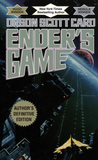
Review: Ender’s Game

Ender's Game (The Ender Quintet, #1)Ender’s Game by Orson Scott Card

My rating: 3 of 5 stars

Ender’s Game is one of those books that everyone just assumes you read in school as assigned reading, then they look shocked when they discover you hadn’t. Well, now I have.

It’s an interesting science-fiction book, and definitely would be classified as “young adult” now. The story–in case you also are late to the party–is about Ender Wiggen, a genius-level boy who is selected by mysterious government men to join the Battle School. These men are entrusted with the care of many such excellent children, with the goal of training them to be perfect soldiers, and, in Ender’s case, the perfect commander, in the human fight against the alien buggers. Because of this, Ender is subjected to trial after trial, both interpersonal as well as intellectual. He is isolated and suffers much. Meanwhile, back at home, his also-genius and somewhat sociopathic siblings Valentine and Peter concoct their own schemes to meddle in Earth politics and gain power…even as children.

The book really shines in the zero-G/null gravity tactical battles, which, according to the preface written by author Orson Scott Card, was what started the whole thing anyway. Card tackles the challenges of combat–distance and hand-to-hand–in three dimensions, adding challenges we just won’t face on Earth (hopefully). It’s easy to see why directors thought this would make a great movie; these scenes are vivid and enthralling.

Otherwise, I found the story a little far-fetched. Ender a super-duper genius at just 6? He certainly doesn’t have interactions like a 6-year-old. I’ll accede that possibly he could be really smart and particularly verbal and accept the language as it is, but even super-geniuses need a certain level of human companionship. I also don’t know that I ever fully bought into the validity of the scheme of isolation to produce leadership, that having no friends was explicitly what was going to make Ender a good leader. Which is one of the main conceits of the book…

Card notes in his preface that, when the book was first published, he received angry letters from parents who claimed no gifted child would talk like that. I’m not sure I see anything that seems totally out of the realm of possibility…not just for gifted children, but for any children. Kids can be sadistic bastards, yo. (And I think we as a culture may have gotten over that squeamishness some, at least in fiction, with Harry Potter and Katniss Everdeen, among many others, being highly cogent.)

I love the space stuff, but don’t particularly love the overall message and themes of this book. Perhaps I’m too old to really appreciate the tortured-youth of it; the adults just seem like unforgivable assholes to me.

The ending–the final ending, after the buggers have been defeated–felt so horribly tacked-on and unformed that it really took a lot away from the book for me. It felt like Card desperately wanted a happy ending for this character he unduly tortured but didn’t know how to get there, so slapped together 20 pages of falderal so he can write sequels. While I’m glad I finally read this book, I don’t think I’ll be pursuing the others.

Card’s highly controversial/offensive personal views–he is an active Mormon and has been outspoken about his disgust toward homosexuality, and has been a generous donor to anti-gay marriage folks–is interesting. I bought this book second-hand because I don’t support his views personally and therefore didn’t want extra money going to him, and perhaps that made it top-of-mind for me…but for all that he was anti-homosexuality, his book could very easily be read as including it in a positive way. It’s something the reader would have to bring to the book, so to speak, but there’s an awful lot of male nudity (I wish I’d kept tabs on how often the word “naked” was used!) and there’s a fight scene in a shower featuring highly lathered and soapy naked teenage boys. There are barely two female characters in the whole book; it’s not a huge leap. Worth thinking about, anyway.

(Related: I found it interesting/odd that religion is apparently gone from this Earth at the beginning of the book–banned, it seems–except that Jews are held in high regard, and by the end Ender has inadvertently created a religion? That seemed inconsistent.)

View all my reviews

Leave a comment

Filed under Reading, Reviews

2014 Year in Books

I like to use Goodreads.com to catalog what I’ve read (and to write reviews for all of them). Sometimes I forget what I’ve read or wanted to read, and it’s a great app. This year, just like last, I participated in a self-appointed reading challenge: 30 books by the end of the year. I managed to get to 33. But as a bonus, all the books I read just in 2014 are in one neat little list.
Here are the stats:
Books read: 33
Graphic novels: 8*
Male authors: 14
Female authors: 13
Most-read author (page/word count): Margaret Atwood
Most-read author (titles): Gail Simone (5)
Genres: Fantasy, Non-fiction; Horror; Science-Fiction; Chick Lit, Literary; Graphic Novels; Mystery
Most common genre: Fantasy (12 titles)
Books by Genre: 
2014 books by genre
Favorite Book: The Song of Achilles, Madeline Miller
Most-Hated Book: Sick Puppy, Carl Hiasson
Comics read as single-issues (and therefore didn’t count as a “book” in Goodreads): SagaBlack Widow, Bitch Planet, She-Hulk, Star Wars, Sandman prequel
*The graphic novel count is tough: I didn’t input all the single issues I read (they seemed too short to count as full “books”) and the collection of all the issues of Transmetropolitan counted as 1 book…but would have otherwise been 10. As such, Warren Ellis also gets recognition as a most-read author (10 graphic novels in one collected book).
What does your Year in Books look like? Any surprises?

Leave a comment

Filed under Reading

Review: Dragonsong

Dragonsong (Harper Hall, #1)Dragonsong by Anne McCaffrey

My rating: 3 of 5 stars

Dragonsong is a quick light read that brings dragons big and small to life. This book would make a great transition for the How to Train Your Dragon lovers out there.

Despite this book having “Volume One” predominantly on the cover, I have no idea if this is the first book in the series or not: it reads like the first book in a variant series off an original, but I had the hardest time figuring out where to start. Since this one claimed to be a volume one, I jumped in here. But I may have guessed wrong.

Interestingly, it claims to be “science fiction,” but aside from the foreward, which tells the reader this takes place in an alternate Earth and mentions some sci-fi mumbo-jumbo, Dragonsong entirely reads like a YA fantasy novel. (In fact, the foreward mostly makes it seem like someone dared author Anne McCaffrey that should couldn’t sell fantasy as sci-fi. I guess she managed it…sorta?)

And that’s not at all a bad thing–particularly because it was written before “young adult” was even a genre.

The story focuses on the awkward and gangly Menolly, a girl from the Sea-Hold, a grim and rough sort of place. She is disparaged for having a talent in music and her parents–the leaders of her Hold–forbid it, for fear of disgracing the hold. After she badly cuts her hand, it seems music is out of the question anyway. In frustration and a fit of teenaged pique, Menolly leaves her home and stumbles into a nest of the secretive and mysterious fire lizards–pocket dragons, essentially. With her clever tunes and kind heart, Menolly wins the trust and adoration of the fire lizards, particularly nine, who follow her and are bonded to her. When she ultimately has to return to civilization out of necessity, she finds people respect and admire her for her skill with the fire lizards, and her music is appreciated rather than castigated.

This is the kind of story that I wish I’d written. I enjoy the storyline very much, but compared to modern similar stories, it’s barely sketched out, there’s not any closure or explanation (why did her father think it was wrong for girls to sing, but later other people think it’s more than ok?), and it just sort of mentions pivotal moments. It feels incomplete or hurried. I wish we could see a much longer version of this, with a great deal of backstory, richness, and detail. I want to know more about the dragons! I want to know why it’s so peculiar that she could impress nine! I want to know why some places are so closed-off but others are super-casual.

I may be in luck: McCaffrey has written a lot about the dragons of Pern, so maybe there is more for me to find out. As an introduction, this book was pleasant, easy, and… relatively insubstantial, more of an appetizer than a meal.

View all my reviews

Leave a comment

Filed under Reading, Reviews

Review: Stone Mattress

Stone Mattress: Nine TalesStone Mattress: Nine Tales by Margaret Atwood

My rating: 3 of 5 stars

Margaret Atwood’s collection of nine short stories retains her incredible ability with the written language. The writing cannot be faulted, but the collection is awash in quiet tragedy. Furthermore, when the first several stories are not stand-alone but overlapping narratives, but all the following are utterly separate the book feels… well, like half a book pasted together with a bunch of random stories.

I hesitate to say I didn’t like Stone Mattress–with such memorable and haunting prose, how couldn’t I?–but this maybe wasn’t the right time for me to read a book so sad.

Whether intentional or not, all the stories in this collection are threaded through with the slow tragedies and indignities of old age. And there are many: lost memories, lost sex drives, lost eyesight, lost independence, lost purpose, lost spouses… The losses weigh heavily.

Even the stories supposedly not at all about old age, such as “Lucus Naturae,” could be read as being about old age and its unstoppable reach, as insidious as fear of the different and the strange. And just as final in the end.

As I said, it’s not a bad time for me to read about old people being attacked by the young, their homes burned to make room for the younger, bitter generation. It’s not a good time to read about an old writer who has become unhinged from reality, choosing instead of let herself be dissolved into the fantasy land she spent her life creating. But then, is there ever a good time?

My grandfather passed away suddenly recently, and I finally got to visit my other grandfather, who is suffering from the effects of Alzheimer’s disease and could not remember who I am or why I was there. Between these two experiences, Stone Mattress is a very raw and close collection for me. It’s too much like the real tragedies I noticed in both situations.

There aren’t many books that tackle the hoary edges of time. We often assume, as a culture, that old age is the end of the line, that all stories must be told past-tense. For that reason, that bravery, Stone Mattress is a welcome treatise…even if I’m not ready to think on its meanings and significance. When you’re in a suitably contemplative mood, muster your strength and try this collection.

View all my reviews

Leave a comment

Filed under Reading, Reviews

Which Way to the Ladies’ Library? Turns Out Even Reading Is Gendered

Book-reading cataloguer Goodreads made some waves when they recently released a study about the gender of a reader compared to the gender of the authors they typically read.

Lots of good data to chew on there: men and women read about the same number of books, collectively rate their Goodreads books at an average of 3.94, women read a lot more new fiction, and men write a lot more really long fiction (500+ pages).

Here’s a stat I stumbled over, though: in the first year of publication, 80% of a female author’s audience will be women; 50% of a male author’s audience will be women. Interesting….

Women authors’ books were also rated, on average, a teensy bit higher than male authored books (just by 0.1, though).

But the 50 most-read books for each gender fall on starkly gendered lines: Of the 50 books published in 2014 that were most read by men, 45 are written by men. Of the 50 books published in 2014 that were most read by women, 45 (46 if you count stealth J.K. Rowling, which you should) were written by women.

That’s the odd one, to me.

A lot of commenters jumped in with “well I never pick a book based on the author.” Assuming that is true, what may be going on here? I’m guessing there are quite a few factors:

  • gendered genre: it’s pretty well-understood that certain genres traditionally tilt to one gender or the other–romance is heavily read and written by women, while “literary” fiction and science fiction both heavily favor men. It stands to reason that these topics would pull the average one way or another.
  • cover design: there’s been some funny/interesting looks lately at the way a book cover is gendered when it goes through a publisher. This is intentional; they’re trying to attract an audience, so they market the book–typically by old and stereotypical methods–to whomever they think it will appeal to. But that also means that a book that both genders really may enjoy equally could get shunted in one direction or the other just because of which photo someone decided to put on the cover. Lots to think about there.
  • the “Oprah effect”: book clubs. From what I can tell, book clubs are overwhelmingly female, tend to pick new authors, and follow recommendations from talk show hosts like Oprah in order to find their next “it” topic. This may be having a powerful effect. (Sue Monk Kidd has said book clubs were the driving force behind her book, The Secret Life of Bees, becoming a best-seller.) The downside may be that book clubs try to pick a certain kind of book…most authors may not be able to harvest the “Oprah effect.”
  • maybe people really do like reading someone of their own gender; maybe they are, even subconsciously, actively selecting for a gendered read.

Personally, I find this kind of breakdown fascinating…and a little scary. I want to read a variety of backgrounds, so sometimes I do actively try to mix up my reading list and get a different genre, gender of author, etc. But there are times I’ve noticed that I’ve read a lot of books written by, say, white males in the 1950s. That’s not a bad thing, but it probably is flavoring my tastes and my writing voice.

But it also worries me as a writer: I’m interested in sci-fi–the male-dominated genre unpopular with book clubs. Uh-oh.

What do you think about the “gendering” of books? Is it an issue at all? Is it surprising?

2 Comments

Filed under Reading, writing