Category Archives: writing

A Choose Your Own Obituary

A man whom I’ve never met but to whom I owe a debt has passed away: R.A. Montgomery, pioneer of the “Choose Your Own Adventure” kid’s book series that is at least partially to blame for my own adult zombie choose-your-own-adventure-style book, Undead Rising. Like just about every other kid who has run across them, I loved those books, and his career–and the way he was heavily involved in his work, even having a stake in all of the 230 books published in the line.

While I and a great many other child readers were sad to hear of Mr. Montgomery’s passing, we were also a little disappointed in his official obituary, because it isn’t in the iconic format he pioneered. Seeing as I have experience both in writing obituaries (which are, by the way, strangely pleasant to write: it’s all the best parts of a person’s life) and in writing gamebooks, I thought I’d give it a shot in revising it.

With complete respect and gratitude for this innovator, I present a revised Choose Your Own Obituary.


Raymond Almiran Montgomery, original publisher and author of the incredibly popular Choose Your Own Adventure book series for children, died in his home in Warren, Vermont, on Sunday, November 9. He was 78 years old. But Mr. Montgomery had a life full of adventures, including:

an illustrious educational career
solving challenging puzzles
world travels
Jump ahead to the parts about CYOA, because you don’t like reading much about obituaries, even Choose-Your-Own-Adventure ones.

Continue reading

Leave a comment

Filed under writing

Will You NaNoWriMo?

I’m an ardent fan of NaNoWriMo, or National Novel Writing Month. The website and community offers an incredible motivation to writers of all kinds to stop talking about writing a novel and just sitting down and actually doing it. I love getting their pep talks in my inbox (here’s one of my absolute favorites, from Lemony Snicket), I love the word count tools to track my progress, and I love the way it gets everyone excited about writing!

But…I’m not sure I can participate this year. I’ve competed as a writer twice, and one year used the motivation as incentive to finish editing a novel that had been collecting dust. I’m so proud of those finished works, even while I figure out what to do next in publishing them. But I’ve got more of “real life” on my plate this year, between work things, family things, editing projects, and trying to keep myself in balance. I’m not sure I can push any of those other things off, to wait for a month, like I’ve been able to in the past.

I’m not going to step away from NaNo completely; like I said, I love it to bits and I think it provides more motivation in a month than I can generate in a year. So I’m going to try to compromise: I won’t officially take on the challenge this year, but I am going to try to use my spare time well, writing what I can when I’m able and otherwise trying to push forward on Undead Rising.

Because, even though I forget sometimes, NaNoWriMo isn’t the only time I can write a novel. I can write all year: I just have to make it a priority.

Will you be participating this year? What are your obstacles and how will you try to overcome or manage them?

4 Comments

Filed under writing

Stephen King as a Writing Teacher

I loved On Writing, and it surprised me just how much I embraced it. Now, even though I’ve read only a few of his books, Stephen King has become one of my favorite authors–not for his writing, but for his devotion, his thoughtfulness, and his brain. I wish I could meet him.

Stories like this one remind me of how much I like him and want to hang out with him.

He’s just very authentic, and honest, sometimes about things that people (writers) aren’t comfortable admitting.

For example, he says that grammar–while still needing to be taught–isn’t the most critical skill.

And, even more heretical, he says that not everyone needs to be a writer. The scandal!

(I’ll take it a step further: not everyone needs to be a self-published writer…)

But I think he’s right. Sometimes it’s a matter of teaching people what they need right now in their real lives; they have opportunities later to further develop their talents if their interests take them there. Fundamentals. (See what he says about teaching kids to write directions from A to B.)

Also, I just love his frank crassness, like this: “Reading good fiction is like making the jump from masturbation to sex.”

Oh heavens, Mr. King, you’re givin’ me the vapors!

Anyway, he’s fabulous.

What do you think of King’s advice? Does it hold true in your experience?

1 Comment

Filed under Editing, writing

Hate A Book? Don’t Force It.

Author Nick Hornby has made waves with this article about highbrow books, and people’s enjoyment of them. (And it’s fortuitous, because I just started reading one of his books, Juliet, Naked, and he’s just phenomenal.)
Some people have interpreted that article to mean: “don’t read anything hard.”
But I don’t think it’s that at all. I think Hornby is trying to emphasize that reading should not be a chore (though, as I’ve said, sometimes it’s inordinately made into one in school). He’s saying that a book can be a “classic” or “highbrow” or “important” without necessarily being something you’re interested in and will benefit from.
I find it interesting that people are upset by this idea at all. If you replaced “highbrow” with a genre, people wouldn’t be at all surprised that not everyone likes it: ex. “If you don’t like a horror book, it’s ok not to read it. Horror may just not be for you.”
See? Is that scandalous? I don’t think so.
But sometimes we put certain kinds of books on a pedestal, sometimes just because they are challenging. I get the impression that some books–perhaps War and Peace?–are idolized not as books but as achievements to be checked off. “Oh, I read that.” Could you have a conversation about it? Did you enjoy yourself? Probably not, but you can check it off your bucket list.
And if that appeals to you, go ahead, have at it. But I’m 100% unabashedly in support of people reading because they like to read. (And, given enough latitude and choice, that everyone could be a reader if they were only given the opportunity to read the kinds of things they may like.)
Full disclosure: I didn’t get through more than 25 pages of Moby Dick. I know it’s an important and worthy book and all that, but I felt like I was being stabbed by ice picks when I read it. And I don’t feel like I’m missing that much, honestly.
What do you think? Should you buckle down during a hard read, or is it ok to put it aside?

3 Comments

Filed under Reading, writing

Awesome Video: Women in Science Fiction

Look at all these inspiring women! It’s so cool to see authors, to hear them speak with video rather than words for a change. I don’t know about you, but I have a few more books to add to my reading list now.

1 Comment

October 11, 2014 · 9:58 am

Chickening Out on Marketing

It’s officially October, the month I declared (last month) that I’d get my book, Undead Rising, published. And I have this awesome cover for it, and I’ve gone over it again to make sure all the links work and the words seem good and…
I’ve stalled out.
I met up with another writer to talk about, well, writing stuff, and was all bluster and confidence, about how I was just going to go ahead and do it already. And he asked a bunch of very sensible questions, like “how do you plan on marketing your book?” and “how will you reach your audience?”
And that’s when I sort of deflated.
I didn’t have a marketing plan. Still don’t, really. Because the truth is, as much as I realize it would help a lot, I just don’t want to do that kind of thing.
I understand it. I know how to do it–I’ve even done a lot of the basics for my day jobs in the past!  I just have zero interest in actually doing it.
Which, as my writing colleague pointed out, isn’t necessarily the best way to do things.
The thing is, I’ve got a day job, a lot of extra work as a freelance editor, and I try to still have a little time left to hang out with my new husband, do chores, and sleep. Oftentimes, marketing seems to take up a ton of time, to the point that it is frequently seen as a full-time (or at least busy part-time) job in and of itself. And it’s just not a priority for me right now.
So I’ve stalled out. I don’t know what to do. Part of me says, “eh, go ahead and get it out there, why not?” This part of me reminds me that I didn’t write this book to become a millionaire and that I’d really like to be able to say I’m a published author already…I’m tired of waiting.
The other, perhaps more sensible part, says, “you’ve put all this work in already, why would you finish it off by only doing half the effort?” And I don’t really know what to say to that part.
Anyone who has been there, what did you do? What do you think I should do? Is the marketing as hard/work-intensive as it looks like it is?

7 Comments

Filed under Publishing, writing

Published Young: Famous Folks Published Before They Turned 25

If you want to feel bad about yourself today, take a moment to read through this list of people who published great works of fiction before they turned 25.

Though it doesn’t always include the masterworks people eventually became famous for, this list is long enough and covers enough people you were forced to read about in school to make you feel a bit off about yourself. For example, both Mr. and Mrs. Shelley–of Frankenstein and Queen Mab lore–F. Scott Fitzgerald, Truman Capote, Brett Easton Ellis, Michael Chabon, Norman Mailer, Jane Austen, Gore Vidal, and more that I hadn’t heard of previously.

While it’s important, and in some ways helpful, to remember that youth does not have to be an impediment to success–that it can be the fire that burns the writer on to greatness–don’t beat yourself up too much if you’re older than 25 and still haven’t published or made it big yet. Remember, you’re the majority.

Plus, a lot of those folks didn’t live that long, anyway: Percy Bysshe Shelley got to be 29; Mary Shelley only hit 54; F. Scott Fitzgerald scraped by to 44; and Austen only cracked 42. Read a different way, they got published only at the middle of their lives.

Here’s to many more birthdays!

Leave a comment

Filed under Publishing, writing

Editing Quick Hit: ‘Backward’ Apostrophes

What I’m about to say may shock and confuse you–it’s okay, it’s not your fault; the machines are lying to you. But I’m here to help.

Your apostrophes are backwards.

Don’t worry, it’s not all the time. The most common writing software is just making things bonkers for you.

On fonts that utilize “curly” apostrophes (unlike online, like this typeface) should always have the “tail” of the apostrophe pointing toward the missing letters in a shortened word, such as in dialogue. In other words, the apostrophe should be “closed” or shaped like a number 9.

But Microsoft Word botches this every time, like this:

wrong way to use apostrophes

The apostrophes for ’em (them) and ’90s (1990s) should show the reader where the missing letters go. Thinkin’ (thinking) is correct, however; the tail says, “there should be a ‘g’ right here!” Instead, Microsoft Word thinks those apostrophes are single quotation marks, which leads it to put in the wrong one.

Here’s how it looks when it is correct:

correct apostrophe position

Now our helpful apostrophes say, “look, these two words are missing letters!” Perfect. (And “thinkin'” is still correct.)

Individually, this is easy to correct: just put in two apostrophes when you want to flip one around. The second apostrophe will be turned the correct direction. Then, just delete the first one.

If you’re going to be apostroph-izing frequently, you may want to look into the programming to see if you can turn off the flippy apostrophes, but most people don’t need to go that far. Of course, you can also hire a good editor/proofreader (like me!) to do all the apostrophe-scrounging for you.

I recently worked on a fun book that featured a lot of Western-y dialogue. There were a lot of backward apostrophes to fix. Here’s an example of how this kind of dialogue should look when it is done correctly:

example of dialogue with apostrophes

With all the shortened words spelled out, this would say, “That is because you run faster than I do, so as I gotta get them first.” But that just sounds crazy, so shortened dialogue it is! Just be sure to keep track of which direction your apostrophes are facing.

If you want to read up on apostrophe directions, consult section 6.114 of your Chicago Manual of Style, 16th Edition.

Are your apostrophes backwards? Have you run into this problem before?

3 Comments

Filed under Editing, Publishing, writing

Gardening Your Words

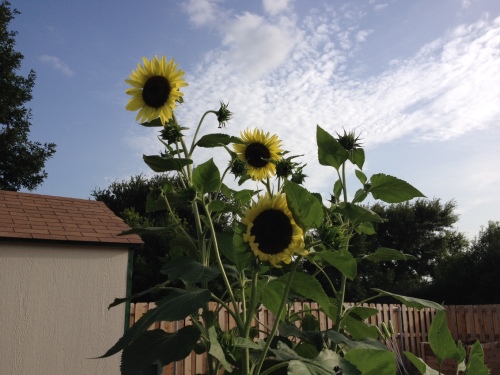
sunflowers

I have a plot at a community garden (though the garden journal-ing hasn’t been going too well lately), and it makes me contemplative. Gardening has been used as an allegory for so many things–not that it’s surprising, with growing our own food being so important through most of civilization. So here’s my allegory: Gardening as the publishing process.

  • Gardens start with relatively few raw materials: you’ve got good dirt, a spot with sun, some seeds and some water. Hopefully you’ve got a trowel.
    • Similarly, it takes relatively little in “things” to start writing. You need a computer or just a paper and pen. Maybe a good “writing chair,” if you’re lucky.
  • The beginning of a garden is full of mystery. You stick some seeds in the ground and water them, but nothing happens. You just hope that they’ll grow. And for days–if not weeks–nothing seems to be happening. You just have to keep showing up, watering and checking for weeds, and hope that the seeds you planted weren’t duds. I found this incredibly frustrating. What were they doing down there?! Other people started their plots with starter-plants bought from the garden center, but sunflowers have to come from seed. And it looked, for at least 2 and a half weeks, like nothing was going to come from it.
    • We don’t know the outcomes when we write. First, we face that terror of the blank page. Then, even if we manage to fill it, we don’t know if it’s any good, or if we’ll get anything out of it. It’s all a big gamble at first, then a lot of waiting. Being a writer of any kind takes simultaneous constant work and patience.
  • Without warning, though, things just start to grow. The little heads of my sunflowers were just the tiniest little hints of green one day, and by the end of the week they were over two feet tall. By the time they were fully grown, they were taller than me and had flowers the size of saucers (see photo above!). But not everything in my garden grew evenly, and other people had a lot more produce than I did. All season, I’ve produced a total of three tomatoes! Little ones!
    • Comparing yourself to others is natural, but it doesn’t always help. Sure, I only have three tomatoes, but I had killer sunflowers that no one else could boast. The same is with my writing; I’m strong in some areas where others may be weak. Even though we’re doing the same things, we have different strengths.
  • Things outside of your control can have a big effect on your outcomes. In the garden, that was a sudden and devastating infestation of squash bugs. No matter what we did to squash them or spray them or make our plots seem unappealing, they proliferated. Everyone in the garden was forced to pull out every squash plant. I even had to sacrifice my cucumber plant–the squash bugs didn’t know they weren’t supposed to like eating that, too.
    • You can do literally everything right and still not have success. I have a zombie book I think has great potential, but zombies are considered passe now; the trend-mobile has already moved on. Does that mean my book isn’t good or that I’m a bad writer? No, it just means there’s something else going on. (Besides, it doesn’t mean I have to tear it up forever. I’ve held on to it, and now maybe it’s time to publish after all.)
  • Gardening takes a lot of work that doesn’t look like work. I’ve been by every day this week: 100+ degree days are not good for growing vegetables, and it’s all I can do to keep my plot watered. But it doesn’t look like I’m doing much; all this watering doesn’t have a lot to show for it. Today I planted potatoes, and hauled two wheelbarrows full of fresh mulch into the bed. You can’t tell at all; it’s just more dirt.
    • Day-to-day, writing doesn’t look like much. It’s a lot of sitting behind a keyboard. It can be tough when someone says “so, what have you written?” and you know there is nothing you can point them to. But that doesn’t mean you haven’t been hard at work.

I’ve decided to think of my writing process as a garden: tend it well, and it will reap rewards…eventually. How do you think of your writing career? How do you keep yourself motivated?

1 Comment

Filed under Publishing, writing

Editing Quick Hit: How Many Spaces Go After A Period?

Spacebar: the Final Frontier

I’ve been saving this image so long; I can’t believe I can finally use this joke.

An unexpected furor popped up among some family friends last month, and because I work as an editor, I was the subject-matter expert (in other words, the controversy swirled around me). And it all started with a 3-year-old online article.

The very important question: How many spaces go after a period ending a sentence?

The question-asker had stumbled upon this article from Slate: Space Invaders: Why You Should Never, Ever Use Two Spaces After A Period.

And it’s full of fightin’ words.

Forget about tolerating differences of opinion: typographically speaking, typing two spaces before the start of a new sentence is absolutely, unequivocally wrong,” Ilene Strizver, who runs a typographic consulting firm The Type Studio, once wrote. “When I see two spaces I shake my head and I go, Aye yay yay,” she told me. “I talk about ‘type crimes’ often, and in terms of what you can do wrong, this one deserves life imprisonment. It’s a pure sign of amateur typography.”

Yowza.

But, yes, the accepted standard is now one space after a period, in all cases. (If you’d like to look it up yourself, it’s in section 6.7 of the Chicago Manual of Style, 16th Edition.)

It came to be with typewriters, which didn’t leave enough visual space between a period and the next letter with just one space. But you probably haven’t touched a typewriter in years, so it’s okay to drop the preference.

I know, it’s likely you learned the habit in school–or maybe just picked it up as a sly way to increase the page count on assigned homework–but you’ll make your editor’s life easier if you slim your manuscript down to just one space after the period. If it’s challenging to unlearn the long-engrained habit, you can also use your search bar in Word to search for two spaces, then use the replace function to replace it with one space (it’ll look like you’re searching for nothing, but this works).

Does it really matter? Not truly. It’s just one of those accepted rules. Consider it like brushing your hair before you leave the house. Sure, you don’t have to, but you’ll look more polished and professional if you do. I don’t care if you put two-three-four! spaces after a period in your personal emails, your journal, your thank-you notes–but when finalizing a manuscript, stick to just one.

5 Comments

Filed under Editing, Publishing, writing