Category Archives: Reviews

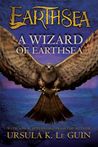
Review: A Wizard of Earthsea

A Wizard of Earthsea (Earthsea Cycle, #1)A Wizard of Earthsea by Ursula K. Le Guin

My rating: 2 of 5 stars

This classic fantasy novel, written in 1967 by one of the world’s top sci-fi/fantasy authors… just didn’t grab me. It’s well-composed, with a nicely fleshed-out world and an interesting power structure for the wizards and some cultural details, but the story of the Sparrowhawk’s beginnings left me wondering, “so why should I care?”
I think I’m ruined for this book by the Harry Potter era. It’s just hard to get attached to a boy wizard in this style, after I’ve gotten accustomed to the very feelings, friendships, and trials of a different, more relatable wizard. The whole “true name” thing may have been a cool storytelling concept, but it just serves as one more layer between the reader and the character–what’s his name again? (The main character has no less than three different names throughout the book!). It’s also told in a rather detached third-person; we only vaguely get a sense of Sparrowhawk/Ged’s feelings at any given time, and we are invited not to feel with him but to watch as he fumbles around. Throw in the jumpy time setting (following not a calendar but whenever the action seems likely to hit) and you’ve got a story I just never felt comfortable in.
I finished the book for the lessons of the craft I could learn, not from any deep affinity for it. In fact, I found the author’s afterward far, far more compelling and approachable than the rest of the story–I’d have rated THAT 5-stars!
Maybe it’s me. Maybe it’s just that this book had its heyday in a different time, in a very different genre fiction landscape. It’s certainly not LeGuin’s fault; she’s a beautiful, if impassive, author who has my utmost respect. But I’m not sure I’ll bother picking up the rest of the series.

View all my reviews

2 Comments

Filed under Reviews

Review: The Sweet Spot

The Sweet Spot: How to Find Your Groove at Home and WorkThe Sweet Spot: How to Find Your Groove at Home and Work by Christine Carter

My rating: 3 of 5 stars

This book was so persuasive, I implemented some of its suggestions even before buying and reading it!
It’s true. I first heard about The Sweet Spot: How to Find Your Groove at Home and Work on the incredibly excellent radio program Think. I only heard the tail end of the discussion, but it was very convincing: that implementing a few routines and intentional habits into your life could make work, life, everything more copacetic.
And that’s how I started doing pushups as soon as I woke up. And then how I bought the book.
Carter does a great job in grouping concepts and providing both detailed research and easy action points. Because of that, I think this is the kind of book you read twice: once to grok it and let it really sink in, and a second time with a pencil and paper as you work out what you’re actually going to try to do.
The things she advocates are both really easy and seem like they’ll be very difficult to implement in real life. Most people already know they should get enough sleep, but allow themselves to stay up late anyway, for example. But even if you take only a little bit away from reading this book, you’ll probably be better for it. I fully intend to go back and complete some of the personal challenges Carter suggests. My favorite was outlining, literally, the top 5 most important things in your life, and only doing things that serve those goals. Oh, and I’m working on halting my habit of checking my cellphone at stop lights while driving, though “embracing boredom to allow for creativity” is proving easier said than done.
Why is this book only 3 stars? Well, it’s true that I liked it (what a 3-star rating on Goodreads means). But it felt a) a little sanctimonious and b) like doing literally all these things would make you a very boring person.
Carter often uses examples from her own life to explain how her concepts could be performed in real life. But these were the absolute low points of the narrative for me: the details of your childrens’ daily breakfasts (a “healthy meal of half an avocado spread on toast!”) just come across as a humblebrag for anyone who knows how much an avocado costs outside of California and how weird it is to eat that every single day. I was further (and possibly unjustifiably) irked when Carter got into her hard-knock story as a single mom…but she still paid for a regular, weekly housekeeper. #firstworldproblems? She gives herself a bedtime of 10 p.m. so that she can wake at 6 to begin her day–I had to wonder, does that ever vary?–and even went so far as so detail her wardrobe (if you have her as a speaker, don’t worry, you’ll know which of the three dresses she’ll be wearing!).
And yet despite the rigidity of her self-imposed habits, Carter never satisfactorily explained what it had gained her (except for the section on her morning workout routines; apparently that has led to some nice benefits). Presumably more creativity–but for what? Potentially more time with her kids, I guess, but they all sound relatively young, with early bedtimes?
Because of that, despite all the positive things I think I can get out of this book, I was a little distant from it and felt myself rebelling. What if I don’t want the same routine forever and always?
Honestly, Carter leaves room for that. She doesn’t necessarily want to make you accept her goals, but does want to teach you how to make your own. I’ll have to try it to see how well it works out.

View all my reviews

Leave a comment

Filed under Reviews

Review: Rat Queens: Sass and Sorcery

Rat Queens, Vol. 1: Sass & SorceryRat Queens, Vol. 1: Sass & Sorcery by Kurtis J. Wiebe

My rating: 3 of 5 stars

When you’re looking for an afternoon of ribald violence featuring sharp-dressed ladies, Rat Queens is the comic for you!
Abandon all illusions you may have of comics/graphic novels as being the province of children, or any idea that a female character must act like a “proper lady,” because Rat Queens goes out of its way to demolish both concepts. In addition to featuring Dungeons & Dragons-style questing and violence, Rat Queens is rife with drunken, foul-mouthed, wantonly sexual storylines and images. It’s delightful because of that, of course, because there just aren’t a lot of books at all that would allow every female character in their book to have some kind of vice, but it also suffers because it sometimes feels like it’s pushing it a little too far.
The art is genuinely great. I love that the characters are each so different, so fab, and so feminine, with so much diversity. I love that they have big hips and broad shoulders and that I believe they could really heft a sword. Rat Queens highlights the many stereotypes we see again and again and again in other art by just being different. It’s beautiful.
I’m a little bit of a terrible comic book fan, because I really prefer to read them as complete volumes, like this one, even though such volume would never exist if someone didn’t buy the weekly trades. But I dramatically enjoy buying a thing just once and getting to follow the complete flow of a storyline. Weekly trades just don’t do it for me.
That said, even as a collection, Rat Queens is unusually abrupt, lacking much transition between characters and leaving me frequently wondering if my pages were stuck together or something (they weren’t. It just does that). You’ll be following one character when boom, we’re with someone else, doing something else, with nary a “Back at the Batcave” to warn you.
Overall, Rat Queens was a fun light afternoon read. I don’t know if I would buy more of it, but I would absolutely borrow it from a library/bum it off my more comic-inclined friend.

View all my reviews

Leave a comment

Filed under Reading, Reviews

Review: Cat Out of Hell

Cat Out of HellCat Out of Hell by Lynne Truss

My rating: 5 of 5 stars

It’s only the end of April and I think I can safely say I have found my favorite book of the year. Cat Out of Hell is dryly hilarious, surprising, riveting, and–most of all–utterly charming.
It’s a quick read featuring an unlikely protagonist and a believable-if-unexpected villain. Alec is a librarian who has just lost his wife and retired (rather early, by American standards) from his job. While trying to distract himself from his grief, he is sent a curious set of documents…about a talking cat. Alec is thrown, quite unwillingly and yet headlong, into a great grisly mystery dating back at least a hundred years.

The story format itself is unique: it is a combination of diary-ish entries, descriptions of photos and audio files, email exchanges, attempted screenplays, and at least one incidence of “emiaow”–cat telepathic communications, of course. Utterly charming, as I said.

One challenge for some readers may be that it is Very British, with absolutely no Harry Potter-like accommodations for American readers. That means you’ll just have to accept (or Google) the many Britishisms and pop culture references, or miss out on a lot of the fun. The sense of humor is also resolutely British in flavor, with our artless protagonist feeling a little bad about winning even when he is completely justified. It’s so incredibly, delightfully, downplayed.

Cat lovers will adore this book for its adroit insight into the feline mind, and cat haters will walk away certain they are correct to dislike our independent little companions. (Oh, dog lovers, don’t worry, there are some nice bits for you, too.) I can’t recommend it enough!

View all my reviews

Leave a comment

Filed under Reading, Reviews

Review: Ship of Destiny

Ship of Destiny (Liveship Traders, #3)Ship of Destiny by Robin Hobb

My rating: 4 of 5 stars

I’ve been waiting to read this book for something like 15 years. Robin Hobb‘s Liveship Traders series was the first to make me desperate for the next book…but it wasn’t written yet. But I also didn’t have much patience, so when I couldn’t get my hands on the book for a month, I gave up, moved on to other things, and forgot about it.

Until I saw Ship of Destiny in a used bookstore! Despite the long wait, Ship of Destiny did not disappoint!
Ship of Destiny is an epic fantasy that features stunning dragons, angsty/crazy talking ships, a horrible pirate, a fierce and bold woman, and desperate policitians. It’s fantastic. Robin Hobb’s knowledge of wooden galleys is incredible and makes it feel like you’re really there, feeling the sway of the swell and lash of the wind. Though the story is incredibly complex–following many paths simultaneously–it is easy to follow and all comes together beautifully.

It is one of those books that you’re both eager finish and sad to put down. It’s an epic conclusion to a great series, and I’m glad to finally have closure on it.

View all my reviews

Leave a comment

Filed under Reading, Reviews

Review: Trigger Warning

Trigger Warning: Short Fictions and DisturbancesTrigger Warning: Short Fictions and Disturbances by Neil Gaiman

My rating: 3 of 5 stars

I’m a huge Neil Gaiman fan. Let’s just get that out of the way. I cried when he signed my copy of The Ocean at the End of the Lane because I was so excited.

But this book barely got its 3rd star from me. If you’re already a fan of Gaiman, there is very little in this short story collection that you haven’t already read somewhere else, or for free via his blog. It’s a collection of short stories with no coherent reason behind them, no theme, no real organization. It feels, honestly, like a book put together because someone–and probably not the author?–said it would be great to be able to sell more books.

I find that a little frustrating.

That said, there were three stories out of this collection that really made the whole thing worthwhile. If you buy it and feel like me, just skip to the end of the book: that’s where the good stuff is hidden.

First, we have a delightful little short story from the witch’s perspective in “Sleeping Beauty.” It’s dark, mysterious, and does a great job following close to the theme and tone of the real Grimm fairy tale. It’s very quick, but really enjoyable.

The second story is also about “Sleeping Beauty.” This one, “The Sleeper and the Spindle,” has since been made into an illustrated book. It may be the best story in the collection: it re-imagines both “Sleeping Beauty” and “Snow White” so that the women can be the heroes and live in neighboring kingdoms. I don’t want to reveal too much, but let’s just say if you love either the Disney version, the original story, or the “10th Kingdom” TV serial, you will most certainly adore this story. It’s just fantastic.

The final feather in this hat is “Black Dog”–an additional story featuring Shadow Moon, the main character in American Gods. Even if you found American Gods to be a challenging book for you, I think you’ll like this story, which is straightforward, touches on some delicious little-known history, and is really scary. Gaiman owes me about two hours of sleep for this story–I stayed up past my bedtime to get to the big ending, and then couldn’t stop thinking about it!

It’s that last story that changed my mind on whether the book as a whole was a good purchase. I don’t know that I’ll ever read large chunks of it again, but the ones I loved, I LOVED, so that makes it worth it to me.

View all my reviews

Leave a comment

Filed under Reading, Reviews

Review: Caliban’s War

Caliban's War (Expanse, #2)Caliban’s War by James S.A. Corey

My rating: 4 of 5 stars

Vomit zombies, a missing child, a possibly sentient planet, a foul-mouthed grandmother politician, dirty-dealing intra-galaxy feuds, a kickass Polynesian warrior, a noble rogue spaceship captain, a brilliant scientist on the edge of despair—this book has everything you could want and more. It’s an engrossing space epic that lives up to the expectations of the first book and leads you desperate for the next one.
If you’re a fan of modern sci-fi shows like Firefly or Battlestar Galactica, and yearn for the depth offered by Asimov or the wicked-cool ideas about how real people would operate in space like in Ender’s Game, this is a book–a series!–you’ll need to pick up.

Following the first (also excellent) book Leviathan’s Wake, Caliban’s War opens with the personal drama of a kidnapped girl and the reappearance of a monster that can survive in the void of space and quickly spirals out to encompass a battle that stretches from Jupiter to Mars.

Our honorable but now-hardened Captain Holden stumbles into the kidnapping and can’t help himself from vowing to find her. Her father, Prax, a biologist from the solar system’s breadbasket planet on Ganymede, guides the crew of the Rocinante as they hurtle from planet to planet to unravel the mystery: who would kidnap a sick little girl…and many other children? And who unleashed the protomolecule monster that attacked hard-line Martian Marine Bobbie and her entire crew?

It turns out the bad apples from the previous book aren’t quite gone, but this time it’s beyond what Holden’s blurt-to-the-system go-to strategy can handle. Luckily he is saved by the fantastically written Avarasala, a shrewd and calculating–but ultimately good-hearted–politician from Earth (I sure wouldn’t want to get on her bad side!).

There are so many great, well-rounded characters in this book that it’s hard to make space for all of them in this review: just trust me. And still I get the thrill of adventure with the incredible, believable, descriptions of humans trying to accommodate life outside of Earth. Everything from the effects of different gravities on human development to what kind of plants would be most beneficial to grow on a space station, to the cultural issues that may stem from human colonies on vastly different planets–it’s a pleasure.

The only thing I can think to ding in this book is that it’s set in the far-ish future and yet frequently references 20th-century American cultural touchpoints (will Alien really still be relevant when we’re actually living in orbit around Jupiter?) but that’s done for the reader’s benefit, not for the realism. And it’s a heckuva lot of fun, I can’t deny.

View all my reviews

Leave a comment

Filed under Reviews

Review: When Bad Things Happen to Good People

When Bad Things Happen to Good PeopleWhen Bad Things Happen to Good People by Harold S. Kushner

My rating: 3 of 5 stars

This is one of the books on the “must-read” list for people struggling with grief of some kind (if there is such a list; dreadful). In it, Rabbi Harold Kushner endeavors to explain why, exactly, bad things happen to good people, and how we should react to it.

It’s clearly a book that has resonated with many people, and with good reason: Kushner doesn’t seem to be talking down to the audience at all, for he has known deep grief. The impetus for the book was the death of his son at 14 years old, having lived his short life with a terrible rare illness known as progeria. As a man of faith, a teacher in his community, and a man who has suffered great personal loss, he is uniquely positioned to address these questions from the same vantage as the reader.

He does an incredible job nailing the kinds of things people say in an attempt to make the suffering person feel better; perhaps an even better job explaining why these things are hurtful, and how they make the grieving person feel. I found myself nodding along; yes, yes, that is how it feels when that happens.

The crux of Kushner’s argument is that the story of Job is a blueprint of grief, and it posits three things:
1) God is all-powerful.
2) God is just.
3) Job (and humans in general) is good.

His theory says that all three things cannot be true: if God is all-powerful, his actions toward Job are unjust or Job is not actually good. If God is just, he may not be all-powerful. If Job is good, then God cannot be both just and all-powerful.

Kushner solves this riddle by deciding that God is in fact not all-powerful, that there are limitations on His power, some self-imposed in the form of allowing free will, and some created by the ambiguously named force “Fate.”

He says that his understanding of God is that God does not give people terrible wasting fatal illnesses, does not kill babies when they are new-born, does not test people’s faith with unbearable suffering for no reason. His understanding of God is that He gives the strength to go on despite these troubles, to encourage compassion and kindness.

For the first half of the book, I felt like this was a book every person of faith should read. But then we got to the second half, and I found myself disagreeing with Kushner, even while I liked what he said. I just can’t get behind it. For one thing, Kushner holds that God does not give people illnesses or kill people off: I have to wonder if he remembers anything from Exodus–the plagues, perhaps? He also seems to say that God doesn’t interfere with people’s lives directly, which is a fine enough thing to believe, I guess, but that also is directly contradicted by several Biblical stories–Elijah, Samuel, David, Moses, Noah, Ruth….lots of stories of direct intervention.

For me, Kushner’s argument just doesn’t quite hold up, for those reasons.

I hope this book gives comfort to those who seek it, but it just left me unsettled.

View all my reviews

Leave a comment

Filed under Reading, Reviews

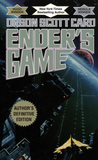
Review: Ender’s Game

Ender's Game (The Ender Quintet, #1)Ender’s Game by Orson Scott Card

My rating: 3 of 5 stars

Ender’s Game is one of those books that everyone just assumes you read in school as assigned reading, then they look shocked when they discover you hadn’t. Well, now I have.

It’s an interesting science-fiction book, and definitely would be classified as “young adult” now. The story–in case you also are late to the party–is about Ender Wiggen, a genius-level boy who is selected by mysterious government men to join the Battle School. These men are entrusted with the care of many such excellent children, with the goal of training them to be perfect soldiers, and, in Ender’s case, the perfect commander, in the human fight against the alien buggers. Because of this, Ender is subjected to trial after trial, both interpersonal as well as intellectual. He is isolated and suffers much. Meanwhile, back at home, his also-genius and somewhat sociopathic siblings Valentine and Peter concoct their own schemes to meddle in Earth politics and gain power…even as children.

The book really shines in the zero-G/null gravity tactical battles, which, according to the preface written by author Orson Scott Card, was what started the whole thing anyway. Card tackles the challenges of combat–distance and hand-to-hand–in three dimensions, adding challenges we just won’t face on Earth (hopefully). It’s easy to see why directors thought this would make a great movie; these scenes are vivid and enthralling.

Otherwise, I found the story a little far-fetched. Ender a super-duper genius at just 6? He certainly doesn’t have interactions like a 6-year-old. I’ll accede that possibly he could be really smart and particularly verbal and accept the language as it is, but even super-geniuses need a certain level of human companionship. I also don’t know that I ever fully bought into the validity of the scheme of isolation to produce leadership, that having no friends was explicitly what was going to make Ender a good leader. Which is one of the main conceits of the book…

Card notes in his preface that, when the book was first published, he received angry letters from parents who claimed no gifted child would talk like that. I’m not sure I see anything that seems totally out of the realm of possibility…not just for gifted children, but for any children. Kids can be sadistic bastards, yo. (And I think we as a culture may have gotten over that squeamishness some, at least in fiction, with Harry Potter and Katniss Everdeen, among many others, being highly cogent.)

I love the space stuff, but don’t particularly love the overall message and themes of this book. Perhaps I’m too old to really appreciate the tortured-youth of it; the adults just seem like unforgivable assholes to me.

The ending–the final ending, after the buggers have been defeated–felt so horribly tacked-on and unformed that it really took a lot away from the book for me. It felt like Card desperately wanted a happy ending for this character he unduly tortured but didn’t know how to get there, so slapped together 20 pages of falderal so he can write sequels. While I’m glad I finally read this book, I don’t think I’ll be pursuing the others.

Card’s highly controversial/offensive personal views–he is an active Mormon and has been outspoken about his disgust toward homosexuality, and has been a generous donor to anti-gay marriage folks–is interesting. I bought this book second-hand because I don’t support his views personally and therefore didn’t want extra money going to him, and perhaps that made it top-of-mind for me…but for all that he was anti-homosexuality, his book could very easily be read as including it in a positive way. It’s something the reader would have to bring to the book, so to speak, but there’s an awful lot of male nudity (I wish I’d kept tabs on how often the word “naked” was used!) and there’s a fight scene in a shower featuring highly lathered and soapy naked teenage boys. There are barely two female characters in the whole book; it’s not a huge leap. Worth thinking about, anyway.

(Related: I found it interesting/odd that religion is apparently gone from this Earth at the beginning of the book–banned, it seems–except that Jews are held in high regard, and by the end Ender has inadvertently created a religion? That seemed inconsistent.)

View all my reviews

Leave a comment

Filed under Reading, Reviews

Review: Dragonsong

Dragonsong (Harper Hall, #1)Dragonsong by Anne McCaffrey

My rating: 3 of 5 stars

Dragonsong is a quick light read that brings dragons big and small to life. This book would make a great transition for the How to Train Your Dragon lovers out there.

Despite this book having “Volume One” predominantly on the cover, I have no idea if this is the first book in the series or not: it reads like the first book in a variant series off an original, but I had the hardest time figuring out where to start. Since this one claimed to be a volume one, I jumped in here. But I may have guessed wrong.

Interestingly, it claims to be “science fiction,” but aside from the foreward, which tells the reader this takes place in an alternate Earth and mentions some sci-fi mumbo-jumbo, Dragonsong entirely reads like a YA fantasy novel. (In fact, the foreward mostly makes it seem like someone dared author Anne McCaffrey that should couldn’t sell fantasy as sci-fi. I guess she managed it…sorta?)

And that’s not at all a bad thing–particularly because it was written before “young adult” was even a genre.

The story focuses on the awkward and gangly Menolly, a girl from the Sea-Hold, a grim and rough sort of place. She is disparaged for having a talent in music and her parents–the leaders of her Hold–forbid it, for fear of disgracing the hold. After she badly cuts her hand, it seems music is out of the question anyway. In frustration and a fit of teenaged pique, Menolly leaves her home and stumbles into a nest of the secretive and mysterious fire lizards–pocket dragons, essentially. With her clever tunes and kind heart, Menolly wins the trust and adoration of the fire lizards, particularly nine, who follow her and are bonded to her. When she ultimately has to return to civilization out of necessity, she finds people respect and admire her for her skill with the fire lizards, and her music is appreciated rather than castigated.

This is the kind of story that I wish I’d written. I enjoy the storyline very much, but compared to modern similar stories, it’s barely sketched out, there’s not any closure or explanation (why did her father think it was wrong for girls to sing, but later other people think it’s more than ok?), and it just sort of mentions pivotal moments. It feels incomplete or hurried. I wish we could see a much longer version of this, with a great deal of backstory, richness, and detail. I want to know more about the dragons! I want to know why it’s so peculiar that she could impress nine! I want to know why some places are so closed-off but others are super-casual.

I may be in luck: McCaffrey has written a lot about the dragons of Pern, so maybe there is more for me to find out. As an introduction, this book was pleasant, easy, and… relatively insubstantial, more of an appetizer than a meal.

View all my reviews

Leave a comment

Filed under Reading, Reviews