Category Archives: Feminism

Let’s Talk About Bridezillas

Let’s talk about the concept of “bridezilla.”

It’s the idea that weddings inherently turn perfectly nice young women into some sort of fire-breathing, plate-throwing, tantrum-screaming monsters. That women develop this malady through their own lack of character, a high budget and the desire to achieve a selfish fantasy in which their every whim must be met.

I hate this concept. It needs to go.

First, as Slate so humorously describes, it is a really bad portmanteau. “Godzilla” and “bridezilla” don’t even sound alike, so it doesn’t make sense from a language standpoint.

Second, it is a term used to judge, cut-down, and control others. “Bridezilla” is a term that comes out when a woman–only a woman, you never hear about “groomzilla,” do you?–doesn’t perform to your expectations. It is a weapon.

Personally, I have heard it several ways.

  • “Oh, don’t worry about it! I’m sure that Major Wedding Problem will work out! You don’t want to be a bridezilla now, do you?”
  • “Don’t get all bridezilla about it, but I need you to…”
  • “You’re really acting like a bridezilla now.”

Every time, it came up–sometimes “jokingly”–as a way to brush off my genuine concerns, to minimize my experiences and stress, and to manipulate me into being something else.

Okay, by now you may be rolling your eyes and saying, “Geeze, she must really be a bridezilla if this is going on!”

And maybe someone objective would say that–but I really don’t think so. All throughout wedding planning, this term has been hanging over my head: don’t be “like that.” I’ve tried to be accommodating wherever possible, and I truly don’t care about things like what color napkins we use or if we use live flowers or not.

Now, will I agree that there are women who do go overboard? Absolutely! But we already have words for unreasonable people, tons of them, and the act of being unreasonable is really not limited to women in this situation. The truth is, some people are bitches all the time.

The other truth is, weddings are extremely stressful and there are a lot of competing values at stake: what you want, what you have money for, what your parents want, what your SO’s parents want, what your neighbor who isn’t even invited to the wedding thinks a wedding should be like, etc etc. (Seriously, I had a family friend call to ask me the color of my guest book, because this was apparently critical to her preparations. Really?!)

I mean, how often do you plan an expensive multi-hour event for hundreds of people? It’s not like you know how to plan a wedding going into it; you’re stuck browsing Pinterest and getting sucked into the DIY rabbithole as you try to navigate all this.

And the wedding industry is literally built on people telling you you are not good enough, that if you don’t have XYZ, your wedding will be the worst and you’ll ruin “the memories.” I am shocked by the mountain of pressure that gets dropped on women when we get engaged (and on the men, but to a lesser degree, in my experience). (This article in The New Yorker does a good job analyzing this.)

In my own circumstance, the accusation of bridezilla-dom came from the then-maid-of-honor. What had I done? I told her I was upset that she went dress shopping without inviting me. Without even telling me. I felt left out of my own wedding, and when I told her–honestly–about my feelings, she came back with that. “You’re really acting like a bridezilla.”

It hurt. It hurt deeply, and I cried. It was an insult from someone dear to me, and I didn’t feel like I’d deserved it (particularly because the dress I was suggesting she wear cost all of $50).

That was a low moment. But it wasn’t the worst thing to come from wedding planning. There have been a lot of stress-tears, and grief-tears (which came when she decided to drop out of the wedding rather than wear said $50 dress). Wedding planning is hard, but, really, it’s just a party. And I’m not a monster for feeling hurt.

I’m looking forward to the marriage, and an end to this madness.

2 Comments

Filed under Feminism

Defending “Fangirls” and Why Greg Rucka is Awesome

Comics writer/novelist/awesome guy Greg Rucka (who is really, really, really good at his job) went to a comic convention last week, and what he saw so frustrated him that he went home and wrote a really marvelous piece on inclusiveness in geek activities.
The basics, if you haven’t heard a whiff of the controversy, is there is a loud (male) subgroup of the “geek” category that feels invaded by the growing population of female fans. The internet labeled these fans “fake geek girls”–ie. girls who don’t REALLY like geeky things, but were somehow pretending to in order to lure themselves a tasty geek boyfriend.
The latest trigger for Rucka was a t-shirt that read “I like fangirls like I like my coffee. …I hate coffee.”
In response, Rucka posted this incredible piece speaking up for female fans of all kinds, but particularly his wife and daughter, whom he sees personally effected by this kind of sexist claptrap.
So, I saw that bullshit piece of shit “joke” t-shirt that managed to insult not only women, not only those of us who call coffee the Black Bean of Life, not only men (via the fact that it was created by an individual with a penis who thinks said piteous appendage allows him the right to tar the rest of us with the same brush), not only fandom, not only, dammit, people with an ounce of decency and who understand that a sense of humor is viable only when it enlightens, entertains, and instructs, rather than demeans and diminishes, and yes, I’ve been thinking about this pretty much all day, why do you ask?”

Read it all here.

[Aside: I met Rucka a few years ago and heard him talk about the writing process. I wanted to become a sponge on his brain and immediately began concocting scenarios in which he adopted me and I became the Robin to his Batman, only in writing. In other words, I really liked him even before this]

I don’t go to a lot of cons, but I have seen this “boo, go away” sort of reaction. On the internet (of course, how could I avoid it?). The worst, though, was when I went to a Star Wars shop with a friend. It was cool–where else can you browse nothing but fan stuff?!

We were the only potential-customers, and the shopkeeper came to chat us up. We were happy to talk, pointing out that we had noticed the shop because of the Rebel Alliance decal hanging outside. He asked if we were looking for gifts…for someone else. No, we were just there to browse. When he caught on that we were, in fact, fans of Star Wars –how could you not be?! It’s the modern myth of our day! Plus lightsabers!–he started to quiz us.

I finally turned red and walked out when he insisted we identify the sex of the tauntaun Han rides on Hoth. And then scoffed when we guessed wrong.

…seriously.

We left the store and the shopkeeper lost out on all potential sales from us, then and in the future. And it’s not always like that. But Rucka is right: let people like what they like. Liking something doesn’t have to be a negative– it’s actually a good thing that your special favorite thing is interesting to others now!

Anyway, go read Rucka’s piece. It has a lot of good things to say.


3 Comments

Filed under Conventional, Feminism

A Stegosaurus Blasted My Gender Stereotypes

stegasaurus, stomping gender normsI consider myself to be pretty thoughtful regarding gender issues. I was the kid in kindergarten who, when asked to draw a doctor, scribbled a woman in a lab coat, not a man (earth-shattering at the time, let me tell you (I’m sure this had nothing to do with the fact that my doctor was a woman and we watched  Dr. Quinn: Medicine Woman as a family. Nothing.)) I care about feminist issues and try to be considerate of the issues faced by LBGTQ individuals. I made a female lead character for my science fiction dystopia and wrote a genderless novel for my gamebook.
I think about this stuff a lot.
And yet, I still have so much to learn sometimes. Unconscious biases can be a bitch.
Neil Gaiman was my teacher, as he has been so many times previously. And he did it with a children’s book.
You’ve read Fortunately, The Milk by now, right? I mean, I gave it a breathlessly positive review, so you definitely went out and bought it already, right?
Well, if not, you may not want to read the rest of this post, because of spoilers.
Anyway, I read Fortunately, The Milk. (And it’s marvelous. Practically perfect in the most Mary Poppins way.) One of the main characters is a time-traveling stegasaurus named Dr. Steg. (I mean, of course).
I’m as enchanted by the story and the misadventures as the children in the story, and then… everything came to a screeching halt.
90% of the way through the book, you are informed that Dr. Steg is a “madam.”
LADY DINOSAUR ALERT
To be fair, this comes as a surprise to the narrator/father as well, but this really hit me like a ton of bricks. Why did it throw me off so much? Why did I automatically assume Dr. Steg was a Mr. Dr. Steg?
I’ve given this some thought, and I think there are several reasons:
  • The drawings include no eyelashes or gaudy bows, cultural codes for “lady cartoon.”
  • The drawing depicts a rather heavyset dinosaur. Often, absent other markers, heavyset cartoons are male.
  • Dinosaurs are “boy things.”
  • Despite my kindergarten drawings, doctors, particularly “sciencey” doctors, are male.
  • Time-travelers are male.
— And they all still amount to “you still probably shouldn’t have made that assumption.”
And that’s what triggered me to write this post. Question your assumptions. It doesn’t have to be “that way,” even — especially! — if that is how it has always been done. (I mean, I’d like to see someone write some elves that are not musical, arrow-wielding, thin blond people. (Yes, I’ve just seen The Hobbit…)).
What assumptions did you have squashed by a fiction book?

2 Comments

Filed under Feminism, writing

The Battle of the Sexes Will Be Won By Robots

A dude promoted his book last week by publishing a long, bloated, purple prose opinion piece in The New York Times Sunday Review that set out to solve the gender gap in who has to do the housework.

His brilliant “answer”? Men don’t want to do housework because housework sucks, so women should just not care about whether the housework gets done or not. No one wants to do it, so women should just do enough and then stop whining.
Unsurprisingly, that answer didn’t sit well with a lot of folks.

Rosie the Robot Poster by Tim Goldman

Beautiful poster from timgoldman.com

But I’m a fan of speculative fiction, so I have the answer: Robots.

Obviously we aren’t quite there yet, but pretty much everyone can agree that basic, boring house chores are both essential and absolutely craptastic to have to do. If men don’t want to step up (plenty do, book-selling NYT guy!), and women are sick of doing it, we need a third option.

If you haven’t yet seen “Robot & Frank,” head out and rent it/Netflix it pronto. That’s the kind of robot I’m talking about. Or basically a non-sassy Rosie. Or a super-powered Roomba. Something that will clean the floors, remember to do the dishes, wipe down the countertops, dust the shelves, maybe water that peace lily you cherish. Nothing fancy.

Sure, we’ve made some art/movies/books about how these domestic robots would be a problem, but really, I think they’re the answer. They wouldn’t replace many jobs — in fact, it may elevate those butlers and housecleaners to a higher-pay position, because having a human housekeeper would become a status symbol. And we’re a really long way off from autonomous robots, so the first tiers of these helper-bots would be pretty limited, and therefore not a serious threat to human jobs.

But if we want that — and I think we can agree, we ALL want that — we are going to need some clever lady engineers to get on that for us.

Why lady engineers, do you ask? Before you cry sexism, just look at history: most of the time-saving housekeeping products we rely on today were invented by women (even if they themselves didn’t do much in the way of housework).

  • Cannister Vacuum, Nancy Perkins, 1987
  • Cooking Stove, Elizabeth Hawk, 1867
  • Dishwasher, Josephine Cochran, 1872
  • Electric Hot Water Heater, Ida Forbes, 1917
  • Mop-Wringer Pail, Eliza Wood, 1889
  • Refrigerator, Florence Parpart, 1914
  • Washing machine, Margaret Colvin, 1871
  • The Practical Kitchen layout, Lillian Gilbreth, 1920s
  • Scotchguard, Patsy Sherman, 1952
  • Improved Ironing Board, Sarah Boone, 1892
  • Vacuum canning and oil burners, Amanda Jones, 1880s
  • Gas heating furnace, Alice Parker, 1919

Really, I don’t care who invents our perfect butler-bots, but history implies it’s going to be a woman. Ladies, just let me know when I can place my order, okay?

4 Comments

Filed under Feminism, Science

Princesses Aren’t the Problem

(If I could have gotten the embed to work, this would have been the image I would have used for this post. Click to see it in full awesomeness and pretend.)

A private all-girls’ school was kicking up a hoopla lately with what is being termed a “girl power campaign.” It features minimalist posters depicting references to fairy tale characters, with lines like “You’re not a princess” and “Don’t wait for a prince to save you.”

Considering it’s an ad campaign designed to draw attention (and donor money) to the school, I’d say they did a good job.

But these posters are also being lauded in general for their “down with princess” terminology. And I have a problem with that.

Judging from some pundits, being a huge fan of Disney movies and fairy tales in general should have made me into a simpering, sparkly, pink-wearing fanatic who doesn’t know how to change a tire or earn an income and spends her whole day writing “Mrs. Prince Eric Charming” over and over on my TrapperKeeper.

And yet… I am not that. I’m a feminist, socially conscious, job-and-a-half having, multicolor-wearing woman — and I’ve never even owned a TrapperKeeper, nor have I figured out whether to take my fiance’s last name or not. (And yes, I do happen to like sparkles. Tasteful sparkles, anyway. Moderation!)

*GASP* How can this be?

Because, frankly, the characterization as “princess = weak and disempowered” is a complete misattribution of these characters.

A quick sample:

  • Snow White: importance of kindness; friendship; value of hard work; internal beauty to match external beauty (she’s the most “princessy” of all the princesses, but the movie came out in 1937…so history is at play here)
  • Belle: intelligence/book smarts; value of reading; kindness; family loyalty; facing your fears; standing up for what you believe in; opposing bullies
  • Jasmine: not a prize to be won; clever; ability to look beyond monetary value; fights back against a giant magical snake; protects her father
  • Ariel: goes against outdated “separate but equal” policies (segregation between merfolk and humans); plays up her talents; exploration/discovery; doesn’t value her looks (unlike her sisters); not afraid to show her enthusiasm; refuses to give up; saves a man from drowning
  • Mulan: values her family over her own life and her culture’s strong dictates against her decisions; refuses to give up in the face of a challenge; smart and adaptive; creative; unlike the men, values her romantic partner for more than what he can do for her (also: not a princess, actually)
  • Tiana: businesswoman/entrepreneur; overcoming racism; friendship despite differences; courage; belief in following her dreams

It IS a problem that a girl in a Disney movie can’t make it through without finding a forever beau (Merida escaped the trend, though, so there is hope!). It IS a problem that toys are separated into “girl toys” and “boy toys,” when, in practical situations, kids will happily play with both. It IS a problem that for a company to sell to girls, they think they have to make things pink (especially when pink was the “boy” color until the 1950s!). It IS a problem that dress-up choices for girls can fall almost exclusively on the “princess” spectrum.

But just because a girl admires a princess does not mean that she is a wussified, pathetic, glittering freak.

2 Comments

Filed under Feminism

Exercise Your Voice

You could say I’m gym-phobic. I’ve never felt comfortable going to one, never knew what I was doing, felt intimidated by spandex-clad shark-grinned instructors, was certain everyone was silently mocking me while I struggled with the treadmill.

But last year, I made a New Year’s resolution that I would start taking a fitness class. I figured a class was a surefire way to get myself moving at least an hour a week (and that when I know I’ve paid to be somewhere, I show up even when I don’t wanna).

Through luck and Google Maps’ navigational skills, I ended up at a Nia class, and it was the best thing I did all January. And I’ve gone just about every Saturday since.

I had no idea what Nia was before I tried it, and I struggle to explain it now. It’s a dance class, but it has martial arts, too, and yoga and imagination, and it changes every week and it’s pretty much nothing like Zumba. It’s a barefoot exhilarating, strengthening, enlivening class.

My class is overwhelmingly female, and while I don’t think Nia is a “lady class,” I think women take to it particularly well because it’s a little subversive.

One of the main lessons I’ve picked up in my classes has nothing to do with how high I can kick or my ability to do a cha-cha step. Nia has taught me to use my voice.

I think it’s a byproduct of my gym-phobia, but there’s a hefty dose of my personality (hello, mousy writer stereotype!) and cultural teachings. See, my gym classes in middle school and high school were like this: girls, go play badminton. Boys, we’re going to play football. Boys, today we learn how to use the weight machines safely; girls, Jazzersize time!

(I never did learn how to use the weight machines, which would have been really freaking useful come college, thankyouverymuch.)

All my attempts at exercise were quiet. I was so terrified of being noticed, of being watched, that I made no sound at all. I never talked to helpful-looking strangers or panted aloud while clambering awkwardly on the stair-stepper. I was head-down, intensely concentrating, focused on getting out of there as soon as I humanly could.

But that doesn’t work in Nia. Nor, I found, did I want it to.

Our instructor, Jule, cheerfully encourages us to vocalize, leading by example. Most of the time, it’s martial arts-style “ha!”s. But sometimes, she does something radical:

Ok guys, say “NO!” when you perform that block. Let me hear you: “No! No! NO!”

This was revolutionary to me. It was like we were visualizing obstacles in our lives and literally beating them down. Woah.

Other times, we may hiss or meow in cat pose, or say “YES!” or “one!” In one class, we ran through a litany of “you!” “me!” “we!”

After 10 months, I’ve noticed a theme. Overwhelmingly, these vocalizations — which turned out to be fun to do — are about defining our personal space. “NO!” comes up in fighting off imaginary attackers, or fending away an overloaded schedule of tasks. “YES” invites us to try new things, to be clear in what we want and do something about it. “ONE” reminds us that we are only one person, and we are there exercising just for us. (Even when we’re pretending to be cats, we’re taking ownership of our personal space– you don’t want to pick up a hissing cat, amiright?)

That’s what is so subversive about it. Drawing boundaries around yourself, speaking up for what you want — these are things we are often told, as women, aren’t for us. We are expected to accommodate others, to be flexible, to give up our needs in exchange for being someone else’s caretaker.

It’s taken me a few months, but now I am loud and present in my class every week, shouting with the others in our group. Finally, I can own, and voice, my participation — saying YES every day.

Note: Other exercise routines might do this for you, but Nia is what works for me. If you’re gym-phobic, keep trying. There’s something out there for you.

5 Comments

Filed under Feminism, Uncategorized

‘Don Jon’ is the Most Feminist Movie

It helps that the leads in this movie are both totally yummy.

Joseph-Gorden Levitt’s new movie “Don Jon” has more naked breasts, mostly naked butts, and revealing outfits on skinny, attractive women than any other movie I’ve ever seen. It probably deserves a Razzie for “most naked boobies to appear in film without losing its rating.” It features a caveman-like guy who aims to score with a different chick every weekend and an uptight controlling bitch.

It’s also the most feminist movie I’ve seen in years.
Before I go any further, let me say I LOVED “Don Jon.” It is a great film. The ending is a bit open-ended, and I’m not in love with that style, but the rest of the movie is so smart I didn’t mind that my fiance and I paid $22 bucks to watch an 86-minute movie. It’s also not for everyone; in fact, I’m really surprised it got made at all. It’s not a movie you should see with any friends or family that you would be uncomfortable watching porn with, so, um, beware before you go. But I absolutely think you should see it.
The movie is about a New Jersey-ite named Jon, considered so good with the ladies his bros have given him the appellation “Don,” thus “Don Jon.” He’s a man of simple tastes: he cares about his “pad,” his family, his Roman Catholic church**, his “boys,” his “girls” (a different one every night), and… his porn. He sees nothing unusual about the inclusion of the last one, and goes into great voiceover detail about what exactly he likes about porn over “smashing” with real ladies.
**(Sidenote: There’s also potential for a really interesting theological discussion when it comes to the Catholic church and Jon’s ability to wipe his sins clean every week, to the point that he uses the number of Hail Mary’s he’s assigned as a marker for how “well” he’s done that week. But that’s for another time.)
But then he meets a ‘dime.” Barbara (Scarlet Johansson) is a perfect 10 for Jon, and when she goes home without sleeping with him, he thinks maybe he needs to change his strategy. So he tracks her down and asks her out.
What about this setup is so brilliant? Because “Don Jon” lures you in by telling you it’s about porn and sex, when really it’s about the way the media we consume makes us think about gender roles.
[Moderate spoilers below!]

4 Comments

Filed under Feminism

I’m a Terrible Bride

I'm a writer, not an artist, ok?  See how  only two dresses have some kind of straps/sleeves? Yeah, that's an overrepresentation. Strapless EVERYTHING, OMG.

I’m a writer, not an artist, ok? Click to see it bigger.
See how only two dresses have some kind of straps/sleeves? Yeah, that’s an overrepresentation. Strapless EVERYTHING, OMG.

I try not to talk about it much because I figure most folks don’t care one silly wit, but I’m getting married in the next year. This, so far, has meant that I’m doing a lot of talking to people who want to sell me lots and lots of things I’m “supposed” to have, and for which I don’t really have a lot of money.

We’re on the dress stage. And I’m suddenly finding out that there are a ton of presuppositions about what that is supposed to mean. I knew about some stuff: mom and girlfriends squeeing over a dress; white satin and lace and sparkly things; fitting rooms and sample sales.

But I didn’t expect so much pressure to like it all.

So that’s why I’m a terrible bride. I don’t necessarily love the experience. Getting into dresses was hot, time-consuming, stressful, highly pressuring and…well, hard. Picking a white dress out of a bunch of nice white dresses is like picking the prettiest flower–they all have nice things you can say about them!

And in this case, all the flowers are danged expensive, too, so that’s another thing I have to worry about.

But most people I’ve talked to about it have been all “oooh, don’t you just love it? Isn’t it so exciting?” Well….no?

Don’t get me wrong, I’m excited to get to marry my fiance. He is the bee’s knees. He makes me smile and makes me a better person. I feel like I can do anything with his support. But wedding planning isn’t exactly a bag o’ fun.

Beyond that, I find that some of these ideas have seeped into my brain somewhere along the line. I had this idea that buying a dress would come fully charged with “MAGIC”: There is supposed to be this magical moment where I put on a dress and look more beautiful than any woman who has ever lived or been imagined, ever. There might be fireworks, but at least sparklers and glitter cannons.

It turns out there aren’t even pom-poms and, when I put on a dress, I look exactly like me…in a dress. I don’t somehow look “more” or “better.” It’s just me, looking a little flushed from the lights and a bit bedraggled in the hair because you have to “dive in” to so many of these dresses that can otherwise stand up by themselves.

How I think I should look (left) vs. How I really look. Click to read the tiny writing.

How I think I should look (left) vs. How I really look. Click to read the tiny writing.

Despite all that, I think I’ve found my dress. I’ve been plagued with doubt because it wasn’t a magical transformation, but reassuring words from bridesmaids and groom alike are helping. Plus I’m going back to the bridal shop for the third time–I’m sure the owner has had enough of me by now–to try it on, all by myself, and see if being alone will reduce the pressure enough so that I can see myself the way I’ve been led to believe I ought.


Shameless plug for a site that has really helped me not be totally freaked out by getting married: apracticalwedding.com. It’s sane advice about a crazy subject. Go look it up, it’s great.

Leave a comment

Filed under Feminism, Uncategorized

Once Upon a Terrible Show

3 Reasons Why “Once Upon a Time” is the Show I Love To Hate

I’ve been binge hate-watching “Once Upon a Time” since it came back on Netflix. The show makes me angry with practically every episode, but I can’t stop. I just watch more and yell at the TV.

You’d think I’d be the kind of viewer who would love this show. I LOVE fairy tales of all stripes, but particularly the original Grimm and Anderson tales. I can sing along with every word from 99% of all Disney movies (except “On the Range.” Nobody saw that one.) I even love retellings of fairy tales and classic stories–I watched ALL of “10th Kingdom” when it aired on TV, pushing my parents out of the way to make sure I saw that show every night. I did the same a few years later for “Tin Man.” No regrets.

On any given night, you might find me rewatching either a Disney/Pixar movie or the likes of “Ella Enchanted,” “Shrek,” “Enchanted” or “Ever After.” (So many enchantments!)

So it was with horror that I realized, in the first episode, that I hated “Once Upon a Time.” (I’m halfway through the third season as of this writing). But I know I’m going to watch the whole thing because I’m a sucker and I’m taking this train all the way to the end of the line.

What’s got me so mad? Here are the three reasons I hate “Once Upon a Time.”

1) It betrays the original concepts.

As I hope I’ve made clear, I LOVE re-imagined stories. They offer a new perspective on something we think we already know and love, and broaden our views of what “really” went on (one of my favorite books as a kid was “The Real Story of the Big Bad Wolf”!)

But the term “re-imagining” can only be loosely be applied to the characters in “Once…” It’s more like “creating a new character and giving them props people will recognize from the original.” It’s so disappointing. It doesn’t help that the ABC/Disney-created show wants to pull mainly from Disney stories, but also wants the darker edge of the originals. That means the source material is all over the place, creating a really awkward hodgepodge. A lot of the time, the backgrounds concocted for these characters are barely cogent. It’s actually getting a little better in the third season, but this mess makes it really difficult to keep track of any individual characters’ storyline. I feel like I’m constantly saying “wait, what happened? What’s going on?”

Beyond that, despite the many versions out there, there usually remains a kernel of the original story. There’s a universal tone, a charm found only in this kind of story. It’s usually uplifting, even if the main character has to die to find that purity (see: The Little Mermaid by Hans Christian Anderson) That tone feels like it’s completely missing in “Once…”

2) It tries to simultaneously make fairy tale worlds and the real world suck.

It’s a bad sign that I’m three seasons in and I still can’t figure out a) why any of the fairy tale folks wanted to leave their magical world or b) why the people of Storybrook would want to go back.

Let’s look at this carefully: There are two villains who apparently wanted to go to non-magic land. Though they both kept a way to use some of their magic, it was really limited. Furthermore, they both got massive demotions: Queen moves down to mayor (I guess it matters if it’s a strong mayor system or if there’s a city council…all the mayors I’ve known don’t really have that much power…) and super-magical Rumplestilskin becomes… a pawnbroker. Well that doesn’t make sense. I mean, I don’t watch “Pawn Stars,” but I get a sense that they aren’t among the 1%, if you know what I mean.

Plus, everything was going just dandily for about 28 years before the hero of the show popped up, so what were they doing for all that time that was SO MUCH BETTER than their lives as all-powerful magical folks would have been in magical-land?

Then I thought perhaps it was more about watching your enemies be humbled. Muhahahaa, the princess is reduced to… being a kindergarten teacher. And…she’s actually really kinda good at it? I mean, I guess she’s not with her magical prince or whatever, but that’s not a bad life, all things considered. She’s got a really cute apartment and stuff.

And then when Henry, ie. the most annoying and delusional kid ever, “discovers” that they’re all magical creatures and works to free them all… why would they want to go back? Now that they’re awake instead of regular-world zombies, they can get back with their beloveds! And now they can do what they want! They’ve sort of built nice lives for themselves in Storybrook. Would you want to go back to a place where someone is always trying to magically kill you? Plus now they get modern medicine, which is apparently more reliable than magical lakes.

If magical-land was as dramatic and messed up as the flashbacks make it out to be, why go back at all? Aside from kinda being trapped, Storybrook seems like a pretty nice place to live.*

*though I do wonder where their food and supplies come from. Do they get, like, a biweekly shipment from the outside world? Can I visit Storybrook? I’d like some of Grandma’s pie.
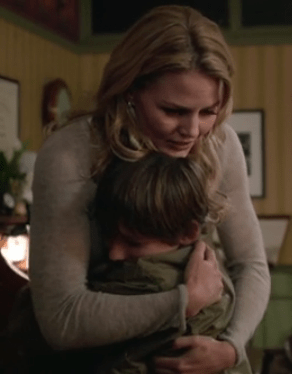
I’ll be a good mother if we just keep insisting the other woman is a bad one!

3) It has a twisted idea of family.

The other things are annoying, but this–this is the thing about “Once…” that really grinds my gears. It’s probably inevitable that a show based on Disney princesses would involve a lot of love stories, and I expected that. But that has morphed into this insane devotion to a very particular kind of “family,” to the sacrifice of literally everything else.

For example, in the first season, Henry claims his adoptive mother is the Evil Queen. That’s a pretty hurtful thing to say to someone, so I was waiting to see how that would be demonstrated. Regina was SO MEAN…she made him do his homework? And..baked him pies (using non-lethal apples). And… what exactly did she do to him that was so offensive and made her a bad mother?

Whereas Emma abandoned him as a baby (probably justifiably so, based on the allusions she makes to her past at the time) and yet she becomes the Heroic Mother very quickly. She, in comparison to Regina, doesn’t seem to care about things like school, doesn’t seem to know how to take care of herself, must less Henry, and, while perhaps a decent babysitter, isn’t really much of a mother. And she makes it very clear that she doesn’t really WANT to be his mother, repeatedly trying to drop him off at home! But the show forces her into the motherhood role, and before you know it, she’s acting crazy-protective of this kid she barely knows, storming up to Regina and saying things like “well, he’s MY son.”

Actually Emma, no, he’s not. You gave up custody a long while ago. Regina’s the mom here, you’re just some weird interloper.

Then we go to other familial relationships: Snow and Charming. It infuriates me that, with everything else going on, all Snow wants is a baby…and preferably a boy, because (of course!) they’re better. Sorry, Charming, you got stuck with a girl, oops! Wanting to protect her kingdom? Insufficient motivation. Wanting to save her beloved? Insufficient motivation. Revenge? Insufficient. She has to obsess over her kid.

This show is chock-full of examples like that. All the women (even Mulan! What a travesty!) are required to be motivated by a) wanting a man (if they aren’t yet married) and then b) taking care of their kid/having a kid.

A man, on the other hand, can enjoy kids, but really they are around to fight things. Philip sacrificing himself nonsensically and very quickly; Charming being incompetent at everything except swords; even Pinocchio as a kid went out of his way to fight things! It’s ridiculous.

And if you dare violate that standard? Something terrible is guaranteed to happen to you. For example, Rumple’ ‘s wife, who admittedly was a horrible wife and mother for a lot of reasons, didn’t deserve to be murdered. Regina dares to adopt a kid rather than having one of her own? Clearly she’s a bad mother and deserves to have her world ruined.

Rumple was denounced as a coward because he wouldn’t fight and would rather take care of his son; that breaks the rules, so his whole life is systematically dismantled.

I think “Once…” sends a horrible message, particularly to kids from non-nuclear families and kids who aren’t gender-conforming. Sure, girls, you can want to fight dragons, but only if you do it for your baby. Boys, grab your swords or be labeled a coward forever. It’s so disappointing, but the show seems to be popular.

Proponents of “Once…” speak up, tell me what you like about it. Please try to convince me I’m wrong, because I desperately want to like this show.

10 Comments

Filed under Feminism, Uncategorized

Dad Wears the Short-Shorts in the Family

If you were on the internet at all last week, you couldn’t help but see this story, about a dad who “taught his daughter a lesson” by going out to dinner in short-shorts, aka. Daisy Dukes.

My first reaction, like most people’s, was to laugh. It’s a funny way for a dad to fuss about his daughters’ outfit, sort of a middle-aged dad protest. But the more I read those stories, and how the father was being praised, and about the “appropriateness” of the short-shorts, I stopped laughing. And I’m not sure I get it now.

Before I say anything else, let me be clear that I think this parent can make whatever rules he wants (provided no one is actually being harmed, of course) and that a little teenaged humiliation is just par for the course in a family. I will also say that I never owned very short shorts, first because my parents only bought shorts that were school-approved (aka embarrassingly long) and later because I felt to self-conscious to buy them myself. So I speak from indirect experience of the short-short phenomenon.

Anyway, back to the case in question. A dad disagreed with his teenaged daughters’ choice of pantaloons and showed his displeasure (after she refused to change) by cutting a pair of old jeans to make his own short-shorts, which he then wore out to the family dinner.

The caption on the NY Post version of the story is: “Scott Mackintosh struts his stuff to teach his stubborn daughter an unforgettable lesson.”

But… what, exactly, is the “unforgettable lesson”? Is it that if you do something dad disagrees with, he’ll make fun of you? Is it that your dad has nice gams?

The lesson we’re supposed to clearly grasp here is that short-shorts are “inappropriate” attire. But… says who? And why? What about shorts is inherently inappropriate?

I’m not trying to be facetious here; I am truly asking what the problem is. (Again, I acknowledge that this family may have rules about clothes, and that’s fine. But the story would not have gained popularity if other people didn’t agree in some way, and the NY Post article specifically states the girls’ shorts were “inappropriate.”)

So why are shorts that are short inappropriate? Is it the quantity of leg shown? Why are the tops of a young girls’ legs inherently scandalous?

I’m reminded strongly of Rosea Lake’s image “Judgments.” Check it out.

I said earlier I had never owned short-shorts. And you know what? Now I wish I did. Instead I feel very self-conscious about my legs and their shape, and I feel I missed an opportunity. Even though it frequently tops 100* in Texas during the summer, I predominantly wear jeans. Why? I’m ashamed of my legs, even when they’re fit and strong. I’ve gotten the message that my legs are shameful, loud and clear, so it was easier to just bow out of the conversation altogether than to try to find well-fitting “appropriate” shorts.

It’s so difficult for women and girls to feel comfortable in their own skin that I find the popularity of this image and its message a little disappointing. At 15, girls are exhilarated about their evolving shapes. They are beautiful, but are awkward like young fillies. Let them wear short-shorts, I say.

And yeah, I don’t have any problem with their dads doing it, too, if they want–but they might be mistaken for basketball players. (But that’s a different body-shame conversation for another day.)

Leave a comment

Filed under Feminism