Category Archives: Editing

It’s Dictionary-Official, Guys.

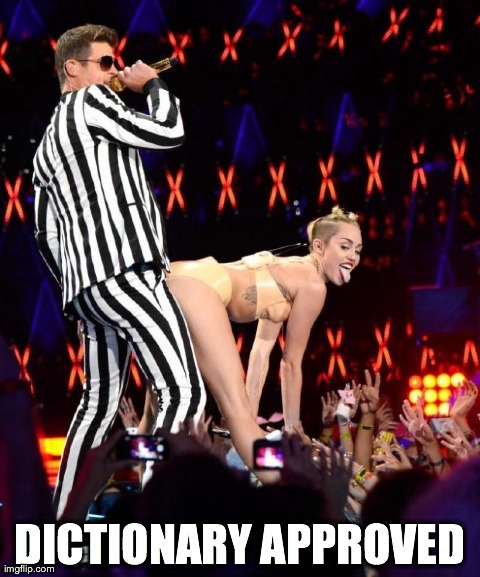
Thank goodness there is something to talk about besides “twerking.”

Oh wait, no, there’s not, because even the good ole’ dictionary is in on the butt-oscillation trend. It was announced yesterday that a bunch of internet-originated terms, including “twerk” of course, have been included in the Oxford Dictionary Online.

Twerk it.

Cue massive moaning and gnashing of teeth and cries about how the world is probably coming to an end, or worse, English is so over.

There’s a whole crop of “new” words that have been officially recognized by an official-sounding dictionary linked to an actually official dictionary; you can read the whole list here.

(But you probably won’t; it’s TL:DR. Oh well).

And, as always happens when dictionaries do this, people freaked out, because there’s a fundamental misunderstanding about the point of dictionaries and the validity of language.

Here’s the truth: Putting a word in a dictionary does not make it “official.” It does not make a word acceptable to use in all cases, and it doesn’t mean it’s more or less legitimate than other words people use. It just means it is a word that has reached an arbitrary threshold of use in pop culture and someone thought maybe you’d benefit from having a definition to help you in the event that you run into it in the wild and don’t know what someone is saying.

That’s it! That’s all it means!

As for appropriateness, you should use whatever words you need to in order to tell your story. If that means inventive, morphine-induced Jabberwockys–power forward, friend! If that means a carefully culled vocabulary from your Scrabble dictionary? Blessings be upon you. One of my favorite books of all time progressively eliminates letters, making it amazing and a challenge I can’t wrap my head around. And that’s great!

As an editor and a reader, I might flag something that I don’t think fits or makes sense, but I’ll never tell anyone they can’t use a word if they want to, dictionary-approved or not. Go ahead! Have a ball!

Actually, I think the Oxford Dictionary Online deserves props for lighting the internet (temporarily) on fire. I mean, how often do you get people to talk about a dictionary, anyway?

4 Comments

Filed under Editing, writing

Is There an Echo in Here? Editing Out Repetition

Inspiration can come from the damnedest places, and so today’s editing lesson comes from a rather old inspiration: the Bible. Specifically, the book of Daniel, chapter 3.

You’ve probably heard this one, the story of the three guys who refused to worship a golden idol and were thrown into a blazing furnace but didn’t die because God was down with their loyalty. (Veggie Tales has a pretty fun take on it if you want a refresher–Rack, Shack, and Benny).

But this is an editing lesson, not a Bible lesson. Bear with me here.

If you go read that first link, you’ll get a sense of what I’m talking about. Daniel Chapter 3 is really repetitive.

  • “the satraps, prefects, governors, advisers, treasurers, judges, magistrates and all the other provincial officials” –stated 3 times
  • “the sound of the horn, flute, zither, lyre, harp, pipe and all kinds of music” – stated 4 times
  • “Whoever does not fall down and worship will immediately be thrown into a blazing furnace.” -stated 4 times (one has a different tense, but close enough)
  • “Shadrach, Meshach and Abednego”–always listed together, just like that, is repeated 11 times.

To be clear, it’s not that long a chapter. Let’s just say the congregation got pretty restless during the reading. It was like “come ON already, get to the point!”

Shel Silverstein does repetition right. I love “Lazy Jane.”

Repetition has its place–it’s a fantastic way to provide emphasis, and you should certainly have repeating themes throughout your book. Stephen King in On Writing talks about how he specifically went back and added more mentions of blood and blood-related imagery to Carrie to help sneakily prepare the reader for the bloody mess at the end.

But often writers end up a bit more like the book of Daniel, just repeating things for the sake of it. I mean, I don’t think this chapter would have been changed at all had some of those “Shadrach, Meshach and Abednego”‘s been changed to “the three men” or, heaven forbid*, “they.”

A lot of the time, our repetitions are smaller: “crutch words.” Every writer has a certain proclivity to use the same word over and over and over and over. (Mine is “actually.” I shudder when I reread my manuscripts and find it everywhere. Bleah.) Another one I see a lot in my editing is “seemingly” or “seemed to.” (For the most part, if something “seems to be,” you can just cut it out entirely…if you’re locked into a character’s perspective, everything they perceive can just be reported.)

The problem with this kind of needless repetition is a) it bores your reader which b) makes them less likely to keep reading. It slows the pace down dramatically, which can kill your pivotal scene. Even if you don’t notice your crutch words, I guarantee the reader will.

Repetition, particularly of “crutch words” because they’re harder to notice when its fresh, is one of those things that justify an editor, or at least a second read after you’ve put it down for awhile. Your grammar and spelling can be perfect, but if you’ve got a bunch of repeated phrases, it’s going to throw the reader out of the flow. But take the time (and, often, money) to get it thoroughly edited, and you’ll cut down, if not outright cut out, a lot of the problematic repetition.


*This is a joke. Get it? Heaven forbid? Bible? I’m hilarious.

Leave a comment

Filed under Editing, writing

The Missed Tax Opportunity

I’ve got a beef. Now, it’s considered rude to discuss politics or religion in polite company, but y’all readers (who more likely than not are also writers) may share this beef, so I figure I might as well tell you.

It’s about everyone’s favorite thing to hate: Taxes.

First, let me be clear: I actually don’t mind paying taxes. I know, that sounds hard to believe, but it’s true. Taxes are good, in that stuff that the community at large needs gets paid for. I like having schools; I prefer it when my roads are well-maintained; I think it’s a good idea that our service men and women have sufficient armor.

But there is one tax that I think is just wrong-headed and counterproductive: self-employment taxes.

It’s a little tricky, so let me explain. When you work for someone else, some of your income is taken out to go to Social Security and Medicare and stuff like that.  Then, come tax time, you also pay any additional income taxes you may owe–this is set up in income brackets. Generally, it’s a percentage of your income. Mine is about 15% last I checked. At my last job, everyone in my general rate of pay wound up overpaying the IRS, resulting in a nice happy refund.

But I didn’t.

What was the difference? Self-employment taxes.

See, I had been honest on my taxes and reported that I’d earned a little bit of money from my side business as an editor. But I was only using one of those answer-the-questionnaire programs, so I never had any human to actually advise me. If I did, they would have explained this part for me.

Because, as a self-employed person, there is no one to take out those SS and Medicare-type taxes, the government puts that on for you come tax time. It’s aptly called the self-employment tax. It’s about 12-15%, depending on the year. And then, in addition, you pay income tax. And they stack, making my estimated taxes on my side business 30%. That’s a considerably more uncomfortable number, particularly because it’s a very small business.

On top of that, the IRS expects a check from self-employed folks 4x a year, so they are regularly getting the money needed to run the country. Rather than just paying taxes through an employer and once a year, a small business owner has to pay regularly. And if you don’t know that or miss a deadline, you get charged interest.

It can be quite surprising.

So last year, even though I made a very paltry sum in my side business, it threw off my total earnings and meant I had to pay Uncle Sam instead of getting a refund. This was disappointing, so I’ve been doing my homework this year to try to get ahead.

But like I said, I don’t mind paying taxes. My problem is: this kind of tax discourages people from starting their own businesses. And, considering a) how turbulent the economy has been and b) how we as employees can no longer trust that business loyalty between worker and owner goes both ways (ie. that you won’t be fired), encouraging more people to be self-employed–even just partially–is a great idea.

I had the privilege of hearing Dr. Muhammad Yunus, the founder of Grameen Bank, speak several years ago. Grameen Bank is all about providing small loans (microloans) to the poorest of the poor to help them start their own businesses. His work is literally transforming his home of Bangladesh, and his model has been adopted all over the world.

Unsurprisingly, Dr. Yunus is also a big fan of self-employment. It is safe to say that his talk and book inspired me to start my own business, too. But Grameen Bank is really struggling to work in the United States. Why? These kinds of taxes–even just the part about it being difficult to learn about what these taxes are–works against the very small entrepreneur. Sure, all the angel-funded entrepreneurs in Silicon Valley getting millions for an app that earns $0 fit right in, but the Etsy seller, writer/editor, or ice cream salesman struggles.

Personally, I think we need to lower that barrier to entry. We could encourage all those people who are on disability in rural areas to earn income, giving themselves a sense of purpose. It would encourage those who are currently hiding their non-9-to-5 income (you know who you are) to come out and be more honest. And it would give a boost to the overall economy, because, while self-employment isn’t for everyone, it can be as steady as the worker wants it to be. (I’ve found it often means I work more than when I’m working 9-to-5 only, because I’m more committed, more interested).

I think it’s just sort of a shame. Obviously it is important that the country’s bills be paid, but I think the current way self-employment tax is structured is a lost opportunity.

Am I the only one who feels this way?

Leave a comment

Filed under Editing, Publishing, writing

He Said/She Said: Why Attribution Matters

I have not seen this movie and have no idea what it’s about, but hey, Kevin Bacon!

Readers have a problem: they cannot read your mind.

For the most part, this is to the authors’ benefit. You get to write it all down, instead of people just downloading the story directly from your creative little noggin (*note: that’s a terrifying sci-fi idea, actually…). I imagine that whole readers-aren’t-mind-readers thing has proved quite lucrative for George R.R. Martin lately, else everyone would know that he was planning to off somebody long before they got too attached.

But it can also lead to problems. Lately, I’ve seen a lot of mind-reading foul-ups involving attribution.

Attribution is quite simply “who said that thing.”

Now I come from a journalism background, and it’s quite important that everything is said by somebody; you can’t just go bandying about quotes without giving the reader context, and you’ll get quite the wrist slap if you try (regardless of what you think of “the media,” there are certain standards).

And yet somewhere in your English education, someone probably told you that it’s ok to not always put a “said” at the end of every quote–it can get a bit tiring. That is entirely true! However–you can go too far. You have to have at least some attribution, because the reader cannot read your mind and it’s tricky to follow a conversation when you can’t tell who is speaking.

For example:

Suzy, Jaime, Bob, and Fernando were talking at recess. Suzy heard an ice cream truck. “Hey, you want to go get an ice cream?”

“I’d love ice cream!”

Sullenly, Bob stared at the ground. “I can’t.”

“Why not?”

Fernando started laughing.

“You can’t have ice cream!” he teased.

“Don’t you like ice cream?” Then she walked toward the ice cream truck.

So I just made up this lovely little ice cream vignette, but I’ve seen this kind of passage written a lot. Let’s dissect it. Who is speaking first? We can guess that Suzy is the one who asks about the ice cream truck, but we aren’t sure. Still, it’s a reasonable guess because she was mentioned in the line before–but keep that uncertainty in mind.

Who loves ice cream? Is it Suzy? Is it one of the boys? No idea. No way to know, either.

It’s probably not Bob. Poor Bob, he’s staring sullenly at the ground. We can be pretty danged sure that Bob made the statement, because he is talked about in the sentence prior AND because the statement goes with the feeling expressed pretty clearly. Unlike the uncertainty with Suzy’s question, we can reasonably pair these two together. So that’s good.

Who asked “Why not?” Also, is Fernando the one teasing Bob? It’s likely, because he started laughing, but we have a large group here, so it’s possible that one of the other boys is teasing Bob AND that Fernando is laughing. It’s ambiguous.

And then we have the question at the end. The writer clearly wants us to know that Suzy said it, because of the “she” in the statement, but it feels disjointed. This could be clearer for the reader, because someone else could be saying this and then Suzy could walk. It’s hard to tell.

Let’s try again, with attribution in the right spots:

Suzy, Jaime, Bob, and Fernando were talking at recess. Suzy heard an ice cream truck. “Hey, you want to go get an ice cream?” she asked the boys.

“I’d love ice cream!” Jaime said.

Sullenly, Bob stared at the ground. “I can’t.”

Looking at his friend with concern, Jaime said, “Why not?”

Fernando started laughing. “You can’t have ice cream!” he teased.

“Don’t you like ice cream?” Suzy asked. Then she walked toward the ice cream truck.

Now we have a much clearer picture of the action here. Fernando is kinda a bully, Jaime is rather exuberant, and Suzy just wants an ice cream already.  Notice that not all of the attributions are the same; it doesn’t get boring to have to read them. In fact, you probably slid right over them without much notice. (This is also why “said” is the preferred unobtrusive attribution. It’s very utilitarian.)

If you aren’t sure if you need attribution or not, try reading your section as if you were a reader and knew nothing about the story–just going off the attribution. If you have a long back-and-forth without attribution, odds are good you’ll need to add some to avoid confusion. (It can be done, but in very rare and unusual circumstances).

Of course, if you’re really not sure, you can always hire an editor to help you straighten it out.

2 Comments

Filed under Editing, writing

Internet Famous

The inimitable Tex Thompson, who I met at DFW Con this year (she gave a killer presentation on grammar) does this brilliant thing I her blog: Grammaticats.
That’s right. She teaches good grammar through funny captioned cats, despite their storied Internet history as grammatically inventive ruffians.

And I am proud to say that one of my two is now Internet Famous. Here is my cat Sawyer, the orange striped rogue in the third image, in a new role as teaching aid in grammatical ellipses.

I can safely say this is the most brilliant he will ever be (which admittedly isn’t saying much; this is the cat who enjoys chewing through electrical cords, leading Amazon to assume I have infants in the house because I keep buying electrical covers).

So go, get your learn on!

20130706-184551.jpg

Leave a comment

Filed under Conventional, Editing, Uncategorized

Fun with Grammar: Lessons from DFWCon

This is my cat, Tavi. He is not a Grammaticat. Maybe one day. We all need dreams.

This is my cat, Tavi. He is not a Grammaticat. Maybe one day. We all need dreams.

Five weeks ago (wow, has it been that long already?) I had the privilege of attending DFWCon, where I got to meet Tex Thompson, grammar-clarifier-extraordinaire. She runs www.thetexfiles.com, which, in addition to general greatness, is where she posts “Grammaticats”–cats teaching lessons in grammar.

I know. My mind was blown, too.

It is no surprise, then, that she led an excellent presentation on Grammar and Style. I hadn’t planned on attending, but my schedule worked out and I made it, and I am so glad I did.

I’ve been a copyeditor and proofreader for years, but I’ll tell you a secret: when editing stuff, we don’t typically talk about it in fancy grammarian-speak. Mostly we just say “ugh, you did that wrong.” For that reason, it was great to brush up on my grammar in Tex’s class: I don’t think I’ve heard some of the fancy titles since high school (if then).

Mostly for my own benefit (and because, who knows? Maybe it’ll help you out, too), here are my notes from Tex’s class.

  • modifier:
  • non-restrictive modifying phrase:
    • 1) Can be deleted
    • 2) must be close to the thing it modifies
    • 3) needs a matched set of commas or dashes
  • Types of modifiers and errors: relative clauses; restrictive vs. nonrestrictive modifying phrases; dangling modifiers; misplaced modifiers; ambiguous modifiers (the phrase being modified could be interpreted two different ways); implied simultenaety (which is fine as long as the actions being given really could be happening at the same time, eg. “Sally walked while talking to Jim.”)
  • Pronoun: subs in for a noun or noun phrase
    • Pronoun case error: using the wrong form of the pronoun (I/me, for example)
    • pronoun antecedent agreement: the pronoun needs to go with the thing it refers to (a group = them; he = Bryan)
    • pronoun reference error: it’s not clear what the pronoun is referring to (“I took my boat and my girlfriend for a ride. She’s a real beaut!” –the boat or the girlfriend?!)
    • wandering body parts (this one’s my favorite)-when anatomy causes confusing issues (is the eye literally falling on the jacket? Ew)
    • dialogue tag: said/ asked/hissed/etc. – it should describe how something is said
    • comma splice
  • Fragment: an incomplete sentence; it needs a subject
    • implied subject (ie. “Run!” The “You” is implied)
    • coordinating vs. subordinating conjunctions (rules for whether or not to use commas)
    • Fragments are often okay if you are writing in deep POV–we don’t always think in complete sentences.

Look at all the words you learned! Don’t you feel like a smart cookie now?

2 Comments

Filed under Conventional, Editing, writing

The Grammarian’s Five Daughters

I found this fabulous short story that uses a fairy tale/fable structure to examine the values of different types of words. It’s beautiful.

Once there was a grammarian who lived in a great city that no longer exists, so we don’t have to name it. Although she was learned and industrious and had a house full of books, she did not prosper. To make the situation worse, she had five daughters. Her husband, a diligent scholar with no head for business, died soon after the fifth daughter was born, and the grammarian had to raise them alone. It was a struggle, but she managed to give each an adequate education, though a dowry — essential in the grammarian’s culture — was impossible. There was no way for her daughters to marry. They would become old maids, eking (their mother thought) a miserable living as scribes in the city market. The grammarian fretted and worried, until the oldest daughter was fifteen years old.

Then the girl came to her mother and said, “You can’t possibly support me, along with my sisters. Give me what you can, and I’ll go out and seek my fortune. No matter what happens, you’ll have one less mouth to feed.”

The mother thought for a while, then produced a bag. “In here are nouns, which I consider the solid core and treasure of language. I give them to you because you’re the oldest. Take them and do what you can with them.”…

I’ll let you find out what happens next, but do go read it. It’s delightful.

It made me wish there was a similar story about punctuation. Maybe there is! I’m a fan of the way commas herd words together in small-but-appropriate-sized bunches, and the way periods are always there to give us a break. The interrobang (?!) is rare but mighty, and apostrophes help us cut the crap.

Leave a comment

Filed under Editing, Short Stories, writing

Grammar for Foodies

If you are what you eat, make sure you’ve got a healthy diet of good grammar.


Or something like that. …Cookies sound tasty…

2 Comments

June 8, 2013 · 10:09 am

What’s the Diff? Past vs. Passed

A quick visit from your friendly neighborhood grammarian, here today to explain an easy mistake that spellcheck won’t discover!

Past vs. Passed

As with many homophones–words that sound the same but mean different things and are spelled differently–it’s easy for your brain to say “past” and your fingers to helpfully write “passed.”

Quick reminder: Past means “things that happened before” (as in not the present nor the future); or nearby, as in “beyond”; or sometimes, “to be on the further side of”

Passed, on the other hand, can mean the opposite of failing on a test; the past tense of “to pass,” as in “to have gone by previously”

The definition you want will help make it clear which of the two you need.

Examples:

He passed his very important test. He was glad it was now in his past. In the first part, he did not fail the test, but got good marks (passed). The second sentence is about when the test took place; it is no longer in the future or the present (past).

Joanna walked past Betsy, refusing even to look at her; she passed her right by. Betsy, in return, looked right past Joanna.
Joanna walked on the other side of (past) Betsy, and she did it previously (she passed), so that sentence needs both words. Betsy uses a different meaning to look beyond (past), rather than at, Joanna.

Moving from the future into the past, time passed.
This might seem tricky, because both uses involve time, but it’s not so bad. The name we use for time that has already happened (the past) is the place that time, as a noun–that is, as a thing–is moving toward, so in this case it went by previously (passed).


So when you’re looking at a statement like “The black cat walked ____ Bryce,” how do you know which to use?

Look at the definitions, and try to fit one in.
-thing that happened before (past)
-nearby (past)
-to the other side of (past)
-to pass a test (passed)
-went by previously (passed)

“The black cat walked nearby Bryce.” The word you need is therefore past.

If the sentence were instead “The orange cat _____ Bryce,” the word “nearby” no longer fits. Now, “went by previously” is a better fit–“The orange cat previously went by Bryce.” That orange cat just passed him.


This can be tricky because your spellcheck won’t pick up on this mistake, so look over your text carefully to figure out which word you really need.

Leave a comment

Filed under Editing, writing

Oxford Comma: What is it, and how do I use it?

I’ve had a lot of book reviews lately; sorry about that! I’ve gotten a lot of reading done lately, and that doesn’t even include my recent re-reading (via audiobook) of The Hitchhiker’s Guide to the Galaxy, as read by Stephen Fry (short version: it’s great!).

But a friend today was moaning over people who didn’t understand the merits of the Oxford comma, and I said “Aha!” When I worked in newspapers, I never used the Oxford comma–and I may have even snubbed my nose at it a time or two (it’s true! Forgive me!). But when I worked in academia, it was required, and I came to love that little bugger.

The Oxford comma confuses people, but it’s actually very simple: When making a list, include a comma before the “and” in front of the final list item. Example: “Buy apples, oranges, and bananas.” The sweet little comma between “oranges” and “and”? That’s the Oxford comma.

Some people don’t use the Oxford comma–AP style, used by media organizations, rejects it–and that’s fine, most of the time. As long as the list still makes sense, it’s ok to drop it. The list “Buy apples, oranges and bananas” still makes sense without the Oxford comma! As long as you are consistent in your non-use of that third comma, you’re fine.

Except.

Sometimes you really do need that last comma for the sentence to make sense.

This fun little graphic does a good job explaining it:

If you don’t get it at first, read the second version aloud, pausing to take a breath at the comma.

But this is my absolute favorite visual explanation of the Oxford comma. It’s… a little less safe-for-all-audiences.

This has floated around the internet so much, I have no idea of the original source. Whoever you are, thank you! This is my favorite grammar comic of all time.

Strippers JFK and Stalin are just so fabulous.

Anyway, that’s the gist of the Oxford comma. Use it to make your writing clearer, or use it all the time, if you like. It’s just a helpful little tool to keep your lists organized.

And if you need some advanced grammar or style help, you can always hire a pro.

4 Comments

Filed under Editing, writing